


Plot Summary
Ashes at Kira’s Door
After four days beside her mother’s body in the Field of Leaving, Kira returns to find that sickness has burned their cottage and taken nearly everything she owned. Her twisted leg has always made her a poor fit for the village’s brutal measure of usefulness; now, without family, she fears she will be denied even the ground where her home stood.
Matt, a scrappy boy from the Fen, warns her that Vandara is rallying women to claim the land for a pen. Rather than flee, Kira faces Vandara and invokes the rule that a deadly conflict must go before the Council of Guardians. The women lower their rocks, but Vandara volunteers to accuse her. Kira’s survival now depends on a hearing.
Kira’s danger begins in a society where care is conditional on productivity. Her mother had secured her place through affection and influence, but once that protection disappears, the village treats disability as a claim to scarce resources. Kira’s appeal to law is not confidence in justice so much as a precise reading of the crowd: the women fear the penalty for causing a death. Her first act of self-preservation is therefore intellectual. Matt’s warning matters because he notices what the adults conceal, while his loyalty gives Kira one fragile human connection in a culture organized around exclusion.
The Council’s Exception
At the Council hearing, Vandara argues that Kira’s disability, orphanhood, and limited labor make her a burden. Kira is too frightened to defend herself, so she asks the guardians to appoint someone. Jamison, a composed council member, cites amendments allowing exceptions to customary rules.
He acknowledges that Kira cannot perform many village tasks, then establishes that she works reliably in the weaving shed. When he asks her to demonstrate her painful walk, Kira obeys, and he uses the visible cost of her disability to answer Vandara’s claim that she is simply idle.
The guardians rule that Kira may stay, but assign her a new place: she must restore the Singer’s ancient robe and eventually complete its blank section. Vandara gets the land for her pen, and leaves Kira with a threat.
The hearing offers protection, but not freedom from institutional control. Kira is spared because her ability can be made useful to the guardians, not because the council rejects the village’s contempt for disability. Jamison’s legal skill gives her life a new structure, yet the robe assignment quietly converts rescue into obligation. Kira’s silence during the proceedings also reveals how power constrains self-description: she knows her artistry matters, but cannot yet explain it in a language the council will recognize. The verdict is both a reprieve and a bargain whose terms she has not chosen.
A Room Above the Village
Matt has secretly rescued Kira’s threading frame, clothes, herbs, and her mother’s pendant from the burning cottage. Carrying the bundle to the Council Edifice, he follows Kira into a life of glass windows, prepared meals, and a private washing room.
Jamison settles her in quarters beside Thomas, a young carver whose parents died when he was small and whose talent brought him into the building. The two recognize the uneasy likeness between their lives: each was taken from ordinary village life because skilled hands could serve the guardians.
Jamison shows Kira the Singer’s robe and its stored supplies, then tells her she must restore its colors and stitching. Kira’s new room protects her from hunger and exposure, but its comfort comes attached to work she does not yet understand.
The Edifice changes Kira’s material circumstances before it changes her emotional security. A bed, hot water, and regular meals feel almost unreal beside the village’s scarcity, yet every comfort is administered by the same authority that assigns her labor. Thomas makes this arrangement legible: he too is sheltered, trained, and watched because his gift has institutional value. Matt’s rescued objects preserve a different kind of continuity. His care carries Kira’s previous life into the new room, reminding her that practical kindness can exist outside official systems.
Learning the Colors
Kira soon discovers that the robe needs more than thread: her mother’s dye materials are gone, and the old colors cannot be matched with the few supplies she saved. Jamison sends her into the woods to learn from Annabella, an elderly dyer who recognizes Kira’s mother and begins teaching her which plants yield reds, yellows, greens, and browns.
Blue remains elusive; Annabella knows it comes from woad but has none. Kira returns each day with dyed yarn and new procedures to remember. Thomas writes her lessons down, giving her a way to study despite the rule against girls reading.
As Kira begins careful repairs, she realizes the robe depicts the world’s long history, including repeated ruin and renewal. Jamison points her toward its empty space, reserved for a future she is expected to create.
The colors make knowledge concrete: each shade depends on plants, timing, water, and patient craft, not merely an inspired hand. Annabella’s teaching also links Kira to a female tradition that official village life largely overlooks. Thomas’s notes expose another barrier. Kira has the intelligence to learn, but access to literacy is rationed by gender; she begins deciphering the written marks anyway, quietly testing the boundary. Meanwhile, the robe’s blank space turns artistic promise into an institutional demand. Kira can repair the past, but the guardians already presume authority over what she will imagine next.
A Singer Behind a Locked Door
On the forest path, Kira hears something moving in the undergrowth and reaches Annabella’s clearing shaken. The dyer insists that no beasts threaten the route, suggesting that someone may be imitating one to frighten her.
Later, Kira and Thomas hear a child crying beneath their rooms, followed by a clear, startling song. Matt recognizes the voice as Jo, a young girl from the Fen. Kira finds Jo locked alone in a downstairs room, grieving for her parents and confused about why adults keep making her learn songs.
Thomas reveals that his handmade wooden key opens the identical locks throughout the building. At night, he and Kira use it to comfort Jo and create a signal she can use to summon them. Kira now sees that the guardians’ care for gifted children has a captive side.
The apparent beasts and the locked child unsettle the official story from opposite directions. Kira is told to fear the forest, while the more immediate danger is inside the Edifice, hidden behind a door. Jo’s natural singing resembles Kira’s intuitive threading and Thomas’s carving, but the guardians treat spontaneous creation as raw material to be disciplined. The secret visits mark Kira’s first deliberate disobedience after accepting institutional protection. Her care for Jo is not abstract pity: she listens, returns, and builds a practical means of calling for help. Friendship becomes a small counter-institution.
Annabella’s Empty Clearing
Matt tells Kira that draggers have taken Annabella to the Field, and Kira learns the old dyer died before she could return to her lessons. Jamison refuses to let Kira spend time mourning; the Gathering is near, and the robe must be ready. Workers move Annabella’s dye plants and equipment to a new shed beside the Edifice, turning her solitary craft into a work station for Kira.
Meanwhile, Matt disappears after a violent quarrel with his mother. Kira and Thomas search for him in the Fen, where Matt’s brother explains that he left with Branch to find blue for his friends. The boy says Matt followed the direction Annabella once indicated. Kira understands that the mischievous child has gone alone into the forest to find the missing color.
The rapid transfer of Annabella’s tools after her death shows how efficiently the guardians absorb knowledge while leaving grief to the individual. Kira is expected to inherit a practice without inheriting its teacher’s time or independence. Matt’s journey offers a contrasting response to absence: he does not wait for permission or a complete map. His promise to find blue grows from a child’s understanding of gifts as proof of affection, but his effort also exposes how much the adults’ world depends on children taking risks for one another. Kira’s worries now extend beyond her own survival.
Blue Arrives at the Gathering
At the Gathering, Kira and Thomas sit before the village as the Singer performs the long history embroidered on Kira’s restored robe. Jo appears as the child being trained to inherit his role, while the guardians present Thomas and Kira as future makers of the staff and robe.
During the ceremony, Kira hears a faint metallic scrape but cannot identify its source. Matt reappears during the break, exhausted from a long journey, and gives Kira a square of blue-dyed cloth. He says the people who supplied it live in a quiet community where many are physically impaired.
Then he presents the larger gift: a blind traveler wearing a blue shirt, whom he has guided from that distant place. The stranger recognizes the village by its smells and sounds, but asks that no one be told he has arrived.
The Gathering makes the village’s system visible as a public spectacle: children are displayed as future instruments, while the robe and staff turn memory into ceremonial authority. Jo’s placement beside Kira and Thomas suggests a shared vocation, but the scrape Kira hears hints that the performance has a cost not acknowledged by the audience. Matt’s gifts break into this controlled pageant from the margins. Blue is not merely a beautiful color; it proves that another way of living exists beyond the village. His guide’s secrecy adds danger to that evidence, setting private knowledge against public ritual.
Christopher Names the Betrayer
The stranger tells Kira that his name is Christopher and that he is her father, long believed killed by beasts before she was born. He explains that a rival struck him down and left him for dead in the Field, damaging his eyes and memory.
People from the distant community found him, treated his wounds, and taught him to live without sight. Matt’s account of the place was true: its residents share food and care for people others abandon. Christopher stayed there because his attackers remained in the village and his injuries made the journey back impossible.
As his memory returned, he remembered Kira’s mother and the child he had never met. Hearing that Jamison protected Kira, Christopher identifies the guardian as the man who tried to kill him. The defender who saved Kira has concealed a violent past.
Christopher’s return reorganizes Kira’s understanding of both her family and the village’s moral geography. The community that calls disabled people useless has been sending its wounded into the Field, while another community has built its life around their mutual dependence. Christopher’s blindness is not a metaphorical lack that others must cure; he has learned to navigate through memory, sound, smell, and assistance. The revelation about Jamison makes institutional benevolence newly suspect. Kira’s survival was real, but the man who arranged it had once tried to eliminate her father, forcing her to reconsider the protection on which she depends.
The Chain Beneath the Robe
After Christopher explains the attack, Kira finally understands the metallic scrape from the Gathering: the current Singer’s ankles were shackled, and the chain had cut his skin beneath the robe.
Jo is being trained to replace a man held in physical confinement, while Kira and Thomas are likewise expected to fill the future with designs chosen by the guardians. Kira realizes that the council has gathered gifted children not to protect their freedom but to control what they create. Christopher plans to take her to the healing community, and Kira briefly considers leaving with him.
Instead, she decides to stay and use her work to shape a different future. Before Christopher departs with Matt and Branch, he gives her blue threads unraveled from his shirt. Kira plants woad for the years ahead, then returns to the unfinished robe.
The chain supplies the missing evidence that turns Kira’s suspicions into a political understanding. Her own comfortable quarters, Thomas’s tools, and Jo’s lessons are not separate arrangements; each gives the guardians access to a particular human capacity. Yet Kira’s choice to remain is not simple submission. She recognizes that leaving would save her personally while abandoning Jo and the other makers to a system she can now name. Blue threads and planted woad hold two times together: the immediate means to continue and the slower possibility of growing a new source. Her commitment is neither certainty nor victory, but a decision to work inside danger.
Analysis
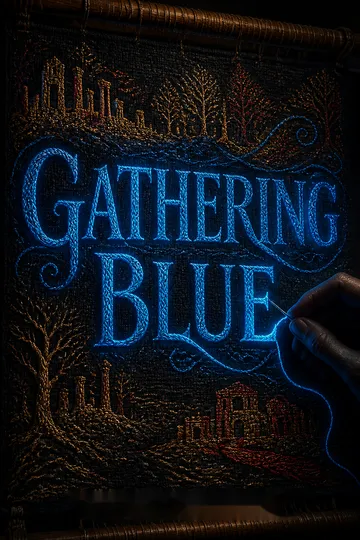
Gathering Blue asks what happens when a society treats human ability as public property. The guardians do not simply suppress creativity; they recruit it, house it, and place it inside visible institutions. Kira restores history, Thomas maintains the staff that guides its recitation, and Jo is trained to reproduce its song. Their comfort is real, which makes the arrangement more persuasive than naked coercion. Each receives food and tools, but the terms of support narrow what they may create.
Kira’s disability exposes the system’s governing contradiction. The village calls her useless when she cannot perform field labor, then values her when her hands can repair a ceremonial object. Neither judgment sees her whole. Her mother’s care and Matt’s practical loyalty offer alternatives to this transactional vision: they help because Kira matters to them, not because she can repay them. The distant community Christopher describes expands that alternative into a social structure organized around reciprocal assistance.
The robe is the novel’s clearest political image. Its historical scenes appear to prove that catastrophe and hardship are inevitable, yet Kira notices cycles of renewal and recognizes that the blank future is still unwritten. The guardians want artists because they can shape memory and expectation, not merely because their work is beautiful. The chain on the Singer’s ankles reveals the violence beneath an apparently sacred ceremony. Kira’s decision to stay therefore carries both risk and agency. She refuses the private safety of escape, but does not mistake institutional shelter for freedom. Her planted woad and the blue threads stand for two scales of resistance: an immediate resource shared by friends, and a future that will require patience, cultivation, and work.
Review Summary
Gathering Blue received mixed reviews, with many readers disappointed it wasn't a direct sequel to The Giver. Some praised its exploration of dystopian themes and character development, particularly Matt's role. Others found it predictable and slow-paced. The book's world-building and treatment of disabled characters were controversial points. While some appreciated the open ending, others felt it lacked resolution. Overall, reviewers acknowledged Lowry's writing skill but felt the book didn't quite meet the high standard set by The Giver.
People Also Read






Characters
Kira
The threader who seesKira is a thoughtful, perceptive girl with a twisted leg and an extraordinary ability to create patterns in thread. Raised by her mother in a village that measures people by physical labor, she has learned to notice what others dismiss: a child’s fear, a hidden threat, the difference between official stories and lived experience. Her disability has made her vulnerable to exclusion, but it has also kept her at the edge of the village’s usual contests for power. Kira values skill and independence, yet she is drawn toward people who need protection. Her central tension is between the safety offered by authority and the responsibility her own judgment places on her.
Matt
The resourceful Fen boyMatt is a quick-witted, scruffy boy whose humor and curiosity conceal a sharp instinct for survival. He gathers news by listening where adults overlook him, barters readily, and improvises his way through dangers that would overwhelm a more sheltered child. His bond with Kira rests on reciprocal affection: she gives him stories and respect, while he offers practical help without asking whether she can repay him. Matt’s loyalty is impulsive but not shallow. He rescues what matters to Kira, protects his injured dog, and treats friendship as a reason to undertake difficult journeys. His rough upbringing has taught him resourcefulness without extinguishing generosity.
Thomas
The careful young carverThomas is a gifted carver who has spent much of his life inside the Council Edifice, where he has tools, training, and a tightly defined purpose. He is conscientious and practical, often accepting the guardians’ rules as ordinary because he has known little else. His friendship with Kira gives him a companion who asks questions he has learned not to ask. Thomas is patient with craft and attentive to small details, whether he is shaping the Singer’s staff or making a key that opens locked rooms. Beneath his compliance is a capacity for mischief and care, especially when Kira invites him to act on behalf of someone more vulnerable.
Jamison
The persuasive guardianJamison is a poised member of the Council of Guardians who speaks through laws, procedures, and carefully managed reassurances. He appears attentive to Kira’s needs and understands how to present her abilities in terms the council will accept. His calm manner contrasts with the village’s open aggression, making him seem like a source of stability. Jamison is also an institutional thinker: he values order, specialized work, and the preservation of communal customs. His relationship with Kira is shaped by this asymmetry. He can offer protection and resources, but he also has authority over the conditions under which she works and lives.
Vandara
Kira’s scarred accuserVandara is a formidable village woman whose visible scar marks a history of physical danger and whose bearing commands other women’s attention. She sees Kira’s disability as evidence that the girl has no rightful claim to food, shelter, or land. Her aggression is direct, strategic, and strengthened by a community that rewards toughness. Vandara is not merely a personal enemy; she voices the village’s utilitarian logic without disguise. She uses a formal hearing when violence becomes risky, showing that she knows how to adapt her methods to the rules of power.
Katrina
Kira’s steadfast motherKatrina raised Kira with a quiet conviction that her daughter’s worth exceeded the limits imposed by her injured leg. A skilled dyer and weaver, she passed on practical knowledge while encouraging Kira’s unusually powerful imagination. Katrina’s stories about Kira’s birth gave the girl an inheritance of belonging in a culture that might otherwise have rejected her. She is remembered through her work, her handmade objects, and the standards of care she modeled. Her influence helps Kira measure other people’s claims against the love and knowledge she received at home.
Annabella
The elder dyerAnnabella is an elderly, sharp-minded craftswoman who has spent years learning how plants, water, and heat can produce durable color. She teaches through observation and repetition, treating technical knowledge as something earned by attention rather than granted by status. Her direct manner can unsettle Kira, but it is paired with patience and an understanding of what a young apprentice needs. Annabella’s garden embodies a kind of expertise that the village depends upon while rarely honoring it. She also points toward knowledge beyond the village’s familiar boundaries.
Jo
The Fen’s gifted singerJo is a small, vulnerable child whose natural singing carries a confidence absent from her frightened daily life. Separated from familiar care and placed under strict instruction, she struggles to understand why adults demand repeated lessons. Her spontaneous songs suggest a capacity for invention that contrasts with the memorized material imposed on her. Jo responds warmly to Kira’s gentleness and Thomas’s practical help, forming trust through brief encounters rather than grand assurances. Her childlike humor and ceremonial enthusiasm sit beside a real need for safety and affection.
Christopher
The blind travelerChristopher is a blind man who arrives from beyond the village with a careful way of listening and navigating by sound, smell, and memory. He is physically marked by old injuries, yet his calm presence suggests a life built around adaptation rather than defeat. Christopher understands the cost of being left without help and has learned to rely on cooperation. He carries knowledge of a community whose customs differ sharply from those Kira knows. His measured manner and willingness to undertake a difficult journey make him a figure of both mystery and hard-won resilience.
Branch
Matt’s loyal dogBranch is a small, scruffy dog with a crooked tail that Matt nursed back to health. He follows the boy through the village and forest, offering companionship and a lively presence in bleak surroundings. His survival reflects Matt’s instinct to protect what others would discard.
The Singer
The village’s living historyThe Singer performs the village’s long account of its past at the annual Gathering. His robe and staff guide a demanding ceremonial role that requires years of preparation. To the community, his performance preserves shared memory and gives the Gathering its solemn center.
Plot Devices
The Singer’s robe
History with a blank futureThe robe records the people’s history in embroidered scenes, from the world’s beginnings through disaster and rebuilding. Kira first handles it as a repair assignment, but its empty section across the shoulders makes her responsible for representing what comes next. Its images also let her read history as a pattern rather than accepting that the village’s present cruelty is eternal. The garment is both an archive and a contested instrument: whoever controls its future imagery can shape what the people are taught to expect.
The living scraps
Art as warning and comfortKira’s small woven scrap and Thomas’s carved piece carry a mysterious, felt sense of knowledge. Kira experiences her cloth as reassurance or alarm, while Thomas’s wood steadies him and seems to warn him. These objects connect artistic ability to intuition that cannot be fully explained or commanded. Their importance grows as Kira recognizes that her gift is not merely technical, and that the guardians’ attempts to direct the artists’ work may suppress a deeper capacity for imagining what has not yet happened.
Woad and blue thread
A color from beyondBlue is the one color Kira’s mother and Annabella cannot supply, so its absence becomes a practical obstacle and a sign of the world’s narrow limits. Matt’s journey brings her a piece of blue cloth and the woad plants needed to make more. The color introduces a distant community with different values, then becomes material Kira can use while waiting for the plants to mature. Blue therefore links friendship, discovery, and future labor: it arrives as a gift, but must also be cultivated.
The Field of Leaving
A threat disguised as customThe Field is where bodies are left after death, but the village also uses it as a destination for people judged too damaged or burdensome to keep. Its beasts give this practice the appearance of natural necessity, obscuring the choices made by the living. Kira’s fear of being sent there drives the opening conflict; later discoveries challenge the village’s account of what happens in the woods and who is actually endangered. The Field thus concentrates the society’s most powerful threat: abandonment recast as tradition.
The Giver Series
Download PDF
Download EPUB
.epub digital book format is ideal for reading ebooks on phones, tablets, and e-readers.








