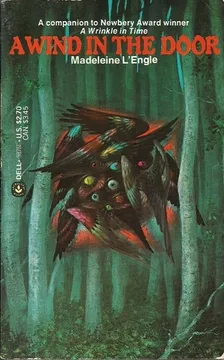


Plot Summary
Dragons Beside the Garden
Meg Murry finds her six-year-old brother, Charles Wallace, bruised again after school and unusually short of breath. He insists that a gathering of dragons appeared in the twins’ vegetable garden, then vanished toward the pasture.
Meg follows him and finds only wind and glacial rocks, but his pallor and exhaustion deepen her worry. Charles suspects his mitochondria, the tiny structures that supply cells with energy, are failing because their even smaller inhabitants, the farandolae, are in trouble.
Their mother, biologist Mrs. Murry, confirms that she and Dr. Louise Colubra are investigating a deadly illness that may be linked to mitochondria. Charles shows the family an unnaturally metallic feather, proof that his strange sighting left something behind.
The story begins by binding the extraordinary to a family’s ordinary alarm: a child’s bruises, a sister’s guilt, a mother’s unfinished research. Charles’s scientific explanation is not a detour from the fantasy but its first map. Meg trusts him emotionally before she can accept his account literally, and that gap between care and comprehension becomes the central work she must do.
The Principal Falls Skyward
That night, Meg sneaks into the garden, fearing that the strange creatures may seek shelter in the house. The snake Louise the Larger blocks her path as Mr. Jenkins, the grade-school principal who has dismissed Meg’s concerns about Charles, approaches with an unexpected apology.
Louise rears and warns him. Mr. Jenkins screams, rises into the sky, and disappears through a tear of nothingness, leaving a foul smell behind. Calvin O’Keefe arrives and steadies Meg, then searches the pasture with her.
They find more shimmering feathers and scales beside the rocks. Charles joins them, having sensed Meg’s terror from bed. As the dragon-shaped creature returns, a towering stranger emerges from the woods and tells the children that they need not fear it.
The first rupture is both cosmic and intimate. Meg’s familiar grievance against Mr. Jenkins is suddenly entangled with a force that can erase a person, while Louise’s warning makes animal perception more reliable than human authority. Calvin’s role is practical: he does not explain Meg’s fear away, and his belief gives her enough steadiness to face what comes next.
Teachers in the Pasture
The stranger identifies himself as Blajeny, a Teacher, and names the many-eyed, winged creature Proginoskes, a cherubim rather than a flock of dragons. Blajeny says Charles, Meg, and Calvin are all needed, not because ordinary school has failed Charles, but because his illness threatens more than one child.
Meg must undertake three unknown trials with Proginoskes; Charles must learn to adapt without losing himself; Calvin is told to wait for dangerous work.
Blajeny sends the children home for the night, then reveals that Louise the Larger is also a Teacher. The next morning Meg confirms that Proginoskes is real and learns that the vanished man was likely an Echthros, a being that attacks creation by making people and things lose their names.
Blajeny refuses to reduce Charles to a problem that adults can solve on his behalf. Each child receives work suited to a distinct capacity, and Meg’s assignment turns her protective instinct into responsibility. The reveal that Louise is a Teacher also unsettles the boundary between the ordinary and the sacred: a creature Meg fears can still be a trusted guide.
Three Mr. Jenkinses
At school, Meg encounters three identical Mr. Jenkinses. Two are Echthroi, but Proginoskes cannot identify which principal is real; Meg must Name him by recognizing who he truly is. The men offer competing versions of help: one would control Charles, another flatten his differences, while the real Mr. Jenkins remains prickly and uncertain.
Meg recalls Calvin’s account of how Mr. Jenkins quietly bought him a proper pair of shoes when his family could not afford them. That kindness does not erase the principal’s failures, but it reveals a person more complicated than Meg’s resentment allowed. She names the imperfect, limited man as the real Mr. Jenkins. The false doubles vanish, and the real principal faints from the encounter.
Meg’s first trial tests whether moral recognition can survive justified anger. She does not excuse Mr. Jenkins’s dismissiveness; she learns to hold it alongside his concealed generosity. Naming here is not praise or absolution. It is the harder discipline of refusing to reduce another person to the harm they have caused, or to the role they occupy.
Metron Ariston Opens
Blajeny explains that the Echthroi have intensified Charles’s illness and takes Meg, Calvin, Proginoskes, and the shaken Mr. Jenkins to Metron Ariston, where size becomes relative. There they meet Sporos, a young farandola whose tiny scale makes Charles Wallace a whole galaxy to him.
Blajeny explains that farandolae live inside mitochondria and must mature into rooted beings called farae; their health sustains the mitochondrion, and the mitochondrion sustains its human host.
Since Charles’s farandolae are failing, the group must enter one of his mitochondria, Yadah. A false Mr. Jenkins approaches before they depart, forcing Blajeny to hurry them away. They witness a star’s birth, then Proginoskes carries Meg into the dark interior of Yadah.
The journey makes scale a moral problem rather than merely a scientific one. What looks negligible from outside can be a complete world from within, and Charles’s survival depends on relationships he cannot perceive. Sporos’s immaturity echoes Charles’s vulnerability, while Mr. Jenkins’s bewilderment prevents the lesson from becoming an abstract lecture: each traveler must learn to regard the unfamiliar as real.
Meg Is Nearly Xed
Inside Yadah, Meg cannot see or move normally, so Proginoskes teaches her to communicate through kything, a wordless sharing of thought and presence. She begins translating this strange world for Mr. Jenkins, whose imagination has long been narrowed by routine.
When Meg reaches for him, an Echthros wearing his likeness attacks her. Proginoskes Names her, Calvin sends familiar mathematics through their bond, and a group of small farandolae distract the attacker long enough to free her. They sacrifice themselves rather than let the Echthros erase them.
Meg then reaches the real Mr. Jenkins by remembering his kindness to Calvin and accepts him as a person she can love. Calvin shares a childhood experiment showing that plants respond to care, helping Mr. Jenkins understand how attention and connection matter in Yadah.
Meg’s peril makes the danger of un-Naming bodily: she nearly loses the ability to think herself into existence. She survives through relationships, not force, as Proginoskes, Calvin, and the small farandolae each reach her differently. Her growing bond with Mr. Jenkins also changes the trial’s meaning. Attention is not sentiment added to knowledge; it is what lets knowledge cross between separate minds.
Sporos Refuses to Deepen
Meg and Calvin discover that Sporos and other young farandolae are resisting Deepening, the growth that roots them as farae and lets them join Yadah’s sustaining song. The Echthroi exploit their fear of losing freedom, urging them to circle and drain Senex, Sporos’s ancient parent fara. Meg and Calvin cannot persuade Sporos to stop, and Meg is swept into the destructive dance.
Mr. Jenkins reaches her and gives her enough strength to survive, but the Echthroi close around him in turn. Seeing the cost of refusing connection, Sporos finally chooses to Deepen, and other farandolae join him. The renewed song strengthens Yadah, but the Echthroi seize Mr. Jenkins, turning him into their instrument and beginning the final struggle.
Sporos’s choice dramatizes a false opposition between freedom and belonging. The Echthroi sell isolation as independence, but the young farandolae’s attempt to dominate Senex leaves them dependent on the very life they are destroying. Mr. Jenkins’s intervention reverses his old pattern of standing apart from distress: he risks himself for Meg, making care an action rather than an agreeable feeling.
Meg Names the Nothing
As the Echthroi use Mr. Jenkins to attack Calvin and Meg, Meg reaches past their borrowed faces to the people they are trying to erase. She Names the Echthroi, insisting through her act that they are not nothing, and fills their void with the joined presence of herself, Calvin, Mr. Jenkins, Charles, Sporos, and the singing farandolae.
Proginoskes throws himself into the assault to protect them and Xes himself by choice. The Echthroi withdraw. Meg returns to Charles Wallace’s bedroom, where his breathing has steadied and Dr. Louise expects him to recover.
Mr. Jenkins is himself again, and he intends to make school safer without pretending he can adapt Charles for him. Meg and Calvin later find the pasture empty; a sudden gust opens the kitchen door, leaving Meg with a quiet sense that Proginoskes remains known.
Meg’s final act does not defeat hatred by pretending it is harmless; she denies it the power to define the whole of reality. Her Naming holds the endangered characters together without making them identical. Proginoskes’s self-offering gives that choice its cost, while Charles’s recovery translates the cosmic struggle back into the intimate fact that began it: a sister trying to keep her brother alive.
Analysis
A Wind in the Door turns interdependence into both its scientific premise and its ethical demand. Charles Wallace’s body contains worlds that cannot be seen from ordinary human scale, yet their vulnerability is as immediate as his labored breathing. The novel repeatedly asks its young characters to replace a hierarchy of importance with a network of dependence: a child relies on mitochondria, mitochondria on farandolae, and each farandola on a community capable of sustaining its song.
Meg’s development follows the same logic. She begins by defending Charles through urgency, anger, and a wish to make danger disappear. Her trials require something more difficult: attention to people she has already judged, especially Mr. Jenkins, and trust in forms of knowledge that cannot be reduced to observation or argument. Naming is therefore not a sentimental instruction to like everyone. It is a refusal to let resentment, fear, or another person’s worst behavior become the whole account of who they are.
The Echthroi offer a counterfeit solution to suffering: erase what hurts, and nothing can hurt anymore. The book counters this with creation, whose beauty depends on distinct beings remaining in relation rather than dissolving into sameness. Sporos’s Deepening and Meg’s final embrace enact that principle at different scales. Both accept connection as a condition of freedom, not its opposite. The story’s cosmic stakes finally return to a family bedroom, where its grandest idea has a plain consequence: Charles Wallace can breathe again.
Review Summary
A Wind in the Door receives mixed reviews, with some praising its imaginative storytelling and profound themes, while others find it preachy and confusing. Many appreciate L'Engle's approach to complex topics and her respect for young readers' intelligence. The book explores love, empathy, and the interconnectedness of the universe through Meg's journey to save her brother Charles Wallace. Critics note the stark difference from its predecessor and debate its accessibility for children. Despite divided opinions, fans of the series often find value in its unique perspective and philosophical depth.
People Also Read
Characters
Meg Murry
Impatient older sisterMeg is a bright, awkward adolescent who protects Charles Wallace with fierce loyalty and often mistakes worry for a reason to take control. Her sharpness toward Mr. Jenkins and her insecurity about her appearance show how readily she turns judgment inward and outward. She is more intuitive than she believes, but her strength is not simply insight: she must learn to stay present with people she finds difficult. Her bond with Calvin offers a rare ease in which she feels accepted without having to perform.
Charles Wallace Murry
Unusual young brotherAt six, Charles Wallace speaks and thinks far beyond the expectations of his classmates, while remaining physically small and socially exposed. He reads other people’s feelings with startling ease, yet has not learned how to move comfortably among them. His interest in mitochondria and farandolae comes from genuine curiosity and from his close attention to his mother’s research. He wants help, but not at the cost of being treated as a problem to fix.
Calvin O’Keefe
Meg’s steady friendCalvin is a popular student, athlete, and gifted reader whose confidence conceals a difficult home life. He recognizes what it means to be judged by circumstances he did not choose, which helps him understand both Meg and Charles Wallace. With Meg, he offers companionship without demanding that she become prettier, calmer, or easier to understand. His instinct is to act when someone is in danger, but his patience and capacity for quiet connection are equally important strengths.
Mr. Jenkins
Rigid school principalMr. Jenkins is Meg’s former principal and Charles Wallace’s current school leader, a rule-bound man who often mistakes conformity for good education. His awkward manner and defensiveness make him easy for Meg to dislike, and his anxiety about being judged shapes how he treats difficult students. Yet he is not simply cruel or indifferent; he is capable of discreet kindness and of recognizing, however slowly, that his own limits can harm others.
Proginoskes
Dragon-shaped cherubimProginoskes is a many-eyed, many-winged cherubim who serves as Meg’s partner and guide in the Teachers’ lessons. He can communicate through kything, move between worlds, and perceive dangers that humans cannot readily see. His great knowledge does not make him all-knowing, and his unease around Earth’s violence gives him an unexpected vulnerability. He is proud, prickly, and earnest, with a deep commitment to Naming and to the beings whose identities he helps preserve.
Blajeny
Cosmic TeacherBlajeny is a towering Teacher who gathers Meg, Charles Wallace, Calvin, Proginoskes, and Mr. Jenkins into a class whose schoolroom is the cosmos. He assigns work without supplying easy explanations, trusting his students to discover what each trial requires. His calm authority does not erase danger; it gives the children a framework in which to meet it.
Sporos
Young farandolaSporos is a newly emerged farandola whose small, animated form contrasts with the ancient beings he is expected to become. He is proud of his kind and dismissive of humans, partly because he cannot yet imagine how much his existence depends on theirs. His resistance to Deepening is rooted in fear of losing movement and choice, not in simple malice.
Mrs. Murry
Scientist and motherMeg and Charles Wallace’s mother is a biologist whose laboratory work has led her to investigate farandolae and a deadly illness affecting mitochondria. She balances scientific discipline with a strong awareness of her children’s emotional lives, though uncertainty makes her cautious about what she can promise. Her work provides the scientific language through which Meg begins to understand the danger.
Dr. Louise Colubra
Physician and family friendDr. Louise Colubra is a small, sharp-minded physician and trusted friend of the Murry family. She examines Charles Wallace and helps his mother investigate his illness. Her quiet manner masks a lively intelligence and a perceptive interest in animals, which makes her more open than most people to the warnings others overlook.
Louise the Larger
Watchful garden snakeLouise the Larger is the black snake who lives in the stone wall beside the Murry children’s garden. Sandy and Dennys treat her as a pet, while Meg remains wary of her. Louise’s unusual awareness and deliberate behavior suggest that there is more to her than the children initially understand.
Mr. Murry
Physicist and fatherMeg and Charles Wallace’s father is a theoretical physicist whose work takes him away from home to investigate unexplained cosmic phenomena. He approaches uncertainty with a disciplined mind but refuses to let intellect become his only guide. His conversations with Mrs. Murry reveal a family trying to hold scientific doubt and personal hope at the same time.
Sandy Murry
Practical older brotherSandy is one of Meg’s twin older brothers. He is practical, socially adaptable, and proud of the vegetables he and Dennys grow. His steadiness contrasts with Charles Wallace’s difference and Meg’s intensity.
Dennys Murry
Practical older brotherDennys is Sandy’s twin and Meg and Charles Wallace’s older brother. He shares Sandy’s ease with other people and helps tend their garden. His loyalty to the family often appears through ordinary, useful work.
Fortinbras
Protective family dogFortinbras is the Murry family’s large black dog. Affectionate and keenly responsive to people around him, he often stays close to Charles Wallace and helps make the family home feel safe.
The Echthroi
Forces of un-NamingThe Echthroi are hostile forces that seek to erase identity and extinguish created life. They can imitate familiar people, exploit fear, and persuade others that isolation or destruction will bring freedom. Their attacks reach from distant stars to the smallest life within a human body.
Plot Devices
Naming
Restores a person’s identityNaming means recognizing and affirming who a being truly is, rather than reducing that being to a role, mistake, or appearance. Meg must use this understanding to distinguish the real Mr. Jenkins from Echthroi wearing his likeness. The idea also gives the larger conflict its moral shape: the Echthroi un-Name, while the Teachers and their students defend particular lives against erasure.
Metron Ariston
Makes every scale reachableMetron Ariston is a state of being in which size becomes relative, allowing people to encounter beings as large as stars or as small as farandolae. Blajeny uses it to take his students from a familiar pasture to the interior of a mitochondrion. The device turns an abstract scientific scale into a place the characters must navigate and makes the health of one child’s cells feel as consequential as a galactic crisis.
Kything
Connects minds without speechKything is a form of wordless communication used by cherubim and farandolae, and gradually learned by Meg. It lets the travelers share memories, sensations, and presence across distances that would otherwise separate them. Meg also uses it to translate Yadah’s unfamiliar life for Mr. Jenkins, whose imagination is less practiced. The device makes emotional attention a practical means of communication rather than a substitute for action.
Farandolae and Mitochondria
Links tiny lives to human survivalThe story imagines farandolae living within mitochondria, which in turn live inside human cells and help supply the body’s energy. The nested relationship makes Charles Wallace’s illness part of a larger, interdependent system: if the farandolae fail, the mitochondria and their human host are endangered. Their growth into rooted farae, called Deepening, provides the central challenge within Yadah and gives the children a way to act on Charles’s illness.
Time Quintet Series
About the Author
Other books by Madeleine L'Engle





Download PDF
Download EPUB
.epub digital book format is ideal for reading ebooks on phones, tablets, and e-readers.








