

Key Takeaways
Close the AI knowing-doing gap by experimenting in your own managerial work
The adoption gap is real. In a survey of 1,100 senior leaders across 14 countries, generative AI appeared on the agenda at 95% of organizations. A separate survey of 1,400 managers found only 15% used it daily. The figures describe different groups, but together they reveal a mismatch between organizational attention and everyday practice.
Start with your own tasks. The authors argue that managers cannot learn the technology by delegating its use. Try it on work you know well, notice where it helps and fails, and share the lessons with colleagues. The aim is not to become an AI specialist. It is to build enough firsthand judgment to use the tools deliberately, recognize their limits, and guide a team through practical experimentation.
The gap is not simply a training problem. Senior leaders can endorse a technology while managers lack permission, safe tools, time, or clear examples for using it. Personal experimentation helps convert abstract enthusiasm into operational knowledge, but organizations must also remove those barriers. The strongest starting point is a familiar, low-risk task: managers can compare the AI-assisted result with their normal approach and learn what actually changes, rather than mistaking visible activity for meaningful adoption.
Choose AI's mode by task: delegate execution, but dialogue through uncertainty
Two kinds of collaboration. The book calls task execution with AI a Co-Pilot mode: the manager supplies direction, reviews the result, and remains accountable. A Co-Thinker mode uses conversation to explore options, question assumptions, and structure reflection. One is primarily about producing an output; the other is about improving the thinking that leads to one.
Match mode to the work. Drafting a meeting summary or turning notes into slides may suit Co-Pilot use. Preparing for a difficult client discussion, examining a team conflict, or weighing a strategic choice calls for Co-Thinking. The modes can also be combined: discuss a decision with AI, then ask it to turn the agreed reasoning into a memo. The manager still supplies context, judgment, and the final decision.
This distinction guards against a common category error: treating every useful AI interaction as automation. Some tasks need a competent first draft; others need the user to think more carefully, not less. Separating those aims also clarifies how to evaluate success. A draft can be judged for accuracy and time saved, while a thinking dialogue should be judged by whether it surfaces better questions or overlooked options. Neither mode makes responsibility transferable.
Give AI context, then make it earn its answer through dialogue
Specific inputs improve usefulness. For a Co-Pilot task, explain the situation, desired result, audience, source material, boundaries, and output format. Examples can help the model follow a preferred pattern. A vague request invites generic work; a well-specified one gives the system a clearer target.
Structure complex conversations. For Co-Thinking, decide what role the AI should play, what context it needs, how the exchange should unfold, and where it should pause for your input. For instance, when rehearsing a presentation, AI can first ask about the audience, then generate challenging questions, and finally simulate the discussion. If the first result misses the mark, clarify or revise the instructions. Prompting is an iterative conversation, not a magic phrase.
The deeper skill here is task design. A manager who can specify the audience, constraints, evidence, and decision criteria is already clarifying the work for human collaborators. AI makes that discipline more visible because vague delegation produces visibly generic output. Structure should not become bureaucracy, however. For exploratory problems, overly rigid steps can shut down useful surprises. A productive dialogue has enough guardrails to stay relevant and enough openness to let new questions emerge.
Treat fluent AI output as a draft, never as evidence
Confidence is not verification. Generative AI can produce plausible but false claims, invented citations, or biased and context-insensitive recommendations. The book calls a false, convincing answer a hallucination, and describes fabricated sources as a particularly deceptive form. Its five collaboration traps are overtrusting outputs, accepting fabrications, settling for conventional ideas, rushing because answers arrive quickly, and using AI in isolation from colleagues.
Keep checks proportional to risk. Verify sources and calculations, protect private or proprietary information, and follow company rules on intellectual property, fairness, and security. For consequential work, add a colleague or expert review. Asking the system to check itself may help surface inconsistencies, but it does not establish that the result is true. Human review is a control, not a ceremonial final click.
Fluent language can trigger a stronger sense of authority than the underlying evidence deserves. That makes verification a behavioral design problem as much as a technical one: teams need review steps that are normal, visible, and proportionate to the consequences of error. At the same time, blanket suspicion can waste AI's value. The practical standard is neither trust nor distrust, but calibrated reliance: use the tool more freely for reversible, low-stakes drafts and demand stronger evidence for consequential claims.
Use AI to reclaim time from the managerial work that clogs calendars
Remove friction from routine work. AI can summarize long email threads and documents, draft or simplify messages, organize calendars, prepare meeting agendas, capture action items, and turn notes into presentations. It can also help clean spreadsheets, create charts, and assemble project updates. These tasks often consume time without requiring a manager to produce every first draft by hand.
Keep the human contribution visible. In the book, a manager named Franck uses AI to make technical emails clearer for nontechnical colleagues. Another manager, Kate, gets a first version of a presentation assembled after a client reschedules with little notice, then edits it and adds her own judgment. In both cases, AI accelerates preparation; it does not remove the need to check accuracy, audience fit, or voice.
Productivity gains matter most when saved time is redirected toward work that benefits from human attention, such as coaching, negotiation, and judgment. Otherwise, faster drafting can simply produce more messages and meetings. The book's examples also show why quality cannot be reduced to speed: a technically correct email that confuses its reader has failed its purpose. Managers should assess whether AI improves the outcome for the recipient, not merely whether it shortens the producer's task.
Put AI inside team thinking without letting it flatten human difference
Use it to widen participation. AI can help prepare agendas, clarify goals, track actions, and suggest questions for quieter participants. In creative work, it can generate options, connect ideas, group them into themes, and make concepts visible through images. In leadership work, it can guide reflection on team purpose, work design, conflict, and psychological safety. It can also help a team investigate a problem before jumping to solutions.
Keep people in the process. A footwear design team used text-to-image tools to rapidly explore concepts, while people selected what merited development. The authors advise letting team members generate ideas before exposing them to AI suggestions, so the system's first answers do not anchor the room. AI can contribute breadth; the team must judge fit, originality, feasibility, and the human effects of its decisions.
AI can lower the cost of participation by giving people a shared draft, a visual prototype, or a question to react to. But a shared starting point can also become a shared ceiling if everyone follows the same suggestions. Independent human thinking before AI exposure is a simple safeguard against anchoring. Team leaders should also watch whether individual AI use replaces conversations among colleagues. The goal is not merely more ideas, but a richer exchange in which machine-generated possibilities meet lived context.
Use AI to stress-test business choices, not make them for you
Make reasoning more complete. For business cases and strategy, AI can help map stakeholders, compare options, expose trade-offs, test assumptions, and imagine different scenarios. It can guide a team through methods such as root-cause analysis, or help reframe a problem from the perspectives of customers, competitors, and other affected groups. These conversations can reveal what the initial framing leaves out.
Turn analysis into investigation. A strategy discussion might examine which markets to pursue, how to distinguish the offer, and whether the organization has the capabilities to deliver. A risk dialogue can end with a ranked list of assumptions and a plan for testing them. AI can organize the debate, but it cannot supply missing local knowledge or own the consequences. Decisions remain with managers and teams who can validate the underlying evidence.
The most valuable contribution may be procedural rather than predictive. A model can help decision-makers articulate criteria and inspect alternatives, even when its forecast is uncertain. That is especially useful when teams are tempted to defend an early favorite. Still, simulated stakeholders are not actual stakeholders, and a polished scenario is not proof that it will occur. The dialogue should generate questions for investigation and real-world consultation, not substitute for either.
Use synthetic customers to explore hypotheses, not certify demand
Artificial data can fill an early gap. Synthetic data is generated to resemble patterns in real data without directly representing actual people or events. Fully synthetic data is created without real data as input; partially synthetic data combines real and generated material. Managers can use it to explore possible reactions to a product feature, pricing change, or interface redesign when access to customer data is limited or research is difficult.
Treat the result as a proxy. The book describes a bank product team using synthetic customer segments to explore how people might respond to new offerings, including during sensitive circumstances when conventional research was difficult. This can help teams formulate questions and test early assumptions. It cannot establish what actual customers want. Generated responses may inherit bias or miss context, so important findings still need validation with appropriate real-world research.
Synthetic research is best understood as a rehearsal space for hypotheses. It can help a team notice what it has failed to ask, compare possible scenarios, and prepare a better study. Its danger is epistemic: a lifelike response can be mistaken for a representative one. The distinction between simulated plausibility and observed behavior should remain explicit in presentations and decisions. When the choice affects real customers, synthetic results should sharpen the research plan, not close the case.
Scale AI through measured trials, redesigned workflows, and shared accountability
Change the work, not just the tools. The book recommends a four-part path: experiment with both AI modes on selected tasks, build prompting and critical-thinking skills, redesign workflows around human-AI collaboration, and establish shared responsibility for ethical use. Begin with manageable experiments and compare results using measures such as time, quality, engagement, and user experience. A high-impact, feasible task is a sensible candidate for expansion.
Make adoption a team practice. During organizational change, AI can help plan initiatives, tailor communications, monitor progress, and explore resistance or mindset shifts. But announcements alone do not make change stick. Managers need to involve stakeholders, learn from feedback, protect human relationships, and ensure that policies address privacy, fairness, and security. A workflow should specify where AI contributes, where people review, and who is accountable.
This implementation path recognizes that deploying software and changing work are different undertakings. Small trials can reveal where value appears, while workflow redesign determines whether that value survives contact with everyday coordination. Measurement should include trade-offs: faster completion may come with weaker quality, and individual efficiency may reduce team exchange. Shared accountability is therefore more than risk management. It gives employees a role in deciding how the technology fits their work and what standards its use must meet.
Analysis
The book's central argument is that generative AI changes management less by automating isolated tasks than by making conversational collaboration with machines broadly accessible. Its practical map is unusually useful: Co-Pilot for execution, Co-Thinker for reflection, followed by examples across personal work, teams, business decisions, and organizational change. The distinction keeps a manager from treating every task as a request for a finished answer. Sometimes the right use is a draft; sometimes it is a structured challenge to the manager's own assumptions.
The strongest thread is human responsibility. AI may summarize, generate options, model perspectives, and organize a decision process, but managers must provide context, assess evidence, protect sensitive information, and own decisions. That makes the book's guidance on verification, team review, and risk awareness integral to its productivity advice, rather than a separate compliance appendix. The discussion of synthetic customers particularly benefits from this distinction: simulations can support exploration, but they are not customer testimony.
The book is also a practical manual, not a rigorous evaluation of the comparative performance of AI tools. Many proposed benefits depend on reliable integrations, suitable data access, organizational permission, and a manager's ability to assess output. Its task catalog therefore works best as an invitation to test, not as a guarantee of results. A useful experiment should compare AI-assisted work with a baseline, assess quality as well as time, and note side effects on collaboration and judgment.
Ultimately, the managerial advantage is not simply knowing how to prompt. It is knowing which questions deserve machine assistance, what evidence would change a decision, when to involve other people, and where human accountability cannot be delegated. That is why the book's larger ambition is workflow redesign: organizations must decide how humans and AI hand work back and forth, not merely add chatbots to existing routines.
Review Summary
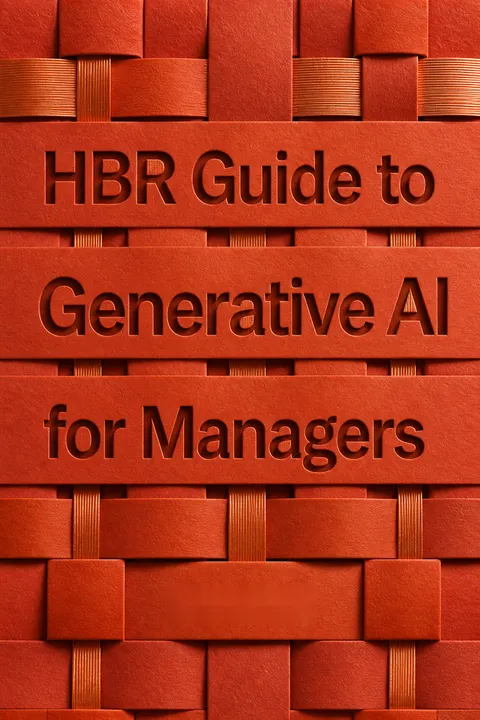
HBR Guide to Generative AI for Managers receives positive reviews for its practical approach to integrating AI in business. Readers appreciate its comprehensive coverage of AI applications for productivity and strategy. The book is praised for offering concrete examples and actionable insights for managers at all levels. Some reviewers note its value as a reference guide, while others highlight its timeliness in addressing the rapidly evolving AI landscape. A few critics mention a desire for more in-depth technical details or real-life examples. Overall, it's recommended for managers seeking to leverage AI in their work.
People Also Read








Glossary
Co-Pilot
AI-assisted task executionA mode of working with generative AI in which the manager gives it a task, relevant context, and instructions about the desired result. The AI produces a draft, summary, analysis, or other output, while the manager reviews and validates it. The mode is suited to work where execution and efficiency are the main aims.
Co-Thinker
AI-supported reflective dialogueA mode of working with generative AI through a back-and-forth conversation rather than a single request for an output. The AI can offer perspectives, ask questions, examine options, or challenge assumptions. The human supplies context and judgment, responds to the exchange, and remains responsible for decisions.
Hallucination
Plausible but false outputAn answer generated by an AI system that sounds credible but contains invented or incorrect information. In management work, this may appear as a false claim, faulty analysis, or a nonexistent citation. Fluency does not demonstrate accuracy, so important output should be checked against reliable sources or expert knowledge.
Trust trap
Overreliance on AI outputThe tendency to accept an AI response because it sounds adequate or authoritative, without applying independent judgment. This can make users overlook errors, omissions, or misunderstandings. The book recommends probing the answer, seeking counterarguments, and identifying weak points instead of treating fluent output as dependable by default.
Chain of Density
Iteratively richer concise summariesA summarization technique that repeatedly revises a summary to include important details missing from earlier versions while keeping its length roughly constant. The user begins with a broad summary, then asks for a denser version based on the source material. The method can help surface more information from a long document without simply expanding the summary.
Synthetic data
Artificially generated proxy dataData produced to imitate patterns and relationships found in real-world information, without directly representing actual events or individuals. Fully synthetic data is created without real data as input; partially synthetic data combines real and generated material. It can support early exploration or testing, but its outputs do not establish what real customers will do.
Guardrails on content
Boundaries for AI responsesInstructions that define what information a generative AI system should use and what its response should include or exclude. They can specify sources, scope, acceptable content, or examples to follow. Content guardrails help keep an answer relevant to the task, but they do not guarantee factual accuracy or eliminate the need for review.
Guardrails on process
Steps guiding AI interactionInstructions that shape the sequence and method an AI system should follow, including when it should ask questions, pause for human feedback, apply stated criteria, or produce a particular format. They are especially useful for complex conversations because they make the collaboration more deliberate and give the human clear points to intervene.
HumanAIzed
Work designed for human-AI collaborationThe book's term for organizations in which human and AI capabilities are integrated across workflows at scale. In this kind of organization, AI is not simply added as a standalone tool. Work is redesigned to define how people and AI contribute, exchange information, review results, and share responsibility.
FAQ
1. What is "HBR Guide to Generative AI for Managers" by Elisa Farri about?
- Practical Guide for Managers: The book is a hands-on manual designed to help managers understand and leverage generative AI (gen AI) in their daily work, moving beyond theory to actionable advice.
- Two Modes of AI Collaboration: It introduces the concepts of using gen AI as a "Co-Pilot" (for task execution) and "Co-Thinker" (for strategic dialogue and reflection).
- Covers 35 Managerial Tasks: The guide details how gen AI can enhance 35 common management tasks across self-management, team management, business management, and change management.
- Focus on Mindset and Skills: It emphasizes the need for a new managerial mindset—conversational, experimental, and responsible—to thrive in the age of gen AI.
2. Why should I read "HBR Guide to Generative AI for Managers" by Elisa Farri?
- Stay Relevant in Management: The book addresses the urgent need for managers to adapt to the rapid integration of gen AI in organizations, highlighting the risks of falling behind.
- Practical, Actionable Advice: It provides step-by-step instructions, real-world examples, and ready-to-use prompts for immediate experimentation with gen AI tools.
- Broad Applicability: Whether you’re new to AI or already familiar, the guide offers value for managers at all levels and across industries.
- Ethical and Responsible Use: The book also covers the risks, ethical considerations, and best practices for using gen AI responsibly in a business context.
3. What are the key takeaways from "HBR Guide to Generative AI for Managers"?
- Machines as Collaborators: Gen AI is evolving from being a mere tool to becoming a true collaborator in managerial work.
- Two Modes: Co-Pilot and Co-Thinker: Managers must learn to use gen AI both for efficient task execution (Co-Pilot) and for strategic, reflective dialogue (Co-Thinker).
- Mindset Shift Required: Success with gen AI requires a new mindset—embracing experimentation, conversation, and responsibility.
- 35 Enhanced Tasks: The book identifies 35 managerial tasks that can be improved with gen AI, providing practical prompts and dialogue outlines for each.
4. How does "HBR Guide to Generative AI for Managers" define and differentiate the Co-Pilot and Co-Thinker modes?
- Co-Pilot: Task Execution: In Co-Pilot mode, gen AI executes tasks based on clear instructions, such as drafting emails, summarizing documents, or creating presentations.
- Co-Thinker: Strategic Dialogue: In Co-Thinker mode, gen AI acts as a thought partner, engaging in back-and-forth conversations to challenge assumptions, brainstorm, and support decision-making.
- Interaction Differences: Co-Pilot is about speed and efficiency, while Co-Thinker emphasizes reflection, dialogue, and collaborative problem-solving.
- Sequential Use: The modes can be used separately or in sequence, depending on the workflow and the nature of the managerial task.
5. What new mindset does "HBR Guide to Generative AI for Managers" recommend for managers working with generative AI?
- Conversational Approach: Managers should interact with gen AI as they would with a human collaborator, providing context, feedback, and clear instructions.
- Experimental Attitude: Embrace hands-on experimentation with different gen AI models and prompts to discover their capabilities and limitations.
- Responsible Use: Stay vigilant about risks such as hallucinations, bias, and data privacy, and always validate AI-generated outputs.
- Continuous Learning: Keep up-to-date with rapid AI advancements and foster a culture of learning and sharing within your team.
6. What are the 35 managerial tasks that "HBR Guide to Generative AI for Managers" says can be enhanced with gen AI?
- Four Main Categories: The tasks are grouped into managing yourself, managing teams, managing business, and managing change.
- Examples of Tasks: These include email management, time management, content generation, meeting management, goal setting, team creativity, problem-solving, data analysis, customer insights, business case development, strategic decisions, and change management.
- Co-Pilot vs. Co-Thinker: Each task is mapped to either Co-Pilot (execution-focused) or Co-Thinker (reflection-focused) modes, with some tasks benefiting from both.
- Practical Prompts Provided: For each task, the book offers sample prompts and dialogue outlines to help managers get started with gen AI.
7. How does "HBR Guide to Generative AI for Managers" advise managers to use gen AI for self-management and personal productivity?
- Email and Time Management: Use gen AI as a Co-Pilot to sort, draft, and organize emails, manage calendars, and prioritize tasks.
- Summarization: Leverage gen AI to quickly summarize long documents, reports, or meeting notes, saving time and improving focus.
- Content Generation: Ask gen AI to help draft business documents, proposals, and presentations, ensuring clarity and audience alignment.
- Personal Growth: Use gen AI as a Co-Thinker for self-reflection on leadership styles, soliciting feedback, and preparing for speeches or job interviews.
8. What practical advice does "HBR Guide to Generative AI for Managers" give for using gen AI in team management and creativity?
- Streamline Operations: Use gen AI as a Co-Pilot for meeting management, agenda creation, note-taking, and project planning.
- Foster Team Creativity: Ask gen AI to generate ideas, cluster and refine them, and visualize concepts during brainstorming sessions.
- Enhance Team Dynamics: Use gen AI as a Co-Thinker to craft team purpose, design high-quality work, and facilitate conflict resolution.
- Support Problem-Solving: Engage gen AI in structured dialogues to frame problems, analyze root causes, and develop compelling problem stories.
9. How does "HBR Guide to Generative AI for Managers" recommend leveraging gen AI for business management and strategic decisions?
- Data Analysis Support: Use gen AI as a Co-Pilot to clean, analyze, and visualize data, and to extract insights from internal and external sources.
- Customer Insights: Design surveys, analyze qualitative feedback, and even generate synthetic customer data for early-stage testing.
- Business Case Development: As a Co-Thinker, gen AI helps map stakeholder perspectives, evaluate trade-offs, and identify and mitigate risks.
- Strategic Formulation: Use gen AI to structure strategic thinking, challenge assumptions, and simulate scenarios for business and supply chain strategies.
10. What are the main risks and ethical considerations highlighted in "HBR Guide to Generative AI for Managers" for using gen AI in management?
- Hallucinations and Fabrications: Gen AI can produce plausible but incorrect or fabricated information, requiring human oversight and validation.
- Data Privacy and Security: Inputting sensitive or proprietary data into public gen AI models can risk data leaks or misuse.
- Bias and Fairness: AI models may reflect biases present in their training data, leading to unfair or discriminatory outputs.
- Environmental Impact: The computational resources required for gen AI can have a significant carbon footprint, urging managers to consider sustainability.
11. How does "HBR Guide to Generative AI for Managers" suggest organizations scale gen AI adoption and redesign workflows?
- Four-Step Transformation Journey: The book recommends experimenting in both Co-Pilot and Co-Thinker modes, building new skills, redesigning workflows for human-AI collaboration, and establishing collective responsibility.
- Structured Experimentation: Start with noncritical tasks, measure impact and feasibility, and iterate based on learnings.
- Upskilling and Prompting: Invest in training managers and teams on effective prompting and critical thinking skills.
- Workflow Redesign: Rethink processes to integrate gen AI, ensuring clear guidelines for when and how humans and AI collaborate.
12. What are the best quotes from "HBR Guide to Generative AI for Managers" by Elisa Farri, and what do they mean?
- "Gen AI can become a Co-Thinker for managers... aiding in problem-solving and decision-making." — Highlights the shift from AI as a tool to AI as a collaborative thought partner.
- "You cannot outsource or delegate it—it is your job and your imperative." — Stresses the personal responsibility managers have in adopting and mastering gen AI.
- "Conversational, experimental, responsible: These are the characteristics of the new mindset managers need." — Summarizes the core attitude required for success with gen AI.
- "This isn’t just a book to read—it’s a universal manual to get better results with any gen AI tool." — Emphasizes the book’s practical, hands-on approach for immediate application.
Download PDF
Download EPUB
.epub digital book format is ideal for reading ebooks on phones, tablets, and e-readers.








