

Key Takeaways
Fame fulfilled Cobain's dream, but never repaired the pain beneath it.
Success arrived beside collapse. On January 12, 1992, Nirvana reached the top of the American album charts and appeared on Saturday Night Live. That same night, Cobain nearly died from a heroin overdose in a hotel room. As a teenager, he had imagined becoming a star; he had also believed recognition might ease his misery. Instead, success intensified the attention and pressure around him without settling his inner distress.
The contradiction sets the book's course. Cross follows a gifted musician whose rise from a poor Washington town was both an improbable triumph and a growing personal crisis. Fame offered money, audiences, and artistic reach, but it did not undo family rupture, chronic pain, or self-hatred.
What's striking is how sharply the opening scene disrupts the usual celebrity success story. Public recognition and private danger arrive almost simultaneously, showing that achievement can change a person's circumstances without changing the beliefs or pain carried into them. This distinction appears across many fields: external rewards do not automatically produce psychological security. Still, the biography cannot establish that fame itself caused Cobain's decline. It shows fame becoming one pressure among several, while addiction and long-standing distress were already in motion.
Treat childhood rupture as a wound, not a complete explanation.
The loss was not the whole childhood. Cobain's early years included affection, playful family rituals, and adults who encouraged his drawing and music. When his parents divorced shortly after his ninth birthday, however, the family life he depended on fractured. His father remarried, his mother formed new relationships, and conflicts over where he belonged followed him through adolescence.
Instability became a pattern. As a teenager, he moved among relatives and other households, then spent periods without secure housing. He often withdrew or expressed anger instead of explaining his hurt. Cross presents the divorce as a defining emotional blow, but also describes other influences, including poverty, family conflict, depression, substance use, and the difficulty of finding a stable home.
The biography's strongest psychological insight is also its most important limit: a formative rupture can shape later expectations without determining a life. Developmental research treats early relationships as influential, but not as a single-cause blueprint. Cobain's story is more persuasive when read as accumulated vulnerability than as a neat chain from divorce to death. The emphasis on his loving early memories matters, too. It resists turning a complicated family into a simple villain and keeps the account from mistaking a painful turning point for a complete explanation.
Separate Cobain's emotional truth from the stories he reshaped.
His life became its own material. Cobain repeatedly told stories that were more dramatic than the available evidence supports. He described himself as having lived beneath an Aberdeen bridge, though friends said he only visited it. He also told versions of trading guns for his first guitar, although he already owned a guitar and used money from the guns for an amplifier.
The feeling could still be real. During one homeless stretch, he slept in a cardboard box, building hallways, and a hospital waiting room. The bridge story compressed that insecurity into a vivid image. Cross compares those accounts with interviews, documents, and memories from more than 400 sources, showing how Cobain's invented or enlarged tales became part of his public identity.
This section offers a useful rule for reading celebrity biography: a false detail can reveal something real about the storyteller, but it should not be treated as evidence of the event itself. Cobain's self-mythologizing helped him control how others saw him and gave shape to humiliation and displacement. Yet emotional interpretation must not become a license to ignore fact-checking. Cross's comparisons are valuable precisely because they preserve both layers, the documented events and the meaning Cobain tried to make from them.
Make private experience specific, then let contradictions carry the song.
A distinctive voice took shape gradually. Cobain drew realistic pictures as a child and made up songs before he could play guitar well. At sixteen, seeing the Melvins perform in a grocery-store parking lot opened a new musical world. He combined punk's roughness with metal's weight, Beatles-like melody, pop instincts, and a fascination with grotesque images.
Personal detail sharpened the writing. Songs such as Sliver drew on the insecurity of a child passed between households; Polly turned a violent news story into a disturbing narrative from the perpetrator's perspective. Quiet melodies against explosive sound, or humor beside bleakness, made the songs hard to reduce to a single message. His lyrics often communicated emotional force even when their literal meaning remained uncertain.
The creative process here resembles bricolage: artists build new forms from whatever materials their lives and cultures put within reach. Cobain's mix of pop hooks, punk noise, and unsettling subject matter was not a tidy theory; it was an ear learning by imitation, selection, and collision. His strongest songs gained power from concrete scenes rather than generalized declarations. There is a necessary caution, though: turning violence or suffering into art can create empathy, but it can also make real harm feel aesthetically distant.
Ambition and resentment can coexist, but denial makes the cost worse.
The anti-star also pursued stardom. Cobain complained about exposure while planning for it. He sent Nirvana's demos to labels, worked to secure a record deal, believed a video on MTV could help the band break through, and pushed for a major label with stronger distribution. He also presented himself as reluctant, mocked celebrity, and often acted inconvenienced by the attention he had sought.
Recognition brought an identity problem. When Nevermind surged up the charts, Cobain sometimes withdrew from celebrations, interviews, or fans. He disliked being turned into a public character, yet he also monitored whether the band was getting enough notice. Cross shows that his objections were not simply fake: he wanted success, but wanted control over what success meant and how much of himself it could claim.
Approach and avoidance can coexist: a person may pursue recognition for what it promises while fearing the scrutiny and dependence it creates. Cobain's public contradictions are therefore more revealing than a simple label such as hypocrite or victim. They also remind readers that interviews are performances, particularly when the subject is actively shaping a persona. The biography sometimes makes that performance legible by comparing statements with private actions. Even so, ambition does not make later distress less genuine, and resentment does not prove the original desire was insincere.
Pain relief can become a second crisis when opioids take over.
The stomach pain was persistent. Cobain described years of burning nausea that interfered with eating, sleep, and touring. He consulted many doctors and underwent repeated tests, but found no lasting explanation or relief. He said opiates eased the pain, and heroin initially offered escape from both physical discomfort and emotional distress.
Relief became dependence. His use escalated from occasional experimentation to daily addiction, secrecy, withdrawal, and repeated overdoses. During the Saturday Night Live weekend, when his album reached number one, Courtney Love revived him after another near-fatal overdose. Cross does not establish one definitive cause for the stomach condition, nor does he suggest pain was merely an excuse. The same drug that seemed to help could deepen the crisis and make it harder to escape.
The account avoids an easy moral distinction between legitimate pain and addiction: both can be present, and one can intensify the other. Chronic illness often creates a search for relief, while a fast-acting drug can make short-term benefit especially persuasive. The biography documents Cobain's account of his symptoms and his escalating use, but it cannot settle the medical cause of the pain. That uncertainty matters. Neither dismissing his suffering nor treating self-medication as a sustainable treatment explains the full situation.
Repeated detox is not recovery without durable support and honest disclosure.
Crisis care kept restarting. Cobain entered treatment several times, sometimes under pressure from his managers, family, or the courts. He could become sober for a period, then return to heroin. He resisted some forms of counseling and group recovery, while the people around him struggled to decide when to confront him and when to keep him safe.
Secrecy weakened the response. The Rome overdose in March 1994 was treated publicly as accidental, even though Cobain had left a suicide note. Later treatment staff were not told the full context. Friends and colleagues often knew he was in danger but disagreed about how to act. Cross portrays repeated detox, enabling, fear, and failed interventions, not a simple story in which one conversation could have changed everything.
A brief period without a drug is not the same as an ongoing recovery plan. Contemporary addiction care often emphasizes continuity, mental health support, and attention to underlying pain rather than treating withdrawal as the entire problem. The biography's account of secrecy is especially important because incomplete information can undermine decisions made by clinicians and loved ones. At the same time, the people around Cobain were not omnipotent caregivers, and his resistance mattered. A more durable system may help; it cannot guarantee an outcome.
Love for his daughter was real, but it could not cure addiction.
Fatherhood brought genuine tenderness. Cobain worried that his daughter, Frances Bean, might be born with disabilities, then wept with relief when she was healthy. Home video shows him playing with her, making her laugh, and behaving like a devoted parent. He fought to regain unsupervised custody after officials temporarily placed restrictions on the family because of the parents' drug use.
Affection did not stop the danger. He continued using heroin after Frances was born, experienced further overdoses, and struggled to remain present and reliable. Nannies and relatives helped care for her. The biography holds these facts together: his love was not invented, but neither was the risk created by addiction. The family had to manage both his devotion and his instability.
This portrait resists two common errors: treating addiction as proof that love is absent, or treating love as proof that a parent is safe. Attachment and caregiving capacity are related, but they are not interchangeable. The book's account also shows how punitive scrutiny can add stress to a family already in crisis, while genuine child-safety concerns cannot simply be waved away. Humane support must protect the child and treat the parent without pretending those goals are always easy to reconcile.
Treat suicidal talk and repeated overdoses as emergencies, not rock mythology.
The warning signs accumulated. As a teenager, Cobain spoke casually about suicide, amid family histories of suicide and a friend's death. As an adult, he had repeated overdoses and a serious overdose in Rome that included a suicide note. In March 1994, his loved ones and colleagues tried to get him into treatment, but he resisted and became increasingly isolated.
His death was not a tidy ending. On April 5, 1994, Cobain died by suicide at his Seattle home, aged 27. Cross reconstructs the surrounding events while acknowledging that the precise state of mind behind a final act cannot be fully recovered. The book challenges the romantic image of a doomed rock star by showing a person in escalating pain, surrounded by people who cared and still could not reliably reach him.
The biography makes a compelling case for taking repeated suicidal statements and overdoses seriously, even when they are delivered as jokes or folded into a celebrity persona. It does not make suicide predictable in retrospect. Risk accumulates unevenly, and a life story assembled after death can create an illusion of inevitability that those living through events did not possess. Rejecting the myth of artistic self-destruction does not require certainty about every cause; it requires refusing to confuse a tragic ending with a necessary one.
Analysis
Cross's biography is both a music history and an investigation into the gap between a public persona and a private life. Its narrative strength comes from setting major cultural events beside intimate, often mundane details: the album reaches number one while Cobain is nearly dying; the famous performer still lacks stable housing; the loving father shares a household with addiction. Those juxtapositions prevent fame from becoming a substitute explanation for character.
The book also treats Cobain as an unreliable narrator of his own biography, but not as a person whose every story can be dismissed. His bridge tale, altered origin stories, and carefully rehearsed interviews show how he shaped himself for an audience. Cross tests those stories against documents and other witnesses, revealing a complex distinction between factual accuracy and emotional meaning. That method is essential, although the large number of retrospective interviews also creates a familiar biographical problem: memory is fallible, and later knowledge can change how witnesses interpret earlier scenes.
A further strength is the refusal to make musical talent a cure for distress. Cobain's songs gave private conflicts a public form, but they did not resolve the conditions behind them. The account likewise avoids reducing addiction to either moral weakness or a simple side effect of fame. Pain, family history, depression, isolation, access to drugs, and the pressures of celebrity overlap without yielding one sufficient cause.
The final chapters are necessarily more speculative in tone because reconstructing a person's last days can create false confidence about inner motives. The strongest reading preserves that boundary: the record can describe decisions, relationships, and repeated danger, but it cannot fully explain why a person dies by suicide. Heavier Than Heaven is most valuable when it presents contradictions without pretending they add up to a diagnosis. Cobain could be ambitious and fame-averse, generous and self-destructive, loving and unreliable. Holding those facts together is more truthful than turning him into either a saint or a cautionary caricature.
Review Summary
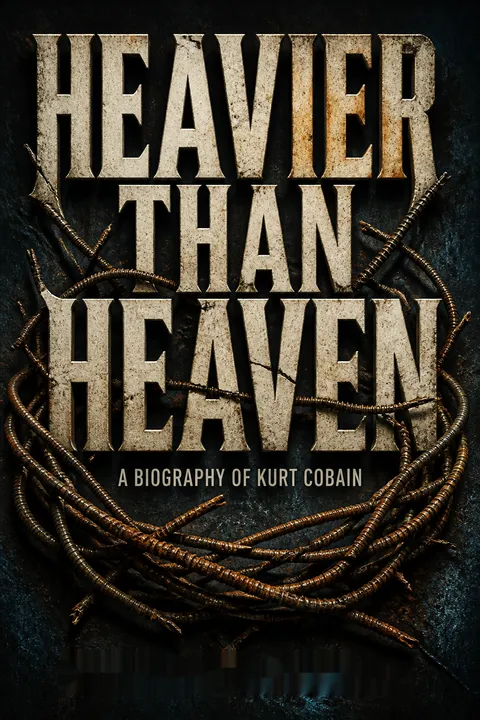
Heavier Than Heaven receives generally positive reviews, averaging 4.12/5, with readers praising Charles R. Cross's extensive research, including 400 interviews conducted over four years. Many appreciate the thorough psychological portrait of Kurt Cobain, tracing his troubled childhood through Nirvana's meteoric rise. Common criticisms include the author's presumptuous depiction of Cobain's final moments, which many find unethical, and perceived bias due to Courtney Love's approval of the book. Despite these concerns, most Nirvana fans consider it essential reading, noting its humanizing portrayal of Cobain's struggles with addiction, fame, and mental health.
People Also Read





Glossary
Boddah
Imaginary childhood companionBoddah was the imaginary friend Cobain created when he was about two years old. The figure remained part of his private inner world and later appeared in his final suicide note as its addressee. In the biography, Boddah connects his childhood imagination with the private self he rarely made fully visible to others.
Kurdt Kobain
Constructed public personaCobain used this altered spelling of his name as part of a self-fashioned identity. Cross connects it to Cobain's effort to distance himself from his ordinary life, shape his image for journalists, and turn personal stories into rock mythology. It suggests performance and self-protection, rather than a wholly separate person.
Cling-Ons
Melvins' young followersBuzz Osborne used this nickname for the group of local teenagers who gathered around the Melvins in Grays Harbor. The name mocked their eager attention and suggested their habit of attaching themselves to the band and its members. Cobain was among the young followers who received music, advice, and exposure to punk rock through this circle.
heroine
Personified heroin addictionCobain's intentional misspelling of heroin, written as though the drug were a female character. The word appeared in his writing years before his serious heroin use and later helped frame the addiction as an intimate, personified presence. Cross treats it as evidence of Cobain's long-standing fascination with drugs and the stories surrounding them, not as a clinical term.
Heavier Than Heaven
Tour slogan for Nirvana and TadA British promoter used this phrase to advertise Nirvana's 1989 tour with Tad, whose frontman, Tad Doyle, was notably large. The slogan referred both to the bands' loud, heavy music and to Doyle's size. Cross uses the phrase as a fitting description of the weight of Cobain's life and public image.
Download PDF
Download EPUB
.epub digital book format is ideal for reading ebooks on phones, tablets, and e-readers.








