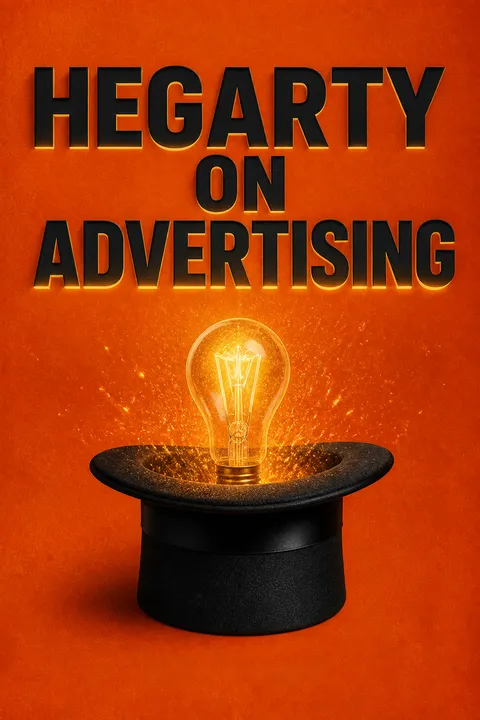


Key Takeaways
Turn market facts into a human idea people can feel and remember
Start with the real problem. Hegarty found his direction when teacher John Gillard introduced him to Bill Bernbach’s Volkswagen work. Rather than disguise the Beetle’s small size and awkward looks, the campaign treated them as honest advantages, then used wit to make the facts appealing. It persuaded Americans to consider a car that seemed to contradict their idea of what a car should be.
Make intelligence felt. Hegarty calls this turning intelligence into magic: strategy identifies a meaningful truth about the brand, and creative expression makes that truth emotionally vivid. Advertising that merely lists features stays information. The work becomes memorable when it gives people a surprising, human reason to care.
The useful distinction here is not between rational and emotional advertising, but between information that is merely present and information people can use to make meaning. A product truth gives a campaign credibility; a human tension gives it relevance. This resembles the way good teaching makes an abstract principle concrete through a memorable case. The Volkswagen example also shows why honesty alone is not enough: the truth must be selected and shaped. Otherwise, bluntness can sound like a product defect report rather than a reason to choose.
Make irreverence expose a truth, not merely grab attention
Challenge with a purpose. Hegarty treats irreverence as a way to disturb a familiar view so people can reconsider it. A poster showing a pregnant man asked men to take contraception seriously by making the consequences feel personal. For Boddingtons beer, the agency turned the brand’s creamy head, an attribute others thought unappealing, into a playful point of difference.
Shock alone goes stale. Hegarty contrasts useful provocation with work that shocks but leaves its audience wondering what it means. His examples include punk as opposition without a constructive replacement, and controversial Benetton advertising that felt disconnected from the product. Humor can soften the challenge, but the work still needs conviction, relevance, and a point beyond its own audacity.
Provocation works best when it changes the audience’s interpretation, not simply its pulse. In social psychology, a mild violation can attract attention while humor signals that the challenge is safe enough to consider. But the pregnant-man poster also illustrates a harder test: who bears the discomfort, and who benefits from it? The brand or cause must earn the right to provoke through a credible connection to the issue. Without that connection, attention becomes a short-lived asset and may be purchased at the audience’s expense.
Build a brand around the role it plays in people's lives
Think beyond the object. Hegarty defines a brand as a valued idea in someone’s mind, built through trust and repeated meaning. The product matters, but its place in a person’s life can matter more. Axe, for example, was presented not simply as deodorant but as a humorous aid to teenage confidence in dating. Häagen-Dazs was positioned as sensual pleasure, not as one more ice cream competing on the freezer shelf.
Address an audience, not a spreadsheet. Hegarty argues that people who never buy a product can still help make it famous, and fame makes a brand easier to recognize and consider. Dyson’s vacuum cleaner illustrates how design and emotional appeal can make even a cupboard-bound appliance feel desirable. Yet function remains the foundation: style cannot rescue a product that fails to do its job.
This approach connects brand strategy to identity: people often choose objects partly for what those objects help them express or experience. It also explains why category definitions can limit growth. If a company sees itself only as selling ice cream, it competes on ice cream; if it understands the pleasure it offers, it has a wider creative territory. The caution is that emotional positioning must remain anchored in delivery. A promise of confidence or indulgence can attract attention, but repeated disappointment erodes the trust that makes the brand valuable.
Treat the brief as a question, not a fence
Interrogate the request. Hegarty advises creative teams to test a brief’s assumptions instead of obeying its wording mechanically. A brief should focus attention while leaving room for an unexpected solution. When Audi wanted to move beyond its reputation as a sensible car for professionals, the useful question was not how to advertise engineering features, but what emotional purpose the engineering could serve. That distinction helped the agency find a more compelling direction for the brand.
Listen beyond the page. Direct conversations reveal what a client means by words such as different or daring. Tone and hesitation can expose the gap between what a client says they want and what they feel able to approve. Hegarty also reframes risk as excitement: people are more willing to pursue a possibility that sounds energizing than one presented only as danger.
A brief is a model of a problem, not the problem itself. Treating it as revisable resembles scientific inquiry: assumptions are useful starting points, but they must survive contact with evidence. Here the evidence includes the client’s business pressures, as well as the audience’s actual experience. The discipline is to question without becoming self-indulgent. A creative team that ignores constraints can confuse novelty with usefulness; a team that never questions them can deliver precisely the wrong answer with perfect compliance.
Protect the uncertainty that lets original ideas emerge
Creativity resists assembly lines. During his consultancy years, Hegarty’s team sometimes produced a major campaign every week under punishing deadlines. The pressure could generate energetic thinking, but it also encouraged teams to compromise a promising idea until it became mediocre. His practical warning is to know when to abandon a solution rather than keep polishing a damaged one.
Structure the work, not the answer. Hegarty distrusts meetings that ask clients to approve half-formed creative routes, because they can turn exploration into premature consensus. He describes creativity as unpredictable: people absorb the brief, think about it, and may find the connection when they are not consciously forcing it. That does not mean planning is useless. It means a process should help people understand the problem without pretending it can manufacture originality on demand.
The tension between creativity and process is real, but it is not absolute. Teams need deadlines, critique, and decision rules; the danger is confusing those supports with a recipe for insight. A useful distinction is to standardize the conditions of exploration while leaving outcomes open. Protect time for incubation, make feedback specific, and set a clear point at which weak work is stopped. Hegarty’s critique of staged approvals is strongest when read as a warning against designing for client comfort rather than audience impact.
Make creative conviction part of the company's operating system
Belief needs structure. Hegarty argues that creative agencies depend on confidence in their ability to produce strong work. At BBH, the founders made their creative positioning concrete from the start by refusing to give away speculative ads in pitches. They wanted clients to agree on strategy first, then judge the work against that strategy. A stated belief matters only when it affects actual decisions.
Power belongs near the ideas. Hegarty sees the creative department as the engine of an agency, with a creative director responsible for protecting its spirit, encouraging talent, and helping ideas survive compromise. He also recounts how TBWA’s shared ownership structure was meant to encourage international cooperation, but could weaken local motivation when effort and reward were poorly aligned. Culture and incentives must support the work they claim to value.
Organizations reveal their real priorities through resource allocation and decision rights, not mission statements. This is why Hegarty’s examples of agency policy and ownership matter: they show values becoming operational. The same principle applies beyond creative firms. If people are asked to take initiative but are punished for failure, caution becomes rational. Still, creative authority needs accountability. A culture that protects ideas from every challenge can become a clique, so conviction should invite rigorous critique rather than substitute for it.
Pitch the client's future, not a stack of advertisements
Change the market frame. Hegarty says a pitch should help a client see what its business could become, not merely display finished ads. When BBH pitched for Polaroid, the agency argued that the company was not simply selling cameras. Its instant pictures helped people socialize, so its competitors included party activities such as music and karaoke. That reframing gave the brand a more distinctive strategic position.
A good reaction is not a contract. In a pitch for Golden Wonder crisps, the chairman praised the agency’s poster idea, but the account went elsewhere. Hegarty calls pitching partly unpredictable, yet says agencies can improve their chances by showing a clear point of view, proving they understand the client’s problem, and demonstrating work that earns attention. Reputation helps open the door; the quality and relevance of the thinking still have to carry the meeting.
The Polaroid example demonstrates a core strategy move: redefine the competitive set around the job customers are trying to accomplish. That is often more valuable than adding another product claim. The pitch also functions as a sample of the future working relationship, so the agency’s questions, judgment, and candor matter alongside its presentation. Yet the Golden Wonder loss is a useful corrective to pitch mythology. Persuasion is not control. A strong proposal improves the odds, but client politics, timing, and internal risk tolerance remain part of the decision.
Tell stories visually, then remove every word that explains too much
Let the audience participate. Hegarty treats storytelling as a durable way to entertain, persuade, and build shared culture. He recalls a story about Marks & Spencer’s founder inviting two salesgirls to eat lunch in his office, which employees understood as a sign of the company’s respect for staff. The episode made an institutional value memorable through a human scene rather than a policy statement.
Pictures can carry the plot. Hegarty’s Levi’s commercials often relied on visual narrative, meaning a story communicated mainly through images and action rather than explanation. He recommends entering a scene close to its key action and leaving before every implication has been spelled out. A concise script gives the audience room to infer, and gives directors room to make the idea vivid.
Stories are efficient because they let people infer motives, consequences, and values from a sequence of events. That makes them powerful in both advertising and organizational culture: a concrete incident can communicate what a handbook only declares. Visual storytelling also crosses language barriers, though not automatically. Images carry cultural assumptions too, and a gesture that feels obvious in one setting may be unclear elsewhere. The goal is not to eliminate words, but to spend them where they add meaning rather than repeat what the image already shows.
Use technology to spread ideas, while transparency earns trust
Tools change access, not human nature. Hegarty argues that new technology is often overvalued at first and underestimated over time. Horse-and-cab operators, for instance, would have been better served by seeing themselves as providers of transport rather than defenders of a particular vehicle. Likewise, brands should begin with the idea and then choose the media that can carry it, rather than treating the newest platform as a strategy by itself.
Networked audiences can check the story. Digital communication gives brands new ways to reach people, but it also exposes contradictions quickly. Hegarty points to companies whose reputations suffered when hidden problems or misleading claims became public. Broadcast and digital media can work together, but open conversation raises the cost of dishonesty. Technology can distribute attention; it cannot manufacture trust on command.
The shift from one-way messaging to public response changes the risk profile of marketing. A claim can be compared with customer experience, employee testimony, and independent reporting almost immediately. That makes transparency more than a virtue signal: it is a form of risk management. But transparency is not the same as publishing everything. Privacy, security, and legitimate confidentiality still matter. The practical standard is whether a brand’s public promise can withstand informed scrutiny, not whether every internal detail is exposed.
Grow into new territory without abandoning the beliefs that made you distinct
Expand with a point of view. BBH began with three partners, a battered suitcase of legal papers, and no clients. Its first wins included Audi, Whitbread, and Levi Strauss. The agency later pursued a manageable global model, which Hegarty called a micro network: a small number of offices in important markets rather than a sprawling system built mainly for reach. The aim was to protect creative quality while learning from local cultures.
Let the product teach you. Hegarty’s vineyard in southern France brought a slower lesson: quality depends on the land, patience, and attention to what a place can produce. A hailstorm once destroyed most of the expected crop in minutes. The experience reinforced his view that a distinct product and honest branding matter more than a clever label alone. Growth, like creative work, depends on adapting without becoming generic.
The suitcase and vineyard make useful bookends. One represents the speed and uncertainty of launching a creative business; the other represents the patience and limits of agriculture. Together they challenge the fantasy that every enterprise can scale through sheer ambition. Hegarty’s micro network is a strategic answer to that problem: expand where local knowledge improves the work, not simply where a map has an empty space. The tradeoff is clear. A small footprint preserves focus, but it may also restrict access to markets and talent.
Analysis
Hegarty’s book is a creative-business memoir organized around principles, not a step-by-step manual. Its argument emerges through episodes: the school assignment that revealed his preference for ideas over formal design, the Volkswagen work that showed him the persuasive power of honest wit, and the risky creation of BBH with little more than shared conviction. The narrative matters because the book’s strongest advice is inseparable from the conditions that produced it. His claims about briefs, pitching, leadership, and technology are not abstract rules; they are judgments formed in particular client relationships and institutional cultures.
The central proposition is that strategy and creativity are complements. Intelligence identifies a brand’s real opportunity; imaginative execution makes that opportunity felt. Hegarty resists formulas because formulas can reward predictability, yet he also insists on discipline, business understanding, and clear positioning. That tension is the book’s productive core. The creative process cannot be fully engineered, but organizations can either make room for judgment or smother it with procedures designed to reduce discomfort.
The memoir is strongest when it makes this tension visible through concrete cases, such as Polaroid being reframed as a social catalyst or Levi’s celebrating product qualities that research initially questioned. It is less conclusive when personal taste becomes general doctrine. Creative leaders may need instinct, but instinct can also mistake personal preference for audience insight. Likewise, irreverence can liberate a brand, yet provocation without accountability can exploit the very people it claims to engage.
The book’s historical setting also matters. Its digital predictions come from an earlier stage of networked media, but the underlying point remains useful: distribution technology changes faster than people’s need for trust, relevance, and memorable stories. The enduring lesson is not that advertising should dominate attention at any cost. It is that commercial communication earns lasting value when a truthful product idea, a distinctive creative expression, and a credible relationship with the audience reinforce one another.
Review Summary
Hegarty on Advertising receives mostly positive reviews, praised for its insightful look into the advertising industry and Hegarty's career. Readers appreciate the book's blend of personal anecdotes, industry history, and practical advice. Many find it inspiring and educational, particularly for those in or interested in advertising. Some criticize the book for being vague or repetitive in parts. Overall, readers value Hegarty's experience and perspective, finding the book an enjoyable and informative read despite occasional shortcomings.
People Also Read









Glossary
Turning Intelligence into Magic
Strategy made emotionally vividHegarty’s description of the creative task in advertising. Intelligence means understanding the client’s business, product, and audience well enough to identify a meaningful opportunity. Magic is the distinctive execution that makes that opportunity engaging and memorable. The phrase captures the combination of strategic clarity and imaginative expression, rather than treating creativity as decoration added after the strategy.
Micro network
Small, focused global agency networkA global agency model built around a limited number of offices in strategically important markets. Hegarty proposed roughly seven to ten offices, rather than an extensive network whose complexity could consume attention and weaken creative standards. The model seeks a balance: enough local presence to understand markets and serve clients, while keeping the organization manageable and focused on the quality of ideas.
Visual narrative
Story told mainly through imagesA form of advertising storytelling in which action, composition, and visual sequence carry most of the meaning, with dialogue or copy used sparingly. Hegarty valued it because audiences can infer the story rather than being instructed about what to think. It can also help campaigns travel across language markets, although images still need to make sense within their cultural context.
Black Sheep philosophy
Choose distinction over conformityBBH’s guiding belief in taking a distinctive path rather than copying prevailing conventions. The idea grew from a Levi’s poster promoting black denim, which represented standing apart from the direction taken by the crowd. For the agency, the principle meant making deliberate choices about its work, clients, and growth, not pursuing difference as a gimmick without strategic purpose.
No creative pitches
Strategy before unpaid speculative adsBBH’s policy of not presenting speculative creative executions during an agency pitch. The agency instead aimed to demonstrate how it understood the client’s business and what strategic direction could unlock the brand. Creative work would follow once the strategy was agreed. The policy was intended to signal confidence in the agency’s creative value while distinguishing it from competitors, though it could also exclude some opportunities.
Download PDF
Download EPUB
.epub digital book format is ideal for reading ebooks on phones, tablets, and e-readers.








