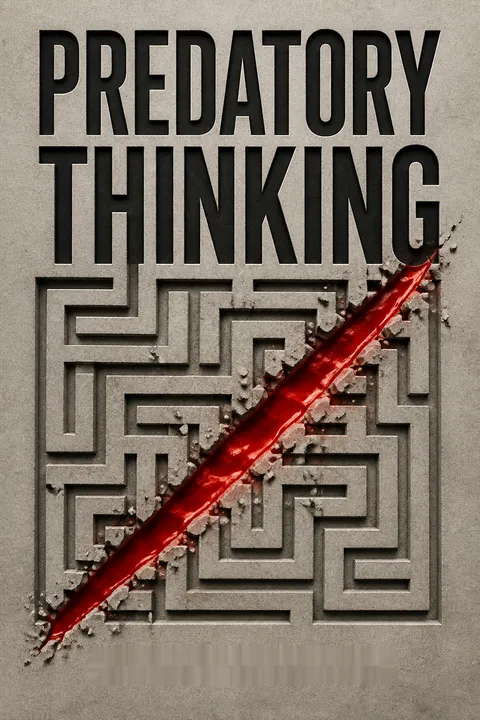


Key Takeaways
Change the frame until the problem has a solvable pressure point
Find the movable part. Trott calls this predatory thinking: instead of attacking a problem as presented, examine its context and locate the element whose alteration could change the whole situation. Creativity is not just having an unusual idea. It means turning a concept into something real through determined action.
A family problem shows the method in miniature. Trott wanted his daughter to learn, while she wanted to watch television. He found animated versions of Shakespeare, so her preferred entertainment carried the learning he valued. With his son, he made access to the TV depend on finishing homework. The useful move was not simply insisting harder. It was redesigning the situation so both sides had a reason to cooperate.
The strength of this approach is its attention to leverage. In systems thinking, changing one constraint can produce more than adding effort everywhere. The family examples also resemble incentive design: behavior shifts when the surrounding choices shift. Yet a solution that works is not automatically fair. A parent controls the household; a manager or advertiser may not have the same legitimacy. Reframing is most useful when it addresses the real problem without disguising whose interests are being served.
Treat ignorance as a starting advantage, not a defect to hide
Begin before certainty. Trott argues that people interpret unfamiliar things through what they already know, often mistaking that limited view for the whole world. He recalls that his grandmother had never encountered teabags. They opened the packets and poured the tea into a pot, unable to imagine the intended use. What is obvious to an expert can be invisible to a newcomer.
That gap matters in marketing and invention. Trott recommends recording what a team knows at the moment it receives a brief, before research turns everyone into an insider. The customer may not know the product’s history, technical virtues, or category conventions. The useful question is not only what can be learned, but what the audience has no reason to know yet.
This is a persuasive case for epistemic humility, the discipline of recognizing the limits of one’s knowledge. It also connects to user-centered design: observing what people actually do can expose assumptions that interviews with experts miss. The caution is that ignorance is not inherently insightful. Newcomers can overlook important constraints as easily as they spot fresh possibilities. The practical advantage comes from combining an outsider’s questions with enough expertise to test whether the answers are sound.
Take market share with one sharp promise, not a crowded pitch
Name the tradeoff. Trott treats marketing competition as a zero-sum contest when one brand is trying to win customers from another. A campaign cannot simply attract buyers from nowhere; its strategy should identify whose spending or preference it hopes to change. That focus matters because customers have limited attention, and a message packed with benefits can weaken its strongest point.
His son discovered a small version of the same limit by combining two favorite snacks, salty Twiglets and strawberry ice cream. The mixture was worse than either alone. Trott applies that lesson to advertising: adding claims does not add persuasive force in a straight line. A single-minded proposition is the central promise an ad concentrates on, rather than a bundle of competing messages.
The idea of opportunity cost makes the argument sharper: every added claim takes space and attention from something else. But the zero-sum frame is most accurate when brands compete for a fixed pool of buyers. Some markets expand, and useful communication can help create new demand rather than merely transfer it. Even there, the discipline of choosing one lead promise remains valuable. It forces a team to say what should be remembered if everything else is forgotten.
Design for the person who has not noticed you yet
Win the first second. Trott recalls a police instructor testing recruits by asking them to describe a man who had entered their classroom. They had not noticed him because they were busy taking notes. The exercise demonstrated how easily attention filters out what is not already important. Advertising faces the same problem: people are not studying every execution for hidden meanings.
The book reports that 89% of UK advertising was neither noticed nor remembered in the figures Trott cites. That makes visibility a prerequisite, not a decorative extra. He also argues that mass communication is received one person at a time. The wartime recruitment poster featuring Lord Kitchener addressed the individual viewer directly, rather than speaking about an anonymous crowd. Reach may be massive; attention is personal.
Attention is a scarce resource, so the story usefully reverses the usual evaluation order. Before asking whether a message is elegant or correct, ask whether it enters anyone’s awareness. This resembles a basic principle in interface design: a feature that users cannot find is functionally absent. However, visibility alone is not success. Startling people can win a glance and lose trust. The stronger standard is attention that quickly connects to a relevant benefit, rather than spectacle detached from the product.
Earn trust through costly behavior, not polished claims
Make honesty observable. An elderly customer called a plumber because his heating had stopped working. The plumber fixed an air lock by tapping a pipe, then refused payment, asking only to be considered when the old boiler needed replacing. The customer decided he trusted this plumber enough to skip competing quotes. The plumber had demonstrated the quality he wanted associated with his business instead of merely claiming it.
Trott compares this with agency leader Nigel Bogle, who sometimes declined rushed work that would not serve the client well. He offered to find a short-term solution elsewhere and invited the client to return when there was time for better work. In both stories, giving up an immediate sale helps establish a more valuable relationship. The promise becomes credible because the person accepts a real short-term cost.
The plumber’s gesture works as a costly signal: behavior that sacrifices immediate gain is harder to fake than a slogan. Trust research often distinguishes stated intentions from reliable conduct, and this example makes the difference intuitive. Still, one generous act does not prove lasting integrity. A reputation depends on repeated performance, especially when incentives change. The lesson is not to give work away theatrically, but to make the customer’s risk smaller through actions that are consistent with the claim.
Choose distinctiveness over universal approval when novelty matters
Leave familiar taste behind. Trott uses Picasso and Andy Warhol to challenge the belief that creativity should look immediately pleasing or respectable. Picasso drew from artists and traditions around him rather than pretending to be uninfluenced. Warhol embraced the very qualities critics called superficial. Their work unsettled established taste, which was part of its difference.
Comedian Jack Dee offers a more everyday illustration. After years of trying to make audiences like him, he stopped performing an agreeable version of himself and adopted a dry, confrontational voice. The audience responded. Trott’s point is not that every provocation is good. It is that the search for universal approval can erase the specific quality that makes a person or idea recognizable.
Distinctiveness is useful because familiar work is easy to ignore, and a recognizable point of view can help an audience know what it is encountering. This connects to identity research: people often communicate more clearly when they stop trying to satisfy incompatible expectations. The limit is important. Offending people is not proof of originality, and rejection can signal poor work as readily as bold work. The question is whether the difference expresses a meaningful idea, not whether it merely generates a reaction.
Repair the brief before polishing the solution
Question the assignment. A French attempt to dig the Panama Canal treated the problem as one of controlling insects that crawled into workers’ beds. Trenches of water seemed to solve it, but mosquitoes bred in the standing water and spread malaria. After thousands of deaths and years of failure, the Americans changed the task: control mosquitoes and their breeding grounds first. The canal was completed after that health problem was addressed.
Trott’s lesson is that a clever answer to the wrong question can make matters worse. The design principle form follows function means that the solution’s shape should serve the job it must do. If the intended function is unclear, polishing the form can waste time, money, and effort. When a solution fails, revisit the brief before adding refinements.
This story captures a central problem-solving error: optimizing a response while leaving the underlying diagnosis untouched. In medicine, engineering, and product design, the definition of the problem often determines which solutions even become visible. Yet reframing should not become an excuse to ignore evidence or stakeholder needs. A useful brief is not simply the version that makes a favored idea possible. It must explain the observed failure and offer a testable account of what would count as improvement.
Build ideas that pull people in instead of pushing messages at them
Create a reason to participate. Trott contrasts push-thinking, which repeatedly urges people to buy, with pull-thinking, which offers something people already want to use. Michelin first published a guide to encourage motorists to travel, listing useful destinations and places to eat. It was connected to selling tyres, but it gave drivers a reason to take trips. The guide’s restaurant ratings eventually became influential in their own right.
A different example is Gatorade’s recreation of a high-school hockey game that had ended after a player suffered a severe injury. The original players trained for a rematch years later, creating a story about lost energy, athletic effort, and renewed competition. The campaign was larger than a conventional product advertisement because the audience could care about the event itself.
Pull-based ideas have an advantage: the audience receives an experience or resource, not just a demand for attention. This overlaps with behavioral design, where environments make a desired action appealing and easy to enter. It also raises a useful test: does the activity matter without the brand attached? If not, the idea may be a sales message wearing an event’s costume. A strong brand connection feels natural because the audience’s participation genuinely fits what the product does.
Expect rejection, and make enough attempts to learn from it
Treat refusal as part of the process. Trott imagines an unusually favorable approval chain: a creative director accepts half the work, planning accepts half of that, and the client accepts half again. Only one in eight would survive those three stages, before accounting for the chance that an idea is good in the first place. The precise odds vary, but the point is practical: one rejected attempt tells little about a person’s potential.
He also recounts professor Randy Pausch learning that a coach’s harsh attention could signal investment in his improvement. Criticism can reveal what praise leaves untouched. The useful response is to ask what the feedback identifies and how the work can improve, rather than treating every objection as a verdict on identity.
Repeated attempts are a form of exploration: each one can produce information about fit, execution, or the decision-maker’s needs. That connects to learning theory, where feedback is most useful when it is specific and actionable. Rejection itself is not automatically instructive, however. Vague hostility can damage confidence without improving skill, and authority does not guarantee good judgment. The reader should seek critique that names a gap, offers reasons, and leaves room to test a better version.
Do the work of the role before asking for its title
Demonstrate readiness in practice. Trott describes wanting to become a group head at his agency, despite a flat structure that had no such post. Rather than wait for a promotion, he took on more work and brought in student teams to help. His manager eventually saw the need for a formal team and gave him the role.
Trott calls the conventional sequence HAVE-DO-BE: first receive the title, then perform the job, then become capable in it. He favors BE-DO-HAVE: begin acting like the person who can do the work, do it, and let the role follow. His example Diane Croll similarly earned wider responsibility by doing each successive job well, from creative secretary to producer and department head.
This is a practical model of earned authority: visible competence can change what an organization believes is possible. It also resembles apprenticeship, where people develop through progressively harder tasks rather than waiting for perfect credentials. The risk is exploitation. Organizations can benefit from unpaid or unrecognized extra work while postponing advancement indefinitely. Initiative is most effective when paired with explicit expectations, evidence of results, and a willingness to discuss fair recognition.
Set the outcome, then let specialists choose how to reach it
Separate direction from execution. Trott distinguishes strategy, the outcome to pursue, from tactics, the methods used to pursue it. He presents Winston Churchill as a leader focused on the strategic goal of bringing the United States into the war, while leaving battlefield decisions to military leaders. He contrasts that with Adolf Hitler’s interference in tactical decisions, which repeatedly disrupted military plans.
The management principle is to give people a clear target without controlling every move. Trott calls this tight targets, loose controls. A leader should understand what the specialists are responsible for, choose capable people, and allow them to exercise judgment. If leaders keep taking the work back, they spend their attention on execution and may neglect the larger purpose.
Delegation works best when authority and accountability match. This is familiar in organizational design: specialists need room to use expertise, while leaders keep the system aligned around shared objectives. The historical contrast is vivid but simplified; the outcomes of a war cannot be reduced to two leaders’ management styles. In everyday work, the principle still needs safeguards. A clear objective, feedback loops, and the ability to intervene when evidence changes are not micromanagement; they are responsible oversight.
Spend your attention on the journey, not an imaginary finish line
Value the part that exists. Advertising photographer Mick Dean walked the long pilgrimage route to Santiago de Compostela, a journey that could have been replaced by a quick flight. The slow walk made him notice the days and experiences he normally treated as wasted time between milestones. He returned with a changed sense of what his working life should contain and decided to train as a painter.
Trott uses Mick’s experience to question the habit of postponing satisfaction until a distant result arrives. Achievement matters, but it cannot replace the lived process that leads there. The question is not only what someone hopes to accomplish, but whether the everyday work is a life they are willing to inhabit.
This is a useful counterweight to purely instrumental thinking. Goals help organize effort, but a life spent treating every present moment as a cost can make success feel strangely empty. The idea also resembles process-based motivation, where the activity itself sustains persistence. Still, enjoying the journey should not become a romantic cover for avoiding outcomes or tolerating bad conditions. The stronger choice is to pursue goals while shaping the route so that the work has value before the finish.
Analysis
Predatory Thinking is a story-driven book about creative work, advertising, and practical judgment. Its argument is less a formal method than a recurring habit: stop accepting the problem’s first description, inspect the context, and find a point where a small change can redirect the result. Trott’s short anecdotes make that habit memorable because each converts an abstract idea into a scene: the teabag mistaken for loose tea, the plumber who declines an easy charge, the mosquito-control plan that worsens malaria, and the pilgrim who discovers that speed can erase the experience being pursued.
The book’s greatest strength is its insistence that creativity includes execution. A clever concept that never changes behavior or becomes real is only potential. Its business lessons are similarly concrete: aim at an identifiable competitor, focus the proposition, earn trust through conduct, and design for an audience that is distracted rather than professionally attentive. These claims apply beyond advertising whenever organizations must persuade people or allocate scarce attention.
The episodic structure is also the main limitation. Many stories are compressed into punchlines, and some historical or commercial examples are simplified to sharpen the lesson. The book’s zero-sum language is powerful for competitive positioning but too broad for markets that can grow or create new needs. Its celebration of risk and dissent also benefits from a distinction between principled experimentation and needless provocation. Rejection can teach, but only when feedback is informative; acting like a role can demonstrate ability, but organizations can exploit unrecognized labor.
Read the anecdotes as prompts for diagnosis rather than universal laws. The durable questions are: What assumption is hiding inside this brief? What does the audience actually know or want? Which constraint matters most? What evidence would show that the idea works? Those questions preserve the book’s central energy while grounding its boldness in observation and accountability.
Review Summary
Predatory Thinking receives mostly positive reviews, with readers praising its entertaining stories and valuable insights for creative thinking. Many find it applicable beyond advertising, offering lessons for problem-solving and business. The book's short, digestible chapters are appreciated, though some find the content basic or repetitive. Readers highlight the author's storytelling ability and unconventional examples. While some criticize its marketing focus, others appreciate its practical wisdom and thought-provoking ideas. Overall, it's considered a quick, inspiring read for those in creative fields.
People Also Read








Glossary
Predatory thinking
Reframe problems for advantageA way of approaching problems by examining their context rather than accepting their apparent form. The thinker breaks the situation into parts, looks for a changeable pressure point, and reshapes the task into one that can be solved. The term also emphasizes acting on the idea, not stopping at an attractive concept.
Single-minded proposition
One central persuasive promiseThe main claim or benefit an advertisement asks its audience to remember. Trott argues that a message becomes weaker when several claims compete for attention, because emphasis is diluted rather than simply enlarged. A single-minded proposition gives the work one clear persuasive center.
Clustering
Group choices into manageable setsThe process Trott describes by which people make a large field of options easier to handle. Rather than evaluate every option separately, they group similar choices and select among those groups. In the book, this helps explain why adding more branded alternatives does not necessarily make choosing easier.
Push-thinking vs pull-thinking
Promote versus attractPush-thinking repeatedly promotes a product or message to an audience. Pull-thinking creates something people want to seek out or use, which can indirectly support the business goal. Trott uses the Michelin Guide to illustrate how useful content can encourage travel and tyre use without making every interaction a direct sales appeal.
HAVE-DO-BE vs BE-DO-HAVE
Title-first versus action-firstTwo sequences for professional development. HAVE-DO-BE assumes a person needs the title or status first, then performs the work, and finally becomes capable in the role. BE-DO-HAVE reverses the order: act like the person who can do the work, demonstrate the ability through action, and allow formal recognition to follow.
Choice Architecture
Shape the choices people encounterThe design of the way options are presented and experienced, which can influence what people choose without removing their options. Trott applies the term to marketing that gives people reasons to engage rather than simply pressing a product message at them. The Michelin Guide is his example of an appealing structure that can create demand indirectly.
FAQ
What's "Predatory Thinking: A Masterclass in Out-Thinking the Competition" about?
- Overview of the book: "Predatory Thinking" by Dave Trott is a guide on how to out-think the competition in business and life. It emphasizes the importance of context and creative problem-solving.
- Core concept: The book introduces the idea of "predatory thinking," which involves changing the context of a problem to find a solution.
- Structure: The book is divided into ten parts, each focusing on different aspects of creativity and strategic thinking, illustrated through stories and examples.
Why should I read "Predatory Thinking"?
- Practical insights: The book offers practical advice on how to approach problems creatively and strategically, making it valuable for anyone in business or creative fields.
- Engaging storytelling: Dave Trott uses engaging stories to illustrate his points, making complex concepts accessible and memorable.
- Broad applicability: The principles of predatory thinking can be applied to various aspects of life, not just business, making it a versatile read.
What are the key takeaways of "Predatory Thinking"?
- Context is crucial: Understanding the context of a problem is essential for finding effective solutions.
- Creativity is a process: Creativity involves breaking down problems into smaller parts and finding the pressure points that can change everything.
- Learning through stories: The book emphasizes learning through stories and experiences rather than rigid formulas or rules.
How does Dave Trott define "predatory thinking"?
- Out-thinking the problem: Predatory thinking involves changing the context of a problem to make it solvable.
- Breaking down problems: It requires breaking down problems into smaller, manageable pieces to identify the key pressure points.
- Creative problem-solving: The approach encourages creative and strategic thinking to outmaneuver competition.
What is the significance of the title "Predatory Thinking"?
- Predatory mindset: The title suggests a mindset that is proactive, strategic, and focused on out-thinking competitors.
- Competitive edge: It implies using creativity and strategic thinking to gain a competitive advantage in business and life.
- Metaphorical approach: The term "predatory" is metaphorical, emphasizing the need to be sharp and strategic rather than aggressive.
What are some of the best quotes from "Predatory Thinking" and what do they mean?
- "Principles endure, formulas don’t": This quote emphasizes the importance of understanding underlying principles rather than relying on rigid formulas.
- "Creativity is creating something out of nothing": It highlights the essence of creativity as the ability to bring new ideas into existence.
- "The journey is the destination": This suggests that the process of learning and growing is more important than the end result.
How does Dave Trott illustrate the concept of "form follows function"?
- Design principle: "Form follows function" is a design principle that suggests the shape of an object should be primarily based on its intended function.
- Practical application: Trott uses examples to show how understanding the function of a product or idea leads to more effective design and solutions.
- Avoiding misalignment: The concept warns against adapting solutions to fit a function they weren't intended for, which can lead to ineffective outcomes.
What role does storytelling play in "Predatory Thinking"?
- Learning through stories: Trott uses storytelling as a method to convey complex ideas in an engaging and memorable way.
- Illustrative examples: Stories provide real-world examples that illustrate the principles of predatory thinking.
- Emotional connection: Storytelling helps readers connect emotionally with the concepts, making them more relatable and easier to understand.
How does "Predatory Thinking" address the concept of "less is more"?
- Simplicity in solutions: The book advocates for simplicity in problem-solving, suggesting that less complexity often leads to more effective solutions.
- Focus on essentials: It encourages focusing on the most important aspects of a problem rather than getting bogged down in details.
- Single-minded propositions: Trott emphasizes the importance of having a clear, single-minded proposition in communication and advertising.
What is the relationship between creativity and context in "Predatory Thinking"?
- Contextual awareness: Understanding the context of a problem is crucial for creative problem-solving.
- Adapting solutions: Creativity involves adapting solutions to fit the specific context, rather than applying generic formulas.
- Changing perspectives: By changing the context, one can often find new and innovative solutions to problems.
How does Dave Trott view the role of failure in learning?
- Learning from criticism: Trott suggests that criticism and failure are opportunities for growth and learning.
- Embracing mistakes: He encourages embracing mistakes as part of the creative process, rather than fearing them.
- Continuous improvement: The book promotes a mindset of continuous improvement through learning from failures and setbacks.
What is the significance of the epilogue "Learning isn’t the same as being taught"?
- Active learning: The epilogue emphasizes the importance of active learning through experience and experimentation.
- Beyond formal education: It suggests that true learning comes from questioning and exploring, rather than just following formal education.
- Entrepreneurial mindset: The book encourages an entrepreneurial mindset that values creativity and problem-solving over rote learning.
About the Author

Download PDF
Download EPUB
.epub digital book format is ideal for reading ebooks on phones, tablets, and e-readers.








