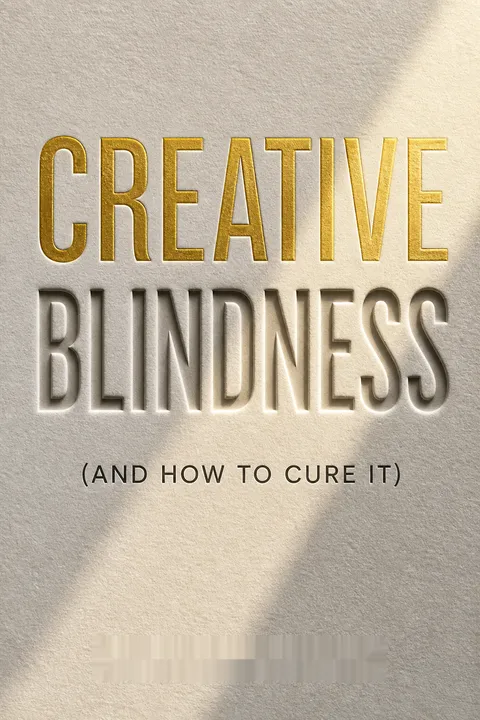


Key Takeaways
Train yourself to see the ordinary problem from an unexpected side
Creativity is a habit of attention. Trott calls this corkscrew thinking: approaching a problem from an unexpected direction instead of accepting its familiar shape. He opens with wartime Britain, where unconventional solutions included codebreaking at Bletchley Park, inflatable decoy forces, and the Sten gun, designed for inexpensive production. These stories make creativity practical rather than precious. It is not confined to art studios, and it can matter most when resources are scarce.
Practice seeing differently. Trott argues that the skill grows by noticing solutions in ordinary life, discussing why they work, and challenging default assumptions. The aim is not eccentricity for its own sake. It is to perceive options that straight-line thinking excludes.
The book's opening move usefully shifts creativity from a mysterious personal gift to a trainable form of attention. That aligns with research on divergent thinking, where people generate more possibilities when they deliberately suspend the first obvious answer. Scarcity can sharpen this search by making familiar solutions unavailable. Still, wartime innovation is rarely the work of a lone inventive mind: institutions, technical expertise, and coordination matter. The practical lesson is not that unusual thinking replaces competence, but that competence becomes more valuable when it can question its own assumptions.
Turn stranded resources into solutions by pairing problems creatively
Look for useful mismatches. In Zimbabwe, psychiatrist Dixon Chibanda found that distant villages had too few mental-health professionals, while many older women had time, community trust, and a willingness to listen. He trained grandmothers in basic talk therapy and brought care to simple outdoor benches. The program treated tens of thousands of people, and a clinical trial reported lower depression and suicidal thoughts among participants than among comparison groups.
Reuse what already exists. APOPO trained rats to detect explosives by smell. Their light weight lets them search mined ground safely, and one rat can cover in minutes what takes a person with a metal detector days. In both cases, the overlooked resource was not a new machine or a large budget. It was already nearby, waiting to be connected to the right need.
This is a form of resource recombination: value emerges not from either element alone, but from a better relationship between them. The same logic appears in ecological design, where one process's waste becomes another's input. The Friendship Bench also shows why social legitimacy is a resource. Familiar community members may make care easier to approach than a distant clinic. Such solutions still need safeguards, training, and oversight; low-cost access should not become an excuse to offer inadequate care. The most durable innovations pair local trust with reliable support.
Change the stakes or rules when the obvious route keeps failing
Move the problem into a new frame. Vulcan, a tiny West Virginia community, could not persuade local and national officials to replace a dangerous bridge. Mayor John Robinette instead contacted the Soviet embassy during the Cold War, presenting the bridge as evidence that America could not care for its own citizens. The prospect of international embarrassment moved the issue up the political agenda, and $1.3 million was approved for construction.
Turn resistance into leverage. A German town could not stop neo-Nazis from marching, so local businesses pledged donations for every metre they walked. The march raised money for a group helping young people leave extremist movements. The villagers did not defeat the march by arguing within its terms. They changed what the march accomplished.
Reframing changes what counts as a relevant decision-maker, a meaningful cost, or a win. That is closely related to agenda-setting: an issue can remain neglected until someone makes its consequences legible to a more powerful audience. The strategy is especially useful when direct persuasion has stalled. Its risks are real, though. A clever frame can attract attention while obscuring the underlying problem, or invite escalation from opponents. Good reframing keeps the original human stakes visible and makes the new incentive serve, rather than replace, the intended solution.
Start from the audience's motives, not the message you want heard
Meet people inside their habits. During the Iraq War, soldiers needed to recognize key regime figures, but conventional intelligence pamphlets were unlikely to hold their attention. The team put photographs of the wanted leaders on playing cards, a format soldiers already carried and studied. Ranking the figures by card value also made them easier to remember.
Translate facts into personal relevance. London garage owner Errol McKellar offered men a discount on their car MOT if they got a prostate-cancer check. He knew many men avoided doctors but cared about their cars. Of the 200 men who took up the offer, 36 were diagnosed, and 34 were treated in time to save their lives. The message worked because it entered a motivation people already understood.
These examples show that communication is not simply information transfer. It is a design problem: what existing routine, incentive, or symbol can carry the desired action? Behavioral science supports this emphasis on friction and salience. People often act when a new choice is made easy to notice and compatible with current habits. Yet matching a message to motivation requires care. A powerful incentive can produce narrow compliance without lasting understanding, and medical screening in particular depends on informed choice. Relevance opens the door; it should not manipulate people through it.
Demonstrate the benefit, and make it impossible to overlook
Proof beats reassurance. When London introduced escalators, anxious passengers ignored written assurances that the moving stairs were safe. An employee with one leg rode them up and down all day. Seeing someone manage the escalator more cautiously than they could changed passengers' minds more effectively than a poster could.
Earn attention before asking for belief. Trott argues that communication must first be noticed, then understood, then persuasive. A provocative book title such as Lord of the Flies attracts a reader more effectively than a plain summary of the plot. Likewise, the cyclist known as Wanksy drew attention to dangerous potholes by marking them with crude graffiti. The council repaired the road defects quickly because the markings made them conspicuous.
Demonstration reduces the gap between a claim and the evidence a person can inspect. In learning theory, observable models can make unfamiliar behavior feel both safer and more attainable. Visibility matters for a different reason: institutions often respond to what is salient, not necessarily to what is most harmful. That creates an opening for creative advocacy, but also a warning. Attention is not the same as understanding, and provocation can distract from the cause it is meant to serve. The strongest communication makes its proof vivid while keeping its purpose unmistakable.
Subtract low-value choices so your strongest offer moves faster
Find the vital few. The McDonald brothers noticed that 87% of their income came from hamburgers, fries, and drinks. They removed most of their 27-item menu, letting the kitchen prepare a smaller range faster and more consistently. Sales doubled, then doubled again. Their innovation came from subtraction, not from adding more options.
Aim effort where it can matter. Trott uses triage thinking, a way of sorting problems by whether intervention can change the outcome. In advertising, that means distinguishing people who will not buy regardless, people who already will, and people whose decision might be changed. Concentrate resources on the third group. The same principle underlies strategic sacrifice: drop activities that dilute the one advantage capable of making a difference.
Reducing choice can lower operational complexity and make a service more dependable, as the McDonald brothers' streamlined kitchen illustrates. The broader lesson resembles the Pareto principle, the observation that a minority of inputs often produces a majority of results. It is a useful prompt for analysis, not a universal law or a license to ignore smaller groups. A neglected minority can contain future customers, vulnerable people, or early signs of change. Effective reduction depends on measuring what matters and revisiting the cuts when conditions shift.
Use evidence to move emotion, because facts alone rarely persuade
Make the evidence felt. The Royal Navy hesitated to adopt screw-propelled ships, despite their technical advantages over paddle wheels. In a head-to-head trial, one screw-driven ship pulled a paddle steamer backward. The physical demonstration made an abstract engineering advantage undeniable and helped change the Navy's direction.
Account for fairness and identity. In the Ultimatum Game, one person proposes how to divide money, and another can accept or reject the offer. A purely financial calculation says to accept any amount. In practice, people may reject an unfair split even when that means receiving nothing. Trott applies this to political communication: voters who feel ignored may act to register disrespect, not simply to maximize income. Decisions have emotional and social meanings as well as material outcomes.
The strongest version of this argument is not that emotion defeats reason, but that emotion helps people decide which facts deserve attention. A dramatic trial can make evidence vivid; fairness can determine whether an offer feels legitimate. This connects with work on procedural justice, which finds that people care about how decisions are made, not only what they receive. Still, a single anecdote or game cannot explain an entire election. Emotional motives coexist with economic concerns, identity, and local experience. Effective communication treats people as complex decision-makers rather than irrational obstacles.
Treat data as fallible, and test it against lived reality
Check the chain behind the number. Air Canada Flight 143 ran out of fuel after a conversion error led the crew to believe the aircraft held twice the fuel it actually had. When its computers failed, pilot Robert Pearson's glider experience helped him land the plane safely. In another case, contaminated DNA collection swabs made German police search for a serial criminal whose genetic trace came from a factory worker.
Question a confident launch. Coca-Cola's Dasani failed in Britain after the company misread local expectations about bottled tap water and used a slogan with an unintended meaning in British English. Data and technology can extend human judgment, but they cannot repair a bad input, an untested assumption, or a team unwilling to notice evidence that contradicts its plan.
The stories distinguish data from the process that produces and interprets it. Measurement can be precise while its inputs, categories, or assumptions are wrong. This is a central concern in statistics and scientific practice: validity depends on the entire chain from sampling to inference, not on the authority of a number alone. Human experience can expose anomalies that automated systems miss, while intuition can also mislead. The strongest method is not data versus judgment. It is independent checks, transparent assumptions, and a willingness to revise conclusions when reality disagrees.
Judge communication in the messy place where people actually meet it
Test the real encounter. Trott calls the gap between a polished presentation and its actual setting the Chairman's Wife Syndrome. An advertisement may seem clear in a quiet meeting room, yet fail on a wet street or during a fast scroll through a phone. He notes that online advertising can be counted as an impression even when it appears briefly or barely enters the screen.
Leave the professional bubble. A department store, Myer, reframed time on hold by telling callers that the music royalties supported families affected by domestic violence. Its abandoned-call rate fell from 40% to 5%. The message worked in the very moment customers were waiting. Communication should be judged in the environment, mood, and time people actually have.
This is a strong case for ecological validity: whether an idea works under the conditions in which people encounter it. A message that succeeds in a presentation may fail amid distraction, limited attention, and competing demands. Testing in context also reveals which parts of a design carry the meaning without explanation. The caution is that realism alone does not establish causality; a campaign's effect may be shaped by timing, audience, or other changes. Field tests are most useful when they are paired with clear measures and comparisons.
Take the first useful risk instead of waiting for perfect certainty
Act before the ideal fix arrives. During World War Two, engineer Tilly Shilling made a simple modification to Spitfire carburettors. It stopped engines from losing power during a dive, giving pilots a timely workaround while a more complete technical solution was still years away. The device was useful precisely because it addressed the urgent failure with available means.
Make a large challenge smaller. At halftime in the European Cup final, Liverpool trailed AC Milan by three goals. Manager Rafa Benítez told his team to focus on scoring once, not on the whole impossible-looking comeback. Liverpool scored three, then won on penalties. A first workable move can change morale and reveal options that were invisible while the entire task seemed overwhelming.
Creative courage is not the same as reckless confidence. These examples favor bounded action: identify a concrete next move, take it, and use the result to update the plan. That resembles iterative problem-solving in engineering, where prototypes expose constraints that speculation misses. Urgency can also cut through status preferences and endless approval loops. But speed has costs when errors are irreversible or affect other people. The useful test is whether a small experiment can produce learning without imposing disproportionate risk. Boldness becomes disciplined when action and feedback stay connected.
Analysis
Creative Blindness is a story-driven argument about creativity as practical perception. Across advertising, wartime engineering, politics, medicine, sport, and ordinary life, Trott repeatedly asks readers to stop treating a problem's customary framing as the problem itself. His most useful examples do not celebrate novelty in the abstract. They show how a solution emerges when someone notices an overlooked audience motive, a neglected resource, a hidden incentive, or a rule that can be changed.
The book's breadth is both its energy and its limitation. The episodes are memorable because they arrive as compact reversals: rats clear mines, a bridge is funded through Cold War rivalry, and an embarrassing painting becomes a tourist draw. Their variety gives readers many entry points for practicing lateral thought. At the same time, anecdotal success stories can make ingenuity look more repeatable than it is. They often compress implementation, institutional resistance, and failed attempts into a clean narrative. The reader should borrow the questions and methods, not assume every clever reframing will work.
The strongest through-line is an insistence on human context. Communication succeeds when it accounts for what people notice, value, fear, understand, and remember. This explains Trott's skepticism toward data and technology when they become badges of sophistication rather than tools for judgment. Yet the book is not best read as an argument against measurement. Its strongest cases rely on evidence, trials, and concrete outcomes. The deeper challenge is to combine data with observation, and analysis with empathy.
The practical method is simple to state, though difficult to master: inspect the situation as people experience it, question the default frame, search for underused assets, remove distractions, and test the result in context. Creativity here is less a flash of inspiration than a disciplined refusal to accept the first description of reality. That makes the book valuable beyond advertising, while its stories remain a reminder that a clever idea earns its worth only when it changes something outside the meeting room.
Review Summary
Creative Blindness (And How To Cure It) is highly praised for its collection of short, inspirational stories showcasing creative problem-solving. Readers appreciate the book's engaging writing style, practical insights, and diverse examples from various fields. Many find it thought-provoking and applicable beyond advertising and marketing. The book is commended for its ability to spark creativity and encourage thinking outside the box. While some critics note repetition of anecdotes, most reviewers consider it an enjoyable and valuable read for anyone interested in developing creative thinking skills.
People Also Read





Glossary
Corkscrew thinking
Unexpected problem reframingA way of approaching a problem from an unconventional angle rather than following the obvious, linear route. Trott uses the term for creative thinking that turns constraints into opportunities, changes the frame of competition, or finds a solution in resources others have overlooked. It is presented as a learnable habit of attention, not a gift limited to artists.
Triage thinking
Effort where it mattersA method of sorting situations by whether intervention can change the outcome. Borrowing the logic of medical triage, it distinguishes cases that will succeed or fail regardless from those where focused effort makes a difference. In advertising, Trott applies it to audiences: spend resources on people whose decisions might be influenced, rather than those who will never buy or already will.
The Scarcity Heuristic
Scarcity raises perceived valueA judgment shortcut in which people treat something as more valuable when it seems difficult to obtain or at risk of disappearing. Trott uses the concept to explain why talk of gun restrictions increased purchases during Barack Obama's presidency, while reduced perceived threat under Donald Trump weakened urgency. The book also describes a potato campaign that used restricted access to increase curiosity.
Veblen effect
Price signals desirabilityThe tendency for a high price to increase a product's perceived desirability or status, rather than simply making it less attractive. Trott illustrates the idea with Julius Caesar, who demanded a much larger ransom than his captors first requested, making his perceived importance rise. Luxury brands also use high prices as signals of exclusivity and value.
Dunning-Kruger Effect
Limited skill distorts self-assessmentA pattern in which people with limited knowledge or ability may overestimate their competence, partly because they lack the expertise needed to recognize what they do not know. Trott recounts a bank robber who mistakenly believed lemon juice made his face invisible to security cameras, then discusses research by David Dunning and Justin Kruger on the relationship between competence and self-evaluation.
Chairman's Wife Syndrome
Presentation differs from real useThe mistake of judging an advertisement or idea in a polished presentation setting instead of the environment where its audience will encounter it. A poster that seems persuasive when studied in a quiet room may be unreadable on a rainy street, just as clothing admired on one person may not work on another. The concept urges testing in realistic conditions.
FAQ
What's "Creative Blindness (And How To Cure It)" about?
- Exploration of Creativity: The book delves into the concept of "creative blindness," where individuals fail to see creative opportunities around them.
- Real-life Stories: It uses real-life stories to illustrate how creative thinking can solve problems in unexpected ways.
- Corkscrew Thinking: The author introduces the idea of "corkscrew thinking," a method of approaching problems from unconventional angles.
- Practical Advice: It offers practical advice on how to develop and harness creative thinking in everyday life.
Why should I read "Creative Blindness (And How To Cure It)" by Dave Trott?
- Enhance Creativity: The book provides insights into enhancing your creative thinking skills, which are valuable in both personal and professional settings.
- Engaging Stories: It uses engaging and relatable stories to illustrate creative problem-solving, making it an enjoyable read.
- Practical Applications: The advice is practical and applicable to real-world situations, making it useful for anyone looking to improve their creative abilities.
- Unique Perspective: Dave Trott's unique perspective on creativity challenges conventional thinking and encourages readers to think differently.
What are the key takeaways of "Creative Blindness (And How To Cure It)"?
- Creativity is Everywhere: Creativity can be found in everyday situations if you know how to look for it.
- Corkscrew Thinking: Approaching problems from unconventional angles can lead to innovative solutions.
- Practical Creativity: Creativity is not just for artists; it can be applied in business, problem-solving, and daily life.
- Overcoming Creative Blindness: By exercising your creative muscle, you can overcome creative blindness and see opportunities where others see obstacles.
What is "corkscrew thinking" as described in "Creative Blindness (And How To Cure It)"?
- Non-linear Approach: Corkscrew thinking involves approaching problems in a non-linear, unconventional way.
- Problem as Opportunity: It encourages seeing problems as opportunities for creative solutions.
- Historical Examples: The book provides historical examples, such as Bletchley Park and the Sten gun, to illustrate corkscrew thinking.
- Secret Weapon: Described as a secret weapon in creativity, it can give individuals a competitive edge.
How does Dave Trott suggest overcoming creative blindness?
- Spot Creativity: Learn to spot creativity in everyday situations, from work to daily routines.
- Exercise Creativity: Like a muscle, creativity needs to be exercised regularly to grow stronger.
- Discuss and Share: Engage in discussions about creativity to broaden your perspective and influence others.
- Practical Exercises: The book offers practical exercises and examples to help readers develop their creative skills.
What are some real-life examples of creative thinking in "Creative Blindness (And How To Cure It)"?
- Washington Redskins Sting: A sting operation used free game tickets to capture fugitives, demonstrating creative problem-solving.
- Friendship Benches in Zimbabwe: Grandmothers were trained to provide therapy, turning a lack of psychiatrists into an opportunity.
- Vulcan, West Virginia Bridge: A creative letter to the Russian embassy led to funding for a much-needed bridge.
- Girl Scout Cookie Sales: A Girl Scout sold cookies outside a marijuana dispensary, capitalizing on the munchies effect.
What is the significance of "The Ploughman’s Lunch" story in the book?
- Invented Tradition: The Ploughman’s Lunch was a marketing invention, not a historical tradition.
- Repackaging History: It shows how history can be repackaged to create a compelling narrative.
- Marketing Lesson: Demonstrates the power of storytelling in marketing to create perceived value.
- Cultural Impact: The story became part of national memory, illustrating the impact of creative marketing.
How does "Creative Blindness (And How To Cure It)" address the role of fear in creativity?
- Fear as a Tool: The book suggests that fear can be a valuable tool for entrepreneurs and creative thinkers.
- Steve Jobs Example: Steve Jobs used fear of competition to drive innovation, leading to the creation of the iPhone.
- Evolutionary Advantage: Fear is presented as an evolutionary advantage that keeps species, and businesses, alert and competitive.
- Embrace Fear: Encourages readers to embrace fear as a motivator for creative solutions.
What are some of the best quotes from "Creative Blindness (And How To Cure It)" and what do they mean?
- "Creativity is your legal unfair advantage." This quote emphasizes that creativity can give you a competitive edge in a fair and legal way.
- "The difficulty lies not so much in developing new ideas, as in escaping from the old ones." It highlights the challenge of breaking free from conventional thinking to embrace new ideas.
- "Strategy is sacrifice." This quote underscores the importance of focusing on what truly matters and letting go of the rest to achieve strategic goals.
- "Simple is harder than complicated." It suggests that achieving simplicity requires more effort and creativity than complexity.
How does Dave Trott illustrate the concept of "creative impact" in the book?
- Barney the Parrot: A parrot's foul language brought attention to a wildlife sanctuary, illustrating how being different can create impact.
- Show Don’t Tell: The book emphasizes the power of demonstration over claims, using historical advertising examples.
- Unfriendly Fire: A story about the Austrian army highlights how overthinking and fear can lead to self-defeat, stressing the importance of clear communication.
- Advertising Lessons: The book provides lessons on how impactful advertising can change behavior and perception.
What is the role of "practical creativity" in "Creative Blindness (And How To Cure It)"?
- Triage Thinking: Focus on where your efforts will make the most difference, akin to medical triage.
- Pareto Principle: Apply the 80/20 rule to focus on the most impactful areas of your work or business.
- Problem Solving: View problems as opportunities for creative solutions, as demonstrated by various real-life examples.
- Simplification: Emphasizes the power of simplification in achieving creative breakthroughs.
How does "Creative Blindness (And How To Cure It)" address the concept of "creative surprises"?
- Unexpected Outcomes: The book discusses how unexpected outcomes can lead to creative breakthroughs.
- Backfire Effect: Illustrates how perceived threats can drive demand, as seen in the gun industry under Obama.
- Boys with Toys: A story about a Russian submarine highlights the importance of understanding different perspectives.
- Hold On a Minute: Myer's creative approach to hold music turned a negative experience into a positive one, showing how small changes can have a big impact.
About the Author

Download PDF
Download EPUB
.epub digital book format is ideal for reading ebooks on phones, tablets, and e-readers.








