Key Takeaways
1. Being: The fundamental question of existence
Why is there something rather than Nothing?
The primordial mystery. Heidegger's philosophy revolves around the question of Being - the fact that there is existence at all. This inquiry goes beyond the study of particular entities to explore the very nature of existence itself. Heidegger saw this as the most fundamental philosophical question, one that had been largely forgotten or obscured in Western thought.
Ontological difference. Heidegger distinguishes between beings (entities that exist) and Being itself (the condition that allows for existence). This ontological difference is crucial for understanding his approach:
- Beings: Specific things that exist (humans, animals, objects)
- Being: The underlying essence or "is-ness" that allows beings to be
Rediscovering the question. Heidegger sought to reawaken our sense of wonder at the sheer fact of existence. He believed that by continually questioning and contemplating Being, we could gain deeper insights into the nature of reality and our place within it.
2. Dasein: Human existence as being-in-the-world
Dasein is an entity which, in its very Being, comports itself understandingly towards that Being.
Unique human existence. Dasein (literally "being-there") is Heidegger's term for human existence. It emphasizes our unique capacity to question and understand our own Being. Unlike other entities, we are always already engaged in interpreting and making sense of our existence.
Inseparable from the world. Heidegger rejects the traditional subject-object split. Dasein is fundamentally "being-in-the-world" - we cannot be understood in isolation from the context of our lives:
- Thrownness: We find ourselves always already in a particular situation
- Facticity: The given circumstances that shape our possibilities
- Projection: Our ability to envision and pursue future possibilities
Everyday being. Heidegger analyzes how we typically engage with the world:
- Ready-to-hand: Practical, involved engagement with tools and equipment
- Present-at-hand: Detached, theoretical observation (less fundamental)
- Being-with: Our essential social nature and relationships with others
3. Authenticity: Embracing one's own possibilities
Dasein is authentically itself only to the extent that, as concernful Being-alongside and solicitous Being-with, it projects itself upon its ownmost potentiality-for-Being rather than upon the possibility of the they-self.
Escaping the 'they'. Heidegger contrasts authentic existence with inauthentic modes of being. Inauthenticity is characterized by:
- The "they-self": Conforming to social expectations and norms
- Falling: Absorption in mundane concerns and idle chatter
- Fleeing: Avoiding confrontation with the deeper questions of existence
Anxiety and freedom. Authentic existence emerges through:
- Anxiety: A mood that reveals the groundlessness of our being
- Resoluteness: Accepting responsibility for our choices
- Anticipation: Embracing our finite nature and mortality
Choosing oneself. Authenticity doesn't mean rejecting society entirely, but rather:
- Owning one's choices and taking responsibility for one's life
- Recognizing the full range of one's possibilities
- Living with a clear-eyed understanding of one's finite nature
4. Being-towards-death: Mortality as the key to authentic living
Death is the possibility of the absolute impossibility of Dasein.
Inescapable finitude. Heidegger sees our mortality as the most fundamental fact of human existence. Death is not just an event that happens at the end of life, but a constant possibility that shapes our entire being.
Authentic relation to death. Rather than fleeing from or obsessing over death, Heidegger advocates:
- Anticipation: Projecting oneself towards one's own death
- Individualization: Recognizing death as one's ownmost possibility
- Freedom: Embracing finitude opens up authentic possibilities
Transformative awareness. A clear-eyed confrontation with mortality can:
- Provide perspective on what truly matters in life
- Free us from inauthentic conformity to social expectations
- Motivate us to seize our genuine possibilities while we can
5. Care: The unifying structure of human existence
The Being of Dasein means ahead-of-itself-Being-already-in-(the-world) as Being-alongside (entities encountered within-the-world).
Fundamental concern. Care (Sorge) is Heidegger's term for the basic structure of Dasein's being. It encompasses:
- Existentiality: Our projection towards future possibilities
- Facticity: Our thrownness into a given situation
- Falling: Our absorption in the present world of concerns
Temporal unity. Care unifies the three dimensions of time in human existence:
- Future: Projecting ourselves towards possibilities
- Past: The given situation we find ourselves in
- Present: Our current engagement with the world
Modes of care. Care manifests in different ways:
- Concern: Our practical engagement with things
- Solicitude: Our relationships with other people
- Anxiety: Our confrontation with our own Being
6. Truth as aletheia: Unconcealment and the disclosure of Being
The essence of truth is freedom.
Beyond correspondence. Heidegger critiques the traditional notion of truth as mere correspondence between statements and facts. Instead, he returns to the Greek concept of aletheia (unconcealment).
Revealing and concealing. Truth as aletheia involves:
- Disclosure: The coming-into-presence of beings
- Concealment: The necessary withdrawal that allows beings to stand forth
- Clearing: The open space in which beings can show themselves
Primordial truth. Aletheia is more fundamental than propositional truth:
- It is the condition that allows beings to be encountered at all
- It involves an active engagement with the world, not passive observation
- It recognizes the mystery and hiddenness inherent in Being
7. Language: The house of Being and the path to understanding
Language is the house of Being. In its home human beings dwell.
Beyond mere communication. Heidegger sees language as far more than just a tool for exchanging information. It is the fundamental way in which Being discloses itself to us.
Poetic essence. Authentic language has a poetic quality:
- It reveals the Being of things rather than just labeling them
- It allows things to "speak" in their own way
- It goes beyond the rigid conceptual frameworks of technical language
Listening and responding. Our relationship to language involves:
- Attentive listening to the "call" of Being
- Responding creatively to what is revealed
- Recognizing the limits of our conceptual grasp on reality
8. Technology: The danger and promise of modern enframing
The essence of technology is by no means anything technological.
Enframing. Heidegger sees modern technology as characterized by a particular way of revealing the world:
- Everything is viewed as a resource to be optimized and exploited
- Nature and even human beings become "standing reserve"
- This mindset goes far beyond just machines and technical devices
Danger and saving power. While critical of technology's effects, Heidegger doesn't simply reject it:
- The danger: Technology can conceal other ways of relating to Being
- The saving power: Recognizing technology's essence can lead to new insights
Poetic dwelling. Heidegger advocates a different relationship to the world:
- Letting things be, rather than constantly manipulating them
- Cultivating a more meditative, less calculative thinking
- Rediscovering a sense of wonder and receptivity to Being
Last updated:
FAQ
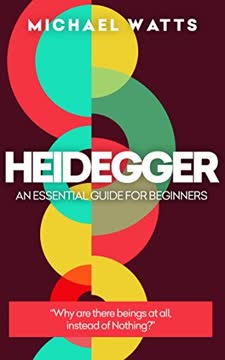
What is "Heidegger: An Essential Guide For Complete Beginners" by Michael Watts about?
- Introductory overview: The book provides a clear, accessible introduction to the philosophy of Martin Heidegger, focusing on his major ideas and their significance.
- Coverage of key works: It explains Heidegger’s most influential work, "Being and Time," and explores his later writings, including his thoughts on language, technology, and Eastern philosophy.
- Biographical context: The guide situates Heidegger’s philosophy within the context of his life, including his upbringing, academic career, and controversial involvement with Nazism.
- Aimed at newcomers: Watts’s approach is designed for readers with little or no background in philosophy, making complex concepts understandable without oversimplification.
Why should I read "Heidegger: An Essential Guide For Complete Beginners" by Michael Watts?
- Clarity and accessibility: Watts excels at translating Heidegger’s notoriously difficult ideas into clear, concrete language, making them approachable for beginners.
- Comprehensive coverage: The book covers both Heidegger’s early and later philosophy, including his views on Being, time, death, language, technology, and connections to Taoism and Zen.
- Balanced perspective: It addresses both the philosophical achievements and the controversies surrounding Heidegger, including his relationship with Nazism.
- Practical relevance: Readers gain insights into existential questions about meaning, authenticity, and the human condition, which remain relevant today.
What are the key takeaways from "Heidegger: An Essential Guide For Complete Beginners" by Michael Watts?
- The question of Being: Heidegger’s central concern is the meaning of Being, which he believes has been neglected by Western philosophy.
- Dasein and authenticity: Human existence (Dasein) is unique in its capacity for self-understanding, and authenticity involves living in awareness of one’s own possibilities and mortality.
- Inauthenticity and the ‘they-self’: Most people live inauthentically, absorbed in social conventions and everyday distractions, rather than confronting their own existence.
- Language, truth, and technology: Heidegger redefines truth as ‘unconcealment’ (aletheia), explores the limitations and power of language, and critiques the technological mindset as a threat to authentic living.
How does Michael Watts explain Heidegger’s concept of "Being" in "Heidegger: An Essential Guide For Complete Beginners"?
- Being vs. beings: Watts clarifies Heidegger’s distinction between ‘Being’ (the fundamental condition that allows things to exist) and ‘beings’ (individual entities).
- Ontology’s forgotten question: Heidegger argues that Western philosophy has focused on beings and ignored the deeper question of Being itself.
- Primordial mystery: Being is not a thing or entity but the ‘isness’ that underlies all existence, and its meaning is ultimately mysterious and inexhaustible.
- Role of questioning: Heidegger believes the value lies not in answering the question of Being, but in continually asking it and remaining open to its mystery.
What is "Dasein" and why is it central in "Heidegger: An Essential Guide For Complete Beginners" by Michael Watts?
- Definition of Dasein: Dasein is Heidegger’s term for human existence, emphasizing our unique way of being that involves self-awareness and engagement with the world.
- ‘Being-there’ explained: The word literally means ‘being there,’ highlighting that humans are always situated in a particular context or world.
- Starting point for inquiry: Heidegger begins his analysis of Being by examining Dasein, since only humans can question and understand Being.
- Dasein as a clearing: Dasein serves as the ‘clearing’ where Being is revealed, making human existence the site of meaning and truth.
How does "Heidegger: An Essential Guide For Complete Beginners" by Michael Watts describe authenticity and inauthenticity?
- Authenticity defined: Authenticity involves living in awareness of one’s own possibilities, mortality, and responsibility for one’s choices, rather than conforming to social norms.
- Inauthenticity and the ‘they-self’: Most people live as the ‘they-self,’ absorbed in the expectations and routines of society, losing sight of their individuality.
- Role of anxiety: Moments of anxiety or existential crisis can disrupt inauthentic living and open the possibility for authentic existence.
- No moral judgment: Watts emphasizes that inauthenticity is not a moral failing but a structural feature of everyday human life.
What is Heidegger’s view of death and "Being-towards-death" as explained in "Heidegger: An Essential Guide For Complete Beginners" by Michael Watts?
- Death as central theme: Heidegger sees the awareness of one’s own mortality as essential for authentic living and understanding the meaning of Being.
- ‘Being-towards-death’: This concept means living with the constant realization that death is inevitable and could occur at any moment.
- Personal responsibility: Death is one’s ‘ownmost’ possibility—no one else can die for you, and it individualizes existence.
- Freedom and meaning: Facing death authentically frees individuals from social conformity and allows them to live more meaningfully.
How does "Heidegger: An Essential Guide For Complete Beginners" by Michael Watts explain Heidegger’s concepts of moods, anxiety, and care?
- Moods as fundamental: Moods are not just emotions but fundamental ways of being ‘tuned into’ the world, shaping our understanding and experience.
- Anxiety’s revealing power: Anxiety (Angst) strips away everyday meanings and confronts us with the Nothingness at the heart of existence, opening the path to authenticity.
- Care as basic structure: ‘Care’ is the unifying feature of Dasein, encompassing concern for oneself, others, and the world, and grounding all other aspects of existence.
- Temporal unity: Care integrates past (thrownness), present (fallenness), and future (projection), showing that human existence is always three-dimensional in time.
What is Heidegger’s critique of technology in "Heidegger: An Essential Guide For Complete Beginners" by Michael Watts?
- Enframing mindset: Heidegger argues that modern technology imposes a ‘mind-set’ (enframing) that reduces everything—including humans—to resources for exploitation.
- Loss of meaning: This technological attitude leads to a ‘forgetting of Being’ and a loss of deeper meaning and connection with the world.
- Not anti-technology: Heidegger does not advocate abolishing technology but calls for a more reflective, ‘poetic’ relationship with it.
- Potential for awareness: The dangers of technology can also awaken us to the need for a more authentic, custodial approach to existence.
How does "Heidegger: An Essential Guide For Complete Beginners" by Michael Watts address Heidegger’s views on language and truth?
- Truth as unconcealment: Heidegger redefines truth (aletheia) as the process of revealing or unconcealing, rather than mere correspondence between statements and facts.
- Language as ‘House of Being’: Language is not just a tool for communication but the medium through which Being is disclosed and understood.
- Dangers of language: Everyday language can become empty and obscure the original experience of Being, necessitating a renewal of language.
- Poetry and authenticity: Poetic language is seen as a privileged way of revealing the truth of Being, going beyond ordinary speech.
What connections does "Heidegger: An Essential Guide For Complete Beginners" by Michael Watts draw between Heidegger and Eastern philosophies like Taoism and Zen?
- Acknowledged affinities: Watts notes that Heidegger himself recognized parallels between his thought and East Asian philosophies, especially Taoism and Zen.
- Shared themes: Both Heidegger and these traditions emphasize the ineffability of ultimate reality, the importance of direct experience, and the limitations of conceptual thinking.
- Letting-be and non-duality: Heidegger’s ideas of ‘letting things be’ and the interconnectedness of beings resonate with Taoist and Zen notions of non-action and non-duality.
- Authenticity and enlightenment: The process of achieving authenticity in Heidegger is likened to Zen enlightenment, involving a break from conventional thinking and a return to the ordinary with new awareness.
What are the best quotes from "Heidegger: An Essential Guide For Complete Beginners" by Michael Watts and what do they mean?
- "To think is to confine yourself to a single thought that one day stands still like a star in the world’s sky." – Emphasizes the depth and focus required for true philosophical inquiry.
- "Being is Being." – Illustrates Heidegger’s view that the meaning of Being is ultimately mysterious and cannot be fully captured in language.
- "Language is the House of Being. Man dwells in this house..." – Highlights the central role of language in shaping human existence and understanding.
- "Where danger is, grows also that which saves." – Suggests that the very threats posed by technology or enframing can also prompt a renewed awareness of Being and authenticity.
Review Summary
Heidegger by Michael Watts is praised as an accessible introduction to Heidegger's complex philosophy. Readers appreciate its clarity, simplicity, and effectiveness in explaining difficult concepts. Many find it helpful as a starting point before tackling Heidegger's original works. The book covers key ideas such as Being, technology, and authenticity. While some reviewers note its limitations in depth and context, most agree it succeeds as a beginner's guide. Overall, it receives high ratings for making Heidegger's thoughts more approachable and understandable.
Similar Books





Download PDF
Download EPUB
.epub digital book format is ideal for reading ebooks on phones, tablets, and e-readers.





