

Key Takeaways
Use philosophy to question confident authorities, including yourself
Start with honest doubt. Philosophy begins not with a store of final answers, but with the practice of asking what makes a belief reasonable. Socrates questioned Athens’s teachers, politicians, and religious authorities, finding that many cared more about appearing wise than examining their claims. He treated awareness of his own ignorance as a better starting point than false certainty. His questioning made him popular with young Athenians and dangerous to powerful ones. He was convicted and executed, but his followers established the Academy, where people could debate ideas.
Make disagreement useful. The book presents philosophy as a shared search for wisdom: clarify what you believe, listen to opposing views, and test your assumptions. Its thought experiments, imagined situations that reveal a theory’s implications, turn abstract disputes into questions readers can assess for themselves.
What's striking is that intellectual humility here is active, not passive. It does not mean treating every claim as equally plausible; it means asking what supports a claim before granting it authority. That habit has clear value in public life, where confident rhetoric can be mistaken for expertise. Socrates’s fate also shows the cost of challenging power. Yet questioning alone cannot establish truth. It needs standards of evidence, careful reasoning, and a willingness to revise conclusions when better arguments appear.
Ask whether reality is physical, ideal, or shaped by perception
One world, rival maps. Plato argued that imperfect objects reflect perfect ideals, much as a drawn triangle falls short of the exact mathematical form we can conceive. His student Aristotle instead studied living things and explained them through their material, form, source of change, and purpose. Margaret Cavendish took physical reality further, arguing that only matter exists and that thought is one of matter’s capacities.
Perception complicates matter. George Berkeley argued that we encounter qualities, such as color, shape, and sound, through perception, not an unknowable material substance beneath them. His famous puzzle about a tree falling unheard asks whether sound exists without a perceiver. These positions are not just different answers to one question: they disagree about what counts as evidence for reality.
The contrast among these thinkers resembles a dispute over scientific models: a model can organize observations without being identical to the world it describes. Berkeley’s argument usefully reminds readers that perception is not a transparent window. It does not, by itself, show that external objects are unreal; differences in how observers experience a thing can coexist with a shared cause outside them. The deeper lesson is to distinguish what experience gives directly from the explanations added to make sense of it.
Test arguments about God against both evidence and suffering
Order can mislead. Averroes argued that the apparent fit between life and its environment suggests a designer. Darwin’s account of natural selection offers another explanation: variation and survival over many generations can produce organisms that appear designed, without requiring a designer to intervene. The cosmological argument asks what set the universe in motion; Aquinas answered with an unmoved first mover, while relying on the disputed premise that nothing can move itself.
Suffering sharpens the test. J. L. Mackie argued that a wholly good, all-powerful God seems difficult to reconcile with real suffering, such as severe abuse of a child. The free-will reply says people must be able to choose wrongly, but Mackie asks why an all-powerful creator could not have made harmful choices rarer.
These arguments illustrate why philosophical questions rarely end with one clever proof. Explaining apparent design through evolution challenges one route to belief, but it does not settle whether a creator exists. Likewise, the problem of evil has force because it begins from morally serious suffering, not merely an abstract puzzle. Its logical conclusion depends on whether any good reason could justify allowing particular harms. Keeping that distinction clear helps readers evaluate arguments without confusing a challenge to a proof with proof of the opposite.
Inspect inherited roles before calling them your identity
Identity has social ingredients. Simone de Beauvoir argued that societies teach people how to perform gender, often making social expectations look like natural choices. Her challenge is to notice the boundaries around what feels acceptable: a person may technically be free to dress or behave differently, while still facing pressure not to do so.
The self remains contested. Daniel Dennett treats the self as a story created by a brain: language connects experiences and gives them an apparent unity, although he sees our choices as biologically determined. David Chalmers counters that a physical account of the brain may not explain conscious experience, such as what music sounds or feels like from the inside. The debate asks whether identity is a social role, a biological process, a conscious subject, or some combination.
The distinction between social influence and personal agency is especially useful: recognizing a norm’s origins can make it easier to examine, but does not automatically free someone from its consequences. Contemporary social psychology likewise treats identity as shaped through interaction, while leaving room for reflection and change. The consciousness debate adds a separate caution. A detailed account of brain activity may explain how perception works without capturing what an experience feels like. Different explanations can illuminate different layers of the self.
Separate freedom to do otherwise from freedom from coercion
Freedom has competing meanings. Epicurus proposed that atoms sometimes swerve unpredictably, leaving room for choice. But randomness alone does not explain how an action becomes deliberate or earns responsibility. Elizabeth Anscombe offered a different picture: physical laws set the rules, as in chess, but complex agents can act intentionally within them. A dealt card game, by contrast, is fixed before play begins.
Control may be internal. The Stoic Epictetus defined freedom as acting through reason without being ruled by external forces or uncontrolled desires. Thomas Hobbes rejected this kind of inner independence, arguing that people act to satisfy their strongest desires and may rationally trade liberty for security. Sartre took the opposite emphasis: people must accept responsibility for choices instead of hiding behind a role.
Many everyday disagreements about free will are really disagreements about its definition. A person might be uncoerced, yet unable to choose differently because of prior causes; another might face few external limits, yet feel enslaved by addiction or fear. Separating these cases makes debates about blame and responsibility more precise. Still, internal self-control is not a complete substitute for political freedom. The ability to govern one’s responses matters, but so do the conditions that determine which choices are genuinely available.
Build knowledge from evidence without pretending induction guarantees certainty
Doubt can clear ground. Descartes imagined a deceiver capable of making every sensory experience false. Even then, the act of doubting would confirm that a thinker exists. Locke took the opposing route, arguing that ideas come through experience and that science should rely on observable evidence, even when its conclusions remain probable rather than certain.
Evidence needs assumptions. David Hume pointed out that predicting the future from past observations assumes nature will keep behaving consistently. Yet that assumption cannot itself be proven by past consistency without circular reasoning. Susan Haack’s foundherentism offers a practical compromise: scientific conclusions depend both on observations and on how well ideas support one another, like answers that must fit both crossword clues and the grid.
The tension between certainty and useful knowledge remains central to science. Hume’s challenge does not make everyday prediction irrational; it shows that prediction rests on a background expectation that cannot be demonstrated without relying on similar expectations. Haack’s approach captures how researchers actually strengthen theories through multiple forms of support. A caution remains: mutual support can preserve a mistaken framework if its assumptions are shared. Independent measurements and opportunities for correction are therefore important companions to coherence.
Make scientific theories risk failure, and examine who sets the rules
A good test can fail. Karl Popper argued that a scientific theory should make predictions that could prove it wrong. Instead of collecting only examples that support the idea that swans are adapted to their environments, researchers could search for counterexamples, such as black swans in snowy regions. Thomas Kuhn observed that scientists often explain anomalies within a shared framework, or paradigm, until enough problems provoke a major shift. Copernicus’s sun-centered account eventually replaced the Earth-centered model.
Knowledge meets power. Michel Foucault examined how institutions classify and monitor people, shaping what counts as normal. The book also distinguishes formal fallacies, whose errors can be demonstrated by logic, from informal errors such as cherry-picking or attacking a speaker rather than an argument.
Popper’s emphasis on risky predictions supplies a valuable discipline: a theory that can explain every possible outcome has little capacity to discriminate among explanations. Kuhn and Foucault add an institutional dimension, showing that evidence is interpreted within communities and systems of authority. That does not make science merely political or arbitrary. It does suggest that strong inquiry benefits from open criticism, varied perspectives, and transparent methods. Falsifiability is a useful test, but it is not the only measure of a theory’s scientific value.
Choose what to desire, attend to, and celebrate in ordinary life
No single recipe fits everyone. Laozi urged people to live in closer harmony with nature and resist unnecessary striving. Siddhartha Gautama taught that attachment to temporary things fuels suffering, and that disciplined practice can loosen its grip. Hildegard of Bingen found meaning in enthusiastic religious devotion and music. Albert Camus rejected hopes of cosmic purpose but urged attention to modest, immediate pleasures, such as a day at the beach.
Ordinary lives count. Alain de Botton argues that work and relationships become more manageable when people understand their emotional needs and communicate them. His alternative to heroic standards is not apathy, but a realistic account of what makes daily life tolerable and worthwhile. Taken together, these views invite readers to examine which habits of desire, attention, and connection actually serve them.
These accounts differ because they diagnose human trouble differently: excess desire, resistance to nature, lack of enthusiasm, or unrealistic expectations. Their variety is a strength, since advice about the good life often fails when it assumes one temperament or culture. De Botton’s attention to emotional needs also connects philosophical reflection to practical communication. Still, a focus on personal adjustment cannot resolve every hardship. Some sources of distress arise from material or social conditions, not from an individual’s expectations alone.
Choose an ethical lens before judging a difficult decision
Three theories ask different questions. Kant’s deontology judges whether a principle could be followed consistently by everyone. A lying promise fails that test because universal deception would destroy the trust promises require. John Stuart Mill’s utilitarianism instead asks which choice produces the greatest overall happiness. In a case where someone hides a family from Nazis, that approach may favor lying to save lives, while Kant’s rule against lying does not.
Character adds another guide. Virtue ethics asks what a person with excellent character would do, treating morality more like a skill learned from examples than a formula. These approaches can point in different directions. Comparing them makes the conflict visible: duties, consequences, and character each identify something morally important.
The theories function like distinct lenses, each bringing certain features into focus. Consequence-based reasoning is valuable when choices affect many people; rules protect individuals from being sacrificed whenever a majority benefits; character ethics attends to judgment and motive. None eliminates hard cases. A useful decision process can ask what rule is at stake, who bears the consequences, and what kind of character the choice expresses. That comparison is more illuminating than pretending every moral dilemma has a painless answer.
Design laws as if you might occupy society’s least protected position
Fairness requires uncertainty about privilege. John Rawls imagined people choosing political rules without knowing their own race, gender, wealth, religion, or social position. This veil of ignorance discourages rules that favor a group simply because its members hold power. Rawls expected people in this position to support equal basic rights and opportunities.
Justice includes distribution and power. Karl Marx argued that capitalist competition can enrich owners while trapping workers in poorly paid, repetitive labor. Martin Luther King Jr. advocated nonviolent resistance to racial injustice, while Martha Nussbaum extended questions of justice to women’s rights and the treatment of animals and nature. Their disagreements show that fair procedures alone may not repair entrenched inequalities.
Rawls’s thought experiment is a powerful antidote to self-serving lawmaking because it asks decision-makers to take uncertainty seriously. It resembles impartial procedures in institutional design: rules are more credible when they do not depend on knowing who will benefit. But a hypothetical agreement cannot identify every form of disadvantage by itself. Historical evidence and the testimony of affected groups are needed to reveal how apparently neutral policies operate in practice. Fairness requires both an impartial standard and scrutiny of actual outcomes.
Judge art by how it changes experience, not only what it depicts
Beauty has several jobs. Sen no Rikyū’s Zen tea practice valued simplicity and imperfection; a broken jar repaired with visible golden seams could become more compelling than an undamaged showpiece. Iris Murdoch argued that attention to a beautiful object can draw people beyond self-absorption. John Dewey treated art less as a precious object than as an experience made meaningful through creation and appreciation.
Art also exposes exclusion. Virginia Woolf imagined a talented sister to Shakespeare whose circumstances prevent her from writing. Her example asks who gets the time, education, and freedom needed to make art. A thought experiment about four identical red squares, including one displayed as a celebrated painting, further asks how intention and context affect what counts as art.
This account shifts aesthetic judgment from identifying a permanent checklist to noticing what works of art make possible: attention, shared feeling, reflection, or a new interpretation of ordinary life. That approach explains why context matters without reducing art to status or price. It also makes access part of the aesthetic question, since the freedom to create is unequally distributed. Yet experience alone cannot explain every disagreement about artistic value. Form, history, intention, and audience expectations can all shape what a work communicates.
Analysis
This book is best understood as a guided tour of disagreements rather than a single doctrine. Its organizing map, reality, knowledge, and value, gives beginners a way to locate questions that otherwise seem unrelated. The most useful move is the repeated pairing of rival answers: Plato with Aristotle, determinism with existential freedom, duty with consequences, and ideal beauty with deliberate imperfection. Readers learn not just what famous thinkers believed, but what each position makes easier to see and harder to explain.
The book’s accessible thought experiments are central to that method. A falling tree probes whether sound depends on a perceiver; the trolley problem makes ethical principles collide; the veil of ignorance turns fairness into a choice under uncertainty. Such cases help expose assumptions, though they do not settle every real-world question. Hypothetical dilemmas simplify circumstances that may involve unequal power, incomplete information, or duties beyond the options presented.
A second strength is the global and historical range, which resists presenting philosophy as one uninterrupted Western conversation. Eastern traditions offer more than decorative alternatives: Daoist harmony and Buddhist detachment challenge assumptions about ambition, selfhood, and permanence. The book also foregrounds women thinkers and the barriers that limited their participation, making philosophy’s history itself an object of criticism.
The compression that makes this survey approachable also makes its portraits necessarily selective. Large traditions become short arguments, and a thinker’s position can appear more settled or uniform than it is. The best use of the book is therefore not as a final authority, but as a map for choosing which disputes deserve deeper study. Its strongest practical lesson is a habit: identify the question, distinguish competing claims, ask what supports each, and notice what remains unresolved. That is philosophy as a usable civic skill, not merely a collection of famous names.
Review Summary
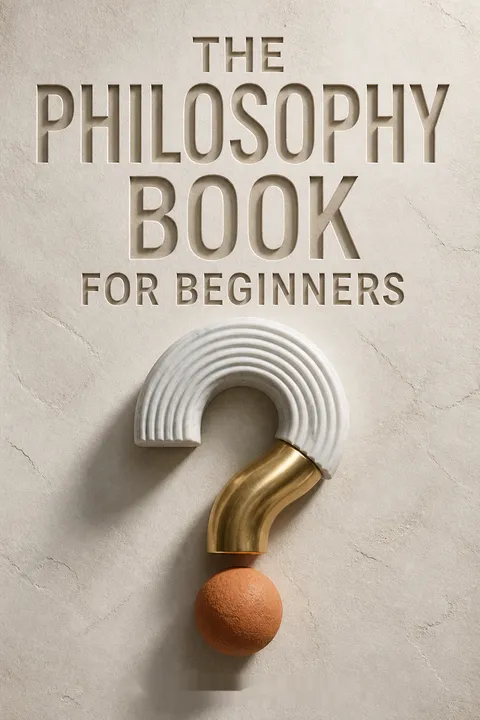
The Philosophy Book for Beginners receives mostly positive reviews, with readers praising its accessibility and comprehensive overview of philosophical ideas. Many find it an excellent introduction for beginners, high school students, and those looking to refresh their knowledge. The book's clear writing, concise sections, and thought experiments are particularly appreciated. Some readers note its elementary nature, while others find it mind-opening. A few mention the challenges of grasping complex philosophical concepts, but overall, the book is well-received for its approachable take on a traditionally difficult subject.
People Also Read





Glossary
Metaphysical idealism
Ideas are most realThe view that physical objects are not ultimate reality. In Plato’s account, imperfect things reflect more fundamental, perfect forms, such as an ideal triangle. The theory explains how people can conceive of perfection despite encountering only imperfect examples in everyday life.
Materialism
Only physical reality existsThe view that reality consists only of physical things and processes, with no separate immaterial realm or substance. Margaret Cavendish used the term to argue that matter can account for phenomena such as thought, rather than requiring a nonphysical soul.
Logos
Reason’s cosmic ordering lawIn Stoic philosophy, Logos is the rational principle that orders the universe and governs how things exist and act. Humans express it through reason. Stoics connect a good life with bringing one’s judgments and desires into line with this cosmic order.
Qualia
The felt qualities of experienceThe subjective qualities of conscious experience, such as the felt character of hearing music, seeing a color, or tasting food. David Chalmers uses qualia to distinguish a physical account of sensory processes from an account of what those processes feel like to the person experiencing them.
Panpsychism
Consciousness pervades matterThe view that consciousness is present throughout the natural world, rather than appearing only in human beings. In Chalmers’s proposal, consciousness manifests in different degrees depending on the complexity of the matter involved, with humans displaying more than rocks.
Compatibilism
Freedom can coexist with determinismThe position that being determined by prior causes does not necessarily rule out freedom. Epictetus’s Stoic account defines freedom less as the ability to choose otherwise and more as acting through reason without external restraint or enslavement to uncontrolled desires.
Problem of induction
Past evidence cannot guarantee future patternsDavid Hume’s challenge to reasoning from observed cases to unobserved ones. An inference that the future will resemble the past assumes nature is uniform, but past experience cannot prove that assumption without using the same kind of inference it is meant to justify.
Foundherentism
Evidence and ideas support each otherSusan Haack’s account of knowledge that combines empirical foundations with logical coherence. Observations provide clues, while relations among claims help rule out inconsistent answers. Her crossword analogy captures how both evidence and fit with other beliefs contribute to scientific judgment.
Paradigm
A shared scientific frameworkIn Thomas Kuhn’s account, a paradigm is the shared framework of assumptions, methods, and standards that guides a scientific community. Scientists usually solve problems within that framework. Persistent anomalies can contribute to a crisis and a shift to a different paradigm.
wu wei
Acting without forcing the flowA Daoist idea associated with Laozi, often understood as noninterference or nonaction. It does not simply mean doing nothing. It describes acting without unnecessary force, in a way that follows the natural course of events rather than imposing rigid ambition or control.
Veil of ignorance
Choose rules without knowing your positionJohn Rawls’s thought experiment for judging political fairness. People choose society’s basic rules without knowing their own class, race, gender, religion, or other social position. Because they might occupy any position, they have reason to reject rules that unfairly favor one group.
Universalizable
Consistent if everyone follows itA principle is universalizable, in Kant’s ethics, when it can be applied to everyone without contradiction. A rule permitting false promises fails this test because if everyone used it, promises would lose credibility, undermining the practice that makes the rule useful.
Unselfing
Attention beyond the egoIris Murdoch’s term for an experience in which attention to something beautiful draws a person beyond self-absorption. A striking natural scene or artwork can interrupt private preoccupations and encourage a more attentive, unpossessive regard for the world and other people.
Download PDF
Download EPUB
.epub digital book format is ideal for reading ebooks on phones, tablets, and e-readers.








