

Key Takeaways
Treat wages as a negotiated price, not a report card on worker worth
Pay is not a verdict. The conventional human-capital account says wages automatically reflect each worker’s contribution and skills. Lind argues that this is incomplete: employers and workers bargain over pay, benefits, hours, and conditions, often with unequal leverage. A worker’s individual contribution can be difficult to measure, especially inside a large company. The book contrasts wage growth near the top with stagnation below: over roughly four decades, earnings for workers at the 95th percentile rose 63.2 percent, compared with 15.1 percent at the median and 3.3 percent at the 10th percentile.
Power shapes the bargain. Lind calls the alternative the worker power theory of wage determination. Unions, minimum wages, and the ability to refuse a poor offer strengthen workers’ position. He notes that private-sector union membership fell from 35.7 percent in 1953 to about 6 percent in 2019.
The distinction between productivity and bargaining power is useful because it separates the size of a company’s output from how that output is divided. Labor economists also study monopsony, situations where workers have few realistic employers to choose from, which can weaken pay even without explicit collusion. That strengthens the case for examining institutions, not just résumés. Still, bargaining power is not the only influence on wages: skills, demand, productivity, and business conditions matter too. Lind’s argument is strongest as a correction to the claim that pay is an objective measure of personal merit, not as a claim that productivity is irrelevant.
Rebuild collective leverage where employers have made workers bargain alone
Weak workers face organized employers. Lind describes a workplace where union membership has been driven low while employers retain many tools to limit competition for workers. The book cites an industry of union-avoidance consultants and lawyers, and estimates that firms spent about $340 million annually on such services. It also recounts secret no-poach agreements among technology and entertainment companies, which restricted workers from moving to better-paying employers.
Contracts can narrow choices. Non-compete clauses limit where people can work after leaving a job, while mandatory arbitration can make legal claims harder to pursue. Outsourcing can shift employees into contractor roles without comparable wages, benefits, or protections. Economist David Weil’s term fissured workplace describes companies separating their core business from contracted-out work, leaving workers with less leverage and unclear responsibility for their conditions.
These practices show why individual freedom to change jobs can be more theoretical than real. A labor market works best when workers can compare offers, leave bad employers, and challenge unlawful treatment. Antitrust enforcement against wage-fixing and no-poach deals therefore belongs alongside labor law, not in a separate policy silo. The caution is that not every employment restriction has the same effect: a narrowly tailored confidentiality rule differs from a broad non-compete imposed on a low-wage worker. Effective reform needs to distinguish legitimate protection of trade secrets from restraints that suppress ordinary job mobility.
Trace cheap labor across borders before calling globalization inevitable
Labor arbitrage is a choice. Lind uses global labor arbitrage to describe employers exploiting differences in wages and rules across countries. Offshoring moves work abroad; immigration arbitrage brings workers into the United States on terms that can leave them with less bargaining power. His example is RCA, which shifted production from New Jersey to lower-wage locations, then to Mexico, while its technology spread to foreign manufacturers. The company and the domestic television industry eventually disappeared.
The benefits and costs land unevenly. Lind argues that trade agreements and immigration rules helped make these choices easier, and that claims of inevitable automation obscured the role of imports and offshoring. He cites research linking import competition from China to concentrated manufacturing job losses. He does not argue that all immigration is harmful: refugee, family, and genuinely scarce-skill admissions have different purposes from employer-bound low-wage labor programs.
The central contribution is to make policy visible where rhetoric often presents markets as weather. A cheap imported product may benefit its buyer while imposing concentrated losses on workers and communities, so aggregate consumer gains do not settle the question of fairness or national resilience. The distinction between immigration categories is equally important: effects depend on workers’ rights, labor-market conditions, and employer practices, not simply on whether someone was born abroad. The harder question is how to protect workers without treating newcomers as the cause of employer power. Strong enforcement and equal workplace standards can address exploitation more directly than blaming immigrants.
Stop asking taxpayers to finish employers’ poverty-level paychecks
Public aid can subsidize low pay. Lind contrasts a low-wage/high-welfare model with a living-wage/social-insurance model. In the first, employers may pay too little for workers to support their families, and public programs fill the gap. The earned income tax credit can reduce poverty, but Lind argues that wage subsidies also make it easier for employers to keep wages low. He cites estimates that fast-food workers are more than twice as likely as workers overall to rely on public assistance.
Follow the public money. A New York example in the book describes a full-time minimum-wage worker with two children receiving public benefits worth nearly 87 percent of annual market pay. That support helps the family, but it also raises a question about who is paying the true labor cost. Lind’s proposed alternative is to make wages sufficient for ordinary needs, with social insurance protecting workers through unemployment, disability, retirement, and caregiving.
This framing shifts attention from the worker’s receipt of assistance to the full system that produces it. It resembles the economic idea of an externality: a business can lower its costs while part of the social bill is paid elsewhere. Yet wage subsidies have real antipoverty value, and removing them before raising pay or improving job access could hurt families immediately. The useful policy test is therefore not whether aid is morally suspect, but whether public support complements decent wages or quietly replaces an employer’s responsibility. Transitional support and enforceable wage standards may be needed together.
Credentials are costly private substitutes for collective bargaining power
Degrees become tickets to scarce jobs. Lind calls the competition for diplomas and occupational licenses a credential arms race. As union protections weakened, more people sought credentials that could distinguish them for better-paid work. In 1960, 7.7 percent of Americans had college degrees and nearly a third of private-sector workers were unionized. By 2019, college attainment had reached 37.5 percent while private-sector union membership had fallen to 6.2 percent. The parallel is striking, though it does not prove one trend caused the other.
Credentials do not create enough good jobs. Licensing rose from about 10 percent of workers in the 1950s to roughly a quarter today. A credential can boost an individual’s pay, but it does not create the broad wage spillovers that unions can produce. Lind notes that about 40 percent of recent graduates work in jobs that do not require a degree, while employers increasingly use diplomas to screen applicants.
Credentials serve two functions: they can teach useful skills, and they can ration access to jobs. Confusing the two encourages people to spend years and money acquiring qualifications that employers use mainly as convenient filters. This is a classic signaling problem: a diploma may indicate persistence without being necessary for the work itself. But the credential story should not flatten real differences in education. Some qualifications protect public safety or deliver substantial expertise. The key question is whether the training requirement matches the task, or mainly protects incumbents by restricting entry.
Treat insecurity as a social force, not just a household problem
Economic strain can travel. Lind’s cascade effect is the idea that weak wages and unstable work can contribute to several wider social problems. He links financial insecurity and credential competition with delayed marriage and childbearing, arguing that many people postpone family life while seeking stable employment. The book notes a gap between the average number of children American women say they want, 2.7, and the national fertility rate, 1.77.
Work is also a social institution. The disappearance of unionized jobs can remove more than income: unions once provided networks and shared activity. Lind connects deindustrialization and isolation with deaths of despair, while noting that friendship has declined sharply. He also argues that competition for limited professional jobs can intensify identity-based status contests and political polarization. The cascade is a proposed chain of influence, not a claim that wages alone explain every cultural or demographic change.
The strength of this account is its insistence that work structures time, relationships, status, and participation in public life. Sociology’s concept of social capital captures a similar point: institutions can create trust and ties that are difficult to replace with individual purchasing power. The causal chain nevertheless needs care. Fertility, friendship, and polarization are shaped by technology, housing costs, gender norms, and changing expectations as well as wages. Lind’s model is most persuasive as an account of how insecurity can amplify existing pressures, rather than a single master explanation for complex social change.
Treat trade rules as industrial policy, not laws of nature
A nation can shape production. Lind calls for national developmentalism, a policy tradition he traces through Hamilton, Henry Clay, Lincoln, and the New Deal. Its aim is to build productive capacity, not simply leave firms free to move production wherever labor costs are lowest. The book points to lost U.S. capacity in semiconductors, batteries, machine tools, and pharmaceutical ingredients as reasons to reconsider the risks of dependence on foreign suppliers.
Use different trade rules for different needs. Lind proposes mixed trade: selective protection for strategic industries, open trade in some commodities, reciprocal agreements between economies with more similar wage levels, and managed trade shaped by diplomatic or security goals. He argues that productivity growth, especially in industries selling to global markets, should matter more than expanding output simply by adding work hours or importing more labor.
This approach challenges the false choice between unrestricted globalization and economic isolation. Supply-chain resilience has value that ordinary price comparisons can miss, especially for goods needed in emergencies or strategic industries. Industrial policy can also help direct investment toward activities that generate skills and supplier networks. Its risks are equally real: protection can become a gift to politically connected firms, and subsidies can preserve inefficient producers. The strongest version of Lind’s proposal requires public goals that are specific and measurable, periodic review, and a willingness to end support when firms fail to deliver productivity, capacity, or broader economic benefits.
Set bargaining rules across industries where one workplace is too weak
Bargaining can match an industry. Lind argues that the old enterprise-by-enterprise union model is a poor fit for many modern workplaces. Sectoral bargaining sets common standards across an industry, so workers at one factory or warehouse do not negotiate alone against a large company. The Railway Labor Act provides a U.S. example: it supports national negotiations among rail employers and unions. In 2018, 81 percent of subway, train, and rail workers were covered by union agreements.
Coverage need not mean universal membership. Lind notes that France has low union membership but broad coverage by sectoral agreements. His proposal is to extend this model to concentrated industries, infrastructure, logistics, and some manufacturing. That could reduce the incentive for companies to compete by cutting wages, while allowing unions to negotiate with organized employers at a scale that reflects how the industry actually operates.
Sectoral bargaining addresses a coordination problem: a single employer that raises wages may fear losing business to competitors that do not. Common standards can reduce that pressure and spread gains beyond workers at one firm. The French example also shows that union membership and bargaining coverage are distinct measures of worker protection. The design challenge is representation: a national agreement must account for differences among regions, firm sizes, and occupations without becoming so rigid that it blocks adaptation. Transparent bargaining and mechanisms for periodic adjustment can preserve the benefits of common rules while limiting that risk.
Use wage boards to lift service jobs without ignoring productivity
Some sectors need a different tool. For low-wage services with many small employers, Lind proposes wage boards, also called worker standards boards. These commissions bring labor, business, and government representatives together to set minimum wages and conditions for an occupation or industry. New York used a wage board to raise the minimum wage for fast-food workers from $8.75 to $15 over several years.
Pair standards with better methods. Lind argues that higher labor costs can encourage employers to adopt productivity-enhancing tools, but small businesses may lack money for research or new equipment. He therefore supports public help with technology development and adoption. He also proposes basic legal reforms for workers outside formal bargaining, including limits on non-compete agreements, no-poach deals, and mandatory arbitration. The goal is not one national rule for every job, but stronger standards adapted to different kinds of work.
Wage boards offer a practical middle ground between isolated worker bargaining and a single national wage rule. They can reflect sector-specific conditions while preventing employers from undercutting rivals through exceptionally poor standards. The productivity element matters: higher wages can encourage investment, but that response is not automatic, particularly in low-margin businesses or labor-intensive care work. Boards should therefore consider costs, quality, and worker voice together, and public technology support should be evaluated for results. Without careful design, standards risk being either too weak to matter or too blunt for the work they govern.
Pair living wages with earned insurance instead of subsidized poverty work
Security can be shared through work. Lind distinguishes social insurance from means-tested assistance. Social insurance is pooled protection, commonly funded through payroll contributions, for events such as retirement, disability, unemployment, and caregiving. It treats benefits as earned protections shared among workers, rather than charity for a separate class of poor people. The book contrasts this with a system where low-paid workers depend on food assistance, housing support, or wage subsidies to survive.
The goal is fewer working poor. Lind’s preferred living-wage/social-insurance model expects full-time wages to cover ordinary needs, with insurance supporting people when they cannot work. He invokes the much-mocked remark, Keep your government hands off my Medicare, to illustrate why people may value a public benefit they helped fund. He also proposes expanding social insurance for families and caregivers, financed through contributions rather than relying entirely on taxes on the wealthy.
The distinction between insurance and assistance has political force because people often view contribution-based benefits as a reciprocal institution, not a handout. That sense of ownership can make shared programs more durable. But work-based eligibility can disadvantage people whose employment is interrupted by disability, caregiving, or unstable work. A robust design must recognize unpaid care and ensure that people with limited contribution histories are not abandoned. Lind’s larger point remains important: a society should not confuse helping a low-paid worker with solving the wage problem that made help necessary.
Analysis
Lind’s most important move is to change the unit of analysis. Instead of treating low pay as a defect in individual skills, he asks who has the power to set terms at work, what public rules shape that power, and where the costs of cheap labor ultimately land. That shift lets him connect subjects often kept apart: unions, immigration, welfare, college degrees, industrial capacity, family life, and democratic representation. His policy argument is not simply for redistribution after the market acts. It is for changing the rules before wages and working conditions are set, then pairing those rules with insurance against life’s risks.
The book is also a polemic, and its strongest claims are not equally supported. The decline of unions and the spread of restrictive employment practices offer a clear institutional account of weaker bargaining. The proposed links from low wages to fertility decline, loneliness, identity politics, and polarization are more difficult to isolate. These outcomes have multiple causes, and the book’s own evidence often supports contribution or correlation rather than a complete causal chain. Similarly, trade and immigration can create broad gains while imposing severe local losses; a sound policy must distinguish the two rather than treating either as a single good or harm.
The proposals are most compelling when they match institutions to economic structure: sectoral bargaining for concentrated industries, wage boards for fragmented services, and stronger legal rights for workers outside either system. They are less self-executing than their appeal suggests. Boards need sound information, bargaining representatives need accountability, and industrial subsidies need tests that prevent favoritism. The book’s lasting question is therefore not whether markets or government should prevail. It is whether institutions can make productivity gains more widely shared, while remaining flexible enough to change when a policy fails. That is a more useful debate than telling every displaced worker to acquire another credential.
Review Summary
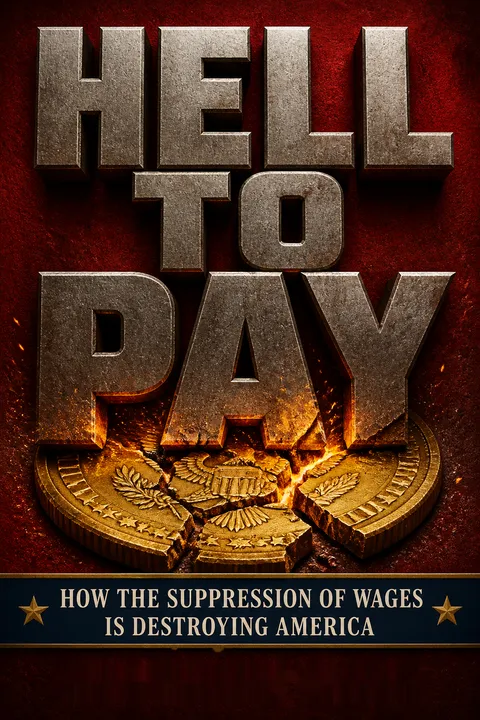
Hell to Pay by Michael Lind examines how wage suppression and worker disempowerment affect American society. Reviews average 3.93/5, with readers praising Lind's well-researched arguments against the "neoliberal elite" and his advocacy for strengthening labor unions and collective bargaining. While some found the book thought-provoking and informative, critics noted it lacked thorough solutions and contained excessive political bias. Readers appreciated his historical analysis and proposals for transitioning from a low-wage welfare system to a living-wage economy, though opinions diverged on his immigration stance.
People Also Read









Glossary
worker power theory of wage determination
Wages reflect bargaining leverageThe account that wages, benefits, hours, and working conditions are shaped substantially by the relative bargaining power of workers and employers. Skills and productivity matter, but pay is not assumed to be an automatic, exact measure of an individual worker’s contribution. Unions, labor laws, and workers’ ability to refuse poor offers can change the negotiated outcome.
global labor arbitrage
Exploiting wage differences across bordersA business strategy that takes advantage of differences in wages, labor protections, or other rules across jurisdictions. Lind identifies two main forms: offshoring production to lower-wage workers abroad, and employing immigrants in the United States on terms that may weaken their bargaining power. The concept focuses on employer incentives and policy, not on migration as a single uniform phenomenon.
fissured workplace
Work divided across contractorsA workplace structure in which a company shifts functions to contractors, vendors, or independent workers rather than employing everyone directly. The lead company can reduce wages, benefits, and regulatory obligations, while responsibility for conditions becomes harder to locate. Workers may continue doing work essential to the business but lose the protections and bargaining position associated with direct employment.
low-wage/high-welfare model
Low pay supplemented by assistanceAn economic arrangement in which employers may pay wages insufficient to support workers and their families, while means-tested public programs make up part of the shortfall. Lind argues that this can help workers avoid destitution yet also enable employers to keep labor costs low. The public supports workers, but the resulting subsidy can indirectly support the business model that underpays them.
living-wage/social-insurance model
Adequate pay plus pooled protectionLind’s alternative to reliance on poverty wages and means-tested aid. Full-time wages should cover ordinary needs, while social insurance protects people against income loss from unemployment, disability, retirement, illness, or caregiving. The model aims to reduce the number of working families who need public assistance and to strengthen workers’ ability to refuse inadequate employment.
credential arms race
Escalating competition for qualificationsThe growing competition to obtain degrees or occupational licenses as employers use credentials to select applicants for a limited supply of stable, well-paid jobs. Credentials can teach real skills and improve an individual’s prospects, but their wider proliferation can raise the time and money needed to compete without creating more good jobs. Lind presents this as a costly substitute for stronger collective bargaining.
cascade effect
Economic strain spreading into societyLind’s account of how weak wages, insecure work, and costly credential competition can aggravate problems beyond the workplace. He links these conditions to delayed family formation, social isolation, deaths of despair, identity-based status competition, and political polarization. The term describes a chain of possible influences, not a claim that economic insecurity is the sole cause of these complex outcomes.
national developmentalism
State support for national productive capacityA policy approach in which government actively supports domestic industries, infrastructure, technology, and productivity in pursuit of broad national goals. Lind traces an American version through Hamilton, Clay, Lincoln, and the New Deal. It contrasts with a system in which public policy primarily enables multinational firms and investors to move production toward lower-cost labor.
mixed trade
Different rules for different sectorsLind’s proposed trade approach, which rejects both unrestricted free trade and blanket economic isolation. It combines selective protection for strategic industries, freer exchange in some commodities, reciprocal agreements between economies with more comparable conditions, and managed trade shaped by diplomatic or security considerations. The intended purpose is to preserve productive capacity while maintaining international exchange.
sectoral bargaining
Negotiation across an industryCollective bargaining in which labor and employer representatives negotiate standards for an entire industry or sector, rather than separately at each workplace. Lind proposes it for concentrated industries, infrastructure, and logistics, where individual workers or establishments may have little leverage. Agreements can cover many workers even when union membership itself is relatively low.
wage boards
Commissions setting industry standardsTripartite or broadly representative commissions that set minimum wages and sometimes other work standards for a particular occupation or industry. Lind favors them for fragmented, low-wage sectors where traditional union organization may be difficult. They can operate at state or local levels and bring worker, business, and public representatives into standard-setting.
social insurance
Pooled protection against income lossA public or government-mediated system that pools contributions to protect people against risks such as retirement, unemployment, disability, illness, and caregiving. Lind distinguishes it from means-tested assistance by emphasizing contributions and earned entitlements. Such programs can strengthen workers’ security and ability to wait for suitable employment, though eligibility must account for interrupted and unpaid work.
About the Author


Download PDF
Download EPUB
.epub digital book format is ideal for reading ebooks on phones, tablets, and e-readers.








