

Key Takeaways
Understand civilization as something first played, not merely built.
Play comes first. Huizinga begins with young animals at play: dogs invite one another with signals, tussle within limits, and clearly enjoy the encounter. Play is therefore not simply a human invention or a tool for practicing useful skills. It precedes human society, then becomes a way people give their shared life shape and meaning.
Culture grows inside it. Language turns experience into images; myth gives those images stories; ritual performs them together. Huizinga traces play-forms into contests, poetry, law, and political life. His claim is not that every activity is secretly a game, but that culture did not develop after play disappeared. Early culture took form through actions that were bounded, rule-governed, and set apart from everyday necessity.
What's powerful here is the reversal of a familiar hierarchy: play is not an ornamental break from serious life, but one way humans create shared meanings. This connects with the idea that conventions let groups coordinate around things that have no physical existence on their own, such as offices, ceremonies, and legal status. The argument is strongest as a lens for understanding how culture is enacted. It is harder to treat as a universal causal account: examples of play-like form do not, by themselves, prove that every institution originated in play.
Protect play's boundaries, because rules make its freedom possible.
A separate world. Huizinga describes play as voluntary activity conducted within limits of time and place, under rules that players accept as binding. It has its own purpose and can absorb people intensely, even when everyone knows it is not ordinary life. A four-year-old playing trains asks his father not to kiss the engine, because the carriages might stop believing in the game. The child understands both the pretend world and the boundary that sustains it.
Order enables freedom. A court, stage, temple, chessboard, or playing field marks off a space where different rules apply. Break the rules and the shared world can collapse. Huizinga calls the person who rejects the game from within a spoil-sport, because that person disrupts the agreement on which play depends.
The boundary is not a cage around play. It is what makes coordinated invention possible. Game design makes this intuitive: a rule limits available moves, but gives each move meaning to the other players. The same logic applies to institutions, where stable procedures make experimentation and trust possible. Still, a rule's existence does not make it fair. A game can be orderly and exclusionary, so the quality of the rules matters as much as the players' willingness to obey them.
Recognize sacred ritual as enacted meaning, not just symbolic theater.
Ritual does things. Huizinga argues that sacred ceremonies share play's bounded space, repeated actions, and special rules. In ritual, however, representation may be more than a picture of an event. Participants can experience the ceremony as making a sacred order present. He cites ancient Chinese seasonal celebrations in which music and dance were believed to help keep nature and harvest in good order.
Belief can be layered. A mask may be made and worn by people who know how it works, while still provoking genuine awe in those who encounter it. Huizinga uses this mixture of knowledge, performance, and emotional conviction to explain why ritual can have a play-like structure without being mere deception. The form resembles a game, but the meaning belongs to the community that performs it.
This approach usefully separates the structure of a rite from the question of whether its participants are sincere. Anthropologists and historians often need that distinction: observable performance can be described without reducing belief to fraud. The comparison also highlights how ritual makes abstract commitments bodily and collective. Its limit is equally important. Calling a ceremony play describes a pattern, not the full experience of faith. A formal resemblance to games cannot establish that worshippers secretly regard their sacred acts as pretend.
Use contests to turn individual excellence into shared honor.
Winning travels outward. Huizinga's agon is a contest in which participants strive to excel under recognized conditions. Victory can bring esteem to the winner, but that honor often passes to the group they represent. The contest matters less for its practical prize than for the public recognition attached to success.
The potlatch makes this visible. In the practice Huizinga describes among Northwest Coast peoples, a host group gives away or destroys valuable goods to demonstrate status. The recipients are expected to answer with a still greater display. The exchange is not simply an attempt to accumulate wealth: prestige depends on giving, challenging, and outdoing a rival. Huizinga connects this logic to ceremonies, poetry, and social obligations, where competition helps bind opposing groups together.
The account anticipates a useful distinction in social analysis: resources can function as instruments of status, not only as things to consume or store. Ritualized competition may circulate wealth and create obligations between groups, while also producing pressure to spend beyond one's means. The pattern is not automatically generous or socially beneficial. Its effects depend on who can participate, who bears the cost, and whether the contest's rules constrain escalation. Honor can bind rivals, but it can also make backing down feel impossible.
Keep conflict rule-bound, or competition stops civilizing anything.
Law can be a contest. Huizinga points to the courtroom's marked space, formal roles, and constrained arguments as features shared with play. He also describes Greenlandic Inuit drum-singing disputes: rivals sang accusations and insults before a community, which judged the performance. Such contests could serve as a way to settle grievances without a conventional court.
War has a limit. Huizinga sees warfare as culturally bounded only when opponents recognize one another as legitimate participants and accept constraints. When a group denies its enemy human standing, or rejects shared rules, combat loses that civilizing form. International law, in his account, depends not only on written agreements but on a willingness to honor them. A contest's rules may limit violence, but they do not make violence harmless or just.
The link between procedure and social peace remains compelling: rules give opponents a way to disagree without making every dispute existential. Legal due process works partly by requiring each side to accept a common forum. But procedural fairness is not the same as substantive justice. A contest can follow its rules while preserving unequal power, and a community's verdict can still punish the wrong person. Huizinga's insight is best read as a condition for civil disagreement, not proof that rule-bound conflict is automatically humane.
Treat riddles, poetry, and philosophy as knowledge performed together.
Questions can be ritual. Huizinga describes Vedic priests testing one another with brahmodya, or sacred utterances about origins and cosmic order. These were not simply brainteasers: knowledge of the answers carried religious weight. He also cites the Toradja of Central Celebes, who held riddling contests during a period associated with the growth of rice, believing the activity helped the crop emerge.
Play shapes thought. Huizinga sees old riddles, poetic exchanges, and early philosophical dialogues as related forms of public challenge. A question demands an answer; the answer can reveal mastery or expose a gap in knowledge. This does not mean philosophy is only a game. It suggests that some intellectual traditions developed through structured encounters where wit, memory, and the ability to answer mattered alongside ideas.
The social setting of knowledge matters: a question can test not only what someone knows, but which assumptions a community accepts. This resembles the value of adversarial debate when participants must make claims explicit and answer objections. Yet competition can reward a clever victory over a truthful account. Huizinga's lineage from ritual riddle to philosophy is suggestive rather than demonstrated by the examples alone. The enduring lesson is less about a single origin than about how performance and audience shape what counts as knowledge.
Hear music and dance as enacted play, not decorative extras.
Some arts happen through action. Music and dance unfold in time, depend on rhythm and repetition, and come alive through performance. Huizinga argues that these features put them close to play. In his discussion of Plato, music and dancing belong to festivals that give people a shared order and respite. Dance, he suggests, is an especially complete form of play because it combines patterned movement with performance.
Art forms differ. A musical performance can be repeated, while a sculpture or building remains materially present after its maker stops working. Huizinga therefore finds the play-element more obvious in music, poetry, and dance than in the plastic arts. He does not deny that art-making can be imaginative or competitive; he questions whether all artistic creation can be explained as play.
The emphasis on performance helps explain why music can create a temporary sense of shared attention without requiring a shared verbal message. Rhythm organizes bodies in time, making coordination itself part of the aesthetic experience. The contrast with sculpture is less decisive: making a durable object can also involve experimentation, improvisation, and play. Huizinga's distinction works best as a difference in how art is encountered, not as a strict division between playful and non-playful art.
Don't mistake organized sport for play when records and profit dominate.
Sport grows more serious. Huizinga traces the rise of organized clubs and matches, especially in nineteenth-century England. Over time, sport gained stricter rules, records, professional training, and public attention. He argues that these systems can weaken the spontaneity and freedom that made play distinct. A professional may be excellent at a game, yet treat it primarily as work.
The same tension appears elsewhere. Huizinga sees competitive records entering commerce and bridge becoming a highly technical activity surrounded by manuals and coaching. In these cases, activity that looks playful can become an intense pursuit of measurable success. His point is not that skill or organization ruins every game, but that a name like sport does not guarantee that the activity still feels like play.
The critique identifies a real tension in modern institutions: formal structure can widen participation and improve skill, while turning performance into a measurable product. Records are useful evidence of excellence, but they can also narrow attention to what can be counted. Huizinga's contrast between amateur and professional risks idealizing an earlier, less accessible version of sport. The sharper test is not whether a game has rules, coaches, or spectators, but whether participants retain meaningful freedom and whether the activity serves ends beyond winning.
Defend fair play against spectacle, propaganda, and group-minded puerilism.
Not every spectacle is play. Huizinga calls puerilism a public mixture of adolescent behavior and brutality: compulsive group display, badges, mass demonstrations, and appetite for crude sensation. It can resemble play without the voluntary spirit or self-restraint that makes play culturally fruitful. He contrasts it with activities such as Scouting, which deliberately uses games to engage young people.
Fair play is an ethical test. A genuine play-community accepts limits and recognizes that the opponent is also entitled to participate. When political groups use game-like rituals to disguise coercion, reject agreements, or treat rivals as enemies to be eliminated, the form of play remains but its integrity is gone. Huizinga's closing warning is that civilization needs more than spectacle: it depends on good faith and restraint.
This distinction remains valuable in an age when political movements can borrow the visual language of sport, ritual, and belonging. Shared symbols can create solidarity, but they can also intensify conformity and make dissent seem like betrayal. The critical question is whether participation is voluntary, opponents retain rights, and rules bind the powerful as well as the weak. Group enthusiasm is not inherently childish or dangerous; Huizinga's diagnosis becomes persuasive when spectacle is joined to coercion and contempt for common limits.
Analysis
Huizinga's most durable contribution is not the claim that every human activity is a game. It is the more careful proposition that culture often takes shape through bounded, patterned activity whose participants understand its rules and invest it with meaning. This makes play a serious object of history. A court, festival, poem, or contest can be examined not only for its practical function, but for the temporary order it creates and the community it gathers.
The argument is strongest when it identifies formal resemblances and follows their social consequences. A lawsuit resembles a contest because it establishes a forum, roles, and procedures. A ritual resembles play because it separates participants from ordinary time and gives actions special force. These comparisons reveal how institutions depend on performance and collective recognition. Huizinga is less convincing when resemblance becomes an account of origin. The examples illuminate possible connections, but they do not establish a single historical path from riddles to philosophy or from contest to law.
His category also stretches. Play is said to be voluntary, yet ritual, war, and social obligation can involve pressure or grave consequences. Calling these play risks confusing structural form with a participant's experience. The distinction between play and false play helps, but it does not settle every case. The book's anthropological vocabulary and broad cultural comparisons also reflect the limits of its era, and its focus on elite European history can obscure other experiences of work, gender, and power.
Still, the ethical conclusion is strikingly modern. Shared rules matter because they require people to limit their own advantage and accept rivals as legitimate. Play is not automatically innocent, nor does it guarantee justice. Its civilizing potential appears when constraints are reciprocal, participation is meaningful, and victory does not cancel the humanity of the defeated. That is why Huizinga's account ultimately speaks less about games than about the conditions under which people can live together without turning every disagreement into war.
Review Summary
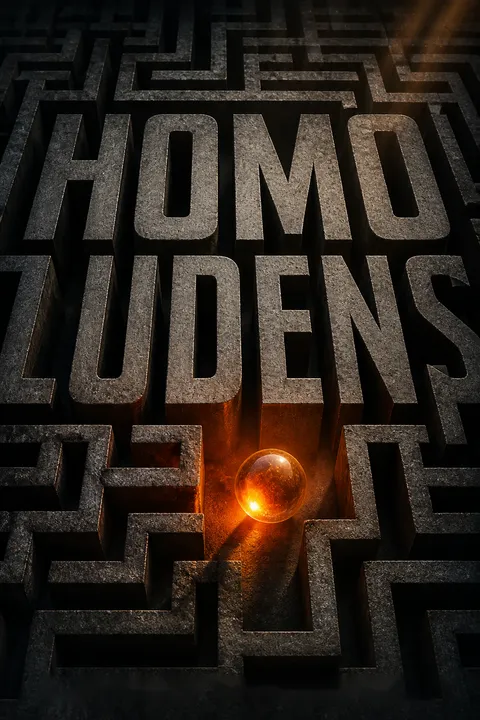
Homo Ludens is a groundbreaking work that explores the role of play in human culture. Readers praise Huizinga's insights into how play shapes various aspects of society, including law, war, and art. Many find the book intellectually stimulating, though some note its dense academic style. The work is seen as paradigm-shifting, offering a new lens for interpreting history and human behavior. While some critics find certain arguments stretched, most agree that the book's central thesis about play's cultural significance is compelling and thought-provoking.
People Also Read

Glossary
Homo Ludens
humanity as playerHuizinga's name for the human being understood as a player, alongside familiar labels that emphasize reason or making. The term expresses his central argument that play is not a minor pastime added to civilization, but a fundamental human activity through which cultural forms arise and develop.
Agon
formal contestA contest or struggle conducted within recognized forms. Huizinga uses the Greek term to discuss competitive activities that seek victory, honor, or public esteem. An agon can be intensely serious and still retain play's structure, especially when opponents accept the contest's rules and recognize each other as legitimate participants.
Play-community
group formed through playA group whose members share the feeling of taking part in an activity set apart from ordinary life. The sense of belonging can outlast the game itself and may be strengthened by distinctive customs, secrecy, or identity. Huizinga uses the idea to explain how play can create durable social bonds.
Magic circle
bounded world of playThe marked space, literal or imagined, within which a game's special rules apply. A court, stage, temple, or playing field can function this way. Huizinga's emphasis is on the boundary's social force: it distinguishes play from ordinary activity and makes a temporary, shared order possible.
Potlatch
competitive ceremonial givingA ceremonial exchange described by Huizinga in which a host gives away or destroys goods to demonstrate status, while recipients incur an obligation to answer with a greater display. The practice connects wealth to honor and rivalry rather than simple accumulation, and shows how competition can organize relationships between groups.
Puerilism
adolescent group spectacleHuizinga's term for public behavior that combines adolescent display with what he regards as brutality. He applies it to mass enthusiasm, group insignia, demonstrations, and sensational entertainment when they lack play's voluntary, self-limiting character. It looks playful, but for him it signals cultural regression rather than healthy play.
FAQ
What's Homo Ludens about?
- Exploration of Play's Role: Homo Ludens by Johan Huizinga examines the fundamental role of play in human culture and civilization. Huizinga argues that play is not merely a leisure activity but a vital component of cultural development.
- Cultural Phenomenon: The book posits that play predates culture and is integral to the development of various cultural forms, including language, law, and art. Huizinga emphasizes that civilization itself arises and unfolds in and as play.
- Historical Context: Huizinga traces the evolution of play from ancient rituals to modern society, highlighting how the perception of play has changed over time.
Why should I read Homo Ludens?
- Understanding Human Nature: Reading Homo Ludens provides insights into the nature of humanity, emphasizing that play is as essential as work and reason. It challenges the notion that serious activities are more valuable than playful ones.
- Interdisciplinary Approach: The book offers an interdisciplinary perspective, connecting play to various fields such as anthropology, sociology, and philosophy, making it relevant for readers interested in understanding human culture.
- Timeless Relevance: Huizinga's exploration of play remains relevant today, encouraging reflection on the importance of play in modern society and its implications for education, creativity, and social cohesion.
What are the key takeaways of Homo Ludens?
- Play as a Cultural Foundation: Huizinga asserts that play is foundational to culture, influencing language, law, and art. He states, "civilization arises and unfolds in and as play."
- Ritual and Play Interconnection: The book emphasizes the connection between ritual and play, suggesting that many cultural rituals originated from playful activities.
- Play's Evolution: Huizinga discusses how the concept of play has evolved over time, becoming more structured and serious in modern society.
What are the best quotes from Homo Ludens and what do they mean?
- "Play is older than culture": This quote underscores Huizinga's argument that play predates human civilization and is a fundamental aspect of life shared by both humans and animals.
- "Culture itself bears the character of play": This statement reflects Huizinga's belief that cultural activities, including art and law, are deeply intertwined with play.
- "All play means something": Huizinga emphasizes that play is not trivial; it carries significance and meaning that transcends mere entertainment.
How does Huizinga define play in Homo Ludens?
- Voluntary Activity: Huizinga defines play as a voluntary activity that is distinct from ordinary life, executed within fixed limits of time and space.
- Rules and Structure: He notes that play operates under a system of rules that participants accept, which gives it structure and meaning.
- Aesthetic Quality: Huizinga highlights the aesthetic quality of play, suggesting that it is characterized by joy, tension, and a sense of freedom.
What is the relationship between play and culture in Homo Ludens?
- Interdependence of Play and Culture: Huizinga argues that play and culture are interdependent, with play serving as a foundation for cultural practices and expressions.
- Play as a Cultural Expression: The book posits that play is a form of cultural expression that reflects societal values and norms.
- Evolution of Cultural Forms: Huizinga discusses how cultural forms evolve from playful beginnings into more serious and structured practices.
How does Huizinga connect play to law in Homo Ludens?
- Legal Proceedings as Play: Huizinga draws parallels between legal proceedings and play, suggesting that lawsuits resemble contests governed by rules.
- Judicial Duel: He discusses the concept of the judicial duel, where the outcome is determined through a contest, reflecting the play element in legal systems.
- Sacredness of Justice: Huizinga argues that the administration of justice retains a sacred quality, akin to play, where the outcome is seen as a divine judgement.
How does Huizinga connect play to war in Homo Ludens?
- War as a Game: Huizinga posits that war has historically been viewed as a game, with rules and structures similar to play.
- Agonistic Nature of War: He emphasizes that war is an agonistic function of society, where combatants engage in a contest for honour and glory.
- Ritualistic Elements: Huizinga notes that many aspects of warfare retain a ritualistic character, reflecting the play element in their execution.
How does Homo Ludens connect play to philosophy?
- Philosophical Origins of Play: Huizinga explores the philosophical implications of play, suggesting that many philosophical inquiries stem from playful questioning and riddle-solving.
- Play as a Method of Inquiry: The book argues that play can serve as a method of inquiry, allowing individuals to explore complex ideas and concepts in a non-linear, creative manner.
- Ritual and Philosophical Discourse: Huizinga highlights the connection between ritualistic practices and philosophical discourse, suggesting that both share a common foundation in play.
How does Huizinga view the evolution of play in modern society?
- Shift Towards Seriousness: Huizinga observes that modern society has shifted towards a more serious and utilitarian view of play, often losing its intrinsic value.
- Play in Contemporary Culture: The book discusses how contemporary culture often commodifies play, turning it into a commercial enterprise rather than a genuine expression of creativity and joy.
- Need for Playfulness: Huizinga emphasizes the need for playfulness in modern life, arguing that it is essential for personal and societal well-being.
What role does ritual play in the concept of play in Homo Ludens?
- Ritual as Sacred Play: Huizinga describes ritual as a form of sacred play that serves to connect individuals with their cultural heritage and community.
- Playful Nature of Rituals: He argues that many rituals have their origins in playful activities, suggesting that the two are deeply intertwined.
- Rituals in Modern Society: The book examines how modern society has largely lost the ritualistic aspect of play, leading to a disconnection from cultural roots.
How does Huizinga differentiate between play and work in Homo Ludens?
- Play as Voluntary Activity: Huizinga emphasizes that play is a voluntary activity, distinct from work, which is often driven by necessity.
- Different Motivations: He notes that while work is typically associated with material gain and obligation, play is pursued for enjoyment and fulfillment.
- Cultural Significance: Huizinga argues that play enriches culture and society, providing a counterbalance to the seriousness of work.
Download PDF
Download EPUB
.epub digital book format is ideal for reading ebooks on phones, tablets, and e-readers.








