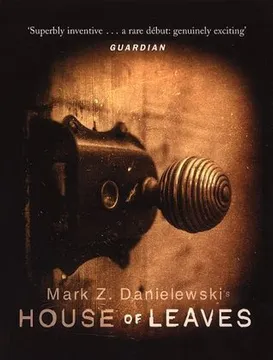


Plot Summary
Prologue
After Zampanô, an isolated blind man, dies in his Los Angeles apartment, Johnny Truant and his friend Lude find his unpublished papers beside gouges torn into the floor. Johnny takes home the papers, which describe a documentary that may never have existed: The Navidson Record.
As he tries to sort its sources from its inventions, he loses hours, withdraws from friends, and begins to fear the dark spaces around him. His account frames the central story, but it also becomes a second story about what happens when reading stops being an observer's act.
The frame establishes two forms of uncertainty at once. Zampanô’s papers may describe an impossible film, while Johnny’s increasingly unstable account makes it hard to distinguish fear from evidence. The blind scholar writes obsessively about images; the young editor, who can see, finds his own perception less trustworthy with every page. Their work becomes an exchange across absence: one man leaves a manuscript, the other gives it a voice, and both are altered by trying to make it coherent. The opening warns that interpretation is not safely outside the story.
The Family Moves In
Photojournalist Will Navidson moves to Ash Tree Lane with Karen Green, his longtime partner, and their children, Chad and Daisy. After years of assignments abroad and separations that have worn down their relationship, he plans to document their quieter life together.
His cameras catch the family arranging furniture and settling in, but also the distance between the adults: Karen watches for Will's return, while he turns domestic moments into images. Chad misses the traffic of city nights and feels uneasy in the countryside silence.
For a time, the move appears to work. The children adapt, the house fills with their belongings, and Will and Karen begin to find tenderness again. Their hoped-for refuge is already carrying the strain they brought with them.
The home movie is both a practical attempt at repair and a defense against loss. Will hopes that filming daily life will make his family permanent, but the camera also lets him observe intimacy instead of fully inhabiting it. Karen’s waiting and Chad’s discomfort register the cost of Will’s earlier absences before the house gives that unease a supernatural form. The word home therefore has two meanings from the outset: a place to settle and a fragile arrangement that must be continually renewed.
The Extra Room
After the family returns from a four-day trip, Will and Karen find an unfamiliar door between their bedroom and the children’s room. Behind it lies a small, smooth-walled black space, though old photographs show that no door was there before.
The motion-sensor cameras recorded no entry or construction. Will measures the rooms against the exterior walls and finds that the interior exceeds the house outside by a fraction of an inch. His twin brother Tom arrives with building tools, and engineer Billy Reston supplies better instruments; both confirm the mismatch.
Karen resists further drilling, while Will keeps testing the measurements. The discrepancy is tiny, but it breaks the assumption that the house obeys the same geometry as the world around it.
The first violation is deliberately small enough to invite correction. Will and Tom respond with better instruments, as though accuracy can restore the shared rules of reality; Karen's resistance recognizes that measurement may verify the danger without making it manageable. The extra fraction matters because it cannot be dismissed as a dramatic illusion. It is ordinary arithmetic failing inside an ordinary home, so the family loses confidence not only in the building but in the methods they use to know where they are.
Echoes Find the Children
A dark hallway appears in the living room, and Chad and Daisy wander inside while playing. Their voices return as unnaturally deep echoes, drawing Will after them; he emerges carrying both children, but Karen remains frozen at the entrance.
Her severe claustrophobia, previously concealed beneath composure, leaves her shaken and clinging to Will. The family locks the passage behind a heavy steel door, yet it grows again. Will later enters alone and finds branching corridors, empty rooms, and distances that shift behind him.
He loses his bearings until Daisy’s voice helps guide him back. The hallway is no longer a harmless anomaly: it has reached into the family’s rooms, exposed Karen’s fear, and shown Will that the house changes when explored.
The hallway turns a structural puzzle into a family crisis. Its echoes make sound a substitute for sight, but the voices do not provide reliable orientation; they intensify the gap between calling and being answered. Karen’s paralysis is not simple cowardice. The dark passage touches a vulnerability she has organized her life around avoiding, while Will’s rescue instinct and appetite for exploration pull in opposite directions. Even Daisy’s voice offers only temporary direction. The house makes dependence necessary, then makes its terms uncertain.
Johnny Loses the Room
As Johnny works through Zampanô’s manuscript, casual curiosity gives way to long stretches of lost time. He stops going out, ignores calls from Lude, and increasingly turns his apartment into a sealed space, nailing windows shut and fixing measuring tapes to the walls. At work in a tattoo shop, he experiences sudden darkness, foul smells, and the conviction that something is behind him, though no one else sees it.
He doubts these episodes even as they multiply. His attraction to Thumper, a stripper who visits the shop, gives him a brief pull toward ordinary life, but he struggles to speak to her as a person rather than an imagined escape. The manuscript is no longer merely an inheritance; it is organizing his days and fears.
Johnny’s enclosure echoes Zampanô’s sealed apartment and the house he is reading about, but the parallel does not prove a supernatural cause. What matters is that interpretation changes his behavior: he measures, barricades, and withdraws, trying to force a stable outline onto fear. His fixation on Thumper reveals the same pattern in another register. He idealizes distance because actual intimacy would require reciprocal knowledge. The manuscript makes this strategy visible while also feeding it, turning the act of reading into a feedback loop.
Holloway Takes the Lead
Unable to investigate safely himself, Will accepts help from Holloway Roberts, a celebrated hunter and expedition leader, who arrives with climber Kirby Hook, known as Wax, and outdoorsman Jed Leeder. Tom and Reston remain at the house, while Karen keeps her distance from the passage. Holloway leads three expeditions deeper into the shifting corridors.
His team maps the first great chamber, discovers an enormous hall and a spiral staircase, and finds that compasses and radios fail as the distance grows. The explorers’ markers and fishing line offer only temporary guidance. Will watches another man name and control the territory of his own house, while Holloway grows increasingly captivated by what might lie beyond the staircase.
Holloway’s arrival replaces domestic improvisation with expeditionary authority. His equipment and confidence reassure the group, but the need to appoint a leader also sharpens Will’s humiliation at being kept outside his own discovery. The house defeats the tools that would normally make exploration cumulative: compass, radio, map, and marker all lose authority. Each trip generates information without producing command. Holloway responds by treating the unknown as a challenge to mastery, a stance that becomes dangerous when the environment refuses to confirm that mastery.
The Staircase Turns Hostile
Before Holloway’s fourth expedition, the team prepares to spend several nights inside, carrying food, water, weapons, and more trail markers. Will stays behind despite his desire to lead, partly to honor Karen’s fear and partly because Holloway insists on command.
During the descent, radio contact fades. Back at the house, Tom keeps watch with jokes and hand-shadow games, while Karen tries to care for the children and discovers that her protective Feng Shui objects have vanished.
Inside, the staircase grows wider, supplies disappear, and the markers are torn apart. Holloway abandons the planned return when he hears the growl, insisting that something must be hunted. Jed and Wax refuse to follow him farther, and the team breaks apart in the dark.
The expedition turns uncertainty into a test of obedience. Holloway's choice to hunt gives the growl a concrete identity, but that certainty is self-authored, not supplied by evidence. Jed and Wax recognize that dwindling supplies and failed markers make retreat necessary; their practical judgment cannot restrain a leader whose self-worth is tied to pressing onward. At home, Karen’s missing objects show that her own modest system of control has failed. The house does not merely disorient explorers; it erases the social and material supports they use to negotiate fear.
The Team Turns on Itself
Alone after Jed and Wax turn back, Holloway becomes increasingly lost and convinced that the growl is stalking him. When the three men meet again near a supply cache, Holloway fires and wounds Wax.
Jed treats the injury and tries to move him toward safety, but Holloway refuses to help, fearing the consequences of his own actions. He vanishes into another corridor. Jed carries Wax through unfamiliar rooms as their equipment and supplies continue to disappear. When Holloway appears again, a second shot kills Jed.
Navidson and Reston, still monitoring the failing radio, hear only fragments of the crisis. Holloway’s tape later records his guilt and terror, then his death in the dark. The expedition has become a catastrophe created by the people sent to map the house.
Holloway’s violence is not a revelation that the house contains a monster; it is a consequence of a leader converting fear into a target. The environment strips away familiar orientation, but Holloway’s choices remain his own: he abandons the team, shoots the people trying to retreat, and cannot recover from the guilt. Jed’s effort to save Wax contrasts with that collapse. The distinction matters because the horror is not purely external. The house creates conditions of extreme vulnerability, while character determines what people do inside them.
A Rescue Signal Answers
After eight days without contact, the family hears a repeating knock from inside the living-room wall. Will treats it as a distress call and prepares to enter with Reston and Tom, despite Karen’s protest. Tom, terrified by the staircase, stays near the entrance to maintain radio contact.
Will and Reston descend, following the remnants of Holloway’s markers. They find Wax badly wounded and Jed dead, then face rifle fire from Holloway in a small chamber. A flash photograph catches Holloway before doors slam between them.
Reston shoots back, but the dark prevents them from reaching the man. The rescuers carry Wax and Jed toward the staircase. Their return is slowed by the house’s changing distances, and the attempt to save the team becomes a new test of whether anyone can get out.
The signal brings the household briefly into one frame, but it does not restore unity. Karen hears the knock as a reason to call authorities; Will hears an obligation that cannot wait. His decision is shaped by his history of witnessing suffering and by guilt he has not yet named. The rescue also changes the film’s perspective: the audience is denied a clear view of the explorers and must wait with Reston at the radio. The structure makes waiting itself an action, burdening those outside the labyrinth with the same uncertainty as those inside.
The Rope Snaps
Tom cannot descend, but he does not abandon his brother. Back at the house, he and Karen assemble a pulley and rope system, allowing the rescuers to lift Wax, Jed’s body, and Reston up the shaft. When Will is being hauled last, the staircase begins expanding beneath Reston, and the rope burns through Will’s hands before snapping.
Tom’s improvised plan has saved the others, but Will is left far below with no working radio and limited supplies. He must find his own route back. At the same time, Tom’s choice marks a change: the brother once dismissed as unreliable has found a practical way to help when courage alone would have failed. The family’s hope now rests on Will surviving without a rescue party.
Tom’s contribution rejects the story that courage belongs only to the person willing to enter the dark. He cannot make himself descend, but he devises a rescue that succeeds until the house changes the terms. The snapped rope converts a useful connection into a severed one, while Will’s isolation exposes the limit of teamwork in a space that continually revises its geometry. Tom’s ingenuity is also a form of care: he accepts his fear without letting it become an excuse to do nothing.
The House Takes Tom
Will eventually climbs back to the house, exhausted and injured, and the family begins evacuating. During the packing, the bedroom walls close in on Karen; Will carries her through the collapsing space and outside. When he reenters to find the children, the floor drops away beneath him. Tom finds Daisy upstairs and carries her toward a kitchen window, where Will pulls her to safety.
Tom cannot make the same crossing. The floor drags him back, and when Will reaches for him, the kitchen opens into a shaft and Tom falls beyond reach. The house’s collapse forces an end to the family’s life at Ash Tree Lane, but it takes Tom’s life in the act of saving Daisy. Chad, already outside, sees his father and sister survive without his uncle.
The collapse turns the house from a place that disorients into one that physically destroys. The family members survive through acts of relationship: Will carries Karen, Tom carries Daisy, and Will reaches back for Tom. The loss is therefore not a simple triumph of courage over danger. Tom’s final movement is the clearest expression of the loyalty he has struggled to show, and it costs him his life. The scene also strips away the fantasy that a family can be repaired merely by sharing a home.
Karen Leaves Virginia
After the evacuation, Karen takes Chad and Daisy to New York while Will remains in Virginia with Reston, trying to understand the house and finish the film. He later joins them only briefly; the separation hardens as Karen refuses to return and Will cannot leave the investigation behind.
Meanwhile, Johnny’s manuscript work grows more consuming. He loses his tattoo-shop job after missing weeks, isolates himself, and experiences episodes of terror and disorientation. His relationship with Thumper offers moments of kindness, but he cannot turn his idealized crush into a steady connection.
When Lude is badly beaten by Kyrie’s wealthy boyfriend, Johnny visits him in hospital, yet soon retreats again into the manuscript. Each strand of the story shows a different cost of being unable to return to ordinary life.
The escape from Ash Tree Lane does not restore the relationships that existed before it. Karen seeks distance to protect herself and the children; Will remains fixed on explanation, as if solving the house could reverse the losses it caused. Johnny repeats the same refusal in a smaller setting, substituting transcription and fantasy for the difficult work of asking others to stay. The parallel is not a claim that their experiences are identical. It is a portrait of how unresolved grief can turn attention into a shelter that gradually becomes another enclosure.
Karen Finds Delial
In New York, Karen edits two short films from the household footage and Will’s photographs. The first gathers outside opinions about the impossible house; the second turns away from it and traces the people Will photographed throughout his career.
As she studies his work, she sees not only his hunger for danger but his attention to people enduring it. Among the images is the Pulitzer-winning photograph of a starving Sudanese child watched by a vulture. Karen finds a name written on the back: Delial.
She realizes that the name Will has repeated in his sleep belongs to the child in the photograph, whose death he witnessed and whose suffering he fears he exploited for an image. Seeing his private burden changes how she understands him and begins to loosen her own resentment.
Karen’s film is an act of looking that differs from Will’s. She does not try to conquer the house with a theory; she studies the person whose habits and absences she had interpreted through her own fear. The photograph’s hidden name makes his guilt legible without making it simple. Will may have documented a tragedy and helped call attention to it, yet the camera could not save the child. Karen’s discovery opens a path toward empathy, but it does not erase the damage between them or guarantee their reunion.
The Samples Tell Time
Will and Reston send fragments from the house’s walls to a Princeton geologist. The samples include ordinary rock types, but the deepest pieces appear to contain meteoritic material billions of years old, perhaps older than the solar system.
The result offers no account of how the house exists or why its passages change. Will continues to treat the data as a problem that can be solved, even as he grieves Tom and remains separated from Karen and the children.
He writes Karen a confused, alcohol-soaked letter explaining that he believes the house is connected to God and admitting what happened to Delial. He leaves Reston’s home soon afterward and prepares to return alone. His scientific inquiry has reached a dead end; grief and compulsion take its place.
The laboratory gives the impossible a measurable surface, but measurement does not produce meaning. The ancient material tempts Will to imagine an origin story, while the missing evidence leaves him with no stable explanation. His letter shifts from data to confession, revealing that the house has become a vessel for guilt about Delial, Tom, and the family he has lost. Returning alone may be a bid for knowledge or self-punishment. The book preserves that ambiguity rather than allowing a diagnosis to settle his motives.
Will Rides Beyond the Map
On April 1, Will enters Ash Tree Lane alone with a bicycle, a trailer of supplies, cameras, film, and a copy of House of Leaves. At first he follows a descending corridor, then discovers that every direction seems to slope downward.
The walls widen and vanish; ceilings rise out of sight, while the growl accompanies each shift. After days of riding, he reaches an abrupt edge and wrecks his bike just short of it. A small structure nearby contains a staircase that changes orientation overnight.
Will climbs through it, crawls through narrowing passages, and eventually finds what looks like a window onto a bright, open landscape. The apparent view offers no exit. Stranded in darkness, he uses his remaining matches to read and burn the book, then records his dwindling strength.
Will’s last expedition removes the familiar goals that shaped his earlier entries. There is no team to rescue, no staircase to map, and no dependable route home. The bicycle turns motion into a trap: every direction carries him farther down. The apparent window offers vision without access, a final version of the film’s central problem. Burning the book collapses documentation and survival into one act. He tries to preserve experience even as the means of recording it consumes the only light he has.
Karen Enters the Dark
After returning to Ash Tree Lane, Karen finds the impossible passage has vanished, leaving an ordinary shallow closet. She stays in the house, writes, tends the garden, and listens for signs of Will. When his clothes, equipment, and tapes reappear in the children’s room, she plays one recording. Behind her, the wall gives way to darkness.
Karen approaches the opening with a flashlight, calls for Will, and steps inside despite the claustrophobia that once stopped her at the threshold. She finds him nearly frozen and curled on the ground. After the light hurts his eyes, she switches it off and holds him. The house dissolves around them, and forty-nine minutes later Karen is seen outside, crying with Will alive in her lap.
Karen’s crossing does not come from mastering her phobia or discovering a reliable map. She enters because her understanding of Will has changed, and because she chooses relationship over the protective distance that once kept her functional. The darkness remains dangerous; love does not make it safe. Instead, her act changes what she is willing to do within it. Her choice answers the opening’s family crisis through action, not explanation, while leaving the house’s nature unresolved.
The Reader Remembers
As Johnny’s notes near their end, Lude’s death leaves him grieving and increasingly unable to trust his own memories. He imagines killing Kyrie’s boyfriend and harming Kyrie, then later reconstructs the event differently: he discarded the bottle, helped the injured man, and watched Kyrie drive away.
The correction leads him to revisit his childhood. His mother’s letters claimed she once tried to strangle him, but Johnny now remembers his father taking her to the institution while she cried for her son.
The sound he had remembered as his father’s roar was his mother calling to him. Johnny leaves his room carrying the manuscript and burns it. The final account does not promise he is cured, but it gives him a memory rooted in grief rather than violence.
Johnny’s revelation is not a clean restoration of truth. His remembered scenes, written fantasies, and his mother’s letters all compete for authority, and the book gives no external witness who can settle every detail. What changes is the emotional meaning of the memory: the imagined murderous mother becomes a distressed parent being taken away, and the remembered roar becomes a call of separation. By refusing the violent version, Johnny recovers a form of agency. His act of burning the manuscript also rejects the notion that only endless interpretation can keep pain at bay.
Analysis
House of Leaves makes the act of knowing part of its horror. Will uses cameras, measurements, and geological samples to turn experience into evidence, yet each method leaves something out: the camera cannot capture the house’s depth, measurement cannot stabilize its dimensions, and scientific dating cannot explain its existence. The failure is not that observation is worthless. Will’s photographs preserve details and communicate feeling, but they cannot substitute for the person who stood beside him or the action he regrets not taking.
The family story gives this epistemological problem emotional stakes. Will’s wish to preserve Karen and the children through film repeats his childhood attempt to secure a world that repeatedly abandoned him. Karen’s camera work becomes different because it attends to Will rather than trying to master the house. Her discovery of Delial does not solve his guilt, but it lets her see the person beneath his professional distance. Tom, meanwhile, demonstrates that care can take forms less theatrical than Will’s bravery: building a pulley, keeping watch, and finding ways to help while afraid.
Johnny’s frame carries the same question into reading. He inherits a text full of contradictory sources and uses it to make sense of his own fractured memories. His notebooks initially intensify his isolation, but his final revision of the story about his mother matters because he stops treating the most violent version as settled fact. The novel does not offer a clean cure or a single authority who can certify truth. It suggests instead that interpretation becomes dangerous when it replaces contact, but can become restorative when it helps a person face another human being more honestly. The house remains unexplained; the meaningful change is in what its survivors and readers choose to do with uncertainty.
Review Summary
Reviews of House of Leaves are sharply divided. Enthusiastic readers describe it as a transformative, haunting experience that lingers long after finishing, praising its innovative structure, layered narratives, and psychological depth. Many find its experimental typography, footnotes, and nested storylines thrilling and uniquely immersive. Critics, however, call it pretentious, self-indulgent, and gimmicky, arguing the unconventional formatting masks a thin, meandering story. Johnny Truant's subplot proves particularly divisive. Nearly all readers agree the book demands significant effort and patience, making it a polarizing but rarely forgettable reading experience.
People Also Read





Characters
Will Navidson
The image-making explorerA celebrated photojournalist, Will is skilled at finding a decisive image in chaos and less skilled at remaining present in family life. His childhood taught him that people can disappear, so photography becomes both his vocation and a way to resist loss. He loves Karen and their children, but his drive toward danger repeatedly competes with the ordinary attention a family requires. Will's confidence is not simple fearlessness; it is a practiced way of moving before uncertainty can stop him. The house draws on that habit, testing whether observation can preserve what action cannot.
Karen Green
The guarded home-builderWill’s longtime partner and the mother of Chad and Daisy, Karen is perceptive, socially agile, and wary of being consumed by another person’s needs. She left a modeling career to raise her children, yet she retains a fierce wish for independence and a deep attachment to Will. Her claustrophobia shapes how she responds to darkness, while her composed smile often hides distress. Karen tries practical rituals and domestic order when events exceed her understanding. Her strength lies less in confronting danger head-on than in noticing what a relationship requires and deciding whether she can meet it.
Johnny Truant
The manuscript's unstable editorA young tattoo-shop apprentice in Los Angeles, Johnny inherits Zampanô’s papers through his friend Lude and begins arranging them into a readable account. He is clever, restless, and quick with invented stories, habits that help him charm strangers while keeping painful memories at a distance. His attraction to women often begins in fantasy, where he can avoid the risks of asking for intimacy. The manuscript unsettles that self-protective performance. Johnny’s voice is funny and candid, but his account is not consistently reliable, and the gap between what he writes and what he remembers becomes central to his character.
Zampanô
The blind, obsessive scholarAn elderly blind man who lives alone, Zampanô produces an immense, unfinished study of a documentary about Will Navidson. He depends on women readers to bring books and texts to him, yet he turns their assistance into a vast intellectual project of his own. His scholarship ranges across architecture, film, myth, and science, mixing genuine research with invented citations and contradictions. Zampanô is both meticulous and disorderly: he pursues precision but never quite closes his arguments. His unseen condition gives his writing about images a peculiar tension, while his solitary habits suggest a life only partly disclosed by the manuscript.
Tom Navidson
Will's easygoing twinWill’s fraternal twin, Tom is an affable builder whose humor and warmth make him easier to approach than his famous brother. He has struggled with alcoholism and drifting work, while Will has built a career around ambition and risk. Their long estrangement leaves affection mixed with resentment, but Tom remains deeply loyal to his family. He is not an explorer by temperament and does not pretend otherwise. His patience with the children and instinct for practical improvisation reveal forms of courage that Will’s more dramatic style can overlook.
Billy Reston
The engineer at the thresholdA paraplegic engineering professor and longtime friend of Will, Reston approaches the house with blunt practicality. His wheelchair gives him firsthand knowledge of how built spaces exclude people, and his engineering training makes him an early check on Will’s measurements. Reston is intellectually curious without needing to dominate the mystery. He supports the explorers from the house, monitors their radios, and often serves as the steady presence others need. His directness and dry humor help him acknowledge danger without turning it into a contest.
Holloway Roberts
The driven expedition leaderA professional hunter and explorer, Holloway arrives with confidence earned through years of dangerous expeditions. He values competence, leadership, and achievement, and he expects those around him to follow his decisions. Beneath his forceful manner lies a powerful need to prove that his life has mattered. The house presents him with a challenge that cannot be mastered through ordinary skill, putting pressure on the identity he has built around control. He is a capable leader in familiar conditions, but the distinction between perseverance and obsession is difficult for him to maintain.
Jed Leeder
The quiet pathfinderA shy outdoorsman from New Jersey, Jed has an exceptional sense of direction and the endurance to keep moving when others tire. He prefers coffee, quiet landscapes, and the company of his fiancée to Holloway’s swagger. On expeditions, he pays attention to practical needs and to the condition of his companions. His modest manner can make him easy to underestimate, but he brings steadiness to a team that often relies on confidence more than judgment.
Kirby Hook
The gifted young climberKnown as Wax, Kirby is a young climber who grew up among mountains and caves and joined Holloway’s team for the experience. He is talented, exuberant, and fond of boasting about drink and romance, though he treats climbing itself with respect. His humor gives him a way to manage danger without pretending it is harmless. Wax’s energy makes him a natural fit for the expedition, even as his youth leaves him reliant on Holloway and Jed’s judgment.
Chad Navidson
The watchful older childWill and Karen’s eight-year-old son, Chad is serious, observant, and unsettled by silence. He misses the city traffic that helped him sleep and often reacts to family stress by withdrawing or wandering. His drawings and behavior register more than he can explain in words. Chad is old enough to recognize danger but too young to understand its cause, so his need for independence repeatedly collides with his need for parental protection.
Daisy Navidson
The fearless younger childWill and Karen’s five-year-old daughter, Daisy meets the unfamiliar house with playfulness and curiosity. She treats spaces as places to inhabit before adults decide what they mean, and she remains closely attached to her father and uncle. Her openness does not mean she is untouched by fear; she responds to the household’s upheaval in ways the adults struggle to interpret. Daisy’s childlike willingness to explore contrasts with Karen’s phobia and Will’s analytical approach.
Pelafina Lièvre
Johnny's absent motherJohnny’s mother, Pelafina is an articulate, affectionate woman whose severe mental illness leads to her confinement at the Whalestoe Institute. Her letters to her son move between lucid care, extravagant praise, fear, and delusion. She wants to remain connected to Johnny, but her illness makes that connection unstable and sometimes frightening. Her writing reveals both the tenderness she can offer and the limits of what either of them can understand about the other.
Lude
Johnny's nightlife companionJohnny’s friend in Los Angeles, Lude is a sociable hair stylist who knows the city’s bars, clubs, and late-night circles. He enjoys sex, drugs, and the stories Johnny tells to entertain strangers. His appetite for immediate pleasure differs from Johnny’s search for meaning, but their friendship is genuine. Lude is often the person who pulls Johnny back toward company, even when he cannot understand the manuscript that is taking his friend away.
Thumper
Johnny's unreturned crushA stripper who visits Johnny’s tattoo shop, Thumper is older than Johnny, candid about her work, and openly engaged with the messy pleasures of life. She is a mother and has years of sobriety behind her. Johnny is drawn to her frankness, but his infatuation makes him idealize rather than know her. Her warmth offers him a possible connection beyond fantasy, while her independence resists the role he has silently assigned her.
Donnie Truant
Johnny's pilot fatherJohnny’s biological father is a pilot whose love of flying leaves a powerful impression on his young son. He is remembered as gentle and calm, especially in contrast with the violence and instability Johnny encounters later. Donnie’s death becomes a defining loss, though Johnny’s memories of it are fragmented and shaped by later stories.
Raymond
Johnny's controlling foster fatherA former Marine who takes Johnny into his household after Donnie’s death, Raymond believes in obedience and control. He is physically intimidating and uses threats and violence to enforce his authority. Johnny’s defiance makes their relationship volatile, but Raymond also provides the environment from which Johnny must learn to escape. His rigid model of strength leaves little room for vulnerability or trust.
Alicia Rosenbaum
The family's real-estate agentThe agent who sells the Navidsons their Virginia home, Alicia is practical and friendly, with a local interest in the house’s history. Karen turns to her for information and later for human comfort. Alicia offers neither a supernatural explanation nor a technical solution, but her ordinary attention gives Karen room to speak.
Audrie McCullogh
Karen's longtime friendKaren’s friend from Washington, D.C., Audrie visits Ash Tree Lane and helps with the bookshelves. She represents companionship beyond the strained couple and offers Karen a familiar social bond while the house becomes harder to discuss.
Plot Devices
The shifting house
Space without stable rulesAsh Tree Lane becomes larger inside than outside, then opens into black corridors, immense chambers, and a staircase whose distances and geometry change. It rejects ordinary tools: measurements conflict, compasses fail, radio signals fade, and markers disappear. Its effects remain concrete even when its cause is unknowable. The house drives the Navidsons’ crisis while resisting the symbolic or scientific explanations characters impose on it. Its rooms work as both setting and antagonist, forcing each person to confront a different limit of control.
The nested record
Story inside storyZampanô’s study describes a documentary made by Will Navidson, while Johnny Truant edits the study and adds notes from his own life. The layers disagree about sources, authorship, and even whether the film exists. This structure makes the reader move between the family’s events and the consequences of reading about them. The manuscript is not a neutral container: its gaps, citations, and errors become part of the action as Johnny tries to assemble it.
Markers and echoes
Fragile navigation signalsThe explorers use fishing line, neon arrows, flares, radios, and sound to map the house. Each device offers temporary guidance, but the shifting passages erase traces and distort communication. Echoes help Will recover a direction during his first exploration, while later static and knocks become the only evidence that people remain alive. The devices turn the house’s resistance to measurement into a sequence of practical consequences: separation, delay, and failed rescue.
Delial's photograph
A hidden name for guiltWill’s famous photograph of a starving Sudanese child and a nearby vulture appears first as a public image of crisis. Karen later discovers the child’s name written on the back of the print. That name clarifies the private grief Will has carried since taking the picture, and it changes Karen’s understanding of his guardedness. The photograph connects his work as a witness to his fear that recording suffering may be inadequate beside the duty to help.
The Whalestoe letters
A mother's fractured archivePelafina’s letters to Johnny preserve an intimate relationship across years of separation and institutional confinement. Their shifting tone moves between affection, instruction, paranoia, and confusion, making them valuable but unreliable records of her life and Johnny’s childhood. As Johnny revisits them, they complicate the memories he has used to explain himself. The letters function as a second manuscript within the first, showing how written evidence can preserve love while also distorting what its reader believes happened.
FAQ
Synopsis & Basic Details
What is House of Leaves about?
- A layered narrative puzzle: House of Leaves is a complex story centered around a mysterious manuscript about a documentary called "The Navidson Record," which details a family's unsettling experiences in a house that defies the laws of physics.
- Exploration of fear and obsession: The book delves into themes of fear, obsession, and the unknown, as characters grapple with the house's impossible dimensions and their own inner demons.
- Intertwined narratives: The story weaves together multiple perspectives, including the manuscript's author, Zampanô, its discoverer, Johnny Truant, and the family at the heart of the documentary, creating a labyrinthine reading experience.
Why should I read House of Leaves?
- Unique narrative structure: The book employs unconventional formatting, typography, and page layouts, creating an immersive and disorienting reading experience that challenges traditional storytelling.
- Psychological depth and complexity: House of Leaves explores the characters' inner turmoil, fears, and obsessions, offering a profound look at the human psyche and the nature of reality.
- Intellectual stimulation and debate: The book's ambiguous nature and open-ended questions invite readers to engage in interpretation and debate, making it a rewarding experience for those seeking a challenging and thought-provoking read.
What is the background of House of Leaves?
- Fictional documentary: The core of the story revolves around a fictional documentary called "The Navidson Record," which is presented as a real film, complete with fabricated interviews and analyses.
- Exploration of media and perception: The book questions the nature of truth and reality in the age of digital media, blurring the lines between fact and fiction, document and artifice.
- Psychological and emotional themes: The story delves into the psychological and emotional impact of trauma, obsession, and isolation, reflecting the characters' inner struggles and their attempts to make sense of the world around them.
What are the most memorable quotes in House of Leaves?
- "This is not for you.": This recurring phrase, found in the foreword, immediately establishes the book's challenging and unsettling nature, warning the reader of the journey ahead.
- "It's freezing in there.": This seemingly simple line, spoken at the end of "The Five and a Half Minute Hallway," highlights the inexplicable nature of the house and its ability to defy logic and reason.
- "The house responds with resounding silence.": This quote emphasizes the house's indifference to human attempts at understanding, highlighting the futility of trying to impose order on the unknown.
What writing style, narrative choices, and literary techniques does Mark Z. Danielewski use?
- Unconventional typography and layout: Danielewski employs a variety of fonts, colors, and spatial arrangements on the page to create a disorienting and immersive reading experience, reflecting the labyrinthine nature of the story.
- Fragmented and unreliable narration: The story is told through multiple perspectives, including Johnny Truant's unreliable narration and Zampanô's academic analysis, blurring the lines between fact and fiction and challenging the reader's perception of truth.
- Intertextuality and metafiction: The book is filled with references to real and fictional works, creating a complex web of allusions and challenging the reader to question the nature of storytelling and the boundaries between reality and fiction.
Hidden Details & Subtle Connections
What are some minor details that add significant meaning?
- The color blue: The color blue appears repeatedly, often associated with the house's strange properties, the characters' emotional states, and even the mundane details of their lives, creating a subtle yet pervasive sense of unease.
- The recurring mention of "Delial": The mysterious name "Delial," which haunts Will Navidson's thoughts, is eventually revealed to be the name of the Sudanese girl in his Pulitzer Prize-winning photograph, highlighting his guilt and the weight of his past.
- The absence of clocks: The lack of clocks in Zampanô's apartment and the house itself emphasizes the characters' disorientation and the breakdown of linear time, reflecting the labyrinthine nature of their experiences.
What are some subtle foreshadowing and callbacks?
- Chad's fear of silence: Early in the film, Chad expresses his fear of silence, stating that "it's like something's waiting," foreshadowing the growing sense of dread and the presence of the unknown within the house.
- Karen's hair: The seemingly insignificant moment of Will removing Karen's hair from a brush foreshadows the themes of loss and the fragility of relationships, as well as the way Navidson values Karen.
- The coffee spill: The scene where Navidson's coffee spills over the rim of his cup foreshadows the house's ability to defy the laws of physics, as well as the way the house will eventually overwhelm the Navidson family.
What are some unexpected character connections?
- Zampanô and Johnny: Despite never meeting, Zampanô and Johnny Truant are connected through the manuscript, with Johnny's life mirroring Zampanô's in many ways, highlighting the cyclical nature of obsession and the power of stories.
- Karen and Holloway: Karen's flirtation with Holloway reveals her vulnerability and her desire for connection, while also highlighting the destructive nature of obsession and the way it can lead to betrayal.
- Will and Tom: The twin brothers' strained relationship is a mirror of the house's own fractured nature, with their eventual reconciliation highlighting the importance of family and the enduring power of love.
Who are the most significant supporting characters?
- Billy Reston: As a paraplegic, Billy Reston provides a unique perspective on the house's physical challenges, while also serving as a voice of reason and a source of support for Will Navidson.
- The various readers of Zampanô: The numerous readers who visited Zampanô during his life, all female, highlight his need for connection and the power of the female voice, while also adding to the mystery surrounding his life and work.
- The various experts: The experts who analyze the house and its effects, from architects to psychologists, provide different perspectives on the house's mysteries, highlighting the limitations of human understanding and the power of the unknown.
Psychological, Emotional, & Relational Analysis
What are some unspoken motivations of the characters?
- Navidson's need for control: Will Navidson's obsession with the house stems from a deep-seated need to control his environment and his own life, a response to his troubled childhood and his inability to maintain stability.
- Karen's desire for independence: Karen Green's fear of enclosed spaces and her flirtations with other men reflect her desire for independence and her struggle to reconcile her need for connection with her fear of commitment.
- Holloway's search for validation: Holloway Roberts's descent into madness is driven by a desperate need for validation and recognition, a desire to prove his worth and overcome his own feelings of inadequacy.
What psychological complexities do the characters exhibit?
- Johnny's identity crisis: Johnny Truant struggles with his own identity, blurring the lines between his life and Zampanô's manuscript, highlighting the power of stories to shape our perceptions of reality and self.
- Navidson's self-destructive tendencies: Will Navidson's obsession with the house and his willingness to risk his life reflect a self-destructive streak, a desire to confront his own mortality and the limits of human understanding.
- Karen's conflicting desires: Karen Green is torn between her love for Will and her need for independence, highlighting the complexities of relationships and the challenges of balancing personal desires with the needs of others.
What are the major emotional turning points?
- The discovery of the hallway: The appearance of the hallway in the Navidson's living room marks a turning point, as it introduces the impossible into their lives and sets the stage for the family's unraveling.
- Tom's death: Tom Navidson's death is a major emotional turning point, highlighting the fragility of life and the devastating consequences of the house's influence.
- Karen's decision to enter the house: Karen Green's decision to enter the house to find Will marks a turning point in her character arc, as she confronts her fears and takes control of her own destiny.
How do relationship dynamics evolve?
- Will and Karen's strained relationship: Will and Karen's relationship is tested by the house's influence, as their individual fears and desires create a growing distance between them.
- The bond between Will and Tom: The twin brothers' strained relationship is ultimately strengthened by their shared experiences in the house, highlighting the enduring power of brotherhood and the importance of family.
- Johnny's isolation: Johnny Truant's relationships with others are strained by his obsession with the manuscript, highlighting the isolating effects of madness and the challenges of maintaining connections in the face of inner turmoil.
Interpretation & Debate
Which parts of the story remain ambiguous or open-ended?
- The nature of the house: The true nature of the house on Ash Tree Lane remains ambiguous, with no clear explanation for its shifting dimensions, its ability to defy the laws of physics, or its influence on those who enter it.
- The meaning of the manuscript: The meaning of Zampanô's manuscript and its connection to Johnny Truant's life remains open to interpretation, with no definitive answer to the questions it raises about reality, perception, and the power of stories.
- The fate of the characters: The ultimate fate of some characters, such as Holloway and Zampanô, remains ambiguous, leaving the reader to ponder the consequences of their actions and the nature of their existence.
What are some debatable, controversial scenes or moments in House of Leaves?
- The nature of the beast: The existence of a creature within the house is left ambiguous, with some readers interpreting it as a literal monster and others as a manifestation of the characters' inner demons.
- Karen's infidelity: The nature and extent of Karen Green's relationship with Fowler is left open to interpretation, with some readers viewing it as a betrayal and others as a symptom of her emotional struggles.
- The ending: The ending of the book, with Johnny Truant's final descent into madness and the ambiguous fate of the Navidson family, is open to multiple interpretations, leaving the reader to grapple with the story's unresolved questions and themes.
House of Leaves Ending Explained: How It Ends & What It Means
- Navidson's final exploration: Will Navidson returns to the house alone, seeking to understand its mysteries and confront his own demons, but his journey ends with his disappearance into the void, leaving his fate ambiguous.
- Karen's escape and transformation: Karen Green manages to escape the house, but her experience leaves her forever changed, as she grapples with her fears and her relationship with Will.
- Johnny's descent into madness: Johnny Truant's journey culminates in a complete loss of his grip on reality, as he becomes increasingly consumed by the manuscript and his own inner turmoil, leaving his fate uncertain and open to interpretation.
Download PDF
Download EPUB
.epub digital book format is ideal for reading ebooks on phones, tablets, and e-readers.








