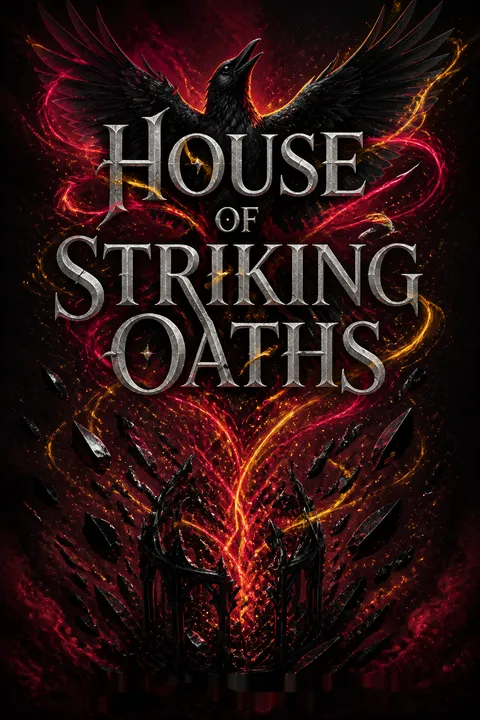


Plot Summary
Prologue
While Fallon1 remains missing, Crow King2 Lore2 studies a vial of blood recovered from the wreckage, hoping it will help the Shabbin sorceress Meriam5 open the obsidian tunnels. His general Cathal6 grieves for his mate7 and daughter,1 while Lore2 refuses to accept that Fallon1 is lost.
Then Bronwen,8 a seer and Cathal’s sister-in-law,8 admits that Meriam5 has used her eyes to watch Fallon1 since infancy. Bronwen8 also confesses that she gave Fallon1 obsidian powder, though she insists Meriam5 directed her to do it. To the furious men, she reveals that Fallon1 needs Meriam5 as much as Meriam5 needs her.
The opening makes absence an active force: Lore and Cathal respond to the missing women by searching, planning, and lashing out at one another. Their grief is not simply private sorrow, since each man’s authority depends on protecting a family he cannot reach. Bronwen’s confession complicates the idea of betrayal before Fallon’s story begins. Her actions have endangered the men’s trust, yet the claim that Fallon and Meriam need each other hints that rescue may require cooperation with the very person the Crows fear. The vial becomes an emblem of their predicament: blood is both evidence of loss and a possible instrument of return.
Wine Cellar Prison
Fallon1 wakes suspended in a cage beneath the ground, separated from her mate, Lore,2 and furious with Bronwen8 for delivering her to Faerie King3 Dante.3 She rocks the cage hard enough to smash the cellar’s bottles and crack its ceiling, forcing Dante3 to come inspect the damage.
The commotion also reveals that her old acquaintance Cato Brambilla,10 now a Faerie sergeant, serves Dante’s3 regime rather than her grandmother. Dante3 orders Fallon’s1 magic released, but insists she will remain a prisoner. He claims her mother, Zendaya,7 is dead and offers a proper burial only if Fallon1 cooperates. Then he makes clear that he wants to marry her, not for affection, but to claim the power in her blood.
Fallon’s first response to captivity is physical disruption. Breaking bottles does not free her, but it forces the people controlling her to react, preserving a small measure of agency in a place designed to erase it. Dante’s promise of magic is inseparable from confinement, revealing his central tactic: offer a desired good while controlling the conditions under which it can be received. The alleged death of Zendaya turns the prospect of power into a threat to Fallon’s family identity. Her anger at Bronwen and grief for Lore are therefore not distractions from the plot. They are the emotional pressure that makes every bargain feel dangerous.
A Crown's Blood Inheritance
As Dante3 marches Fallon1 toward the sorceress5 who can unbind her, he explains that spouses can manipulate Shabbin wives’ blood magic. Fallon1 learns that Justus Rossi,4 Dante’s3 general, is married to Meriam,5 the witch who bound her powers. That makes Justus4 her grandfather by marriage,4 though Fallon1 refuses the relationship.
Dante3 also admits that one of Lore’s2 five crows has become iron after an obsidian attack. Fallon1 believes Gabriele,12 a Faerie ally she urged Lore2 to trust, may have betrayed him. Dante3 says Gabriele12 carried the obsidian weapon into the Sky Kingdom and is now trapped there. To secure Fallon’s1 compliance, he reveals that her friend Antoni11 is imprisoned and will be tortured if she refuses the planned rites.
This section gives Fallon information in deliberately weaponized pieces. Dante does not merely threaten her body; he attacks her capacity to judge the people she loves, making Gabriele’s loyalty and Lore’s secrecy newly uncertain. The marriage rule turns intimacy into political technology, so Fallon’s refusal is also a defense of bodily and magical autonomy. Justus’s unexpected place in her family tree complicates her categories of kin and enemy. Every fact arrives with a cost: knowledge may help Fallon understand the system, but Dante controls when she receives it and what fear accompanies it.
The Thronebound Sorceress
Inside a vault packed with treasure, Fallon1 finally sees Meriam,5 an aged Shabbin sorceress fused to a golden throne. Meriam5 and Justus4 perform a blood-binding between Fallon1 and Dante,3 marking both with linked circles and making Dante’s3 magic dependent on Fallon’s1 blood. Fallon1 resists, but Dante3 uses Antoni’s11 safety to force her hand.
When Meriam5 begins the unbinding, she secretly tells Fallon1 that Zendaya7 is alive and that Meriam5 saved her by hiding her in another form. She explains that her past alliance with the first Faerie king created the wards around Shabbe and helped give the Regio bloodline Shabbin magic. Meriam5 then releases Fallon’s1 power while pretending the spell failed.
The blood-binding literalizes the difference between consent and attachment. Fallon and Dante are connected, but the bond has been imposed through threats, so its intimacy is coercive rather than reciprocal. Meriam’s throne provides a physical image of punishment that has become inseparable from identity: she is both powerful and immobilized by her history. Her secret disclosure shifts the moral landscape without instantly making her trustworthy. Fallon receives the truth while physically restrained and unable to answer freely, so even revelation remains entangled with control. The scene begins her transformation from a prisoner awaiting power into someone who must decide how to use power she does not yet understand.
Eyes Across Obsidian
After Meriam5 collapses from the spell, Dante3 orders Fallon1 kept under guard and plans to use her blood as ink for Shabbin sigils. Justus4 privately warns Fallon1 that he intends to keep her queen of Luce, but his motives remain difficult to read. During her confinement, Fallon1 discovers she can see through Bronwen’s eyes.
In the Sky Kingdom, she witnesses Lore2 alive and physically whole, commanding his Crows despite Dante’s3 claim that the king2 is losing them. Lore2 cannot hear her through the obsidian, but he urges Bronwen8 to help find her. Justus4 later admits that the rebel leader Vance21 is his son and that he and Meriam5 have been disguising their resistance to Dante’s3 rule.
The vision reconnects Fallon to Lore without restoring the bond that captivity has severed. That partial contact matters psychologically: she can witness his existence, but cannot comfort him or correct the misinformation Dante has fed her. Justus’s role likewise resists a simple traitor-or-ally reading. He protects Fallon while acting within a violent regime, using secrecy as both shield and political instrument. His hidden son confirms that opposition is already embedded inside Dante’s power structure. The section’s central tension is epistemic: Fallon gains access to truths, yet she cannot know whom to trust or how much those truths have been altered for strategic effect.
A General's Double
At a forced supper, Dante3 makes Fallon1 feed salt to Antoni,11 whose halfling body cannot easily resist its truth-revealing effect. Antoni11 admits that he wants both Dante3 and Lore2 dead, and imagines Luce governed by a council rather than a king. Justus4 and Meriam5 have arranged a deception: a healer, Dottore Vanche, takes Justus’s4 appearance to draw Dante’s3 suspicion.
Dante3 sees through enough of the scheme to attack the apparent general, while Fallon1 seizes a dagger and wounds Dante’s3 eye. The false Justus4 is transformed back into the dead healer, leaving the real general4 alive but badly exposed. Dante3 orders Fallon1 returned to her cage, and she understands that her captors are hiding more than they admit.
The salt interrogation reveals that Antoni’s political ideals do not cancel his capacity for violence. He wants a new system, but his willingness to remove both rival kings places him outside Fallon’s growing loyalty to Lore. The disguise plot shows how survival in Dante’s court depends on manipulating appearances, yet the deception cannot control every consequence. Fallon’s attack briefly reverses the usual power relation, but it also gives Dante another reason to constrain her. Rather than presenting resistance as clean heroism, the episode shows its compromises: allies lie, prisoners are used as leverage, and an attempt to protect one person can expose another to danger.
The Wrong Man Falls
Justus4 takes Fallon1 to Dante’s3 bedroom, where a dagger is hidden so she can kill the king.3 Dante3 finds the weapon before she can use it and stabs Justus,4 exposing the general’s4 apparent betrayal. Fallon1 grabs the blade and drives it into Dante’s3 eye, then escapes through a wall using a blood sigil.
In the struggle that follows, she sees a figure behind a curtain and thrusts her sword through it, believing she has killed Dante.3 The victim is Cato,10 who had come searching for her. Dante3 survives and recaptures Fallon.1 She grieves over Cato’s10 body, horrified that she killed a man who had tried to protect her, while Lore’s2 voice reaches her through their restored connection.
The mistaken killing fractures Fallon’s emerging confidence. She has been forced to make violent choices under pressure, and Cato’s death makes the cost intimate rather than abstract. Her grief is sharpened by ambiguity: Cato served the system that imprisoned her, yet he also showed her kindness within it. Lore’s presence cannot erase the injury, and his harsher judgment of Cato risks simplifying a relationship Fallon experiences as morally mixed. This turning point challenges the fantasy that power automatically grants clear choices. Fallon can act decisively and still cause the very harm she hoped to prevent.
Lastra's Betrayal Breaks
Back inside the underground estate, Justus4 returns to Fallon1 and reveals that he and the healer had switched places before Dante’s3 attack. He also explains that Dante’s3 iron resistance is failing because Justus4 has replaced the king’s3 supposed immunity treatment with harmless powder. When Justus4 secretly opens a passage, Fallon1 escapes her cell and uses blood sigils to free Antoni11 from his chains.
She then creates waves across the ceiling above the tunnels, drawing the ocean through the obsidian structure. Justus4 fights the guard Lastra, who tries to seize power and kill him. The flooding breaks the underground prison apart, forcing Fallon,1 Justus,4 and Antoni11 to escape through the rising water.
Justus’s concealed resistance is finally made legible through action rather than assurances. He risks his position and his life, but he still speaks of keeping Fallon on the throne, reminding her that his loyalty includes political ambition. Fallon’s magic changes from a secret liability into a practical tool: she opens barriers, frees Antoni, and destroys the architecture that made her captivity possible. The flood is not simply spectacle. It reverses the prison’s logic, turning its protective stone into a source of collapse. At the same time, the escape remains collective and fragile, dependent on trust among people who have only recently learned how to trust one another.
The Serpent Beneath
Fallon,1 Justus,4 and Antoni11 emerge into Mareluce, where Lore2 and the Crows have been searching. Lore2 reaches Fallon1 in shadow form, furious that she risked herself but relieved to have her back. Justus4 tells Cathal6 that Zendaya7 survived because Meriam5 transformed her into a mareserpens and hid her in the ocean.
Fallon1 realizes that the giant pink serpent Minimus,7 her childhood companion, is her mother.7 She also learns that Meriam’s5 spell linked the lives of herself, Zendaya,7 and Fallon,1 and that Zendaya7 cannot return to human form until the Cauldron is accessible. The family’s reunion is therefore incomplete: Fallon1 has found her mother,7 but the curse still holds her beyond reach.
The revelation that Minimus is Zendaya retroactively alters Fallon’s memories of childhood care. The serpent was not merely a magical friend but a mother who remained present in a form Fallon could not interpret. This makes recognition a process of revising the past, not simply receiving a new fact. The three-way life tether deepens that revision by binding survival to responsibility: Fallon cannot kill Meriam without killing Zendaya, and she cannot treat the sorceress as a disposable enemy. The reunion with Lore restores emotional contact, but it does not solve the family’s separation. Love becomes a reason to continue the political struggle rather than an escape from it.
The Iron Crow Retrieved
Lore2 tells Fallon1 that one of his crows lies at the bottom of Filiaserpens, too deep for ordinary rescuers to reach. He wants to wait for help from Shabbe, but Fallon1 uses her mother’s7 guidance and her own Shabbin magic to descend into the trench. She strings together jewels and an abandoned fishing cage to make a retrieval line, then reaches the crow near a submarine volcano.
The heat and depth cloud her judgment, and she becomes dangerously confused as her gills begin to fail. The cage catches the iron bird,2 but the chain traps Fallon1 as well. Zendaya7 swims into the trench and carries her daughter1 back toward the surface with Lore’s2 crow still enclosed.
Fallon’s descent is an act of devotion, but also a return to her most dangerous habit: treating risk as proof that she can solve a crisis alone. Her ingenuity with the fishing cage turns scavenged objects into a rescue device, yet the same improvisation becomes a snare. The scene refuses to equate courage with sound judgment. Lore’s fear is warranted, and Fallon’s insistence that she is immortal does not protect her from bodily limits. Zendaya’s intervention then gives the mother-daughter relationship a material form: she saves Fallon with the same body that has sheltered her for years.
A Crow Returned Whole
On the shore, Fallon1 burns away the wooden arrow shaft lodged in Lore’s2 iron body and pushes the obsidian tip through with a metal skewer. Lore2 returns to his full form, and Fallon1 receives the Crow feather inked beneath her eye. Back at the Sky Kingdom, Justus4 explains why Lore2 cannot kill Dante:3 the Regio line carries Shabbin magic, and a Crow killing one of Mara’s descendants would lose humanity.
The Cauldron has also shut itself off until Dante’s3 line ends. Meanwhile, Cian9 chooses to become a forever-Crow after Bronwen’s8 death, and Antoni11 returns seeking an audience with Lore.2 Fallon1 refuses to trust his ambition, but Lore2 hears him out and lets him leave alive.
Restoring Lore’s body does not restore an uncomplicated future. Fallon’s careful removal of the obsidian point is a tender counterpoint to the violence that caused it, but the curse explains why she must carry the burden of killing Dante herself. Cian’s choice demonstrates the personal cost hidden inside the term forever-Crow: grief has made ordinary life feel less bearable than surrendering humanity. Antoni’s survival introduces a different model of political compromise. Lore can spare a rival without trusting him, while Fallon learns that protecting her mate does not require endorsing every method he uses.
Glace's Stolen Stone
The Crows need the runestones held by Glace and Nebba to open Shabbe’s wards, so Fallon1 joins Lore2 and Cathal6 on the journey north. Before they leave, she sees through Bronwen’s eyes and witnesses a vision of herself standing over Princess Alyona’s18 body with a Glacin dagger.
In Glace, King Vladimir19 initially seeks an alliance through marriage, but Fallon1 rejects the idea of offering herself or Lore2 to his family. Before they can inspect the runestone, Bronwen8 senses it has vanished. Alyona18 is found and admits she gave the stone to Tavo,13 the Lucin general, hoping to protect Faeries from the Crows. Vladimir19 orders his people to pursue her sister and recover it.
The prophecy places Fallon under suspicion before she has acted, making self-knowledge feel dangerously close to self-fulfilling violence. Her refusal of Vladimir’s marriage bargain asserts that political alliance cannot legitimately claim her body, even when the goal is strategically important. Alyona’s theft complicates the simple division between ally and enemy: she believes she is protecting her people, though her fear rests on false stories about Shabbe. The missing stone turns diplomacy into a race, while the vision presses Fallon to question whether foreknowledge can guide action without becoming an excuse for it.
The Ship of Iron
Fallon1 and the Crows pursue Tavo’s13 vessel across the Northern Sea, but its concealed weapons fire pellets of obsidian. Colm and Fionn are struck and become stone, while Gabriele12 is badly injured in the attack. Fallon1 boards the tilting ship to reach her friends, and Lore2 finally stills the storm when he realizes she is on deck.
The Crows kill the remaining crew and find no runestone aboard. Justus4 uses hidden Shabbin crystals to heal Gabriele12 and help Fallon1 revive Colm and Fionn by removing the pellets. A captured sailor reveals that Tavo,13 Dante,3 and Meriam5 are still in Glace, and that the runestone never left the kingdom.
The ship battle transforms the Crows’ symbolic vulnerability into a tactical one. Obsidian is not merely the material that keeps them from reaching Shabbe; in pellet form, it can stop a living person mid-flight. Fallon’s choice to board the ship shows how care for companions repeatedly overrides her own safety, while Lore’s storm demonstrates the danger of trying to protect her through force. Justus’s concealed crystals provide a countermeasure, but their scarcity makes rescue dependent on preparation and secrecy. The failed search raises the stakes: the enemy has not fled, and the next encounter will happen on terrain chosen by Dante.
The White Fang Trap
Gabriele12 recalls the ice caves beneath the White Fang, and the Crows fly there to find Dante’s3 party. Just as they approach, Fallon1 suffers sudden pain through the life-tether joining her to Meriam.5 The flying group loses control and plunges into the valley. Fallon1 wakes chained in the cavern beside Bronwen,8 while Lore2 has been turned to iron and the other Crows to stone.
Dante’s3 soldiers wear his face, concealing their identities and making the assault harder to read. Tavo13 reveals that he used Meriam’s5 blood to create the disguise spell. Dante3 intends to make Lore2 kill Fallon,1 believing her death will destroy Meriam5 and end the threat of Shabbin magic.
Dante turns the intimate bond meant to restrain his magic into a weapon against Fallon’s body. The fall from the sky externalizes the loss of agency: the Crows’ defining freedom of movement becomes the means by which they are captured. The identical faces of the soldiers extend that disorientation, making individual identity difficult to trust at precisely the moment when loyalty matters most. Dante’s plan depends on treating Fallon as a switch that can be thrown to control both Meriam and Lore. The scene exposes the political logic of his cruelty: he does not seek merely to defeat his enemies, but to make their relationships perform the violence for him.
Bronwen's Last Vision
Fallon1 learns that Dante3 plans to use Lore’s2 iron beak to kill her and make him lose his humanity. Before the soldiers can carry out the execution, Tavo13 murders Bronwen8 with an iron sword, despite her long service to their cause. Fallon1 uses her blood to dissolve her chains and turn invisible, then escapes the altar as the guards search for her.
She wounds several soldiers and tries to reach Meriam,5 whom Tavo13 is dragging toward Lore’s2 beak. Gabriele12 arrives and uses wind magic to stop Tavo13 from completing the sacrifice. His intervention gives Fallon1 a chance to attack, but it also places him between Tavo’s13 weapon and Meriam.5
Bronwen’s death turns her visions from a source of forewarning into an unfinished inheritance. Fallon cannot ask whether the seer predicted her own end or whether her choices altered it; she must respond to what is happening now. Invisibility gives Fallon an advantage, but it also isolates her, making her dependent on sound, timing, and others’ perception. Tavo’s assault on Meriam recreates the structure of coercion that has defined the book, with a woman’s body positioned as a tool for controlling magic. Gabriele’s intervention shifts the scene from concealment to open sacrifice, forcing Fallon to act before she can make sense of the loss around her.
The King On Ice
Gabriele12 knocks Meriam’s5 throne away from Lore,2 but Tavo13 kills him with the iron sword. Fallon1 tackles Tavo,13 pins him onto Lore’s2 beak, and drives the blade through his heart. Justus,4 who has been fighting through the cavern, offers Fallon1 his sword and holds Dante3 down.
Fallon1 looks the king3 in the face and kills him, ending the bloodline that carried Meriam’s5 stolen magic. The loss of Dante’s3 life releases the curse that held Lore’s2 Crows in iron and stone. Fallon’s1 victory is immediate, but the cavern remains full of bodies, including Bronwen8 and Gabriele,12 and the cost of the victory leaves her unable to celebrate.
The climax gives Fallon the choice Dante has tried to deny her throughout the book: she is the one who decides when violence is used and against whom. Yet control does not make killing emotionally clean. She acts to stop Tavo and end Dante’s regime, but the dead remain present, refusing a triumphant reading of victory. Justus’s sword links the act to the fragile alliance they have built, while Lore’s iron body makes the stakes physically visible. The release of the Crow curse is a consequence of Dante’s death, not a reward that can compensate for Bronwen and Gabriele.
The Wards Give Way
With Dante3 dead, Meriam5 reunites the broken runestone pieces and draws their stored blood back into herself. The ground shakes, then steadies. Lore2 calls to his Crows, and those still trapped in Shabbe return to Luce, while Fallon1 discovers she can shift into a Crow and speak their language.
In the aftermath, Cian9 chooses to leave his human life behind and become a forever-Crow so he can follow Bronwen.8 Lore2 asks Fallon1 to marry him, and she accepts. The victory does not erase grief: Fallon1 helps Cian9 release Bronwen’s8 ashes into the sky, and Cathal6 remains separated from Zendaya7 until the Cauldron can restore her. The family sets out for Shabbe, carrying hope into an uncertain reunion.
The lifting of the wards resolves the political architecture of the conflict, but the return of Crowkind is paired with losses that cannot be reversed by magic. Fallon’s new ability to fly completes a long desire for belonging, yet Cian’s transformation shows that belonging can also require surrendering an earlier self. Her engagement to Lore offers a freely chosen bond after Dante’s coercive one, distinguishing intimacy from possession. Cathal’s hope for Zendaya prevents the ending from becoming a sealed resolution. The book closes with a world newly connected, but with healing still dependent on what the Cauldron can restore.
Epilogue
In Shabbe, Lore2 introduces Fallon1 to Queen Priya,22 who agrees to use the Cauldron first for Zendaya.7 Cathal6 brings the serpent7 from Mareluce and releases her into the magical vessel. Zendaya7 emerges in human form, but with black serpent eyes and a pearl-like mark on her forehead.
She cannot yet speak or recognize the people around her, though she reaches for Fallon’s1 hand. Cathal,6 unable to hear or understand her, flies away in grief. Lore2 holds Fallon1 as she watches her mother7 return changed, and privately warns Cathal6 that he must come back to his daughter.1
The epilogue makes restoration deliberately incomplete. Zendaya returns from the Cauldron, but her changed eyes and inability to communicate resist the simple fantasy that recovering a body also recovers a person’s former life. Fallon recognizes her mother through touch and choice rather than through familiar speech. Cathal’s flight shows how hope can reopen grief instead of closing it. Lore’s final appeal to him reflects the book’s larger concern with the obligations that survive catastrophe: love cannot compel healing, but it can ask someone not to abandon the living while they mourn the changed.
Analysis
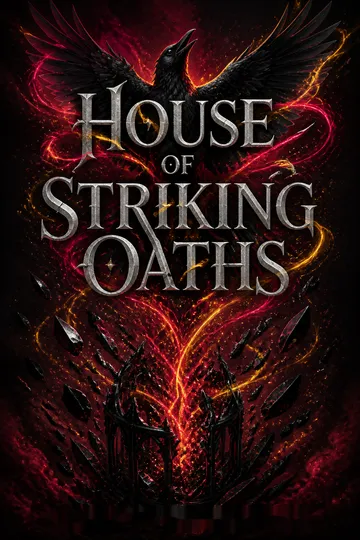
House of Striking Oaths treats magic as a politics of access. Blood, stone, marriage, and prophecy each determine who can cross a boundary, command another person, or claim authority over a future. Fallon’s1 captivity is therefore not only physical: Dante3 wants to control the meaning of her blood, while others sometimes decide what she should risk for the cause. Her resistance becomes most consequential when she learns to make magic herself and chooses whom to save, even when her choices carry real costs.
The novel also distrusts clean divisions between loyalty and betrayal. Justus4 serves Dante3 while undermining him; Cato10 obeys the regime while showing Fallon1 care; Antoni11 opposes monarchy yet wants Lore2 dead; Meriam5 has harmed generations and still tries to repair what she helped create. These contradictions prevent the political conflict from becoming a simple contest between good people and bad institutions. The characters must judge actions, not labels, and Fallon’s1 changing trust is part of her education in power.
Romance offers a countermodel to the blood-bind. Dante3 treats connection as ownership and uses marriage to command Fallon’s1 magic. Lore’s2 relationship with her is intense and jealous, but the story gives Fallon1 room to disagree, choose, and set limits. Her final engagement matters because it follows her refusal of coerced unions and her own return to Lore.2 Even so, love does not erase the book’s losses. Bronwen8 and Gabriele12 die, Cian9 relinquishes his human life, and Zendaya’s7 return is incomplete. The ending insists that victory can change the conditions of a society without restoring everyone to the life they wanted. Fallon’s1 new power is thus not a reward for suffering so much as a responsibility to act without pretending that courage makes anyone invulnerable.
Review Summary
House of Striking Oaths received mixed reviews, with an overall rating of 4.01 out of 5. Some readers loved the book's action, reveals, and character development, praising Fallon's growth and the satisfying conclusion. However, others found the pacing slow, criticized the abundance of information dumps, and felt the ending was rushed. Common complaints included confusing world-building, inconsistent character behavior, and modern dialogue clashing with the fantasy setting. Despite divisive opinions, many readers remained invested in the series and looked forward to potential spin-offs.
People Also Read



Characters
Fallon Báeinach
The stubborn curse-breakerFallon is a young woman raised by a human grandmother and a Faerie mother7, with a Crow father6 and an unexplained connection to Shabbin magic. Her irreverence and quick improvisation often protect her, but her instinct to act before she has a plan repeatedly places her and her friends in danger. She is fiercely loyal to Lore2, her preordained Crow mate, and to the friends who have made a home for her in Luce. What drives her is not a desire to rule, but a wish to keep those she loves from being used as leverage. Her growth depends on learning that courage includes judgment, patience, and accepting help.
Lorcan Ríhbiadh
The storm-bound Crow kingLore is the ruler of the Crows, a powerful shifter who can become smoke and command the sky. He is fiercely protective of Fallon1, whose place as his mate gives their relationship both tenderness and a source of acute vulnerability. His long experience of war makes him strategic, suspicious, and capable of frightening violence, though his deepest commitments are personal: his people, his family, and Fallon’s1 safety. He tends to carry pain as responsibility, which can become controlling when he fears losing someone. His relationship with Fallon1 tests whether protection can coexist with her independence. He must act as king without allowing grief or jealousy to dictate every decision.
Dante Regio
The possessive Faerie kingDante is the reigning Faerie king, raised within a dynasty built on political calculation and inherited power. His history with Fallon1 began in affection, which makes his later efforts to possess her feel especially intimate and violating. He seeks to secure Luce and extend his rule by controlling magical blood, strategic marriages, and the people he can use as hostages. Beneath his confidence is a fear of losing authority, which he converts into cruelty rather than examining. Dante’s capacity for charm does not soften his ambition; it makes his manipulation more effective. He treats loyalty as something owed to him and sees other people’s autonomy as an obstacle to his security.
Justus Rossi
The double-dealing generalJustus is an ancient Faerie general whose austere bearing conceals a history more complicated than Fallon1 first believes. He understands military power, bargains, and the value of appearing more loyal than he is. His relationship with Meriam5 gives him access to Shabbin magic and knowledge, while his connection to the Rossi family ties him to the regime he helps undermine. He is not an uncomplicated rescuer: his plans are secretive and often involve making decisions for Fallon1. Yet he values family and shows care through practical intervention rather than easy reassurance. His challenge is to reconcile political ambition with a genuine wish to protect the people he has come to regard as his own.
Meriam
The thronebound sorceressMeriam is a Shabbin sorceress whose magic helped shape the political barriers dividing Luce and Shabbe. She has survived centuries of imprisonment, physical transformation, and the consequences of loving the wrong ruler. Her stillness on the throne masks a mind capable of intricate bargains and long strategy. Meriam is neither a simple villain nor an uncomplicated ally: she has caused immense harm, but also works to repair it through Fallon1. Her relationship with Fallon1 begins under coercion and secrecy, making trust difficult even when Meriam tells the truth. She is driven by the desire to undo the damage she helped create and by an enduring attachment to her daughter7.
Cathal Báeinach
Fallon's grieving fatherCathal is a Crow general and Fallon’s1 biological father. His immense physical presence and blunt temper conceal a grief that has shaped his life since he lost Zendaya7. He thinks in terms of duty and protection, but those instincts can harden into impatience when the people he loves are endangered. Cathal has a close bond with Lore2, whom he treats as both king and brother, and he is fiercely protective of Fallon1 even when she resists his plans. His story is defined by the tension between enduring loss and continuing to hope. He wants his family restored, yet must recognize that love cannot dictate what another person is ready to become.
Zendaya
The mother beneath scalesZendaya is Fallon’s1 Shabbin mother and Cathal’s6 mate. Her past is bound to the conflict between Shabbe and Luce, as well as to Meriam’s5 choices and the danger surrounding Fallon’s1 birth. For much of Fallon’s1 life, she is present in a form her daughter1 cannot recognize, offering care through instinct and action rather than language. Zendaya’s character is shaped by endurance: she survives separation, violence, and a transformed existence without losing her connection to her child. Her eventual relationship with Fallon1 must be built from the fragments they can share, rather than from an imagined return to the family life they were denied.
Bronwen
The dangerous seerBronwen is a Shabbin seer and Cathal’s sister-in-law8, able to witness events through another person’s eyes. She believes the Cauldron’s visions point toward a necessary destination, even when the route is painful. That conviction makes her both valuable and difficult to trust, especially when she withholds information or manipulates events for what she sees as the greater good. Her bond with Cian9 gives her a private source of tenderness beneath her stern certainty. Bronwen is driven by a wish to protect her people and fulfill prophecy, but her methods raise the question of whether saving a future can justify depriving others of choice in the present.
Cian
Bronwen's devoted mateCian is Cathal’s brother9 and Bronwen’s8 mate. He is loyal, protective, and deeply attentive to her, often supporting her even when he does not fully understand her visions. His bond with Cathal6 carries the ease and strain of family shaped by war. Cian’s devotion can make him willing to follow Bronwen8 into danger, but it also gives him a perspective grounded in emotional consequence rather than prophecy alone.
Cato Brambilla
The torn-hearted sergeantCato is a Faerie sergeant who once belonged to the life Fallon1 knew through her grandmother. He remains in the service of the Lucin Crown, even though his history gives him personal ties outside the regime. Cato is courteous and attentive, and he tries to shield Fallon1 from immediate harm while still obeying orders that keep her confined. His divided loyalties reflect the difficulty of choosing between an oath, a political institution, and the people one cares about.
Antoni Greco
The ambitious sea captainAntoni is Fallon’s1 halfling friend, a sailor and strategist who distrusts both Faerie and Crow rule. He has helped the Crows while imagining a different political future for Luce, one led by a council of learned people. His affection for Fallon1 is real, but it does not place him on Lore’s2 side. Antoni is resourceful and politically ambitious, with an instinct for survival that can look like betrayal to those who expect simple allegiance.
Gabriele Moriati
The compromised Faerie allyGabriele is a Faerie friend of Lore2 and Fallon1 whose loyalties become difficult to read during the conflict. He is willing to accept danger for the people he considers his allies, even when his choices create suspicion. His close friendship with Dante3 and his political position leave him caught between personal bonds and the demands of war. Gabriele’s easy manner can disguise how much risk he is prepared to take.
Tavo Diotto
Dante's ruthless generalTavo is a Lucin general who carries out the most dangerous parts of Dante’s3 military strategy. He is practical, ambitious, and comfortable with cruelty when it serves his understanding of victory. Unlike Dante3, who wants the authority of kingship, Tavo often appears most at ease in the role of enforcer. His ability to improvise makes him a formidable threat, especially when he can exploit the confusion of battle.
Sybille
Fallon's fierce confidanteSybille is one of Fallon’s1 closest friends, a sharp-tongued companion who offers humor, frank advice, and practical loyalty. She is outspoken and emotionally perceptive, though she often disguises concern with teasing. Her relationship with Fallon1 gives the heroine a connection to ordinary friendship beyond kings, prophecies, and magic. Sybille’s own intimate life is changing, but she remains a steady presence in Fallon’s1.
Phoebus
The affectionate truth-tellerPhoebus is Fallon’s1 other closest friend, a warm and flamboyant companion who uses jokes to soften fear without pretending that danger is harmless. He is emotionally generous and quick to defend the people he loves, though he can be uncertain in his own romantic life. His friendship with Fallon1 offers a place where she can be ridiculous, vulnerable, and loved without being treated as a political symbol.
Aoife
The loyal Crow sisterAoife is a Crow shifter and a close friend to Fallon1, known for her directness and powerful attachment to her sister, Imogen17. She is loyal to the people she loves and brave enough to act when they are threatened, though her urgency can lead her into difficult situations. Her friendship with Fallon1 develops through shared danger and the trust required to carry one another through it.
Imogen
The guarded Crow fighterImogen is Aoife’s sister17 and a Crow fighter whose composure often contrasts with Aoife’s16 more openly expressed emotion. She is observant, disciplined, and protective of her family. Imogen’s reserve does not signal indifference; it is a way of keeping control in a world where visible fear can be exploited.
Alyona
The Glacin princessAlyona is a Glacin princess raised within a royal family that treats marriage and alliance as matters of state. She is proud, perceptive, and uneasy with the future her father19 is arranging for her. Her feelings about Dante3 and the Crows are shaped by rumor, fear, and the limited choices available to a royal woman. Alyona is more than a bargaining piece, though the people around her often treat her as one.
Vladimir
The cautious Glacin kingVladimir rules Glace, a kingdom insulated by its climate and wary of the magical societies beyond it. He loves his children but sees strategic marriages and political concessions as ways to protect their future. His caution makes him hard to persuade, though he is capable of revising his position when the cost of inaction becomes clear.
Konstantin
The dutiful Glacin heirKonstantin is Vladimir’s heir20 and Alyona’s brother20. He is disciplined and loyal to his family, but his affection for his sister18 sometimes conflicts with the expectations of royal duty. He approaches outsiders cautiously and values order, yet can recognize when a political demand has crossed into personal injustice.
Vance
The hidden rebel leaderVance is a human rebel leader whose work challenges the rule of the Faeries. He is Justus Rossi’s son21, though he lives outside the general’s4 public family history. Vance’s presence shows that resistance to the monarchy is not limited to Crows or Shabbins. His independence and willingness to organize against a stronger regime place him at the center of a human political struggle.
Priya
The Queen of ShabbePriya is the Queen of Shabbe and the great-grandmother of Fallon1. She governs a society shaped by its separation from Luce and carries the authority of a long matriarchal tradition. Her decisions matter not only because of her title, but because the Cauldron and the future of Shabbe are bound to her family. She is careful with power and expects those seeking access to it to understand its cost.
Mattia
The practical halfling allyMattia is a halfling ally of the Crows and a friend to Antoni11. He is useful in the political and military work of rebuilding Luce, with loyalties shaped by his own community as well as by his companions.
Lazarus
The Crow kingdom's healerLazarus is a healer trusted by the Crows. He treats injured allies and carries knowledge of the magical materials and customs that shape their lives. His role is practical, but his care helps keep the group’s fighters and friends alive.
Plot Devices
Blood sigils
Magic drawn into matterShabbin magic is activated through blood shaped into particular symbols. Sigils can open passages, conceal people, alter size, create light, or draw the ocean through stone. Their effects depend on the symbol, the person’s blood, and the surface receiving it. Fallon’s1 growing ability to use sigils turns her wounds from signs of victimhood into tools, but blood magic also carries risks: it can expose her, drain her, or endanger people whose blood mixes with obsidian. The device makes magic concrete and procedural, so power depends not just on lineage but on knowledge, practice, and the ability to act under pressure.
The blood-bind
A coerced magical tetherMeriam5 binds Fallon1 and Dante3 through a Shabbin ritual, marking their palms with linked circles. The rite makes Dante’s3 magic dependent on Fallon’s1 blood and secures a connection that neither of them chose. Justus4 supports the ritual because he believes it limits Dante’s3 power, but Fallon1 experiences it as another violation of her autonomy. The blood-bind also sets up the central danger of the final conflict, since Meriam5, Zendaya7, and Fallon1 are tied together through their magic. The device distinguishes a magical bond from a loving relationship: connection alone does not create consent, trust, or mutual care.
Obsidian and iron
Weapons against shiftersObsidian blocks Crow powers and can turn a Crow into iron, while iron can harm the Fae and disrupt their magical protections. The materials shape both the war and the geography of the story: obsidian walls isolate Fallon1 from Lore2, and obsidian weapons make the Crows vulnerable even in flight. Iron weapons and pellets become decisive in confrontations with Faeries and shifters alike. Their effects are not interchangeable, which forces the characters to understand who is vulnerable to what. The materials operate as more than fantasy weapons: they embody the way political systems use knowledge of another group’s weaknesses to confine and control it.
The runestones
Keys to Shabbe's wardsThe broken ward stone is divided among Luce, Nebba, and Glace. Reuniting its pieces gives Meriam5 access to the blood magic that created the wards around Shabbe. The stones make diplomacy inseparable from physical recovery: Fallon1 and the Crows must bargain, investigate, and eventually pursue the pieces through enemy territory. Their history also reveals how successive rulers used magical barriers to isolate people and secure power. The runestones give the story a clear external objective, but their deeper function is to make the consequences of an old political decision impossible to ignore.
The Cauldron's visions
Prophecy without certaintyBronwen8 receives visions through the Cauldron, while Fallon1 can sometimes see through Bronwen’s8 eyes. The visions warn of possible futures, including a death involving a Glacin princess and the loss of Crow humanity if Lore2 kills Dante3. Yet predictions can be misunderstood, withheld, or mistaken about the path to their destination. They shape behavior even before anyone knows what they mean, which makes prophecy a source of pressure rather than a simple instruction manual. The device asks whether foreknowledge protects people or steals their freedom by making them act as though an imagined future has already happened.
The Kingdom of Crows Series


About the Author
Other books by Olivia Wildenstein



Download PDF
Download EPUB
.epub digital book format is ideal for reading ebooks on phones, tablets, and e-readers.








