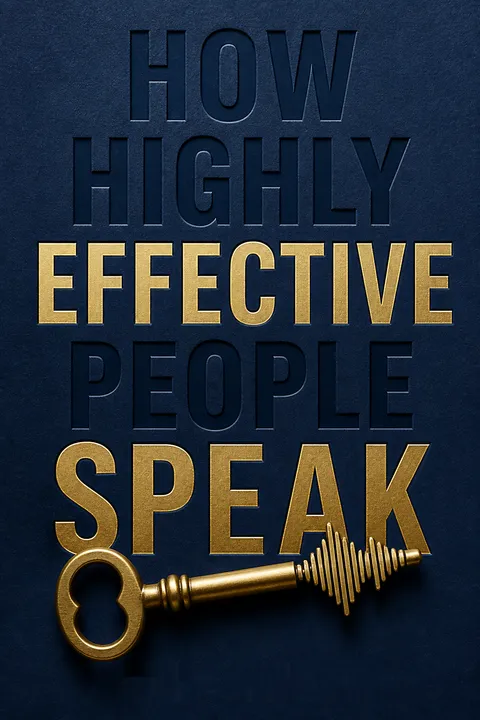


Key Takeaways
Treat communication as applied psychology, then practice it until it feels natural.
A failed speech became a laboratory. Andrei opens with a story of freezing before an audience of 200, delivering a speech that barely moved anyone. He then studied influential speeches, including John F. Kennedy’s, and concluded that effective communication is not only artistic instinct. It can be analyzed and practiced as a set of techniques grounded in how people notice, remember, and judge information.
The central rule is human-centered. Shape the message for the way listeners process information, rather than assuming that clear facts alone will persuade. Rehearsal matters because complex techniques become useful only when a speaker can apply them fluently. The book’s ethical boundary is equally important: persuasion should help people recognize what is true, not disguise a falsehood.
The book’s most useful premise is that speaking is a design problem as well as a performance. Cognitive psychology can help explain why some messages are easier to process, but it cannot establish whether a conclusion is true or morally sound. That distinction protects the reader from confusing effectiveness with virtue. Practice also matters for more than polish: fluency reduces the mental effort a speaker spends on delivery, leaving more attention for the audience and the substance of the exchange.
Make the message easy to remember when the decision finally arrives.
Memory shapes judgment. The availability bias is the tendency to give extra weight to information that comes readily to mind. Andrei uses Ronald Reagan’s account of a Cuban refugee to show how a personal story can make an abstract claim about freedom vivid and memorable. A memorable example can affect a later decision more than a statistic that listeners cannot easily recall.
Build a retrieval path. Stories, emotional detail, images, short summaries, and repeated exposure can help listeners retrieve the central point. Abraham Lincoln’s concise image of a divided house, for example, gave a memorable handle to a complex argument. Pair quantitative evidence with a story, then give the audience a short summary or written reminder. The aim is not to bury facts, but to make the important facts easier to retrieve.
This insight connects persuasion to the psychology of memory: information that is vivid or recently encountered often feels more important because it is easier to recall. That makes stories useful teaching devices, especially when they embody the point rather than merely decorate it. But ease of recall is not evidence of frequency. A striking anecdote can help an audience understand a real case while badly distorting how common that case is. The story should clarify a claim, not quietly stand in for proof of its prevalence.
Choose the first comparison, or listeners will invent one for you.
Judgment needs a reference point. The anchoring effect occurs when an initial number or piece of information influences later estimates. A seller who displays a high reference price before a discount may make the lower price look like a bargain, even if the reference price is a poor measure of true value. Kennedy’s speech on tax policy arranged figures so that the comparisons supported his case.
Contrast changes impressions. People also judge an option against nearby alternatives, not only on its own merits. A home can seem attractive after buyers have toured inferior, overpriced homes. For ethical use, establish relevant comparisons: show what a proposal costs, what a credible alternative costs, and what each delivers. When evaluating an offer, seek independent data before accepting its first number as a sensible starting point.
Anchors and contrasts are related but not identical. An anchor pulls an estimate toward an initial reference, while contrast makes an option look different because of what surrounds it. Together, they explain why a technically accurate price or statistic can still create a misleading impression. The practical discipline is to ask who selected the comparison set and whether it is genuinely relevant. In negotiation, a first number can be strategically useful, but shared, verifiable standards often produce more durable agreement than a clever opening bid.
Combine several honest reasons so one proposal feels consequential.
Persuasion can compound. Charlie Munger’s term, the Lollapalooza effect, describes multiple psychological tendencies reinforcing the same judgment. Andrei illustrates the idea through Lyndon Johnson’s Great Society address, which mixed humor, appealing values, a vision of improvement, and clear contrasts between progress and stagnation.
Use more than one channel. Explain the benefit of acting, the cost of inaction, and the reason the recommendation is credible. Curiosity can draw attention, a relevant example can make the problem concrete, and social proof can show that others have acted. A clear next step matters too, because listeners may accept an argument yet postpone action. The point is not to pile on every possible influence. It is to align a few truthful reasons behind a useful decision.
The idea of reinforcing cues is plausible: a benefit, a credible source, and an easy next step can support one another rather than compete for attention. It also resembles behavior design, where motivation, ability, and a prompt must converge for action. Yet a larger stack of appeals is not automatically stronger evidence. Too many tactics can feel engineered, and emotional pressure can reduce a listener’s sense of choice. A persuasive message works best when its support is mutually consistent and its audience can inspect the reasoning.
Reduce real downside before you promise confidence.
Certainty attracts, but guarantees need substance. The zero-risk bias is the tendency to prefer eliminating a small risk entirely, even when another option offers a better overall return. The book’s example compares investments whose expected returns favor the riskier option, yet the completely safe option can still feel more appealing.
Make risk manageable. A seller may offer a refund if promised results do not arrive, guarantee actions within the company’s control, or provide evidence about past outcomes. Churchill’s wartime address also offered a powerful form of reassurance: even if Britain suffered defeat, the struggle could continue elsewhere. Such language can motivate, but perceived safety is not actual safety. State what is guaranteed, what remains uncertain, and what the listener can do if the plan fails.
Risk communication is strongest when it makes uncertainty legible rather than pretending uncertainty has disappeared. A refund policy can transfer some financial risk, but it cannot erase time, inconvenience, or opportunity cost. The distinction between a controlled promise and an uncontrollable outcome is especially valuable in business and public policy. Listeners benefit from knowing not only the best-case scenario but also the conditions under which the guarantee applies. Confidence earns trust when it is calibrated to the evidence.
Design the first impression, but let substance sustain the halo.
Early signals spread. The halo effect occurs when one noticeable quality leads people to assume other, unobserved qualities are present. Kennedy’s Rice University opening acknowledged guests, expressed gratitude, and praised the university and city before turning to his larger subject. Preparation, clear speech, and respectful attention can create a favorable first impression that colors how listeners receive the rest.
Control what can be controlled. Check the room and equipment, open with a relevant concern and a preview of the solution, and speak clearly enough to be heard. If a speaker stumbles, continuing calmly can matter more than the mistake itself. These signals support credibility, but they do not prove expertise. For important decisions, combine a polished presentation with specific evidence, transparent limits, and a record of performance.
First impressions are efficient but imperfect. In unfamiliar situations, people use visible cues because they lack enough information for a careful assessment. This can help a prepared, capable speaker be heard, while unfairly disadvantaging someone whose accent, appearance, disability, or communication style differs from audience expectations. The practical goal should be to remove avoidable distractions, not to treat conformity as competence. In hiring or evaluation, structured criteria and documented performance help prevent a pleasant opening from outweighing stronger evidence.
Explain problems through human actions without pretending one actor caused everything.
People understand agency quickly. Agent detection bias is the tendency to explain events by attributing them to an intentional person or group. Reagan’s questions about the economy directed listeners toward President Carter as the responsible actor. A story with a person facing a problem, an identifiable obstacle, and an action-oriented solution can make an issue easier to follow.
Make the mechanism clear. Ask who acted, what happened, how the action produced the result, and why the actor acted. This structure can turn an abstract process into an understandable account. But it can also oversimplify. Economic or social outcomes may have many causes, including chance and decisions by numerous people. Identify a relevant agent when the evidence supports it, and distinguish that person’s contribution from the larger system.
Human agency makes causation narratively accessible. It gives an audience a model to remember and a point at which intervention might be possible. The danger is a familiar one in political storytelling: the demand for a single culprit can turn a complex system into a morality play. That may simplify explanation while weakening diagnosis. A stronger account can name a decision-maker, describe the mechanism of influence, and still acknowledge other causes. Clarity need not require a lone villain.
Notice which easy question is secretly replacing the hard one.
A substitute can feel like an answer. Attribute substitution happens when people replace a difficult question with an easier one, then treat the easier answer as if it resolves the original. Someone deciding whether an argument is true might instead ask whether the speaker seems likable or confident. A polished proposal can similarly feel more valuable because it looks attractive.
Name the real decision first. The book’s ASA algorithm asks the communicator to identify the judgment they want the audience to make, anticipate the easier cues listeners may rely on, and address those cues while also supporting the real claim. For example, a car buyer may care about total value but respond first to appearance, comfort, or the salesperson. Those cues can guide attention, but they should not replace evidence about cost, reliability, or alternatives.
This is a useful diagnostic because it separates what people assess from what they use as evidence. A source’s confidence may correlate with competence in some settings, but it is not a dependable test of truth. Aesthetics can make information easier to navigate, but attractive design can also conceal weak reasoning. The best response is not to eliminate intuitive judgment, which is often unavoidable, but to make its shortcuts visible and pair them with criteria that bear directly on the decision.
Pair every vivid example with the base rate it cannot replace.
Specific cases crowd out statistics. Base rate neglect is the tendency to give too little weight to general frequencies when a vivid individual example is available. Andrei recalls a class discussion of the Milgram obedience experiment, in which roughly 70 percent of participants continued administering what they believed were painful shocks under an experimenter’s direction. Students assumed they would behave differently, focusing on their self-image rather than the observed rate.
Use numbers and stories together. The book’s P Quant Qual P model presents a point, quantitative evidence, a concrete example, and the point again. Numbers indicate scale; a story shows what the numbers can mean in a person’s life. Reagan’s memorable welfare-fraud anecdote illustrates the reverse danger: one case can make a problem seem widespread without establishing how common it is. Keep the denominator in view.
The combination of statistics and cases can serve two different jobs: prevalence and meaning. A rate estimates how often something happens, while a personal account can reveal what an instance feels like or how a mechanism works. Neither can fully replace the other. A representative anecdote may be compelling precisely because it is unusual, so communicators should disclose whether an example is typical, exceptional, or merely illustrative. That small distinction preserves narrative force without letting a memorable case masquerade as population-level evidence.
Analysis
The book’s deepest contribution is not a catalogue of tricks but a shift in the speaker’s question: what must listeners notice, remember, compare, and trust before they can act? This turns communication into a sequence of cognitive tasks. Stories aid retrieval, comparisons give numbers meaning, first impressions shape interpretation, and simple causal accounts reduce mental effort. Taken together, the chapters suggest that influence depends less on volume of information than on its fit with the audience’s attention and memory.
That strength carries a real tension. The same mechanisms that make useful truths graspable can make weak claims feel compelling. An anecdote can outshine a base rate; a confident delivery can borrow credibility it has not earned; an apparent guarantee can obscure risks that remain. The author repeatedly places ethical limits on persuasion, but those limits cannot be enforced by technique. They depend on the speaker’s willingness to present counterevidence, clarify uncertainty, and avoid exploiting a listener’s blind spots.
A practical standard follows: use psychology to improve access to evidence, not to bypass its evaluation. A communicator can open with a story, anchor a comparison, or identify an agent, then show the source, denominator, assumptions, and plausible alternatives. This is not less persuasive by definition. It is persuasion designed to survive scrutiny. The strongest version of the book’s advice is therefore a two-part discipline: make the message memorable enough to be considered, and make its reasoning transparent enough to be tested. Influence then becomes more than getting agreement. It becomes helping people reach a decision they can understand and defend.
Review Summary
How Highly Effective People Speak receives mixed reviews. Some readers praise its insights on cognitive biases and communication techniques, finding it valuable for improving speaking skills. Others criticize the lack of citations, repetitive content, and chaotic presentation. Positive reviews highlight the book's exploration of psychological principles in communication, while negative reviews point out its common-sense advice and lack of academic rigor. The book's format and graphics are also subject to criticism. Overall, readers' opinions vary widely, with ratings ranging from 1 to 5 stars.
People Also Read






Glossary
Availability bias
Recall shapes judgmentThe tendency to judge information as more important or frequent when examples come readily to mind. Vivid stories, recent events, emotional details, and repeated messages can become especially easy to recall. The shortcut is useful for quick decisions, but it can distort judgments when memorable cases are rare or unrepresentative.
Anchoring effect
First information pulls estimatesThe tendency for an initial number or piece of information to influence a later estimate. People often adjust from the first reference point but do not adjust far enough, even when that starting point is arbitrary or strategically selected. The effect is common in pricing and negotiation, where the opening figure can shape what seems reasonable.
The "E.F.F.E.C.T.I.V.E" Framework
Nine psychology-based message leversAndrei’s organizing framework for applying cognitive psychology to communication. Its chapters consider how to make a message memorable, set early reference points, combine persuasive cues, use comparisons, reduce perceived risk, establish credibility, explain events intuitively, engage emotional shortcuts, and ground claims in concrete evidence. The framework groups tactics by the mental processes they aim to engage.
Sententia
Memorable summary phraseA rhetorical device in which a concise, memorable statement summarizes or crystallizes the point made in more complex material. The phrase gives listeners an accessible handle for recalling the larger argument. In the book, Lincoln’s image of a divided house illustrates how a compact line can make an extended political argument easier to remember.
Lollapalooza effect
Several biases reinforce one judgmentA term associated with Charlie Munger for the unusually strong result that can occur when multiple psychological tendencies push behavior in the same direction. The book applies it to speeches that combine, for example, emotional stakes, social cues, curiosity, and clear contrasts. The concept highlights cumulative influence, though it does not imply that every added appeal improves a message.
Zero-risk bias
Zero risk feels disproportionately valuableThe tendency to favor eliminating a particular risk completely, even when doing so is less beneficial overall than choosing an option with a small remaining risk. The bias can shape decisions about investments, purchases, and proposals. The book recommends reducing genuine exposure through guarantees or clear protections, while distinguishing perceived safety from actual safety.
Victim-Perpetrator-Benevolence triad
Problem, cause, and proposed remedyA rhetorical structure that identifies people harmed by a problem, identifies an actor responsible for causing or worsening it, and presents the communicator or proposal as a force that can help. The structure gives an audience a clear story and a possible remedy. It is appropriate only when the claims about harm, cause, and remedy are supportable.
Agent detection bias
Events attributed to intentional actorsThe tendency to explain events by identifying a person or group acting with intent, rather than by beginning with chance or a complicated web of causes. Such explanations are intuitive and easy to turn into stories. They can clarify how an action produced an outcome, but can also exaggerate one actor’s responsibility for a multifactorial event.
Attribute substitution
An easy question replaces a hard oneA mental shortcut in which a person answers a difficult question by unconsciously answering a simpler, related question instead. For instance, someone evaluating whether a message is true might rely on whether its speaker seems likable or confident. The shortcut saves effort, but the substitute attribute may not reliably answer the original question.
P Quant Qual P model
Point, numbers, story, pointA structure for combining a main claim with quantitative and qualitative support. The speaker states a point, gives numerical evidence, follows with a specific story or example, and restates the point. The numbers establish scale, while the example makes the issue concrete. The model works best when the anecdote illustrates rather than overstates what the statistics show.
ASA algorithm
Plan around substituted judgmentsThe attribute substitution activation algorithm is Andrei’s three-step process for designing persuasive communication. First, identify the judgment the audience needs to make. Second, anticipate the easier cues they may use as substitutes. Third, address those cues while also supporting the underlying judgment with relevant evidence. It is intended to make communication fluent without confusing a cue with proof.
Base rate neglect
Specific cases eclipse general ratesThe tendency to underweight general statistical information about a population when judging a vivid individual case. A memorable person or story can seem more informative than the frequency of similar events, even when the base rate is highly relevant. The book recommends using statistics and specific examples together, while making clear what each can establish.
FAQ
What's "How Highly Effective People Speak" about?
- Focus on Communication: The book by Peter Andrei explores how high performers use psychology to communicate effectively and influence others with ease.
- Behavioral Economics: It delves into the intersection of communication and behavioral economics, revealing how cognitive biases shape human judgment and decision-making.
- E.F.F.E.C.T.I.V.E Framework: The book introduces a framework that outlines strategies to make communication enduring, first, forceful, exceptional, confident, trustworthy, intuitive, visceral, and evident.
- Practical Strategies: It provides actionable strategies and techniques to enhance communication skills, making them more persuasive and impactful.
Why should I read "How Highly Effective People Speak"?
- Improve Communication Skills: The book offers insights into mastering communication, a critical skill for personal and professional success.
- Understand Cognitive Biases: It helps readers understand and leverage cognitive biases to influence others effectively.
- Actionable Advice: The book provides practical, step-by-step strategies that can be applied immediately to improve communication.
- Broaden Influence: By adopting the techniques in the book, readers can enhance their ability to persuade and lead in various contexts.
What are the key takeaways of "How Highly Effective People Speak"?
- Communication as a Science: Effective communication is both an art and a science, with patterns that can be studied and applied.
- Cognitive Biases: Understanding and leveraging cognitive biases can make communication more persuasive.
- E.F.F.E.C.T.I.V.E Framework: The framework provides a structured approach to making communication impactful and memorable.
- Practice and Mastery: Mastering communication requires practice and the integration of strategies into automatic habits.
What is the "E.F.F.E.C.T.I.V.E" Framework in "How Highly Effective People Speak"?
- Enduring: Make your message memorable to activate the availability bias.
- First: Use the anchoring effect by presenting your message first to make it more influential.
- Forceful: Activate multiple cognitive biases to make your message compelling and direct.
- Exceptional: Use the contrast effect to make your message stand out and appear superior.
How does Peter Andrei suggest using cognitive biases in communication?
- Availability Bias: Make your message memorable through stories and emotional engagement.
- Anchoring Effect: Present your message first to set a reference point for others.
- Halo Effect: Create a positive first impression to influence perceptions of other qualities.
- Agent Detection Bias: Attribute events to human actions to make explanations more intuitive.
What are some practical strategies from "How Highly Effective People Speak"?
- Tell Stories: Use narratives to make your message memorable and engaging.
- Use Pathos: Evoke emotions to make your message more persuasive and memorable.
- Set High Anchors: Use high initial numbers or values to influence perceptions of worth.
- Present Zero Risk: Offer guarantees to reduce perceived risk and increase persuasion.
What is the significance of the "availability bias" in communication?
- Memorability: The availability bias makes memorable information more influential.
- Storytelling: Telling stories can make complex messages more relatable and memorable.
- Emotional Engagement: Emotionally charged messages are more likely to be remembered and overweighed in decision-making.
- Practical Application: Use vivid, simple, and emotionally engaging content to activate this bias.
How does the "anchoring effect" influence communication according to Peter Andrei?
- First Impressions: The first piece of information presented sets a reference point for subsequent judgments.
- Numerical Anchors: Initial numbers can influence perceptions of value or worth.
- Strategic Use: Set high anchors to make subsequent offers or messages seem more favorable.
- Overcoming Anchors: Be aware of initial anchors to avoid being unduly influenced by them.
What role does the "halo effect" play in effective communication?
- First Impressions: A positive first impression can lead to a halo of other positive perceptions.
- Extrapolation: Observers may attribute additional positive qualities based on one observed trait.
- Trustworthiness: Creating a positive initial impression can enhance perceived trustworthiness and credibility.
- Practical Tips: Use open body language, project confidence, and dress slightly above average to create a positive halo.
How can the "contrast effect" be used to make communication exceptional?
- Comparative Perception: Humans judge items based on contrasts with other items.
- Antithesis and Paradox: Use rhetorical devices to create vivid contrasts and emphasize key points.
- Direct Comparisons: Compare your message or product to alternatives to highlight its superiority.
- Pattern Interrupts: Break established patterns to capture attention and create memorable contrasts.
What are some of the best quotes from "How Highly Effective People Speak" and what do they mean?
- "Convey information how the human mind is wired to receive it." This emphasizes the importance of aligning communication with cognitive processes for maximum impact.
- "Communication creates reality." This highlights the power of words to shape perceptions and influence outcomes.
- "If you can think and speak and write, you are absolutely deadly." This underscores the transformative power of effective communication skills.
- "Truth lies at the bottom of a very muddy well." This suggests that uncovering and conveying truth requires effort and clarity in communication.
How does Peter Andrei address the ethics of using rhetoric and persuasion?
- Neutral Tool: Rhetoric is a tool that can be used for good or ill, depending on the user's intentions.
- Moral Responsibility: Communicators have a duty to use persuasive techniques ethically, promoting truth and positive outcomes.
- Historical Context: The book references historical figures and speeches to illustrate both ethical and unethical uses of rhetoric.
- Empowerment: The goal is to empower readers to use communication skills to achieve moral and beneficial objectives.
About the Author
Other books by Peter Andrei
Download PDF
Download EPUB
.epub digital book format is ideal for reading ebooks on phones, tablets, and e-readers.








