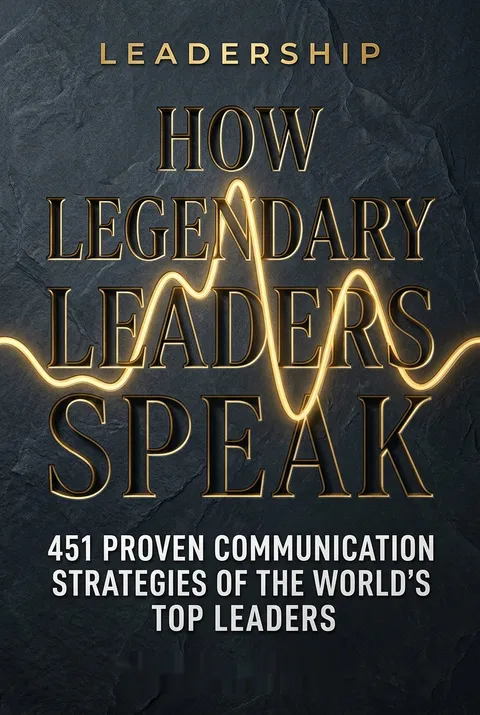


Key Takeaways
Turn shared attention into a purpose people can act on
A speech is a sequence. The author begins with a failure: anxious before addressing 200 people, he delivered a talk that barely moved anyone. Studying historic speeches led him to treat persuasive leadership as a learnable craft, not a gift reserved for the naturally charismatic. His model moves from gaining attention to focusing it on one aim, calling for action, shaping how people think about acting, and connecting the effort to a motive they value.
Words meet circumstances. Franklin Roosevelt's radio addresses during the Depression illustrate the argument. They reached people in their homes, named their insecurity, and made collective recovery feel possible. The author stresses that plans require public participation, not only sound policy. Communication can help people coordinate, but cannot make an impossible plan workable.
What's useful here is the shift from treating a speech as a performance to treating it as a sequence of audience tasks. Attention, understanding, commitment, and action are not interchangeable: a crowd can be captivated yet leave unsure what to do. This resembles behavior-design approaches that reduce the gap between intention and action by specifying a next step. The historical examples also show that communication works inside institutions and material conditions. Roosevelt's rhetoric could help create confidence, but it did not independently cause economic recovery. Leadership communication is best understood as one component of coordinated change, not a magic lever.
Name people's pain before you claim authority to solve it
Start with their experience. In a televised debate described in the book, an audience member asks how the national debt has affected the candidates personally. George H. W. Bush struggles to answer the personal question directly. Bill Clinton asks the woman to explain the effects again, then describes people in his state losing jobs, homes, and health coverage. The author reads the exchange as a display of empathy: the candidate shows that he has heard the person before moving to his own explanation.
Then explain the cause. Clinton does not stop at sympathy. He reframes the problem as wider than debt, pointing to weak growth and economic policy, then offers a response. The book's practical pattern is to pair an account of people's hardship with a credible diagnosis and a solution. A leader earns authority by showing both understanding and judgment.
The distinction between acknowledging a problem and describing its felt consequences is powerful. People often assess whether a leader understands the stakes before they weigh proposed remedies. Research on trust and procedural fairness similarly suggests that being heard can shape whether people view decisions as legitimate, even when outcomes are contested. Still, empathy is not proof of competence. A fluent account of hardship can be performed without changing policy or improving outcomes. The strongest version combines attentive listening, accurate diagnosis, and a response that affected people can scrutinize.
Give many initiatives one memorable, defensible destination
Make the aim singular. The author argues that attention weakens when a leader asks people to pursue a jumble of unrelated goals. A central purpose gives the audience a simple answer to what the effort is for, while allowing supporting projects to sit beneath it. Lyndon Johnson's Great Society speech illustrates this structure: a broad vision of a better society held together proposals concerning cities, rural areas, education, poverty, and racial injustice.
Keep the branches visible. The umbrella purpose should not erase the steps beneath it. Johnson previewed three arenas for action, then discussed problems and possible responses in each. This pyramidal organization gives listeners a compact idea they can remember and a structure for understanding the more complicated agenda. The book also points to campaign slogans as examples of a short phrase carrying a larger platform.
A shared banner can help people explain an agenda to one another, an advantage when a coalition contains different priorities. In organizational terms, it functions like a strategy: it establishes the intended direction while leaving room for separate teams to contribute. But compression has a cost. A slogan can conceal disagreements about what the goal means, who pays, and which trade-offs are acceptable. A sound umbrella purpose therefore needs visible subgoals and measures of progress. Otherwise, the memorable destination becomes a shield against accountability rather than a guide for action.
Show what people gain, avoid, and hope to regain
Translate the purpose into stakes. A proposal becomes meaningful when audiences can see how it changes their lives. The author describes three benefit frames: gaining something valuable, preventing a loss, and restoring something people feel they once had. He argues that a promise to recover a lost condition can feel especially compelling because it combines the desire for a benefit with the pain of its absence. The word again in a political slogan is offered as a compact example of that restoration frame.
Trace benefits to people. A goal such as raising economic output is abstract until its consequences are explained. The book recommends following the chain toward longer lives, better education, or less hardship, rather than assuming that a statistic speaks for itself. Loss-focused language can sharpen urgency, but it should identify a real loss and a credible remedy, not manufacture grievance.
This approach connects rhetoric to behavioral economics, especially the observation that people can react more strongly to losses than to equivalent gains. It also reflects a basic communication principle: abstract indicators matter when audiences understand their human consequences. Yet the restoration frame deserves care. People can remember the past selectively, and political claims about a lost golden age may be emotionally potent without being historically accurate. Benefit language is most persuasive and responsible when it distinguishes measurable outcomes from nostalgia, states who benefits, and leaves room for evidence to challenge the story.
Make ambitious promises credible by showing the route
Pair ends with means. A compelling picture of the future is not enough. Listeners also want to know how the promise could be delivered. In Johnson's Great Society address, the vision of social improvement is followed by problems in cities, the countryside, and classrooms, then by proposals for expert working groups and cooperation between national and local government. The author calls this the means that make the ends believable.
Show how the plan holds up. A persuasive plan should name concrete steps, explain why they address the problem, account for obstacles, and show evidence or prior experience where available. The book contrasts bold proposals without persuasive implementation details against more modest proposals supported by a clearer path. Its underlying lesson is not to promise less, but to make ambition answerable to resources, institutions, and execution.
This is the book's strongest corrective to rhetoric as mere performance. In public administration and product design alike, a vision gains credibility when it can be translated into owners, resources, dependencies, and feedback. A plan also benefits from stating what would count as failure and how it would adapt. The author's proposed relationship between perceived benefit and trust is a useful intuition, not a validated measurement formula. Confidence and detail cannot establish that a plan will work. Independent evidence, transparent assumptions, and implementation capacity matter more than eloquent assurances.
Use human stories and live details to make ideas felt
Give abstract claims a human shape. Barack Obama's 2004 convention speech traced his family's history across continents and generations, connecting a personal story to a larger account of opportunity and national identity. The book argues that stories make ideas easier to picture, remember, and feel because audiences follow people through events rather than process a list of abstractions.
Notice the present moment. The author also examines Australian prime minister Julia Gillard responding when her opponent looked at his watch while she spoke. By addressing that visible behavior, rather than continuing with prepared remarks, she made the exchange immediately relevant. Stories and timely details can bring attention to a message, but they should serve the point rather than become decoration. Concrete imagery can help listeners visualize a goal; too much description can make a speech feel inflated.
Stories are cognitively efficient: a sequence of characters, actions, and consequences gives listeners a structure for organizing information. Narrative can also make distant policy feel connected to a person's life. But vividness is not the same as representativeness. One moving story can dominate judgment even when it is unusual or incomplete. Strong communication pairs a memorable example with enough context to show how typical it is, what it does not establish, and how it connects to broader evidence. Responsiveness to the moment works best when it illuminates the issue rather than merely scoring a point.
End with an action specific enough for your level of leadership
Turn agreement into a next move. The book studies recurring ways leaders invite action, including questions, collective invitations, declarations of necessity, and repeated short statements. Winston Churchill's repeated commitments to resist during the Battle of Britain show how rhythm and repetition can make resolve memorable. Johnson's sequence of questions at the end of a speech invites listeners to imagine joining a common effort.
Match detail to authority. A policy is a statement of who should do what, when, and how. The right level of detail depends on the speaker's role. A movement leader may need to give a broad vision, while a frontline manager should specify responsibilities and deadlines. A stirring appeal can create energy, but it does not substitute for an actionable instruction. The audience should leave knowing what contribution is expected and what happens next.
The distinction between visionary direction and operational instruction is essential in organizations. Senior leaders set priorities and resolve trade-offs; teams closer to the work need explicit ownership and coordination. Repetition can aid recall, while a clear request reduces ambiguity about what follows. A useful test is whether listeners can state the action, responsible person, and timing after the speech. Collective language can build belonging, but it can also blur accountability. Effective calls to action make participation feel shared without making responsibility impossible to locate.
Give people hope and principles, not confidence without evidence
Prepare the mind for effort. The book argues that people are less likely to act if they see no chance of improvement. Leaders can acknowledge difficulty while showing why the group has the capacity to respond. Dwight Eisenhower's address to Allied troops before the Normandy invasion recognized that the enemy was capable and the task dangerous, while expressing confidence in the soldiers and the preparation behind them. This combination is more credible than pretending the challenge is easy.
State the principles behind action. Gandhi's defense of nonviolence during India's independence struggle illustrates how a leader can define limits as well as aims. Shared principles, hope, and a sense of unity can help people choose behavior without receiving a separate instruction for every situation. The book treats these beliefs as part of the mental climate that supports action, not as a replacement for practical guidance.
Hope can sustain effort when outcomes are uncertain, and principles help groups coordinate when rules cannot anticipate every case. This connects leadership to resilience research and moral psychology: people often endure difficulty more effectively when they see purpose and social support. The caution is that confidence can become dogma, while unity can silence dissent. Leaders should distinguish justified confidence from certainty theater, and make it safe for people to report bad news. Hope is durable when it acknowledges risk and includes a credible path for adapting to setbacks.
Use persuasive skill in service of truth, not as its substitute
Connect a real purpose to real stakes. The author says rhetoric can advance humane aims or harmful ones; the tool itself does not supply moral judgment. He invokes the classical ideal of a good person skilled in speaking and argues that leaders should connect their subject to what audiences genuinely care about. One way to do that is to assess how widely an issue matters, how strongly people care, and how long that concern is likely to last.
Separate technique from endorsement. Political figures from different sides appear as examples of communication methods, not necessarily as endorsements of their policies. That distinction helps readers study a speaker without adopting the speaker's program. Still, alignment should mean making relevance clear, not disguising an agenda. A leader should disclose trade-offs, avoid promises that outrun the evidence, and ask whether the intended action serves the audience as well as the speaker.
The ethical question is not whether persuasion occurs, but whether it respects the audience's capacity to judge. Democratic rhetoric can make complex issues accessible and help people act together; manipulative rhetoric can exploit identity, fear, and selective facts to narrow their choices. The book's insistence on truth and self-mastery points toward a useful standard: persuasion should strengthen understanding, not merely compliance. Its political examples also show why separating technique from policy is necessary, but not sufficient. Methods carry values through the problems they spotlight, the people they cast as victims, and the remedies they make imaginable.
Analysis
The book's central contribution is a practical account of leadership speech as a chain of audience transitions. It asks a speaker to earn attention, focus that attention, translate it into action, furnish a way of thinking that supports action, and connect the effort to an important motive. The sequence is memorable because it treats a speech not as a container for information but as an attempt to change what a group notices, believes, and does. Its close readings of Roosevelt, King, Churchill, Kennedy, Johnson, and others make rhetorical choices visible in actual historical language.
Its greatest strength is also its main risk. The book often treats persuasive features as if they operate predictably, sometimes attaching confident psychological or evolutionary explanations to broad claims about audience behavior. Attention, emotion, loss framing, and group identity can matter, but people do not respond uniformly, and a rhetorical pattern is not evidence of a single causal mechanism. The author's own analysis of Clinton's inaugural address recognizes that categorization involves judgment and possible error. That humility is important because the book's tallies and labels are interpretive tools, not experimental proof.
Historical examples also create a selection problem. Famous speeches are remembered partly because their speakers had power, institutions, coalitions, and favorable or urgent circumstances. Their success cannot be assigned to wording alone. A compelling address may rally support, but policy design, trust earned over time, organizational capacity, and opponents' decisions shape what follows. The book is most useful as a rehearsal framework: test whether a speech speaks to actual concerns, clarifies one purpose, gives people a doable role, and supports its promises with credible means. Its ethical conclusion deserves equal weight. Rhetorical fluency can serve public understanding or exploit it, so effectiveness should be judged alongside truthfulness, accountability, and the quality of the action being encouraged.
Review Summary
Leadership has a mixed reception with an overall rating of 3.44 out of 5. Some readers appreciate its unique frameworks, such as the 17 classifications of 194 human desires, and find it valuable for crafting effective speeches and communication strategies. However, common criticisms include excessive complexity, repetitiveness, and an overwhelming number of concepts. Readers also note the book could be significantly condensed, and some reported that promised bonus content was unavailable.
People Also Read







Glossary
Communication of leadership
Speech that mobilizes groupsThe author's name for communication that helps a leader focus a group's attention, unite it around a purpose, encourage deliberate action, shape the beliefs supporting that action, and connect the effort to a meaningful motive. It describes a proposed sequence for turning an idea into coordinated effort, rather than a single speaking technique.
Mastermind principle
Shared focus on a purposeA concept the author attributes to Napoleon Hill and applies to leadership: people can combine controlled attention, a definite purpose, deliberate effort, sound thinking, and a deeper motive. In this account, communication helps a leader organize those elements across a group, so that people work toward a common objective rather than pursuing disconnected aims.
pyramidal organization
One aim, supporting subgoalsA way of arranging a complex agenda beneath one overarching purpose. The leader states a clear central aim, then groups policies or initiatives as supporting routes toward it. The structure is meant to make an agenda easier to understand, remember, and discuss without requiring every part of the plan to be reduced to a slogan.
victim-perpetrator-benevolence triad
A story of injustice and repairThe author's label for a persuasive narrative that identifies someone harmed, identifies a person or force responsible for the harm, and presents the speaker or their cause as able to repair it. The structure can make a problem emotionally legible and motivate action, but its fairness depends on whether the roles and causal claims are accurate.
benefit-triad
Gain, protection, restorationThe author's grouping of three ways to describe the value of a proposal: what people may gain, what harm they may avoid, and what lost condition they may recover. The frames give a speaker several ways to explain why a purpose matters. They are persuasive forms, not evidence that a promised benefit will occur.
Kairos
The opportune momentAn ancient Greek term for the fitting or opportune time to speak or act, contrasted with chronological time. The author applies it to persuasion: a proposal may gain force when circumstances make its relevance plain, such as discussing economic change during a downturn. The timing should reflect the real situation, not merely exploit fear.
declaratory cascade
A rhythm of firm statementsA sequence of short, emphatic statements, often sharing a repeated opening phrase or grammatical pattern. The author argues that the pattern creates rhythm, lowers the effort required to follow the speech, and can make a final variation especially memorable. Churchill's repeated declarations of resistance during the Second World War serve as the central example.
interrogative cascade
A sequence of guiding questionsA succession of rhetorical questions designed to keep listeners mentally engaged and guide them toward a conclusion or commitment. The author notes that repeated openings and parallel sentence structures can strengthen the sequence. In practice, questions can invite reflection, though they do not guarantee that listeners will accept the speaker's implied answer.
Difficulty-confidence matrix
Acknowledge challenge, express confidenceThe author's label for pairing an honest account of a task's difficulty with a reasoned expression of confidence in the group's ability to meet it. Eisenhower's message to Allied troops before the Normandy invasion illustrates the combination: the challenge is not minimized, but preparation and capability are emphasized as grounds for resolve.
alignment
Connect a subject to audience concernsThe author uses alignment to mean connecting a speaker's subject to consequences the audience already considers important. He suggests considering how many people care about an issue, how strongly they care, and how long that concern is likely to persist. Alignment makes relevance explicit; it should not be used to conceal weak evidence or manipulate priorities.
About the Author
Other books by Peter Andrei

Download PDF
Download EPUB
.epub digital book format is ideal for reading ebooks on phones, tablets, and e-readers.








