

Key Takeaways
Teach the novice in front of you, not the expert they may become
Beginners see different problems. A schema is an organized structure of knowledge in memory that helps someone interpret new information. In a study of physics problems, novices grouped questions by visible features, such as blocks on a slope, while experts grouped them by underlying principles, such as energy conservation. The experts did not merely know more. Their knowledge was organized differently, allowing them to recognize which solution applied.
Match guidance to expertise. A method that helps an expert explore a problem may leave a novice guessing. Teachers need to find out what students already understand, surface misconceptions, and adjust support accordingly. Expertise is domain-specific: a student may reason like an expert in one subject and a beginner in another.
The expert-novice distinction is a useful antidote to assuming that students can simply imitate the habits of professionals. Expertise changes perception: the same task presents different cues to someone with organized knowledge. That insight supports careful sequencing and domain-specific teaching. It also cautions against labeling students globally as capable or incapable. Expertise is local and developable, and a learner who needs substantial guidance in physics may be quite independent in literature. The practical question is not whether a student is smart, but what knowledge is available for this particular task.
Start new learning from what students already know
Knowledge needs an anchor. An advance organizer is an introductory framework that connects unfamiliar material to relevant concepts students already understand. In David Ausubel's study, students who received a broad conceptual introduction before reading about carbon steel performed better on a later test than students given historical background that was interesting but less relevant.
Check before adding. A brief quiz, discussion, or review can reveal what students know and what misconceptions need attention. If the necessary background is missing, teach it before expecting students to absorb details. A lesson on a new religion, for instance, can use a familiar one as a comparison, helping students notice both shared features and differences. Prior knowledge is not a blank space to fill. It is the structure new learning must connect with or revise.
This principle has consequences beyond lesson planning. Prior knowledge can differ sharply between students because of experience, opportunity, and home environment, so assuming a common starting point can quietly widen gaps. A quick diagnostic is more equitable than treating confusion as lack of effort. Organizers also need to be accurate and relevant: a misleading analogy can anchor a misconception just as effectively as a sound one. Their value lies not in being an introductory ritual, but in making the relationship between old and new knowledge explicit.
Give novices knowledge before asking them to solve unfamiliar problems
Working memory is limited. Cognitive load theory studies how the demands of a task interact with the limits of working memory. A novice solving an unfamiliar problem often searches for relevant facts, possible moves, and a route to the answer all at once. That search can consume attention without building useful knowledge in long-term memory. Experts can work forward because they recognize patterns and retrieve stored strategies.
Teach the tools first. Explain key concepts and procedures, model a solution, and then move toward independent problems. The book contrasts this with unguided discovery, which can burden novices and foster incomplete understanding. Bloom's tutoring research illustrates the potential of intensive support: the average tutored student performed about two standard deviations above the conventionally taught comparison group. One-to-one tutoring is costly, but guided practice and mastery checks can bring some of its advantages to classrooms.
The argument is strongest when it distinguishes learning from merely reaching an answer. A student can stumble onto a solution without acquiring a reusable method, while worked examples can expose the structure that makes later problem-solving possible. This does not mean exploration has no place. Students with substantial prior knowledge may learn productively through inquiry because they can use that knowledge to guide their search. The design challenge is to make guidance responsive, rather than treating direct instruction or discovery as universal doctrines.
Make students retrieve and revisit knowledge, not merely reread it
Effortful recall strengthens memory. Retrieval practice means bringing previously learned information to mind, as in a quiz or a closed-book explanation. Distributed practice means spreading learning across multiple sessions rather than concentrating it in a single cram session. Both methods have strong support in the reviewed research. A short recall exercise at the start of class can revisit yesterday's material, while later quizzes can bring back earlier topics.
Choose study methods carefully. The reviewed evidence rates rereading and highlighting as unreliable ways to improve learning, especially when students use them without knowing how to select important ideas. Combining words with useful images can help explain material, while decorative or redundant media can distract. The central test is what learners must think about: retrieving, explaining, and applying information usually demand more processing than seeing it again.
Retrieval practice changes assessment from a final audit into part of instruction. It can reveal what is accessible from memory before a high-stakes test, giving both student and teacher a chance to respond. Yet difficulty alone is not proof of learning: retrieval should be followed by feedback when answers are wrong, and spacing must fit the material and learner. The larger lesson is to judge study strategies by durable recall and use, not by how familiar or fluent the material feels during review.
Model the thinking, then remove support as competence grows
Make expert work visible. Cognitive apprenticeship is an approach in which a teacher demonstrates a task and explains the reasoning behind it, then coaches learners as they practice. The sequence commonly includes modeling, temporary scaffolding, coaching, and gradually fading support. This matters especially for abstract tasks such as writing or mathematical reasoning, where the steps are invisible unless someone makes them explicit.
Keep the destination in view. In a study of young children building a block pyramid, the tutor helped maintain attention, simplified choices, pointed out important features, managed frustration, and demonstrated solutions. Effective support varied with each child's ability. Teachers can similarly show a complete example, guide practice, and then withdraw prompts as students become more capable. The aim is not dependence on the teacher, but independent performance built on successful practice.
Modeling is a way to reveal the hidden curriculum: the decisions, checks, and corrections that experts may perform too automatically to explain unless asked. It also makes failure less mysterious because students can see how a capable person responds to a problem. The risk is mistaking support for a fixed script. Scaffolds should respond to evidence of what a learner can do, not simply be removed according to a timetable. Independence is an outcome of well-calibrated guidance, not a starting condition.
Use assessment to choose the next teaching move
Assessment can guide action. Formative assessment is the use of evidence about student understanding to adjust teaching and learning while learning is underway. A grade alone reports a result; it does not necessarily tell a student how to improve or a teacher what to teach next. Useful feedback clarifies the goal, shows current progress, and identifies a next step.
Make students use the feedback. Research reviewed by Black and Wiliam found substantial gains from approaches that strengthened feedback, although the size of effects varied. Feedback itself is not automatically helpful: it can be vague, unwanted, or focused on the learner's identity rather than the work. Comments on an essay should identify a specific move the student can make, and the student needs time to make it. Assessment becomes instructional when the information changes what someone does.
The key shift is from assessment as a verdict to assessment as a control loop. Evidence matters only if it prompts a change in teaching, practice, or strategy. That makes time for response essential: returning marked work without a chance to act on it is closer to reporting than formative instruction. Feedback should also be selective. An avalanche of corrections can obscure priorities, while comments tied to a clear learning goal give students a manageable way forward.
Build confidence through mastery, not slogans about mindset
Beliefs shape persistence. Self-efficacy is a person's belief that they can carry out the actions a particular task requires. It is domain-specific and grows most reliably through successful experience, supported by modeling, credible encouragement, and manageable exposure to challenging tasks. Attribution theory adds that students interpret success and failure through perceived causes, including ability, effort, difficulty, and luck. Whether they believe the cause can change affects their expectations and next effort.
Aim beyond the grade. Students may pursue mastery, wanting to understand, or performance, wanting to demonstrate ability; they can also act to avoid looking incompetent. These goals shape study behavior. The book treats growth-mindset messages cautiously: effort matters, but innate differences do not vanish, and motivational slogans are not a substitute for effective instruction. Specific goals, useful feedback, and attainable challenge give students evidence that improvement is possible.
This account avoids two easy mistakes: treating motivation as a magic cause of achievement, and treating low confidence as a character flaw. Confidence can reflect prior success, task design, and the credibility of support. That makes mastery experiences more informative than generic praise. At the same time, teachers should not imply that effort guarantees equal outcomes or that failure always reflects a student's choices. A fair interpretation asks which parts of the task, instruction, and learning history shaped the result.
Teach knowledge in context, then help learners carry it elsewhere
Learning takes place somewhere. Situated learning describes knowledge as shaped by the activities, social relationships, and setting in which it is acquired. School exercises often differ from everyday tasks, so students may know a formula yet fail to recognize when it applies. Context can help make a concept meaningful, but instruction still has to provide the knowledge and strategies needed to understand that context.
Learn with a community. Cognitive apprenticeship links teaching to authentic tasks and visible expert practice. Communities of practice extend this idea to groups that develop shared expertise through ongoing work. Xerox technicians, for example, informally exchanged repair knowledge that manuals missed; a searchable system based on those shared solutions reportedly saved the company more than $100 million in service costs. To support transfer, teach core ideas across varied examples, not just one supposedly realistic scenario.
Context helps learners see why knowledge matters, while variation helps them notice what remains true across settings. These are complementary aims: a single authentic activity can feel relevant yet leave students unable to generalize beyond it. The Xerox story also shows that expertise is partly collective, living in shared routines and records as well as individual memory. In schools, collaboration is most useful when the group exchanges substantive knowledge, rather than merely dividing up work.
Choose methods by evidence, not by novelty or educational folklore
A popular idea is not a proven method. The book challenges claims such as the learning pyramid's precise retention percentages, learning styles, digital natives, effortless multitasking, and the belief that technology itself improves learning. Richard Clark's review argues that media are delivery vehicles: instructional method, not the device, accounts for learning. Research on learning styles has not established that matching instruction to a preferred style improves results.
Treat evidence as cumulative. The book's guiding premise is that teaching should build on findings that have been tested and corroborated, rather than each generation reinventing practice from intuition. That requires distinguishing established evidence from attractive but weak claims. The volume selects 28 influential works, but it is a curated introduction, not a complete map of educational research. Its recommendations are a starting point for informed judgment, not rules to obey mechanically.
The warning against educational folklore is a call for intellectual discipline, not a demand to standardize every classroom. Claims should be judged by evidence, but evidence also has boundaries: findings from one subject, age group, or task may not settle every instructional decision. The book's curated format makes research accessible to busy educators, while its selection process necessarily leaves out other traditions and questions. A strong evidence culture pairs reliable findings with careful attention to local students and clear measures of learning.
Analysis
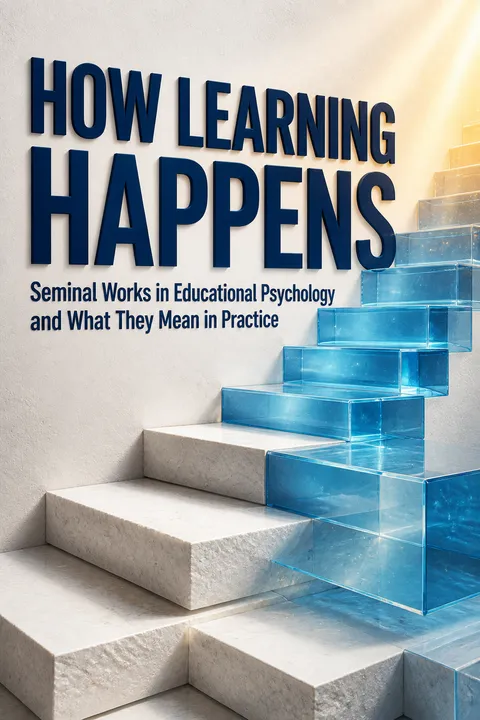
How Learning Happens is best read as a field guide built from selected research, not as one all-purpose theory of teaching. Its recurring claim is that learning depends on changes in durable memory, and teaching works best when it respects how people acquire and organize knowledge. That claim links the book's accounts of expertise, prior knowledge, working-memory limits, practice, feedback, and guided instruction.
The strongest practical synthesis is a progression: establish what learners know, explain and model unfamiliar material, guide practice, check understanding, and adjust support as competence develops. Retrieval and spaced practice strengthen retention; feedback and assessment help identify what needs attention; context and varied examples help learners understand where knowledge applies. This is more coherent than choosing a fashionable method and hoping it produces learning.
There is a productive tension between the book's defense of explicit instruction and its attention to situated learning, collaboration, and learner agency. These are not necessarily competing camps. Clear instruction can provide the knowledge that makes later inquiry meaningful, while authentic tasks can help learners integrate and apply what instruction has taught. The important distinction is readiness: unguided exploration asks very different things of a novice than of an expert.
The book is also strongest when it distinguishes learning from its proxies. Enjoyment, engagement, confidence, test performance, and technology use may accompany learning, but none automatically proves durable understanding. Its caution about mindset claims and learning-style myths is therefore part of a larger demand for better evidence. Still, the selected papers do not constitute an exhaustive consensus statement. Teachers should apply robust principles with judgment, attend to differences in subject and student, and evaluate whether learning lasts and transfers, rather than treating any single study or teaching recipe as conclusive.
Review Summary
How Learning Happens receives praise for its accessible format, presenting key educational research papers with practical applications. Readers appreciate its evidence-based approach and insights into cognitive psychology. The book challenges common misconceptions about learning styles and discovery learning. Some criticize its repetitiveness and dismissal of certain educational approaches. Overall, it's highly recommended for educators seeking to understand learning processes and improve teaching methods. Many consider it essential reading, though a few note its potential lack of nuance in certain areas.
People Also Read


Glossary
Cognitive load theory
Design for working-memory limitsA theory of instruction based on the limited capacity of working memory and the large store of knowledge in long-term memory. It recommends presenting unfamiliar material in ways that avoid unnecessary mental demands, so learners can process the content they need to understand and build organized knowledge.
Schema
Organized knowledge structureA schema is a mental structure that organizes related knowledge, skills, and ideas. It helps a learner interpret new information and recognize how it relates to what is already known. Expertise involves developing rich, useful schemas that support recognition and appropriate action in a domain.
Expertise reversal effect
Guidance depends on expertiseThe expertise reversal effect describes how an instructional method that helps beginners can become redundant or counterproductive for more knowledgeable learners. Novices often benefit from explicit explanations and worked examples. As knowledge develops, learners may benefit from reduced support and more opportunity to use their own organized knowledge.
Advance organizer
Framework before new materialAn advance organizer is a broad, inclusive framework presented before unfamiliar learning material. It helps learners connect new ideas to relevant prior knowledge or provides an initial conceptual structure when that knowledge is missing. Its purpose is to make later details easier to organize and understand, not simply to preview them.
Self-efficacy
Belief in task capabilitySelf-efficacy is a person's judgment of their ability to carry out actions required by a particular task or situation. It is specific to a domain rather than a general measure of confidence. Successful practice, observing a comparable person succeed, and credible guidance can influence it.
Mathemagenic activities
Actions that foster learningMathemagenic activities are learner actions that contribute to learning from instruction. They include directing attention, selecting relevant material, and mentally processing it. A teacher can present useful material, but learning depends partly on what the learner does with that material, such as answering questions or applying an idea.
Cognitive apprenticeship
Make expert thinking visibleCognitive apprenticeship adapts features of traditional apprenticeship to teaching complex thinking and school tasks. An expert models a task and explains the reasoning involved, then coaches learners through practice with temporary support. Support is gradually reduced as learners become able to perform more independently.
Communities of practice
Groups learning through shared workCommunities of practice are groups whose members develop shared expertise through sustained participation in a common area of work. They build knowledge through mutual engagement, shared goals, and resources such as language, stories, tools, and routines. New members can learn by taking part in meaningful tasks alongside experienced members.
Retrieval practice
Recall to strengthen memoryRetrieval practice is the act of bringing learned information to mind rather than simply reviewing it again. Quizzes, flashcards, and closed-book explanations are common forms. Recalling information can strengthen later access to it, especially when practice is revisited over time and errors receive appropriate feedback.
Formative assessment
Evidence that guides next stepsFormative assessment uses information about a learner's current understanding to adjust teaching and learning while instruction is underway. It may involve questions, quizzes, observation, or feedback. The defining feature is that evidence is used to decide what the teacher or learner should do next, rather than only to report a final result.
Dual coding theory
Verbal and visual memory systemsDual coding theory describes cognition as involving connected verbal representations, such as words, and nonverbal representations, such as images. Learning can benefit when words and relevant visuals work together. The relationship must be clear: redundant text, decorative images, or poorly coordinated material can distract rather than help.
Situated learning
Knowledge shaped by activitySituated learning emphasizes that knowledge develops through participation in activities and social settings, rather than being entirely detached from the circumstances in which it is learned. It highlights the role of context, practice, and community. Effective teaching can connect school concepts to meaningful tasks while still explicitly teaching the knowledge required.
FAQ
1. What is "How Learning Happens" by Paul A. Kirschner about?
- Comprehensive research overview: The book introduces 28 seminal works in educational and cognitive psychology, explaining how effective learning occurs and how research translates into classroom practice.
- Six key sections: It covers how the brain works, prerequisites for learning, learning activities, teacher roles, learning in context, and cautionary tales about educational myths.
- Evidence-based teaching focus: Kirschner emphasizes building on well-established research, moving away from unproven methods and educational dogma.
- Bridges research and practice: Each chapter situates research in a broader scientific context and provides practical teaching tips for educators.
2. Why should educators read "How Learning Happens" by Paul A. Kirschner?
- Rigorous, practical guidance: The book distills decades of educational psychology research into accessible summaries with actionable classroom recommendations.
- Bridges research and practice: It helps teachers understand how research can improve teaching, making complex findings usable in everyday instruction.
- Debunks myths and misconceptions: The book addresses common teaching challenges, clarifies misconceptions, and provides evidence-based strategies to enhance student learning.
- Supports professional development: It offers strategies for feedback, assessment, and social learning, making it valuable for teacher training and ongoing improvement.
3. What are the key takeaways and principles from "How Learning Happens" by Paul A. Kirschner?
- Direct instruction and scaffolding: Teachers should provide clear, structured lessons with explicit modeling and gradually fade support as students gain competence.
- Cognitive load management: Instructional design must reduce extraneous cognitive load and sequence content from simple to complex to facilitate schema acquisition.
- Formative assessment and feedback: Frequent, actionable feedback and assessment for learning are crucial for guiding student progress and motivation.
- Social and contextual learning: Learning is enhanced when situated in authentic tasks within social communities, promoting collaboration and transfer.
4. What are the most important quotes from "How Learning Happens" by Paul A. Kirschner and what do they mean?
- "Learning, simply stated, means that there has been a change made in one’s long-term memory." This highlights that true learning is a lasting cognitive change, not just temporary performance.
- "What teachers know, do, and care about which is very powerful in this learning equation." (John Hattie) Emphasizes the critical role of teacher expertise and attitudes in student learning.
- "Feedback should be more work for the recipient than the donor." (Dylan Wiliam) Effective feedback requires active engagement from students to process and act on it.
- "No one medium is better than any other medium." (Richard Clark) The effectiveness of instruction depends on the method, not the delivery medium.
- "Social learning theory is the view that people learn by observing others." (Zimmerman) Underlines the importance of modeling and interaction in learning.
5. How does "How Learning Happens" by Paul A. Kirschner explain the difference between novices and experts in learning?
- Novices vs. experts: Novices focus on surface features and use inefficient problem-solving strategies, while experts rely on deep principles and organized schemata.
- Role of prior knowledge: Experts have rich, organized knowledge structures, enabling efficient problem-solving; novices often have limited or incorrect knowledge.
- Instructional implications: Teaching should be tailored to learners’ knowledge levels, providing more guidance and structured support for novices.
- Expertise reversal effect: Methods effective for experts may not work for novices, so instruction must adapt as learners progress.
6. What does "How Learning Happens" by Paul A. Kirschner say about cognitive load theory and its impact on learning?
- Working memory limitations: The book highlights that working memory is limited in capacity and duration, affecting how learners process information.
- Intrinsic vs. extraneous load: Effective teaching manages the complexity of material (intrinsic load) and minimizes unnecessary demands (extraneous load).
- Minimally guided instruction: Approaches like discovery learning overload working memory, especially for novices, and hinder learning.
- Scaffolding and worked examples: Providing clear guidance, breaking tasks into steps, and using worked examples help learners process information efficiently.
7. How does "How Learning Happens" by Paul A. Kirschner address the myth of learning styles and digital natives?
- Learning styles myth: The book explains that tailoring instruction to supposed learning styles lacks scientific support and does not improve outcomes.
- Digital natives misconception: The idea that today’s youth inherently possess unique digital skills or learn differently due to technology exposure is unsupported.
- Learner preferences vs. effectiveness: Students may prefer certain modalities, but these preferences do not equate to better learning.
- Focus on effective strategies: Teachers should guide learners based on evidence, not myths, and teach critical evaluation of information and technology use.
8. What is dual coding theory and how does "How Learning Happens" by Paul A. Kirschner recommend applying it?
- Two memory systems: Dual coding theory posits that humans process verbal and non-verbal (imagery) information in separate but interconnected systems.
- Additive effect on memory: Learning is enhanced when information is presented both verbally and visually, creating stronger memory traces.
- Practical classroom advice: Teachers should combine images and words effectively, avoid redundant text and narration, and use concrete examples for abstract concepts.
- Supports deeper understanding: Dual coding helps students understand and retain information by engaging multiple cognitive pathways.
9. How does "How Learning Happens" by Paul A. Kirschner describe the importance of prior knowledge in learning?
- Prior knowledge shapes learning: New information is best learned when linked to existing cognitive structures, as emphasized by Ausubel’s advance organizer concept.
- Types of subsumption: Learning involves integrating new knowledge by linking, adding details, introducing higher-level concepts, or combining concepts with prior knowledge.
- Teaching practice: Teachers should assess students’ prior knowledge, activate it before new lessons, and provide conceptual frameworks to scaffold learning.
- Facilitates meaningful learning: Connecting new content to what students already know enhances retention and understanding.
10. What does "How Learning Happens" by Paul A. Kirschner say about depth of processing and its role in learning?
- Levels of processing model: Deeper, semantic processing of information leads to better retention than shallow, surface-level processing.
- Encouraging meaningful engagement: Students remember information better when they relate it to prior knowledge, apply it, and elaborate on it.
- Teaching strategies: Activities that promote elaboration, distinctiveness, personal relevance, and transfer-appropriate processing enhance learning depth.
- Move beyond rote learning: The book advocates for teaching methods that foster deep understanding rather than mere memorization.
11. How does "How Learning Happens" by Paul A. Kirschner explain self-regulated learning and motivation?
- Social cognitive view: Self-regulation depends on personal, behavioral, and environmental factors, not just internal motivation.
- Role of self-efficacy: Belief in one’s ability influences goal-setting, effort, persistence, and strategy use; teachers can boost self-efficacy through modeling and feedback.
- Guidance over independence: Independent learning is not effective for novices; explicit instruction and scaffolding are necessary to develop self-regulation skills.
- Developing self-regulation: Teachers should provide structured opportunities for students to practice and reflect on self-regulated learning strategies.
12. What are the "deadly sins" of education according to "How Learning Happens" by Paul A. Kirschner?
- Learning pyramid myth: The idea that students remember fixed percentages from different teaching methods is unsupported and misleading.
- Reliance on learning styles: Tailoring instruction to learning styles wastes time and can hinder learning.
- Digital natives and multitasking: Assuming today’s youth learn differently or can multitask effectively is false and can lead to poor instructional choices.
- Overemphasis on motivation and discovery learning: Motivation alone does not guarantee learning, and unguided discovery learning often fails novices.
- Ignoring prior knowledge and expertise reversal: Instruction must be tailored to learners’ knowledge levels to avoid harming learning; misuse of technology and media is also cautioned against.
Download PDF
Download EPUB
.epub digital book format is ideal for reading ebooks on phones, tablets, and e-readers.








