

Key Takeaways
Study your decisions, especially the ones that expose your weaknesses
A defeat became a mirror. In his first world championship match against Anatoly Karpov, the young Kasparov fell behind 0-5. The match was cancelled after 48 games, but the long struggle gave him an education beyond chess: he began examining how he reached decisions, where his judgment failed, and what his opponent had learned to exploit. When they met again, Kasparov had repaired some of those weaknesses and won the title.
Improve the process itself. Talent, effort, and study were not enough for sustained success. The missing ingredient was awareness of the thinking behind each move. Kasparov argues that people often remember outcomes while forgetting how they chose, which makes repeated mistakes easy to miss. Reviewing recent decisions, including ordinary ones, turns experience into useful evidence.
What's valuable here is the shift from self-image to observable behavior. A person can believe they are decisive, cautious, or analytical, while their actual choices tell a different story. This resembles the logic of a clinical case review: reconstruct the sequence, identify the contributing conditions, and change the procedure rather than merely condemning the person. The chessboard makes feedback unusually clear, but everyday outcomes are noisier. A good result can follow a bad decision, and a bad result can follow a sound one, so reflection should judge the reasoning available at the time, not just the final score.
Work backward from the goal, making each present choice serve it
Start with the position desired. A chess strategist does not need to calculate every possible line twenty moves ahead. First, the player decides what kind of position would make success more likely, then identifies intermediate objectives that could create it. To attack a king, for example, a player may first need to weaken its defenders rather than launch an immediate assault.
Kasparov learned this through planning. Before his 1985 rematch with Karpov, his team defined the goal, compared their strengths, and chose openings likely to produce complicated positions that suited Kasparov. They even prepared a risky gambit because it could steer play toward his preferred kind of battle. The plan gave individual moves a purpose, while leaving room for adjustments.
Working backward is a form of causal reasoning: instead of asking only what action is available, it asks what conditions must exist for the desired outcome. That is useful in project design, education, and personal planning, where distant goals often fail because prerequisites remain implicit. The chess example also exposes a limitation: in a real organization, other people can change the objective or refuse to cooperate. A strategy therefore needs assumptions that can be checked, not just a sequence of milestones. The point is not to predict the future precisely, but to make present actions answer to a coherent direction.
Hold your strategy steady, but adapt when the battlefield truly changes
Consistency is not rigidity. In Kasparov's 1993 championship match against Nigel Short, the plan was to steer games into slower positions where Short was less comfortable. After an early lead, some observers expected Kasparov to switch to aggressive openings and press for a quick finish. Instead, he changed the specific opening while keeping the underlying strategy, and won more games.
Adapt when the terrain demands it. On the road to the title, veteran Viktor Korchnoi repeatedly forced Kasparov into quiet positions unlike his preferred attacking games. Rather than keep forcing sharp play, Kasparov accepted the conditions and focused on making good moves. The distinction matters: constant strategy changes amount to drift, but refusing to change tactics when circumstances shift is stubbornness.
This distinction resembles the difference between a mission and a method. Teams often confuse commitment to a purpose with loyalty to the first plan, even after evidence changes. The reverse error is equally common: reacting to every new signal until priorities dissolve. A useful test is whether the environment has changed in a way that undermines the plan's assumptions, or whether discomfort is merely prompting an unnecessary pivot. Chess offers a clean opponent and bounded arena; in markets or public policy, the environment may be ambiguous and the indicators contested. That makes regular assumption-checking essential.
Count usefulness, not just assets: weigh material, time, and quality
Three measures shape a position. Kasparov's framework, Material, Time, Quality, evaluates more than who owns the most pieces or resources. Material means assets. Time means how quickly an objective can be reached, including whose moves force the other side to respond. Quality means how useful those assets are in their current placement and circumstances.
Value changes with context. In a game against Karpov, Kasparov gave up pawns to keep an attack moving. Karpov later offered material back to gain time for defence. The pieces did not change their nominal worth, but their practical value shifted with the position. A badly placed bishop may be less useful than an active one of equal material value. The same logic applies to businesses, careers, and household decisions: resources matter through what they enable.
The framework is a compact antidote to single-metric thinking. Organizations routinely optimize a visible measure, such as cash, speed, or output, while neglecting whether those gains improve actual capability. Quality adds the crucial question of fit: a resource can be plentiful yet poorly positioned. Still, the three measures are not a universal accounting system. Human welfare, legitimacy, and fairness can resist conversion into a common scale. The framework is most useful as a prompt to inspect neglected dimensions, not as permission to reduce every value to a strategic trade.
Narrow the options, calculate deeply, and pause before irreversible moves
Manage the branching tree. In chess, each move opens many possible replies, so exhaustive calculation quickly becomes impossible. A player first identifies a few candidate moves, meaning plausible choices worth serious examination, then follows the most promising lines and discards weak ones. Kasparov describes typical analysis as exploring several moves for each player, with deeper work reserved for dangerous or decisive positions.
Spend attention where it matters. During a time-troubled game against Veselin Topalov, Kasparov chose the wrong square for a knight and missed a winning attack. Later analysis showed that a false assumption had distorted his calculation. The lesson is not to analyze everything endlessly. It is to notice when a decision is pivotal, and to take special care with choices that cannot easily be reversed.
This is a practical model of bounded rationality: good decisions require limits on search because attention and time are finite. Generating a short list before comparing options can reduce impulsive selection, while a reversibility check helps distinguish routine choices from commitments with lasting consequences. The method should not be mistaken for a guarantee of correctness. A narrow shortlist can exclude the best option if the initial framing is poor. In unfamiliar situations, it can be wise to widen the search briefly before investing heavily in a few candidates.
Train intuition by recognizing patterns, then daring to imagine beyond them
Expert memory stores patterns. In a study described by Kasparov, elite players reproduced 93 percent of meaningful chess positions, compared with 51 percent for average players. When pieces were arranged randomly, the experts lost that advantage. Their strength was not photographic recall; experience had taught them to recognize meaningful groupings, or chunks, that made positions easier to understand and remember.
Imagination breaks stale patterns. Kasparov also describes Mikhail Tal realizing that calculation alone could not settle a complicated position. Tal stopped trying to trace every variation and considered an unconventional sacrifice, accepting that the choice rested partly on intuition. Creative leaps still need testing: an attractive idea can be a beautiful mistake if evaluation and calculation do not support it.
The combination of pattern recognition and deliberate novelty captures an important tension in expertise. Familiar structures make action faster, but the same familiarity can create blind spots when a situation only resembles a known one. Research on expert performance often emphasizes domain-specific experience rather than a general-purpose instinct, which supports Kasparov's emphasis on accumulated patterns. The counterweight is useful: imagination can generate candidates that habit would suppress. But intuition should be calibrated through feedback. Confidence without review can preserve a mistaken pattern just as effectively as a correct one.
Preparation compounds even when the prepared idea never reaches the board
Work builds more than answers. Kasparov's opening research involved studying opponents, analyzing new ideas, and preparing lines he might never play. Looking back, he found that some of his prepared variations were flawed. Yet the work still improved his understanding and confidence, and the preparation could influence an opponent who knew surprises were possible.
Make effort sustainable. The contrast between José Raúl Capablanca and Alexander Alekhine illustrates talent and discipline working differently. Capablanca relied heavily on natural ability and disliked study; Alekhine devoted extensive time to preparation and eventually defeated him for the title. Kasparov also credits Mikhail Botvinnik with systematizing training, including rest, routine, psychological readiness, and review of one's own games. The useful standard is not endless labor, but work matched to personal efficiency.
Preparation has option value: it creates knowledge and readiness that may prove useful in ways that cannot be specified in advance. This helps explain why training can pay off without a neat line from effort to immediate result. The caution is that sunk hours do not automatically become skill. Practice is most productive when it includes feedback, deliberate correction, and adequate recovery, rather than repetition alone. The Capablanca and Alekhine contrast is vivid, but it should not imply that every person can or should imitate a champion's workload. Sustainable effort depends on the task and the individual.
Take the initiative before a small advantage quietly disappears
Pressure can create options. In chess, the initiative is the ability to make threats that shape the opponent's choices. The attacker gains influence because the defender must respond, and those responses can become predictable. The advantage is temporary, however. If the player with the initiative hesitates, the opponent may reorganize and the opportunity may vanish.
Risk should serve the position. Kasparov argues that small advantages often require action to become decisive, whether that means investing resources or accepting uncertainty. But aggression is not indiscriminate force. Sustained pressure can be more effective than an all-or-nothing assault, and the attacker must avoid demanding more than the position can support. The aim is to use momentum productively before it decays, not to confuse constant motion with progress.
The initiative is a useful lens for situations where one party can shape the agenda rather than merely react to it. In negotiation, product development, or advocacy, early movement can establish standards and attract attention. Yet initiative has costs: speed can suppress consultation, and visible boldness can expose a fragile plan. Chess's turn-taking structure makes pressure unusually legible, while social systems allow coalitions, delays, and multiple simultaneous moves. The transferable principle is to recognize when an advantage is perishable, then act proportionately rather than treating urgency as proof that a risky move is sound.
Pair human judgment with machine calculation, and optimize the collaboration
Different strengths can combine. In Advanced Chess, each player could consult chess software during play. The human handled strategic evaluation and planning, while the computer searched tactical possibilities quickly. The partnership was not automatically superior: players had to learn when to trust the machine, when to challenge it, and how to use its analysis efficiently.
Process can outrank horsepower. In a later online freestyle event, two amateur players using several computers defeated stronger human-computer teams. Their advantage was coordination, not greater chess talent or faster hardware. Kasparov draws a broader lesson: access to a powerful tool matters less than the quality of the process that directs it. Machines can calculate, but human operators still have to frame questions and interpret what the results mean.
This is an early, concrete account of human-computer complementarity. Modern AI systems extend the same problem: a model can search patterns or generate options, but people remain responsible for choosing the objective, checking constraints, and deciding what counts as a useful answer. The amateur team's success highlights workflow design, an often overlooked source of performance. Still, human judgment is not automatically wise or unbiased. A poor question can make a machine confidently efficient at solving the wrong problem, so collaboration needs both technical literacy and scrutiny.
Interrogate victories before confidence turns yesterday's success into today's blind spot
Winning can conceal weakness. Before his 2000 title match against Vladimir Kramnik, Kasparov had won a string of major events and felt difficult to beat. Kramnik selected a quiet defensive system that pushed the contest into positions Kasparov disliked. Kasparov kept trying to win on Kramnik's terms, failed to adapt quickly enough, and lost the championship without winning a game.
Audit success as well as failure. A favorable result does not prove the plan was sound; luck, an opponent's mistake, or an overlooked vulnerability may have helped. Kasparov urges the same rigor after a win as after a loss. That means examining assumptions, identifying flaws, and accepting criticism as useful information rather than an attack on one's record.
Success creates a subtle measurement problem: it reinforces the behavior that preceded it, even when that behavior was not the cause of the outcome. In organizational learning, this is why near misses and favorable accidents deserve review, not just failures. A disciplined post-mortem can separate process quality from outcome quality. There is a risk of overcorrecting, too: constant suspicion can undermine sound confidence and produce needless change. The goal is not to distrust every win, but to ask what evidence shows the decision was robust rather than merely fortunate.
Spot the crisis early, before choices narrow and pressure does the thinking
A crisis is a turning point. Kasparov uses the word for a high-stakes moment with uncertain outcomes and a point of no return, not merely a catastrophe. Warning signs include rising complexity, growing decision pressure, and options that are becoming harder to distinguish. Recognizing that a choice is pivotal helps direct attention toward the decisions that matter most.
Seville tested that skill. In the final game of his 1987 match with Karpov, Kasparov had to avoid losing the title after a late defeat. Rather than force an immediate attack, he chose a slower plan that kept pieces on the board and maintained pressure. Karpov eventually resigned, and Kasparov retained the championship. Earlier experience against the same opponent helped him prepare for this decisive moment.
Crisis detection is a form of attention allocation. People cannot give every choice maximum scrutiny, so identifying consequential decisions is itself a core skill. The signals named here can also be understood as rising complexity and shrinking reversibility, which are useful prompts for teams facing deadlines or strategic pivots. However, the metaphor of a clear turning point can make events seem more legible in retrospect than they were at the time. Good preparation therefore includes scenario planning and contingency options, not confidence that a crisis will announce itself plainly.
Analysis
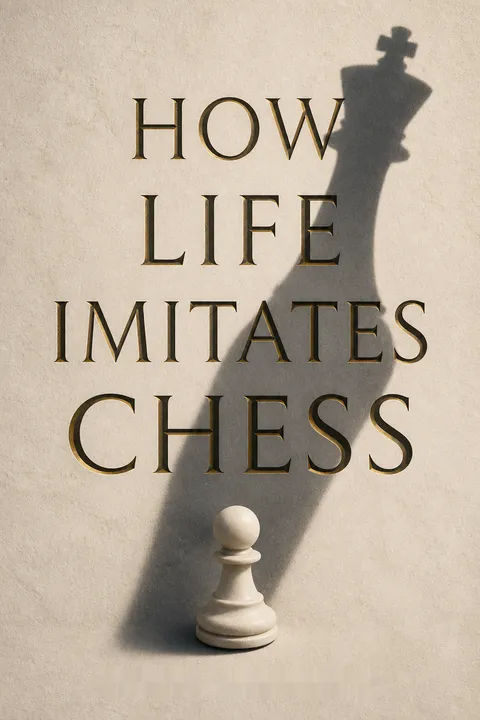
How Life Imitates Chess is less a promise that chess lessons transfer wholesale to life than a memoir of one expert learning to inspect his own mind. Its central movement is from instinctive success to conscious self-correction. The 1984-85 match with Karpov supplies the formative rupture: Kasparov's talent cannot rescue him until he studies the decision process that produced his vulnerabilities. From there, the book builds a practical vocabulary for strategy, calculation, evaluation, preparation, initiative, intuition, and crisis.
Its strongest contribution is the insistence that decision quality cannot be inferred from outcomes alone. That claim anticipates a central problem in fields such as medicine, investing, and management: noisy results reward luck as if it were skill, then punish sound choices when circumstances turn. Kasparov's advice to examine victories as rigorously as defeats is therefore more than a motivational device. It is a method for resisting hindsight bias and complacency.
The Material, Time, Quality framework is especially useful because it resists reducing a position to what can be counted. Assets matter, but so do timing and the utility of those assets in context. The framework encourages multidimensional evaluation while remaining simple enough to remember. Its limitation is also clear: social life includes values that cannot be cleanly traded against one another, and chess's sharply defined win condition does not exist in many human decisions.
The book's human-machine argument remains striking: raw computational strength can be less valuable than a good process for combining machine search with human evaluation. This insight now applies well beyond chess software. Yet the book is most persuasive when it stays grounded in Kasparov's own career, where the reader can see adaptation, overconfidence, and pressure at work. Its broad historical analogies sometimes imply a cleaner transfer from chess to politics or business than those domains permit. The best use of the book is not to play life as chess, but to borrow chess's discipline of asking why a move serves the larger position.
Review Summary
Reviews of How Life Imitates Chess are mixed. Some readers praise it as insightful and thought-provoking, drawing parallels between chess, business, and politics. They appreciate the valuable life advice and strategic thinking lessons. However, others find it overly focused on chess history and politics, lacking practical value for novices. Critics argue it's too superficial in places and not as helpful for improving chess skills as expected. The book's style, blending chess experiences with broader life lessons, appeals to some but disappoints others seeking more specific chess or strategic guidance.
People Also Read

Glossary
Material, Time, Quality
Three factors for evaluationKasparov's evaluation framework considers material resources, time or tempo, and quality, meaning how useful resources are in their current position. In chess, a player may trade pieces for attacking speed or sacrifice a pawn to activate other forces. The framework broadens assessment beyond counting assets and asks what those assets can accomplish.
Candidate moves
Plausible choices to examineCandidate moves are the small set of plausible moves a chess player selects for detailed analysis. Rather than examine every legal move, the player compares a manageable number, follows likely replies, and removes weaker branches. Kasparov presents this as a way to balance breadth and depth when time and attention are limited.
Initiative
Capacity to create threatsIn Kasparov's chess vocabulary, the initiative is the ability to generate threats that force an opponent to respond. The player holding it can influence the course of play because the defender has fewer choices and less freedom to pursue an independent plan. The advantage is dynamic and can disappear if it is not used.
Advanced Chess
Human and computer partnershipAdvanced Chess is a format in which human players use chess software during a game. The human contributes strategic judgment, evaluation, and planning, while the computer checks tactical lines and calculations. The format tests not only the power of the machine, but also how effectively a person can direct and interpret its analysis.
chunks
Recognized patterns of informationChunks are meaningful groups of information that an experienced person recognizes and remembers as a unit. In chess, a master can recall familiar arrangements of pieces more easily than a random placement because the arrangement carries recognizable structure. Kasparov uses this idea to explain why expertise depends more on pattern recognition than on photographic memory.
theoretical novelty
A move new to the positionA theoretical novelty is a move that has not previously been played in the position under discussion. In professional chess, players search databases and analyze established openings to discover such moves. A novelty can surprise an opponent and create a practical advantage, but being new does not make a move good; its quality still depends on analysis.
crisis
High-stakes turning pointKasparov uses crisis to mean a consequential turning point where the outcome is uncertain and choices may become irreversible. It is not simply another word for disaster. A crisis can present danger and opportunity, and detecting one early matters because complexity, pressure, and narrowing options can otherwise overwhelm deliberate judgment.
FAQ
What's How Life Imitates Chess about?
- Chess as a metaphor: Garry Kasparov uses chess to explore life and decision-making, illustrating how chess principles apply to broader contexts.
- Personal insights: The book includes anecdotes from Kasparov's chess career, particularly his matches against Anatoly Karpov, to highlight decision-making processes.
- Interdisciplinary approach: It combines psychology, strategy, and philosophy, making it relevant to anyone interested in improving decision-making skills.
Why should I read How Life Imitates Chess?
- Learn from a champion: Kasparov, a world chess champion, shares insights into the mindset and strategies that led to his success.
- Practical applications: The book offers advice on approaching challenges, making better decisions, and adapting to change.
- Engaging storytelling: Kasparov's narrative style makes complex concepts accessible and engaging.
What are the key takeaways of How Life Imitates Chess?
- Self-awareness is crucial: Understanding one's decision-making processes is essential for peak performance.
- Adaptability over consistency: Success requires adapting to changing circumstances while maintaining momentum.
- Strategy and tactics: Long-term planning (strategy) should guide short-term actions (tactics).
What are the best quotes from How Life Imitates Chess and what do they mean?
- “The man who knows how...”: Emphasizes understanding the reasoning behind actions for leadership potential.
- “Success is the enemy...”: Warns against complacency from past achievements, advocating for continuous self-evaluation.
- “Every move creates a weakness.”: Highlights the risks in decision-making, encouraging careful consideration.
How does Garry Kasparov define strategy in How Life Imitates Chess?
- Long-term planning: Strategy is an overarching plan guiding decisions over time.
- Dynamic adjustments: Strategy must be flexible to adapt to changing circumstances.
- Self-awareness in strategy: Understanding strengths and weaknesses is crucial for effective strategy formulation.
How does How Life Imitates Chess address the concept of talent?
- Talent is multifaceted: Encompasses qualities like memory and creativity, varying under strain.
- Nurturing talent: Hard work and preparation are essential for developing talent.
- Recognizing patterns: Critical aspect of talent, encouraging exploration of unique strengths.
What is the significance of adaptability in How Life Imitates Chess?
- Key to survival: Adaptability is crucial for success in a rapidly changing environment.
- Flexibility in strategy: Allows for adjustments based on new information or circumstances.
- Learning from experiences: Involves applying lessons from past experiences to future situations.
How does Kasparov relate chess to decision-making in life?
- Strategic parallels: Chess strategies mirror decision-making processes, requiring evaluation and adaptation.
- Crisis management: Crises reveal character and decision-making abilities, crucial for success.
- Long-term vision: Encourages considering broader implications of choices, akin to seeing the entire chessboard.
How does Kasparov view the role of computers in chess?
- Tools for improvement: Computers enhance understanding and provide insights not immediately apparent.
- Human vs. machine: Reflects on matches against Deep Blue, exploring human intuition vs. machine calculation.
- Collaboration over competition: Advocates for humans and machines working together for greater results.
What lessons does Kasparov draw from his chess career for personal development?
- Continuous learning: Success requires evolving and embracing new challenges.
- Resilience in failure: Highlights the necessity of resilience in overcoming setbacks.
- Strategic planning: Encourages setting clear objectives and remaining flexible in approaches.
How does Kasparov connect chess with broader societal issues?
- Reflection of society: Chess reflects societal changes and intellectual progress.
- Political insights: Uses chess as a metaphor for strategy in governance and leadership.
- Crisis and opportunity: Suggests crises present opportunities for growth and change.
How does Kasparov suggest we develop our intuition?
- Experience and practice: Intuition is developed through challenging activities and practice.
- Learning from mistakes: Analyzing past decisions refines intuition and decision-making skills.
- Balancing analysis and instinct: Advocates for a balance between analytical thinking and trusting instincts.
About the Author
Other books by Garry Kasparov

Download PDF
Download EPUB
.epub digital book format is ideal for reading ebooks on phones, tablets, and e-readers.








