

Key Takeaways
Mark Twain turned publishing genius into wealth, then repeatedly gambled it away
Two talents, unequal. Twain could write books that captivated readers and negotiate unusually generous publishing terms. He could also spend fortunes chasing inventions and businesses he barely understood. At fifty, profits from Ulysses S. Grant’s memoirs made him feel newly rich. He soon poured money into a complicated typesetting machine, despite its delays and mounting costs, and lost heavily when it failed. His story is not a simple tale of a fool who never succeeded: the same confidence that helped him seize an extraordinary publishing opportunity also made him vulnerable to grand promises.
The book’s central joke. Twain wanted wealth more than a literary calling, yet the work he treated as a route to money became his most reliable source of it. His financial life asks readers to separate creative brilliance from investment skill. One does not guarantee the other.
What's striking is how clearly Twain's strengths and weaknesses share a root. Confidence helps a writer take risks, persuade a powerful author, and build an audience. In investing, the same confidence can turn a plausible possibility into an imagined certainty. This resembles a broader problem of expertise transfer: mastery in one domain can make people overestimate their judgment in another. Twain's publishing success was real, but it did not validate his instincts about machinery, mining, or nutrition. The useful distinction is not between boldness and caution, but between boldness supported by evidence and boldness that substitutes for it.
A promised inheritance can keep ambition alive while distorting every decision
Wealth on the horizon. Twain grew up poor, but his father bought large tracts of Tennessee land and assured the family that patience would make them rich. The acreage became a promise that never quite arrived. Twain remembered the peculiar burden of starting poor while believing prosperity was just ahead. His brother Orion struggled to manage the property, titles were uncertain, and proposed sales repeatedly fell apart. The land eventually left the family for little apparent gain, although the book’s afterword notes that retained acreage could have become valuable much later.
Hope as fuel and trap. This anticipated fortune helped shape Twain’s drive to get rich through mining, publishing, and inventions. It gave him a reason to keep trying, but also encouraged him to treat future wealth as if it were already within reach. A forecast is not an asset, even when it has been repeated for years.
The land functions as more than a failed investment. It is a family story that teaches Twain to live emotionally in a future that has not yet happened. Behavioral economics calls attention to how expectations influence present choices: people may take larger risks when they feel a windfall is near, even if the evidence is weak. The counterpoint is that ambitious expectations can help people persist through real hardship. The challenge is to keep aspiration separate from accounting. Twain's family had a claim to land, but not a dependable source of money, and the difference mattered.
Test the route before falling in love with the fortune at its destination
The Amazon plan. As a young man, Twain read about coca leaves and imagined building a trade that would supply the world. He recruited partners, planned an expedition, and left for New Orleans with little money. There he discovered that no ship ran from the city to the Brazilian port he needed. His grand enterprise had overlooked the first practical step: getting there. The scheme ended before it began.
A useful pivot. On the return journey, Twain asked steamboat pilot Horace Bixby to train him. He borrowed the required down payment from his brother-in-law, completed his apprenticeship, and earned good wages steering riverboats. The shift shows both sides of Twain’s temperament. He acted before researching basic logistics, but he could also recognize an available path and move toward it. Before committing money or time, check whether the essential steps, partners, transport, and costs actually exist.
This episode makes a sharp distinction between vision and execution. A compelling destination can create energy, but it can also hide mundane dependencies. In project planning, the equivalent is testing the riskiest assumption first: if the route, supplier, permission, or customer does not exist, the rest of the plan is decoration. Twain's pivot also matters. Planning is not a demand to avoid uncertainty; it is a way to encounter uncertainty cheaply. His river career emerged not from a perfect master plan, but from responding to a real opportunity after the imagined one collapsed.
In a boom, separate a mine’s real value from the story selling its shares
Silver fever. In Nevada, Twain joined the rush to mine and trade claims. He once believed a glittering sample meant riches, only to learn it was worthless mica. Later, he and partner Cal Higbie found a promising hidden vein called a blind lead. Local rules required them to begin work within ten days to keep the claim. Each man missed the other’s note, neither did the work, and another prospector took it. The ore later proved valuable.
A market built on promotion. As a reporter in Virginia City, Twain saw mine owners reward journalists with shares. Reporters praised tunnels, machinery, and supervisors while evading the central question of whether the ore would pay. When the Comstock boom collapsed, Twain’s stock holdings became nearly worthless. The episode suggests a basic rule: when a seller’s story can move the price, seek evidence independent of the seller, and understand the conditions attached to ownership.
The missed claim is partly a comedy of communication, but it also exposes the difference between identifying value and capturing it. A promising asset can be lost through a deadline, unclear ownership, or failure to act. The newspaper work adds an information problem: people who influence an investment story may profit from the securities they promote. Modern investors encounter the same structural conflict in different forms, from sponsored analysis to insider enthusiasm. Yet the book also warns against treating every failure as proof that speculation is irrational. Twain sometimes spotted genuine opportunities; he lacked a reliable process for validating, securing, and exiting them.
Treat writing as Twain’s dependable business, not merely his route to riches
An accidental profession. Twain did not begin with a sacred calling to write. He wanted money, and his early humorous story about a jumping frog brought attention more than immediate profit. That recognition led to newspaper work, lectures, and travel writing. His book The Innocents Abroad became a major success. Rather than accept a $10,000 payment for the manuscript, he took a royalty, a choice he later regarded as sound business judgment.
A rare winning deal. Twain’s publishing company also secured Ulysses S. Grant’s memoirs by offering Grant’s family a far larger share of proceeds than a competing publisher proposed. The book sold more than 300,000 sets, paid Grant’s widow over $400,000, and earned Twain about $200,000. This success rested on a strong author, a large audience, and a distribution plan. Twain’s literary career was not just a lucky side effect: it repeatedly financed the ventures that his other instincts endangered.
Twain's career complicates the familiar advice to discover one passion and pursue it. He found a craft through paid work, audience response, and repeated practice, not through an early revelation. His strongest business decisions also show the importance of incentives: Grant received a substantial share, while Twain's firm gained a valuable book. The lesson is not that royalties are always better than a guaranteed payment, since the right choice depends on risk and bargaining power. It is that Twain could make astute decisions when the product, audience, and economics were visible, rather than hidden inside an inventor's promise.
A clever invention still needs proof that customers will pay for it
Ideas are not demand. Twain patented a self-pasting scrapbook that sold well, showing that practical invention could work for him. Other ventures did not. He backed a process called Kaolotype after its inventor presented impressive samples, but his nephew discovered the samples predated the company’s investment and the claimed process had not been perfected. Twain estimated that the venture cost him about $42,000. He also expected a biography of Pope Leo XIII to sell widely because Catholics formed a vast potential audience. The book fell far short: a large population did not mean a large group of eager buyers.
Validate before scaling. These failures had different causes, including fraud and misjudged demand, but both exposed the cost of treating possibility as proof. A prototype must work as claimed; a market must contain customers who want the product at its price. Twain often skipped one or both tests.
The contrast between the scrapbook and the failed ventures is a useful reminder that originality alone is not a commercial strategy. Product development depends on at least two distinct questions: can the thing be made reliably, and does someone value it enough to buy it? Fraud frustrates the first; wishful market sizing frustrates the second. The book's examples anticipate modern startup language about validation, but they also caution against reducing every failure to poor research. Twain faced deception as well as his own optimism. Due diligence cannot eliminate risk, yet it can make the source of risk visible before the expense becomes irreversible.
Stop funding perfection when a rival product already works
The machine that ate the profits. Twain invested heavily in James Paige’s elaborate typesetting machine, intended to set print far faster than human workers. The device contained thousands of parts and could produce impressive results, but it needed years of tinkering. Twain kept paying as deadlines slipped, while Ottmar Mergenthaler’s simpler Linotype machine gained customers. By the early 1890s, Twain had invested roughly $175,000 in the Paige venture, and profits from his publishing company helped sustain it. When the machine was tested by the Chicago Herald in 1894, it proved too error-prone and difficult to maintain.
The cost of waiting. A technically remarkable invention can still be a poor business if it is unreliable, expensive, or too late. Twain’s mistake was not simply backing an ambitious machine. It was repeatedly treating more funding as a path to completion without setting a credible stopping point or accounting for the working alternative.
The Paige Compositor illustrates escalation of commitment: after investing heavily, decision-makers may keep spending partly to avoid admitting that earlier spending cannot be recovered. But sunk costs are not the only issue. A complex machine can be technically impressive and commercially inferior if customers need dependable service more than maximum speed. Rogers's description of the device captured that mismatch: it behaved too much like a person, with a person's susceptibility to breakdown, and not enough like a maintainable machine. Twain's story therefore separates invention from adoption. The market rewards not only what a device can do, but what customers can operate and repair.
Read Twain’s debt-free comeback alongside the deals that made it possible
Recovery had several engines. In 1893, Twain’s publishing company was in trouble, and his debts threatened the royalties on his books. Financier H. H. Rogers reorganized the situation, helped unwind the failing Paige venture, and arranged a bankruptcy process for the publisher. Twain then toured internationally, lectured for income, and published new work. In 1898, Rogers told the family that they were clear of debt, with money left over. Twain’s copyrights and continuing popularity also remained valuable sources of income.
The legend needs context. Twain later became famous for paying his debts, but the book notes that the story was more complicated: assets had been transferred to Livy before bankruptcy, and the Mount Morris Bank was not repaid. Twain’s comeback involved hard work and genuine concern for creditors, but also legal and financial protections. A celebrated reputation can be true in part without being the whole account.
This ending resists the tidy redemption arc. Twain did labor to earn money and satisfy many creditors, but Rogers's financial management and the transfer of assets shaped what could be lost in bankruptcy. That distinction matters because reputations often compress complex legal arrangements into a single moral label. It also matters that preserving copyrights gave Twain a continuing income stream, while the lecture tour converted fame into cash. The lesson is not to condemn the recovery, but to distinguish personal virtue, creditor outcomes, and strategic protection. Those are related questions, not interchangeable ones.
Analysis
This financial biography is most revealing when read as a study of mismatched strengths. Twain possessed unusual literary instinct, social energy, persuasive force, and curiosity about machines. He could recognize that Grant’s memoirs had a major audience, negotiate aggressively for them, and use publicity to sell books. Those capacities did not transfer neatly to mining claims or technical ventures. There, he often treated conviction, an inventor’s confidence, or a huge imagined market as evidence.
The chronology matters. Twain’s ambitions formed in a nineteenth-century economy transformed by railroads, mining booms, industrial production, and new publishing channels. His choices were not made with today’s regulatory systems, investment disclosures, or standardized business practices. That context helps explain risk, but it does not make his repeated leaps into poorly tested ventures prudent. The book’s best stories hold both truths at once: he faced a volatile environment, and he repeatedly made himself more vulnerable through impulsive judgment.
The title promises a cautionary lesson, but the book is not a simple manual for avoiding bad investments. Twain also benefited from chance, timing, family wealth, a growing celebrity, and the work of capable allies. His recovery depended on Rogers’s expertise, Livy’s support, Twain’s own touring and writing, and the enduring value of his copyrights. No single trait explains the rise or the near-collapse.
The most useful frame is therefore not that genius makes people foolish, or that failure is secretly a blessing. It is that success in one domain can conceal weaknesses in another, especially when confidence becomes a substitute for evidence. Twain’s literary gift generated real value. His business failures show what happened when the possibility of a fortune felt more compelling than the unglamorous questions of feasibility, demand, timing, and control. The biography’s humor makes these reversals entertaining, but the financial consequences were serious for his family and partners.
Review Summary
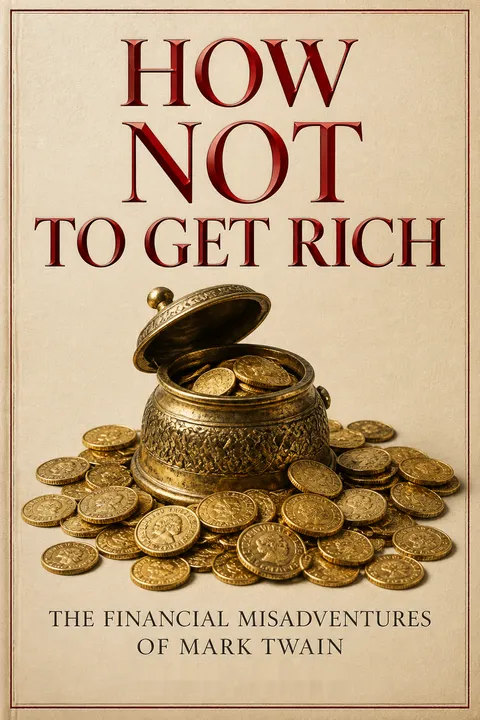
How Not to Get Rich receives mixed reviews, with an average rating of 3.65/5. Readers find Twain's financial mishaps amusing but also frustrating. The book is praised for its humor and insights into Twain's lesser-known side. Some criticize the chronological structure and lack of clear focus. Many appreciate learning about Twain's business ventures and obsession with wealth. The book is described as engaging and enlightening, offering a unique perspective on the famous author's life. However, some found it repetitive or disappointing in its execution.
People Also Read




Glossary
Big Hairy Audacious Goal (BHAG)
A bold, long-term objectiveA term for a large, clear, and demanding goal intended to energize a person or organization over an extended period. The book uses it to describe Twain’s imagined plan to establish a worldwide trade in coca. The ambition was vivid and expansive, but his preparations overlooked basic questions such as whether he could travel to the intended market.
blind lead
A hidden mineral veinA mining term for a vein of ore that is not visible at the surface. Twain and his partner Cal Higbie believed they had found such a vein near an existing silver mine. Local rules required them to begin working the claim within a short period. Because they failed to do so, another prospector took it.
Kaolotype
A proposed printing processA process for making book illustrations using a clay mixture called kaolin and steel plates. Twain invested in a company formed to develop and market it, then financed further experiments and applications. His nephew’s investigation found that the inventor had misrepresented the samples and had not produced the promised new process.
Paige Compositor
A mechanical typesetting machineJames Paige’s elaborate machine, designed to assemble movable type far faster than human typesetters. Twain invested heavily in its development and believed it could transform newspaper production. Despite its speed and technical complexity, it remained difficult to finish, operate, and repair. A competing Linotype machine reached the market sooner and proved more practical.
Plasmon
A powdered protein foodA food supplement made from a protein-rich substance that Twain encountered in Europe. He believed it was highly nutritious and promoted it to friends and investors, eventually leading companies formed to sell it in Britain and the United States. The American company failed, and Twain lost money. The book presents his confidence in its benefits as another example of enthusiasm outrunning independent verification.
subscription book business
Books sold through advance agentsA publishing model in which commissioned agents visited homes, showed customers promotional materials, and collected advance orders for books. It offered access to readers beyond bookstores and helped sell popular works such as Twain’s travel writing and Grant’s memoirs. The model carried substantial sales and distribution costs, and it became less effective as bookstores spread and installment payments went unpaid.
Download PDF
Download EPUB
.epub digital book format is ideal for reading ebooks on phones, tablets, and e-readers.








