

Key Takeaways
Treat memory as a skill: encode information, then practice retrieving it.
Memory can improve. O’Brien’s central claim is that poor recall is not a fixed personal defect. He describes struggling to absorb schoolwork, then becoming a memory champion through training. The book’s opening tests, covering words, numbers, shapes, and cards, offer a baseline for practice, not a verdict on someone’s potential. The final tests can show progress, though their scores are not directly comparable because the last assessment adds a category.
Build the memory deliberately. O’Brien organizes his approach around association, location, and imagination. First make information distinctive, give it a place in an orderly mental structure, and create a cue that can bring it back. The methods are most useful when practiced on real errands, names, and facts, rather than treated as tricks for one-off demonstrations.
The book’s most persuasive move is to replace a vague judgment, such as having a bad memory, with specific skills that can be practiced. That shift resembles deliberate practice in music or sport: performance improves when a learner identifies a task, gets feedback, and repeats it. The important qualification is that mnemonic skill is not identical to broad intelligence or understanding. A person may become excellent at recalling an ordered list without gaining deeper knowledge of its subject. The methods work best as tools for reliable access to information, alongside comprehension and judgment.
Put ordered facts on a familiar route, not in a shapeless list.
Give information addresses. The Journey Method stores items at successive landmarks on a route the learner knows well. A familiar home, walk, or workplace becomes an ordered retrieval path: each stop cues the item placed there. To remember several errands, for instance, a person could assign one to the front entrance, one to the kitchen, and another to the stairs, using a logical route through the house.
Reuse a well-learned route. Once its stops are familiar, the route can hold new material without being rebuilt each time. Walking forward retrieves items in order; walking backward can reverse the sequence, and a known landmark can help locate a particular item. Separate routes help keep different sets of information from colliding.
This method turns a strength of everyday cognition, remembering where things are, into an indexing system. Spatial cues can make arbitrary sequences easier to retrieve because each item has both a distinctive image and a stable address. The route also supplies order without requiring the learner to rehearse every item as an isolated fact. The main practical risk is interference: if multiple lists occupy the same landmarks at once, their images can blend. A clean route, vivid scenes, and deliberate clearing between uses make the technique more dependable.
Make information strange, active, and personal enough to earn attention.
Forge memorable links. The Link Method connects successive items through imagined interactions. Rather than repeating a list of unrelated objects, the learner creates a short chain in which one object acts on the next. The book also offers the Body System for brief lists: attach each item to a body part, moving in a consistent direction. It recommends keeping this quick method to roughly ten items.
Use vivid cues, not perfect pictures. Images can be cartoonish or incomplete. A defining feature, sound, smell, or movement may be enough to trigger the target. Exaggeration and humor help make a scene distinctive, but the association must still point clearly to the intended word. The exercise is not about artistic talent. It is about inventing a retrieval cue that is easy to recognize.
Distinctiveness explains why unusual imagery can help: a memorable cue is less likely to be confused with the many ordinary scenes competing for attention. The book’s sensory emphasis also encourages learners to use more than visual detail, which can make an image personally meaningful. However, bizarre is not automatically memorable if its connection to the target is obscure. A useful test is whether the image retrieves the intended item quickly, without a long chain of explanation. The strongest mnemonic is not the strangest one, but the one that is both vivid and legible to its maker.
Turn long numbers into familiar people before storing them in sequence.
Give digits identities. The Dominic System translates each two-digit number into letter initials, then assigns those initials to a familiar person with a characteristic action or prop. Its letter code is: 1=A, 2=B, 3=C, 4=D, 5=E, 6=S, 7=G, 8=H, 9=N, and 0=O. For example, 72 becomes GB, which can stand for a person whose initials match. A twenty-digit sequence becomes ten people placed along a Journey Method route.
Combine images for scale. The Complex Dominic System joins a person and another person’s action or prop into one scene, allowing a four-digit group to be stored compactly. Simpler single-digit systems use number shapes or rhyming words. These codes take practice, but they turn a string of abstract digits into recognizable, ordered images.
The underlying move is a form of chunking: several low-meaning symbols become one richer unit that can be handled as a single image. That is especially useful for phone numbers, dates, and performance tasks where exact order matters. The system’s cost is its setup. Each learner needs stable, instantly recognizable characters, and the author’s examples may not mean much across generations or cultures. Personalizing the cast is therefore not decoration; it is part of the encoding. For security-sensitive numbers, memorability should not become a reason to reuse or expose a code.
Attach each new name to the face before the introduction ends.
Names need extra hooks. A face often feels familiar while its name remains elusive because names usually describe no visible feature. O’Brien recommends noticing a distinctive facial detail, finding a sound or image inside the name, or placing the person in a familiar location. A complicated surname can be divided into syllables and converted into cues. The goal is a chain that leads from the person’s face to the name, rather than an attempt to memorize the name by repetition alone.
Pay attention at the meeting. The technique begins with actually hearing the name and observing the person. If the person later appears in a different setting, a familiar place or feature can help retrieve the association. The same location-based logic can organize directions: encode each instruction at a successive stop on a route, preserving the order of turns.
This advice highlights a common source of forgetting: information that was never fully attended to cannot be retrieved reliably. The name-face link gives attention a job at the moment of introduction, then turns an arbitrary label into something connected to perception. The method also recognizes that retrieval depends on cues. A name may return when the person is encountered in a familiar context, even if it failed in another setting. There is a limit, though: a cue helps only if it was encoded accurately, so asking someone to repeat an unclear name is often more useful than inventing a confident but wrong association.
File new foreign words by sound, meaning, and grammatical gender.
Make vocabulary multi-cued. O’Brien suggests finding a sound-alike link between a foreign word and its meaning in the learner’s language. For languages with masculine and feminine nouns, Gender Zones assign a different familiar region to each gender. The learner can then place a sound-based image in the appropriate region. One scene can carry both the word’s meaning and its grammatical category.
Extend the filing system. The same idea can organize other vocabulary groups, such as verbs, adjectives, and numbers, in separate familiar places. A learner should choose locations that are easy to picture and keep the gender assignment consistent. The method is intended to make recall more direct than rote repetition, while still requiring repeated practice to make the foreign word and its meaning familiar.
The technique combines phonological association with spatial organization, giving a new word more than one path into memory. It also addresses an awkward feature of language learning: grammatical gender is often arbitrary from the learner’s perspective, so a location can act as a clear label. This is a useful support for vocabulary retrieval, but it cannot substitute for hearing words in context, learning their usage, or practicing conversation. A mnemonic may retrieve a translation while leaving pronunciation or nuance weak. Its best role is as an entry point into richer language use.
Use maps and route cues to recall a speech's argument, not a script.
Remember the structure. A Mind Map places a central subject in the middle of a page, then connects major ideas and supporting points through branches, keywords, color, and simple images. O’Brien recommends it for organizing reading, lectures, projects, and presentations. A speaker can mentally follow the branches in a chosen order, using each key point to prompt the explanation rather than memorizing every sentence.
Keep delivery flexible. The Journey Method offers another way to order a speech: convert each main point into an image and place it at a successive landmark. This is safer than learning a talk word for word, because forgetting one sentence need not erase the next idea. Important phrases can still be practiced exactly, while the overall talk remains organized around its essential points.
A map or route acts as an external structure that can be internalized, reducing the burden of holding a whole presentation in working memory. It also protects a speaker from the brittle all-or-nothing quality of verbatim recall: missing one line does not have to derail the argument. There is a productive balance here between preparation and spontaneity. Key claims and transitions need to be clear, while exact wording can remain flexible. A visual outline is not automatically a good argument, however. The speaker still has to decide which ideas matter and how they connect.
Schedule five reviews so vivid cues survive beyond the first performance.
Revisit before forgetting. The book draws on Hermann Ebbinghaus’s experiments with memorizing meaningless syllables and tracking recall over time. It also describes primacy and recency effects: items near the beginning and end of a sequence can be easier to recall than those in the middle. O’Brien’s proposed rule of five schedules reviews immediately, after 24 hours, after one week, after one month, and after three months.
Test, then strengthen. The first review is the initial learning session. Later reviews should check whether the material can still be retrieved, rather than simply invite another passive read-through. The schedule is presented as a practical pattern for maintaining recall across different kinds of information. A notebook can track the material and its review dates.
Spacing retrieval attempts over time is a powerful complement to vivid encoding. It requires the learner to reconstruct information after some forgetting has begun, which reveals gaps that rereading can conceal. The book’s schedule is best treated as a usable template rather than a universal biological timetable. Material difficulty, the consequences of forgetting, and how often the information is used all matter. The central principle is more durable than the exact intervals: revisit important knowledge at expanding gaps, and check recall instead of relying on familiarity.
Multiply memory capacity by nesting landmarks and images in orderly layers.
Add more storage points. The Roman Room Method expands a route by using several objects or positions within each room as smaller landmarks. Ten rooms with five selected points each create fifty ordered places. In another extension, a person already stored at a landmark can become a hook for an additional fact, creating a memory within a memory.
Championship feats use systems. O’Brien describes memorizing 2,808 playing cards by pairing cards into a person-and-action image, then placing those images across many routes. He also recounts Malaysian memory champion Dr. Yip Swe Chooi’s claim to have memorized roughly 58,000 dictionary entries along one enormous journey. These feats depend on elaborate preparation and practice, not a photographic memory.
Nested cues resemble hierarchical indexing in libraries and computing: a broad location narrows the search, then a smaller landmark identifies the target. This makes the method extensible in principle, and the championship stories show how systematic encoding can support feats that look supernatural from the outside. But capacity alone is not the same as speed or usefulness. A dense mental filing system can become difficult to navigate if its landmarks overlap or its cues are weak. Practicing retrieval at different levels, such as finding one item or scanning a whole sequence, helps test whether the structure is genuinely usable.
Train attention and the body, because encoding starts before mnemonic tricks.
Set up to notice. O’Brien advises short, regular memory exercises, a quiet and comfortable setting, and relaxation before trying to learn. He suggests closing the eyes and recalling a pleasant scene when the mind feels hurried. He also recommends regular physical activity and a balanced diet, and warns that sustained stress can undermine recall. His suggested daily exercise is about twenty minutes, with no need for extreme training.
Practice beyond the desk. Everyday tasks can become memory drills: remember a person’s name, a street number, or an errand without immediately writing it down. The book’s broader point is that attention, physical condition, and memory technique work together. Mnemonics cannot reliably preserve details that were never noticed in the first place.
This section usefully widens memory training beyond clever images. Attention governs what gets encoded, while stress can consume mental resources that would otherwise support learning. Physical activity and relaxation also make practice easier to sustain. Some of the book’s nutrition and brain claims are stated more confidently than its evidence in the text can establish, so they should not be treated as precise medical guidance. The sound practical advice is modest: protect concentration, move regularly, and make memory practice part of ordinary life rather than an occasional test.
Analysis
This is a practical training manual organized as a gradual course, not a theory of memory in the abstract. Its narrative engine is the author’s transformation from a struggling student into a memory champion, which gives force to the claim that recall can be trained. The strongest through-line is encoding: convert information into vivid cues, place those cues in stable locations, and rehearse retrieval. That framework is unusually concrete. A reader can try it on a shopping list, names at a gathering, vocabulary, dates, or a speech, then increase difficulty through longer journeys, number codes, and nested locations.
The book’s most transferable insight is not that every fact should become bizarre imagery. It is that arbitrary information becomes easier to retrieve when it has meaningful structure. Routes provide order; distinctive images reduce confusion; review strengthens access. The named techniques are variations on those functions. Their impressive use in card and number competitions demonstrates how far deliberate encoding can go, but such feats should not be confused with universal memory improvement. Remembering a coded sequence does not automatically improve comprehension, reasoning, or the ability to judge whether a fact is true.
A modern reading should also separate the book’s useful practical advice from its more sweeping explanations. The claim that mnemonic images move information directly into long-term memory is a metaphor, not a literal bypass of ordinary learning processes. Likewise, its discussion of brainwaves and nutrition should be read cautiously. The durable recommendations need no grand neurological promise: attend closely, connect new facts to existing knowledge, practice retrieval, and space reviews. The route method is likely to suit people who think readily in images and places; others may prefer verbal or diagrammatic cues. The book is best used as a toolbox, with each technique tested against the learner’s actual recall, rather than as a promise of perfect memory.
Review Summary
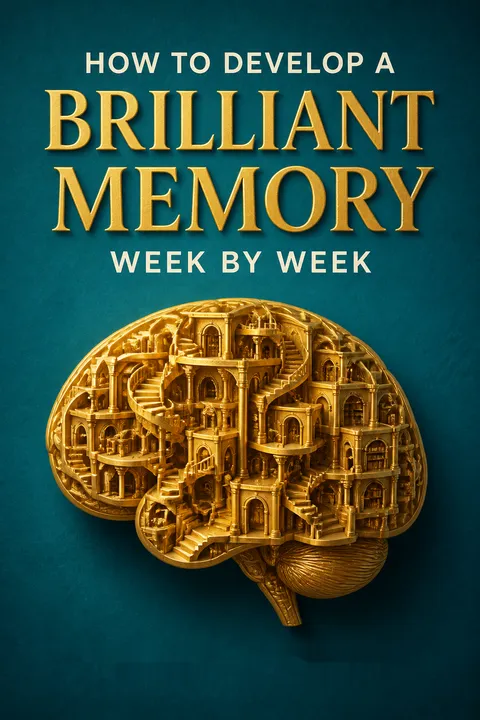
How to Develop a Brilliant Memory Week by Week offers practical memory techniques and exercises, focusing on visualization, association, and location. Readers appreciate its structured approach and progressive difficulty. Many find the techniques effective, particularly for everyday tasks like remembering names and lists. Some reviewers note that while certain methods may seem outdated or impractical, the book provides valuable tools for memory improvement. The exercises are praised for allowing immediate practice and personalization. Overall, most readers find the book helpful in enhancing their memory skills, though some suggest it's best suited for beginners.
People Also Read









Glossary
Journey Method
Route-based memory storageA mnemonic technique that stores information at successive stops along a familiar mental route. The route supplies order, and each landmark cues the item assigned to it. It can be reused for short lists or expanded with additional routes for separate sets of information.
Link Method
Chained imagined associationsA method for recalling an ordered list by imagining each item interacting with the next. The resulting chain of scenes provides cues for the sequence. Exaggeration, movement, and unusual details can make a link more distinctive, but the image should still clearly suggest the item it represents.
Dominic System
Two-digit person codeA number mnemonic that assigns each two-digit number from 00 to 99 a pair of initials, using a fixed digit-to-letter code. The initials are matched with a familiar person, who can then represent that number in a sequence. A characteristic action or prop makes each person easier to distinguish.
Complex Dominic System
Person-action number encodingAn extension of the Dominic System that combines a person representing one two-digit number with the action or prop of another. The combined scene can encode four digits as one image. The image can then be placed at a stop on a Journey Method route to preserve its position in a longer sequence.
Number-Shape System
Digits represented by shapesA mnemonic for single digits that turns each number into an object resembling its visual form. The learner links those objects into a scene or sequence to help recall the digits. The chosen images can be customized, provided each digit has a stable, recognizable shape association.
Number-Rhyme System
Digits represented by rhymesA mnemonic that gives each single digit a word that rhymes with it, such as a selected object or person. The rhyme word becomes a cue that can be linked to a fact involving that number. Consistent associations help the learner retrieve the intended digit.
Gender Zones
Locations for noun genderA vocabulary technique for languages with grammatical gender. The learner assigns a familiar region or location to each gender, then places an image linking a foreign word’s sound to its meaning in the appropriate zone. The location cues gender while the sound-based image cues the word and its translation.
Roman Room Method
Multiple cues within roomsAn extension of route-based memorization that uses several objects or distinct positions inside each room as additional storage points. For example, a room’s furniture and architectural features can each cue a separate item. A consistent viewing order helps keep the smaller locations distinct.
Binary Code
Binary groups become digitsO’Brien’s mnemonic conversion for binary sequences. It divides binary digits into groups of three and assigns each possible group a single decimal digit. Six binary digits then become a two-digit number, which can be encoded using the Dominic System and placed along a mental route.
Time Travel
Location-cued autobiographical recallA reflective exercise for recalling personal memories by mentally returning to a place from one’s past. The learner reconstructs sensory details, people, sounds, and emotional context associated with that location. These cues can prompt connected memories and help organize recollections of a particular period.
rule of five
Five spaced review pointsA review schedule proposed in the book to strengthen retention: revisit material immediately, then after 24 hours, one week, one month, and three months. The schedule is a practical guideline for spaced review, not a claim that every kind of information requires identical intervals.
Mind Map
Visual map of key ideasA diagram that places a central subject at the center of a page and organizes related ideas as branching topics. Keywords, color, and simple images help show relationships and relative importance. The book attributes Mind Maps to Tony Buzan and applies them to reading, lectures, planning, revision, and speech preparation.
Three keys of memory
Association, location, imaginationThe book’s shorthand for three elements used across its mnemonic techniques. Association links new information to a cue; location gives the cue an ordered mental place; and imagination creates a distinctive scene. Together they form the basic method behind routes, linked images, and other memory systems.
FAQ
What's "How to Develop a Brilliant Memory Week by Week" about?
- Memory Enhancement Focus: The book is a comprehensive guide to improving memory skills through a series of 52 steps, each designed to be tackled weekly.
- Structured Approach: It offers a structured approach to memory training, with each chapter focusing on different aspects of memory improvement, from basic tools to advanced techniques.
- Practical Exercises: The book includes practical exercises and tests to help readers apply the techniques and track their progress.
- Author's Expertise: Written by Dominic O'Brien, a world memory champion, the book draws on his extensive experience in memory training.
Why should I read "How to Develop a Brilliant Memory Week by Week"?
- Improve Memory Skills: The book provides proven methods to enhance memory, which can be beneficial in both personal and professional settings.
- Step-by-Step Guidance: It offers a clear, step-by-step guide that makes memory improvement accessible to everyone, regardless of their starting point.
- Practical Application: The exercises are designed to be practical and applicable to everyday situations, such as remembering names, numbers, and directions.
- Expert Insights: Gain insights from Dominic O'Brien, who has successfully trained his memory to world-class standards.
What are the key takeaways of "How to Develop a Brilliant Memory Week by Week"?
- Three Keys of Memory: The book emphasizes association, location, and imagination as the three fundamental keys to improving memory.
- Journey Method: A central technique taught is the Journey Method, which uses familiar locations to store and recall information.
- Dominic System: The book introduces the Dominic System, a method for memorizing numbers by associating them with people and actions.
- Regular Practice: Consistent practice and review are crucial for transferring information from short-term to long-term memory.
How does the Journey Method work in "How to Develop a Brilliant Memory Week by Week"?
- Familiar Locations: The Journey Method involves using familiar locations as a mental map to store information.
- Sequential Order: Information is placed along a predetermined route, preserving the order and making it easier to recall.
- Visualization: By visualizing vivid images at each stop, the method leverages the brain's natural ability to remember spatial and visual information.
- Reusability: The same journey can be reused for different sets of information, making it a versatile memory tool.
What is the Dominic System in "How to Develop a Brilliant Memory Week by Week"?
- Number-Person Association: The Dominic System converts two-digit numbers into initials, which are then associated with a person.
- Action and Prop: Each person is linked with a specific action or prop, creating a memorable image for each number.
- Complex Images: For longer sequences, the system combines characters and actions to form complex images.
- Efficient Memorization: This method allows for the quick and efficient memorization of large numbers by turning them into meaningful stories.
How can I use the techniques in "How to Develop a Brilliant Memory Week by Week" in daily life?
- Names and Faces: Use association and visualization to remember people's names by linking them to distinctive features or familiar places.
- Directions: Apply the Journey Method to memorize directions by visualizing each step along a familiar route.
- Numbers and Dates: Use the Dominic System to remember phone numbers, PINs, and important dates by converting them into characters and actions.
- Speeches and Presentations: Create a Mind Map or use the Journey Method to organize and recall key points during public speaking.
What are some practical exercises from "How to Develop a Brilliant Memory Week by Week"?
- Word Lists: Memorize lists of words using association and visualization techniques to improve recall.
- Number Sequences: Practice memorizing sequences of numbers using the Dominic System and Number Shapes.
- Shopping Lists: Use the Body System to remember shopping lists by associating items with parts of the body.
- Binary Numbers: Challenge yourself with binary number sequences using the Binary Code method for advanced memory training.
What are the best quotes from "How to Develop a Brilliant Memory Week by Week" and what do they mean?
- "Memory depends on three basic processes: making something memorable, storing that item in the mind, and recalling it accurately at some future time." This quote highlights the fundamental processes involved in memory and the importance of each step in effective recall.
- "Imagination is more important than knowledge. Knowledge is limited. Imagination encircles the world." Quoting Einstein, the book emphasizes the power of imagination in creating memorable associations.
- "You are never too young nor too old to acquire these skills." This encourages readers of all ages to engage in memory training, reinforcing the idea that memory improvement is accessible to everyone.
How does "How to Develop a Brilliant Memory Week by Week" address common memory challenges?
- Names and Faces: The book provides techniques for associating names with visual cues to overcome the common challenge of forgetting names.
- Complex Information: It offers methods like the Journey Method and Dominic System to handle complex information such as numbers and dates.
- Concentration: Tips for improving concentration are included, helping readers focus better and enhance memory retention.
- Stress Management: The book discusses the impact of stress on memory and offers strategies to manage stress for better cognitive performance.
How does "How to Develop a Brilliant Memory Week by Week" suggest improving concentration?
- Daily Practice: Engage in daily memory exercises to train your brain and improve focus over time.
- Relaxation Techniques: Use relaxation methods, such as visualization and meditation, to reduce stress and enhance concentration.
- Controlled Environment: Create a quiet, distraction-free environment for memory practice to maximize concentration.
- Physical Exercise: Incorporate regular physical activity to boost oxygen flow to the brain, supporting better concentration and memory.
What advanced techniques are covered in "How to Develop a Brilliant Memory Week by Week"?
- Roman Room Method: An extension of the Journey Method, using objects within a room as additional memory pegs.
- Complex Dominic System: Combines characters and actions for memorizing longer sequences of numbers and dates.
- Binary Code System: A method for memorizing binary numbers by converting them into base-10 numbers and using the Dominic System.
- Multiple Decks of Cards: Techniques for memorizing multiple decks of cards using the Journey Method and Complex Dominic System.
How does "How to Develop a Brilliant Memory Week by Week" incorporate health and lifestyle tips?
- Physical Exercise: Encourages regular physical activity to improve brain health and memory function.
- Balanced Diet: Recommends a diet rich in antioxidants and essential fatty acids to support cognitive performance.
- Stress Management: Offers strategies for managing stress, which can negatively impact memory.
- Holistic Approach: Emphasizes the importance of a healthy lifestyle in conjunction with memory training for optimal results.
About the Author



Download PDF
Download EPUB
.epub digital book format is ideal for reading ebooks on phones, tablets, and e-readers.








