Key Takeaways
1. Memory is a skill that can be dramatically improved through training
The key to a perfect memory is your imagination.
Imagination is crucial. The human brain excels at remembering images, especially those that are vivid, unusual, or emotionally charged. By converting abstract information into striking mental pictures, we can dramatically enhance our ability to recall it later. This technique leverages the brain's natural strengths.
Practice makes perfect. Like any skill, memory improves with consistent exercise and application of proper techniques. Regular practice not only enhances memory capacity but also increases the speed at which information can be encoded and retrieved. As these skills become more ingrained, what once seemed like remarkable feats of memory become second nature.
Memory affects all aspects of life. A well-trained memory doesn't just help with party tricks or academic pursuits. It can boost confidence, improve social interactions, enhance professional performance, and even open up new career opportunities. The ability to quickly and accurately recall information is a valuable asset in nearly any field.
2. The journey method is the foundation for remembering lists and sequences
Location is important. Always picture your person at the house you want to remember.
Create mental journeys. The journey method involves visualizing a familiar route and placing items to be remembered at specific points along that route. This could be a path through your home, a walk around your neighborhood, or any sequence of locations you know well.
Leverage spatial memory. Our brains are naturally good at remembering spatial information. By associating items with specific locations, we tap into this innate ability, making it easier to recall not just the items themselves but also their order.
Make it personal. The most effective journeys are those that have personal significance. Using locations that you're intimately familiar with ensures that the "backdrop" for your memories is always clear and easily accessible in your mind.
3. Memorizing numbers becomes effortless by converting them to memorable images
When I look at a number today, I see a person.
The DOMINIC system. This technique involves converting pairs of digits into letters, which then become initials for a person's name. For example, 14 might become AD for Arthur Daley. Each person is then associated with a specific action.
Create complex images. By combining the person and action derived from a series of numbers, you can create a vivid mental scene that represents a longer number sequence. This makes even long strings of digits memorable.
Practice and speed. With regular use, this conversion process becomes automatic. What initially might take conscious effort soon becomes an instantaneous translation from numbers to memorable images.
4. Names and faces can be easily recalled by creating vivid mental associations
Pigeon-hole people! First impressions count! Judge a book by its cover!
Leverage first impressions. When meeting someone new, pay attention to your initial reaction and any distinctive features. These can be exaggerated in your mind to create a memorable association.
Link to familiar faces. If the person reminds you of someone you know or a celebrity, use that as a basis for your mental image. This provides a strong anchor for your memory.
Associate with location. Place your mental image of the person in a location that's relevant to where you met them or something about their life or work. This adds another layer of association to strengthen the memory.
5. Mastering card memorization unlocks impressive mental feats
When I see the 6 of diamonds, I don't see the letters SD; I don't even perceive the card as the 6 of diamonds; I automatically have an image of Sharron Davies, the swimmer, wearing a rubber ring.
Assign people to cards. Create a system where each card is associated with a specific person and action. This converts the abstract symbols of playing cards into vivid, memorable images.
Use journeys for sequences. When memorizing the order of cards in a deck, place these images along a mental journey. This allows you to recall not just the cards but their exact sequence.
Practice for speed. With consistent practice, the process of converting cards to images and placing them on a journey becomes faster and more automatic. This is what allows for impressive feats like memorizing multiple decks quickly.
6. A trained memory enhances learning in various fields, from languages to trivia
You should find that it accelerates your rate of learning quite dramatically. If only I had discovered it when I was at school!
Language learning. Use mental imagery and location techniques to associate foreign words with their meanings. This can dramatically speed up vocabulary acquisition.
Historical dates and facts. Convert dates into memorable images using the DOMINIC system, and place these images on journeys to remember sequences of events.
General knowledge. Apply these techniques to memorize large amounts of trivia, making it easier to recall facts on a wide range of subjects.
7. Memory techniques can be applied to excel in games, sports, and even gambling
I don't consider myself a gambler. I play to a strategy not a system.
Improve game performance. In games like chess, use memory techniques to recall strategies, opening moves, and previous games. This can give you a significant advantage over opponents.
Enhance sports skills. Apply memory techniques to remember complex sequences of movements or plays in sports, improving your overall performance.
Gain an edge in gambling. While not encouraging gambling, the book demonstrates how a trained memory can be used in games like blackjack to keep track of cards and gain an advantage.
8. The art of memory has ancient roots but remains relevant today
I find this passage from Ad Herrenium particularly uncanny. As you know, people play an essential part in my approach to memory.
Ancient techniques still work. Many of the memory techniques described in the book have roots in ancient Greek and Roman practices, showing their enduring effectiveness.
Adaptation for modern use. While the core principles remain the same, these techniques have been adapted and refined for contemporary applications.
Universal cognitive principles. The fact that similar memory techniques have been independently developed across time and cultures suggests they tap into fundamental aspects of human cognition and memory.
Last updated:
FAQ
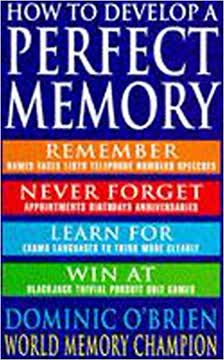
1. What is "How to Develop a Perfect Memory" by Dominic O'Brien about?
- Memory training from a champion: The book is a practical guide to memory improvement, written by eight-time World Memory Champion Dominic O'Brien.
- Step-by-step memory systems: It introduces readers to O'Brien’s personal memory techniques, developed through years of experimentation and competition.
- Everyday applications: The book covers how to remember names, numbers, lists, appointments, speeches, languages, and more, using creative and structured methods.
- Emphasis on imagination: O'Brien’s approach centers on using vivid mental imagery and association to make information memorable.
2. Why should I read "How to Develop a Perfect Memory" by Dominic O'Brien?
- Learn from a world expert: Dominic O'Brien is a multiple world record holder in memory, offering proven, real-world techniques.
- Practical, actionable advice: The book provides clear, easy-to-follow instructions for improving memory in daily life, exams, business, and social situations.
- Boost confidence and organization: O'Brien shows how a trained memory can enhance social confidence, organization, and even financial success.
- Suitable for all: The author emphasizes that anyone, regardless of age or intelligence, can benefit from and master these memory techniques.
3. What are the key takeaways from "How to Develop a Perfect Memory" by Dominic O'Brien?
- Memory is a skill: Memory can be trained and improved with practice, much like a muscle.
- Imagination is the key: The core of O'Brien’s system is using your imagination to create vivid, bizarre, and memorable mental images.
- Use journeys and locations: The "journey method" (also known as the method of loci) is central, placing information along familiar routes or locations in your mind.
- Numbers become people: The DOMINIC SYSTEM transforms numbers into memorable people and actions, making even long strings of digits easy to recall.
4. How does Dominic O'Brien’s "journey method" work for memorizing lists and information?
- Choose a familiar route: Select a well-known journey (e.g., around your house) and break it into distinct stages or locations.
- Place images at each stage: For each item to remember, create a vivid, exaggerated mental image and "place" it at a specific stage along your journey.
- Recall by walking the route: To retrieve the information, mentally walk through the journey, observing the images at each location.
- Ensures order and structure: This method not only helps recall items but also preserves their sequence, making it ideal for ordered lists.
5. What is the DOMINIC SYSTEM in "How to Develop a Perfect Memory" by Dominic O'Brien, and how does it help with numbers?
- Converts numbers to letters: Each digit (0-9) is assigned a letter (e.g., 1 = A, 2 = B, etc.), allowing two-digit numbers to become pairs of letters.
- Letters become people: Each letter pair is associated with a memorable person (e.g., 15 = AE = Albert Einstein).
- People have unique actions: Every person is given a distinctive action, which can be combined to form complex, memorable scenes for longer numbers.
- Makes numbers memorable: By turning abstract numbers into vivid, personalized stories, even long sequences like phone numbers or dates become easy to recall.
6. How does Dominic O'Brien recommend remembering names and faces in "How to Develop a Perfect Memory"?
- Use first impressions: O'Brien encourages making instant associations based on a person’s appearance, linking them to someone familiar or a type.
- Create a location link: Associate the person with a location (real or imagined) that fits your first impression or the context of the meeting.
- Build a chain of associations: Connect the face, location, and name using vivid, sometimes bizarre mental images.
- Practice and speed: With practice, these associations become quick and natural, allowing you to remember large numbers of names and faces effortlessly.
7. How can "How to Develop a Perfect Memory" by Dominic O'Brien help with remembering appointments, tasks, and daily life information?
- Mental diary for appointments: Use a journey with 31 stages (one for each day of the month) to store appointments as memorable images at each stage.
- Mental in-tray for tasks: Assign chores or to-dos to stages along a short, pleasant journey, using key images to represent each task.
- Visualize and review: Regularly "walk" your mental journeys to review upcoming appointments or tasks, reinforcing memory and organization.
- Flexible and adaptable: The same principles can be applied to shopping lists, meeting agendas, or any set of daily reminders.
8. What techniques from "How to Develop a Perfect Memory" by Dominic O'Brien can be used for learning languages and vocabulary?
- Use a mental map: Assign different areas of a familiar town or city to different word types (nouns, verbs, adjectives) and genders.
- Create phonetic associations: Let the foreign word suggest a key image, focusing on its sound rather than spelling.
- Place images in context: Combine the key image with a relevant location (e.g., a restaurant for food words) to reinforce meaning and gender.
- Rapid vocabulary acquisition: This method allows for learning 50–150 words per hour, making language learning faster and more enjoyable.
9. How does Dominic O'Brien’s system help with memorizing historical dates, facts, and complex information?
- Use journeys for chronology: Assign each event or fact to a stage along a journey, using key images to represent the event and the DOMINIC SYSTEM for the date.
- Combine people and actions: Transform dates into people and actions, then integrate them with the event’s key image for a memorable scene.
- Store additional details: Add more information (e.g., political party, location) by incorporating extra images or actions at each stage.
- Adaptable to any subject: The same approach can be used for geography, science, or any subject requiring factual recall.
10. How does "How to Develop a Perfect Memory" by Dominic O'Brien address memorizing playing cards, numbers, and other advanced memory feats?
- Assign people to cards: Each card (using suit and value) is turned into a person using the DOMINIC SYSTEM.
- Use a 52-stage journey: Place each card’s person at a unique stage along a journey, creating a vivid scene for each.
- Recall in order or reverse: By walking the journey forward or backward, you can recall the entire deck in sequence or by position.
- Scalable for competitions: The method can be expanded to memorize multiple decks, long numbers (like pi), or even binary sequences.
11. What are some of the most memorable quotes from "How to Develop a Perfect Memory" by Dominic O'Brien, and what do they mean?
- "The key to a perfect memory is your imagination." — Emphasizes that memory improvement is less about rote repetition and more about creative visualization.
- "Your memory is limited only by your imagination." — Suggests that anyone can achieve extraordinary memory feats by harnessing their creative potential.
- "Practice makes perfect." — Reinforces that regular use and refinement of these techniques will lead to mastery.
- "You are merely developing the way in which the brain already works, rather than teaching it a new method." — Highlights that these systems align with natural memory processes, making them accessible to all.
12. What is the historical background and scientific basis for the methods in "How to Develop a Perfect Memory" by Dominic O'Brien?
- Roots in classical memory: O'Brien’s journey method is closely related to the "method of loci" used by ancient Greeks and Romans, as described in Ad Herrenium and by Cicero.
- Supported by psychology: Modern research confirms that association, imagery, and spatial memory are powerful tools for recall.
- Similarities to memory prodigies: The book discusses parallels with famous memory experts like Shereshevsky ("S") and historical mnemonists.
- Adapted for modern life: O'Brien’s methods are updated for contemporary needs, making ancient techniques relevant for today’s challenges in learning, business, and daily living.
Review Summary
How to Develop a Perfect Memory receives mostly positive reviews, with readers praising its practical techniques and easy-to-follow style. Many find the journey method and Dominic System particularly useful for memorizing various types of information. Some readers note the book's repetitive nature and focus on specialized memory feats. Overall, reviewers appreciate the author's credibility and the book's potential to improve memory skills, though some feel certain sections are less relevant to everyday life.
Similar Books



About the Author
Other books by Dominic O'Brien


Download PDF
Download EPUB
.epub digital book format is ideal for reading ebooks on phones, tablets, and e-readers.





