

Key Takeaways
Stop rehearsing death; learn from what happens when control slips
An accident changed the question. As a young man, Montaigne tried to conquer his fear of death by imagining it repeatedly. Instead, the exercise trapped him in visions of illness and loss. Around 1569 or 1570, a servant’s galloping horse struck him from behind. Montaigne was thrown, lost consciousness, and later recalled an unexpectedly peaceful drift toward death, like falling asleep. His body appeared to thrash, but his inward experience felt calm.
Nature, not mastery. The experience weakened his belief that death required philosophical preparation. In his view, the dying person does not command the process; the body gradually lets go. That insight did not make life painless. It helped him stop wasting living hours on imagined endings.
What's striking is the gap between the observer's view of Montaigne's convulsing body and his own reported calm. Contemporary neuroscience likewise cautions that outward behavior does not transparently reveal subjective experience, especially during altered consciousness. His accident offers a useful correction to the idea that mentally rehearsing a feared event always reduces anxiety. Exposure can help when carefully structured, but repetitive, uncontrolled imagery can intensify distress. Montaigne's lesson is not to ignore mortality. It is to notice when preparation has become another form of captivity, and to avoid mistaking control for readiness.
Write down ordinary experience before habit makes it invisible
Attention became a practice. After leaving his Bordeaux magistrate’s post, Montaigne withdrew to a tower library at his family estate. Retirement did not bring immediate peace. With less work to occupy him, his thoughts became scattered and unsettling. Around 1572, he began recording them, not to prove a thesis but to examine what his mind actually did. He followed recollections, conversations, bodily sensations, and the odd incidents of daily life.
An essay is a trial. Montaigne’s word essai meant an attempt or test, not a polished argument marching toward a fixed conclusion. His writing changes direction because he changes, and because attention discovers complications. He described a mind that shifts from moment to moment, so the book preserves movement rather than a final, consistent portrait. Writing, for him, was a way to look closely without pretending to have captured life completely.
The practice resembles a field notebook more than a diary of achievements: it records observations while leaving their meaning open. In psychology, expressive writing is often studied as a way to organize experience, while mindfulness trains attention toward the present without immediately judging it. Montaigne combines both impulses, turning introspection into a craft. Yet close observation is not automatically accurate. Memory edits, language frames, and self-presentation can distort what they describe. His strongest safeguard is not a claim to objectivity, but his willingness to show uncertainty and revise the picture.
Treat confident judgments as provisional, especially when judging other minds
Doubt can be useful. Montaigne drew on Pyrrhonian Skepticism, an ancient approach that suspends judgment when evidence cannot settle a dispute. Its Greek shorthand, epokhe, means holding back from declaring one side certainly true. For Montaigne, this was not a demand to doubt every practical fact. It was a discipline against human arrogance: perception varies with health, mood, circumstance, and species.
The cat gets a perspective. Montaigne wonders whether his cat sees their play as entertainment for herself, just as he sees it as play for him. The question unsettles the assumption that humans alone possess an inner life. He also notes that animals may perceive the world through senses unavailable to us. His skepticism widens curiosity: a limited viewpoint is not the same thing as a complete account.
This is epistemic humility with an ethical consequence. If other minds cannot be fully inspected from the outside, their experiences still deserve consideration rather than dismissal. Contemporary debates about animal cognition echo the same tension: behavioral evidence can reveal learning, memory, and social capacities, but researchers must avoid projecting human motives too quickly. Montaigne's method does not prove that animals think exactly as people do. Its value is more modest and more defensible: uncertainty should make perception careful, not make concern disappear.
Let grief change your life without pretending it can be argued away
A friend became a lasting absence. Montaigne’s closest companion, Étienne de La Boétie, died of plague in 1563, aged thirty-two. Montaigne stayed beside him, recorded his final days, and helped prepare his writings for publication. The friendship had lasted only a few years, but its loss remained painful. Montaigne admitted that pleasures often felt incomplete when he had no one to share them with.
Writing gave sorrow a form. He did not claim to solve grief or replace his friend. By recounting La Boétie’s death and preserving his work, he returned to the loss in a shaped, shareable form. That work helped lead Montaigne toward writing his own Essays. The result was not a cure that erased attachment. It was a way to carry the relationship into a life that had to continue without the person.
Montaigne's response anticipates a distinction now common in grief research: adapting to loss is not the same as severing an emotional bond. Memories, rituals, and stories can maintain a continuing connection while allowing daily life to resume. His account is especially compelling because it does not turn bereavement into a tidy lesson. Still, writing can support reflection without being sufficient for everyone; grief also involves relationships, material conditions, and time. The broader insight is that meaning may emerge through how loss is carried, not through a persuasive explanation of why it happened.
Use small mental detours when direct resistance makes distress worse
Philosophy offered practical tools. Montaigne borrowed from Stoic, Epicurean, and Skeptical traditions, selecting techniques that helped with actual troubles. The shared aim was eudaimonia, or human flourishing, supported by ataraxia, a steadier state less shaken by anxiety. One method was to imagine losing something valued, so its presence became vivid again. Another was to rehearse a feared event in order to see what mattered.
Sometimes, change the subject. Montaigne found that painful thoughts could be easier to redirect than to defeat. When consoling a grieving widow, he gradually steered conversation toward nearby topics until she could attend to something else. He used a similar diversion against anger, drawing attention to the honor of mercy rather than arguing about revenge. These techniques did not solve every cause. They helped people get through an intense moment.
This is a subtle account of emotion regulation: attention can be redirected, and a changed frame can alter what a situation feels like. Modern approaches distinguish cognitive reappraisal, which changes an interpretation, from attentional deployment, which shifts focus. Montaigne uses both without insisting on a single universal remedy. The important limit is context. Distraction may provide breathing room during acute distress, but it can become avoidance if it permanently replaces facing a problem. His examples suggest a flexible question: does the detour restore enough steadiness to respond, or merely postpone every response?
Choose a human scale instead of chasing impossible perfection
Ordinary life is not a consolation prize. Montaigne distrusts the fantasy that a person can rise above ordinary human limits. He preferred balanced conduct to grand displays of genius or virtue. His visit to the brilliant poet Torquato Tasso, who was confined after losing his mental stability, sharpened his concern about ambition carried past its limits. Montaigne feared that extreme striving could destroy the everyday capacities that make a life livable.
Imperfection belongs to being human. Montaigne wrote openly about forgetfulness, laziness, changing opinions, sexual embarrassment, and practical incompetence. He did not present these as virtues in themselves. Rather, acknowledging them made self-knowledge less theatrical and less punitive. In his final years, kidney stones repeatedly brought him close to death, yet he learned to notice relief, companionship, and small pleasures even within an imperfect body.
The argument challenges a culture that often treats exceptional performance as proof of worth. Research on perfectionism distinguishes high standards from harsh self-evaluation; the latter is associated with distress and can undermine persistence. Montaigne's acceptance of limitation resembles the healthier alternative: keep judgment, but loosen the demand to be flawless. This should not become an excuse for preventable harm or neglected responsibilities. His emphasis is not that every flaw deserves celebration. It is that self-improvement works better when it begins with an accurate picture of a finite, changeable person.
Practice seeing the individual behind the category, including across species
Conversation widened his judgment. Montaigne loved lively disagreement because another person could expose the narrowness of his own view. He prized social ease, directness, and the freedom to speak without elaborate ceremony. In his essays on cruelty, this openness extends beyond human company. He could not bear hunting or watching animals suffer, because he imagined that their experience mattered from the inside.
Difference can be a mirror. Montaigne’s encounter with Tupinambá visitors from Brazil led him to question French claims of civilization. Their customs seemed strange to Europeans, but their reactions also revealed how strange European habits could look from outside. He did not claim that Indigenous societies were flawless. The point was to stop using unfamiliarity as proof of inferiority, and to notice the shared human capacities for courage, attachment, and cruelty.
Perspective-taking links interpersonal ethics to anthropology: seeing another group's customs in context can loosen the assumption that one's own habits are natural or universal. Contemporary social psychology finds that contact and individuating information can reduce reliance on stereotypes, though effects depend on power, setting, and how the encounter is framed. Montaigne's sympathy is unusually expansive for his era, particularly toward animals. His account also needs the caution he himself supplies: admiration for another culture can turn into romantic projection if real complexity is edited out.
Protect a private inner space without abandoning the people who need you
A retreat can preserve independence. Montaigne called for a private room behind the public business of life, a place to converse with oneself without making happiness depend entirely on family, property, or status. His own library tower gave this idea a physical form. Yet he was not simply a hermit. His estate was busy with visitors and workers, he enjoyed conversation, and public responsibilities repeatedly drew him back into civic life.
Boundaries are not indifference. Montaigne disliked household management and often left practical affairs to his wife. He also knew that excessive attachment could make loss unbearable. His advice to maintain some inward independence was therefore both philosophical and protective. It can be read as a way to remain capable of connection without allowing every external demand to govern one's identity.
The distinction between solitude and isolation matters. A protected space can support reflection, recovery, and autonomous judgment, while chronic withdrawal can weaken social ties and reduce access to help. Modern research on boundaries often treats them as negotiated arrangements, not walls: their quality depends on whether they support mutual respect or shift all burdens onto others. Montaigne's own household makes that tension visible. His retreat is useful as a model of inward freedom, but less convincing when his freedom relies on other people doing the work he avoids.
In divided politics, do your duty without feeding the fever
Moderation meant action, not neutrality alone. Montaigne lived through France’s wars of religion, a cycle of massacres, unstable truces, and renewed violence. As mayor of Bordeaux from 1581 to 1585, he worked between royal authorities, Catholic factions, and Protestants. He was known as a go-between who listened broadly and resisted pressure to become an instrument of any one camp. He valued calm judgment when zeal made compromise seem sinful.
Duty has limits. When plague killed thousands in Bordeaux in 1585, Montaigne did not enter the city for a ceremonial handover, after asking officials whether his presence was worth the danger. Some later critics called this cowardice; others can see a reasoned boundary. His record is not a simple blueprint for retreat. It shows the difficulty of distinguishing real obligation from public performance, especially in a crisis.
Montaigne's politics resemble a form of de-escalation: refuse apocalyptic framing, preserve communication across factions, and resist treating cruelty as proof of conviction. That has clear relevance wherever political identity rewards outrage. Yet moderation is not inherently virtuous. It can protect dialogue, but it can also preserve unjust arrangements or abandon people facing danger. The plague decision makes the trade-off concrete: personal safety, civic duty, and symbolic leadership point in different directions. His example is strongest as a demand for judgment, not as a rule to stay safely above conflict.
Let readers reshape your work; a living self never stays finished
The book kept changing. Montaigne revised his Essays for about twenty years, adding observations rather than forcing his changing opinions into one consistent doctrine. The result became a self-portrait in motion, built from digressions, contradictions, and details most writers would omit. Readers from Pascal to Virginia Woolf found different versions of themselves in it, while critics and editors repeatedly reshaped the text to fit their own era.
Another reader became its guardian. After Montaigne’s death, Marie de Gournay, his chosen literary daughter, edited and defended the Essays. Her edition guided readers for centuries, though later scholars disputed whether it represented his final text. Bakewell’s account treats that uncertainty as part of the book’s life: no editor, reader, or author can fully control what a work becomes once it enters other minds.
The book's afterlife supports a productive idea from reception theory: meaning is not simply stored in a text and retrieved unchanged, but formed through encounters among language, readers, and historical conditions. That helps explain why Montaigne could serve as sage, skeptic, rebel, or companion to different generations. The risk is that a flexible text becomes a mirror for whatever readers already believe. Historical context and attention to the wording can constrain projection without eliminating interpretation. The most enduring conversation balances imaginative response with evidence about the person and period.
Analysis
Bakewell makes Montaigne’s life and the afterlife of his book tell one connected story: a man tries to understand how to live by observing himself, then leaves behind writing that generations keep using to observe themselves. The structure is deliberately exploratory. A near-fatal riding accident loosens his fear of death; retirement exposes him to the unruly movement of his own thoughts; bereavement, public service, illness, and travel supply new material. The Essays grow alongside these experiences rather than resolving them into a single system.
That form is also the argument. Montaigne’s self-knowledge is not a route to certainty or self-improvement in the modern, optimized sense. It is a practice of noticing how unstable judgment can be, how differently a moment feels from the inside, and how easily custom disguises itself as nature. His skepticism is most valuable when it produces curiosity and restraint, especially toward other people and animals. It is less persuasive when detachment shades into avoidance, or when an elite landowner’s private freedom depends on labor and obligations carried by others. Bakewell foregrounds those frictions rather than flattening Montaigne into a saint of self-care.
The book’s most original narrative move is to make reception history part of biography. Descartes, Pascal, the Romantics, English essayists, Marie de Gournay, and modern editors each discover a different Montaigne, often because they bring different anxieties and ideals to his pages. This shows how a work can remain alive without remaining fixed. It also exposes a danger: readers can mistake recognition for proof, treating the writer as a timeless version of themselves. Bakewell’s account invites both intimacy and skepticism. Montaigne feels familiar not because the centuries have vanished, but because his method makes the distance visible and asks readers to test their own perspective. His answer to how to live is therefore less a prescription than a discipline: stay attentive to experience, question claims to perfect knowledge, and keep returning to the ordinary life in front of you.
Review Summary
How to Live is a highly praised biography of Michel de Montaigne, exploring his life, philosophy, and impact through 20 answers to "How to live?". Readers appreciate Bakewell's engaging writing style, historical context, and accessibility. The book is seen as an excellent introduction to Montaigne's essays, offering insights into his thoughts on moderation, self-acceptance, and skepticism. While some criticize its contemporary framing, most find it a thought-provoking and enjoyable read that inspires further exploration of Montaigne's work.
People Also Read



Glossary
Essai
an exploratory attemptMontaigne used the French word essai in its sense of trying, testing, or exploring. His essays do not set out to deliver a finished doctrine. They follow questions through anecdotes, reading, memory, and personal observation, often changing direction or reaching contradictory impressions. The form makes inquiry itself visible, including its uncertainty and revisions.
Pyrrhonian Skepticism
suspending uncertain judgmentsAn ancient philosophical practice associated with Pyrrho and developed by Sextus Empiricus. When arguments for opposing positions seem equally persuasive, the skeptic suspends judgment rather than claiming certainty. Montaigne adapted this approach as a discipline against human overconfidence. Its purpose was not simply to deny knowledge, but to reduce the disturbance caused by pretending to know what remains unsettled.
epokhe
suspension of judgmentA Greek term used in Pyrrhonian Skepticism for withholding judgment when a question cannot be settled with confidence. Montaigne treated it as a practical mental stance: pause before declaring a belief unquestionably true or false. For him, this restraint could preserve intellectual flexibility and calm without requiring a person to stop acting in ordinary life.
ataraxia
freedom from disturbanceA classical philosophical ideal often translated as imperturbability or freedom from anxiety. In the Hellenistic traditions discussed by Bakewell, it describes a steadier relationship to fortune, pain, and uncertainty. Montaigne approached it through observation, moderation, and practical mental techniques, rather than through a rigid system intended to eliminate every difficult emotion.
eudaimonia
human flourishingA Greek term for living well in a broad sense, including thriving, acting well, and experiencing a satisfying human life. It is not simply momentary pleasure. Bakewell presents it as a shared goal of Stoic, Epicurean, and Skeptical traditions, each of which offered different methods for dealing with fear, desire, loss, and the instability of events.
arrière-boutique
a private inner retreatLiterally a room behind a shop, this is Montaigne’s image for a private inward space kept apart from public roles and relationships. It allows a person to think and maintain some independence without denying the value of family or society. Montaigne also treats this retreat as protection against becoming wholly defined by possessions, obligations, or attachment.
politiques
moderate political pragmatistsA label applied during France’s wars of religion to people who prioritized political stability and compromise over religious factionalism. Montaigne was associated with this tendency. The politiques sought ways to maintain civic order and a legitimate monarchy amid Catholic and Protestant conflict, though opponents often accused them of irreligion, deception, or insufficient commitment.
amor fati
acceptance of what happensA Stoic phrase meaning love of fate, or willing acceptance of events as they occur rather than being consumed by wishes that reality were different. In Bakewell’s account, Montaigne finds this attitude congenial: he resists regret and tries to accept the changing conditions of his life. Acceptance here is a stance toward events, not proof that every event is good.
FAQ
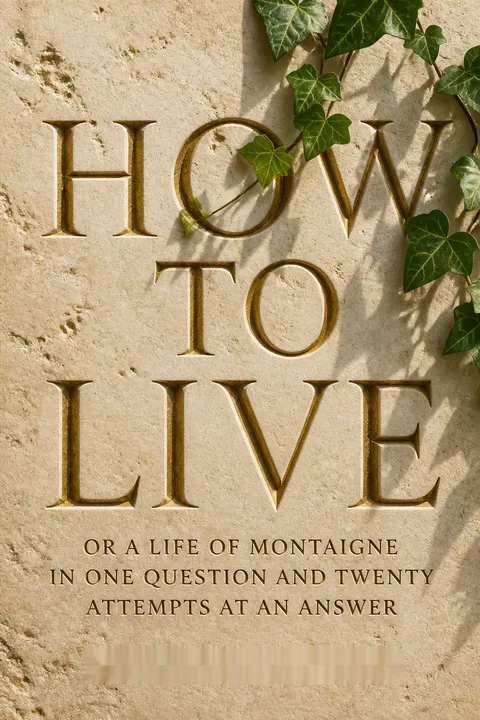
What's How to Live: Or A Life of Montaigne in One Question and Twenty Attempts at an Answer about?
- Exploration of Montaigne's Life: The book is a biography of Michel de Montaigne, focusing on his philosophical inquiries into the question, "How to live?" It combines biographical details with philosophical insights.
- Twenty Attempts at Answers: Sarah Bakewell organizes the book around twenty different answers Montaigne might give to the central question, each representing a different aspect of his philosophy and life lessons.
- Blend of Biography and Philosophy: The narrative intertwines Montaigne's personal anecdotes with philosophical discussions, making it both a historical account and a guide to living well.
Why should I read How to Live: Or A Life of Montaigne in One Question and Twenty Attempts at an Answer?
- Insight into Human Nature: The book provides profound insights into human emotions, motivations, and the complexities of life, making it relevant to anyone seeking to understand themselves better.
- Timeless Wisdom: Montaigne's reflections on love, loss, and the art of living resonate across centuries, offering wisdom that remains applicable in today's fast-paced world.
- Engaging Writing Style: Bakewell's narrative is accessible and engaging, making philosophical concepts easy to grasp while maintaining a lively storytelling approach.
What are the key takeaways of How to Live: Or A Life of Montaigne in One Question and Twenty Attempts at an Answer?
- Embrace Uncertainty: Montaigne teaches that life is filled with uncertainties, and one should learn to "question everything," encouraging open-mindedness and adaptability.
- Value of Personal Experience: The book emphasizes the importance of personal experience over abstract reasoning, as Montaigne believed that "all I know is that I know nothing."
- Live in the Present: A recurring theme is the significance of mindfulness and living in the moment, reminding us to appreciate life while we have it.
What are the best quotes from How to Live: Or A Life of Montaigne in One Question and Twenty Attempts at an Answer and what do they mean?
- "How to live? Don’t worry about death.": This quote encapsulates Montaigne's philosophy of accepting mortality as a natural part of life, allowing one to live more freely and fully.
- "Pay attention.": A reminder to be mindful and present in our experiences, this quote highlights the importance of awareness in achieving a fulfilling life.
- "Be ordinary and imperfect.": Montaigne encourages embracing our flaws and the mundane aspects of life, suggesting that perfection is an unrealistic expectation that can hinder our happiness.
How does Montaigne address the fear of death in How to Live: Or A Life of Montaigne in One Question and Twenty Attempts at an Answer?
- Acceptance of Mortality: Montaigne suggests that worrying about death detracts from the joy of living. By accepting death as a natural part of life, one can live more fully.
- Experiential Learning: Through his own near-death experiences, Montaigne learns to embrace life rather than fear its end, stating, "Death is only a few bad moments at the end of life."
- Philosophical Rehearsal: He advocates for contemplating death regularly to prepare oneself mentally, which can lead to a more serene approach to life.
What techniques does Montaigne suggest for living well in How to Live: Or A Life of Montaigne in One Question and Twenty Attempts at an Answer?
- Mindfulness and Attention: Montaigne emphasizes the importance of paying attention to one's experiences and surroundings, as he believes that awareness enhances the quality of life.
- Use of Little Tricks: He suggests employing mental tricks to cope with emotions, such as imagining the loss of something to appreciate its value more fully.
- Questioning and Reflection: Montaigne encourages questioning everything, which fosters a deeper understanding of oneself and the world, leading to a more authentic life.
How does How to Live: Or A Life of Montaigne in One Question and Twenty Attempts at an Answer relate to modern life?
- Relevance of Montaigne's Ideas: Montaigne's reflections on love, loss, and the human condition resonate with contemporary readers facing similar existential questions.
- Encouragement of Self-Discovery: The book inspires readers to embark on their own journeys of self-discovery, emphasizing that understanding oneself is key to living well.
- Philosophy as a Practical Tool: Montaigne's approach to philosophy as a means of navigating life's complexities is particularly relevant in today's fast-paced, often overwhelming world.
How does Montaigne's skepticism influence his views on religion in How to Live: Or A Life of Montaigne in One Question and Twenty Attempts at an Answer?
- Faith Beyond Doubt: Montaigne maintained that his religious faith was beyond doubt, adhering to Catholic dogma despite his skeptical philosophy.
- Critique of Rational Theology: He critiqued the idea that human reason could stand alone without divine support, reflecting the skepticism of his time.
- Fideism and Skepticism: Montaigne's work was embraced by the Catholic Church as a counter to Protestantism, as it emphasized faith over reason.
What role does friendship play in Montaigne's philosophy as discussed in How to Live: Or A Life of Montaigne in One Question and Twenty Attempts at an Answer?
- Importance of Connection: Montaigne views friendship as a vital aspect of a fulfilling life, as seen in his deep bond with Étienne de La Boétie.
- Mutual Growth: He believes that friendships should foster personal growth and understanding, allowing individuals to learn from one another's experiences.
- Philosophical Companionship: Montaigne's essays often reflect on the philosophical nature of friendship, suggesting that true friends help each other navigate life's challenges.
How does Montaigne's approach to self-exploration manifest in his writing in How to Live: Or A Life of Montaigne in One Question and Twenty Attempts at an Answer?
- Introspective Style: Montaigne's essays are characterized by a deeply personal and introspective style, where he reflects on his thoughts and experiences.
- Embracing Contradictions: He often acknowledges the contradictions within himself, demonstrating a willingness to explore the complexities of human nature.
- Philosophical Inquiry: Montaigne's writing serves as a philosophical inquiry into the self, blending personal anecdotes with broader reflections on existence.
How does How to Live: Or A Life of Montaigne in One Question and Twenty Attempts at an Answer explore the theme of moderation?
- Moderation as a Virtue: Montaigne emphasized the importance of moderation in all aspects of life, believing that extremes lead to imbalance and unhappiness.
- Practical Applications: The book provides practical examples of how to apply moderation in daily life, from eating habits to emotional responses.
- Philosophical Balance: Montaigne's reflections on moderation also extend to philosophical inquiry, suggesting that a moderate approach to knowledge leads to greater wisdom.
What is the significance of Montaigne's Essays in How to Live: Or A Life of Montaigne in One Question and Twenty Attempts at an Answer?
- Foundation of Personal Philosophy: The Essays serve as the foundation for Montaigne's personal philosophy, exploring themes of self-reflection, human nature, and the art of living.
- Influence on Future Thinkers: Montaigne's Essays have had a profound influence on subsequent philosophers and writers, shaping modern thought.
- Invitation to Reflect: The Essays invite readers to engage in their own reflections on life, encouraging a conversational approach to philosophy.
About the Author

Download PDF
Download EPUB
.epub digital book format is ideal for reading ebooks on phones, tablets, and e-readers.








