

Key Takeaways
Begin again by testing political stories against lived reality.
Reality before doctrine. Hannah Arendt’s life repeatedly forced her to begin again: she fled Nazi Germany, became stateless, escaped internment in France, and built a new life in the United States. For her, starting over meant more than adapting. It meant examining what had changed and resisting explanations that blurred the facts. Her work resists a tidy doctrine because each historical crisis demands renewed attention. After Donald Trump’s 2016 election, sales of her study of totalitarianism rose more than 1,000 percent in a year. The renewed interest reflected a concern that political lies, conspiracy theories, and public cynicism were returning, not proof that contemporary America was identical to Nazi Germany.
A method, not a slogan. Arendt’s approach is to face events without forcing them into familiar historical patterns. A theory that explains everything too quickly can make real suffering disappear inside abstractions. Comprehension begins by looking closely, including when the facts are disturbing or confusing.
What's distinctive here is the insistence that political understanding is a practice of attention, not possession of a correct formula. That stance resembles scientific inquiry: a model earns trust by staying answerable to evidence, and must be revised when evidence resists it. It also offers a useful check on crisis rhetoric. Historical comparison can reveal recurring mechanisms, but false equivalence can erase differences in scale and institutions. The discipline is to ask both what resembles the past and what is genuinely new, without letting either question settle the matter prematurely.
Keep an inner conversation alive, especially when authority demands obedience.
Thinking is ordinary. Arendt drew on Socrates to describe thought as an inner dialogue, a person talking silently with themselves. This is not technical expertise. It is the everyday capacity to ask whether an action can be faced honestly afterward. Kant’s moral philosophy deepens the demand: people must judge whether their own conduct could be accepted as a general rule, rather than treating obedience as an excuse. In Arendt’s account, Adolf Eichmann wrongly invoked Kant to defend his compliance with Nazi authority. Kant’s ethics, properly understood, requires personal judgment, not automatic submission.
A private check on conduct. Arendt called the inner dialogue the “two-in-one”: the self is both the one who acts and the one who must live with that action. This does not guarantee wise choices. It does make moral self-censorship harder to disguise as mere duty.
The connection between self-dialogue and accountability is powerful because it locates moral resistance in a capacity shared by ordinary people, not in exceptional intelligence. Research on group conformity and authority helps explain why that capacity can be suppressed: social pressure can make refusal feel costly, even when the rule being enforced is plainly wrong. Still, introspection is not enough. A person can deliberate carefully from distorted facts or inherited prejudice. The inner conversation needs contact with other people and with evidence, or conscience risks becoming a closed echo chamber.
Judge a society by whether displaced people can claim rights within it.
Citizenship makes rights usable. Arendt experienced statelessness after Nazi Germany stripped her citizenship in 1938. Refugees could be treated as human beings in principle yet lack a political community obliged to protect them in practice. She called the basic claim to belong and participate the “right to have rights.” It means living within an organized community where a person’s speech and actions can count. During one 1940 rescue effort, more than 1,100 visa claims were submitted to the United States, but only 238 were granted. For many refugees, the obstacle was not simply a lack of sympathy. It was the absence of secure legal standing.
Displacement is political. Arendt argued that statelessness was not an accidental side effect of modern states. It exposed a weakness in a system that depended on citizenship and national borders to make rights enforceable. Humanitarian aid may keep people alive, but it cannot by itself provide a place in public life.
This argument anticipates a central problem in contemporary human rights practice: universal rights are most vulnerable precisely when people lose the institutions that can enforce them. Legal scholars distinguish having a right on paper from having standing, a forum, and a remedy. Arendt’s phrase captures that gap with unusual force. The challenge is that national citizenship is not the only possible source of protection, and treating it as indispensable may reinforce borders that exclude. Her insight is best read as a demand to build durable political membership, not as proof that nation-states are the only answer.
Let love sustain human difference, but never substitute it for politics.
Love affirms the particular. Arendt’s early study of Saint Augustine explored love as a response to the fact that human beings enter the world without choosing to be here. She developed the idea that love can affirm another person’s existence, rather than treating them as a means or a symbol. Such love helps people remain human in isolation, as Arendt and her husband Heinrich Blücher found among refugee friends and later in their New York community.
Care cannot replace rights. Arendt also feared love as a public political program. A movement claiming to love humanity may flatten real differences or justify coercion in the name of a better future. Her exchange with James Baldwin over race exposed a disagreement: Baldwin treated love as a force that could confront racial hatred, while Arendt worried that love could not replace law, negotiation, and political action. Her distinction asks how compassion can sustain solidarity without becoming a mandate to control others.
The useful distinction is between care as a motive and institutions as a means. Private affection can recognize a person’s singularity, while public rules must protect people who are not loved, admired, or understood. That separation guards against benevolent paternalism, a recurring danger in charity and reform. Yet movements rarely operate through rules alone. Shared grief, loyalty, and hope can help people take political risks together. The stronger reading is not that emotion should be excluded from public life, but that emotional unity should never be allowed to erase disagreement or excuse coercion.
Listen before imagining another person's struggle for them.
A blind spot in practice. Arendt’s writing traced the links between racism, imperialism, and totalitarian rule, yet she sometimes failed to see racism clearly in the United States. In 1959, she criticized efforts to desegregate schools in Little Rock, worrying that Black children were being put in danger to advance a political goal. But Elizabeth Eckford was not entering an integrated school and choosing to join an unwelcome group. She was being turned away by officials and pursued by a white mob. Arendt misunderstood the scene and the Black community’s struggle around it.
Correction required attention. The writer Ralph Ellison argued that Arendt had missed the sacrifices and political meaning of Black action. After reading his account, she acknowledged that her analysis had gone badly wrong. Her own principle of imagining another viewpoint had failed because she had not adequately learned the facts or listened to those living the experience.
This episode demonstrates that imaginative sympathy is not a substitute for knowledge. In contemporary terms, it warns against epistemic injustice: people with less social power are often treated as objects of interpretation rather than authorities on their own lives. Arendt’s willingness to acknowledge error matters, but the correction came after her public judgment had done harm. The practical lesson is methodological: consult testimony, check the sequence of events, and ask who is missing from the account. Perspective-taking works best when it is disciplined by evidence and open to being corrected.
Look for evil where thought stops, not only where monsters appear.
Banality is not innocence. Reporting on Adolf Eichmann’s 1961 trial, Arendt was struck by the gap between the enormous crimes and his repetitive, self-important speech. She described the “banality of evil” to name a horrifying failure of moral imagination: Eichmann could not meaningfully consider the reality of the people his actions sent to their deaths. The term does not mean his crimes were trivial or that he was innocent. Evidence from his earlier conversations with Nazi associates showed that his courtroom image of a dutiful, unthinking bureaucrat was a performance.
Responsibility needs precision. Arendt’s target was the claim that orders or bureaucracy erase personal responsibility. Her account also drew fierce criticism, especially for its tone and its discussion of Jewish councils. The controversy shows how difficult it is to analyze complicity without sounding as if victims are being blamed or perpetrators excused.
The concept remains useful because large harms often depend on routine procedures, specialized roles, and people who avoid imagining consequences beyond their immediate task. Organizational studies describe similar risks as moral disengagement: responsibility becomes fragmented until no participant feels answerable for the whole. But the idea must not turn into a comforting claim that perpetrators are merely thoughtless. Eichmann’s ideological commitment matters, as does the evidence that he shaped his own defense. A sound analysis keeps both dimensions visible: ordinary habits can enable extraordinary crimes, and individuals remain responsible for what they choose to do.
Treat loneliness and invented certainty as warning signs of political collapse.
Isolation creates an opening. In her account of totalitarianism, Arendt describes how social disintegration and political failure left many people isolated and distrustful. Movements could exploit that condition by offering a simple explanation for complex troubles, often built around a fabricated enemy. Conspiracy stories such as the forged “Protocols of the Elders of Zion” persisted even after they were exposed as false. Their political power came not from evidence, but from the promise of certainty and belonging in a confusing world.
Solitude is different. Arendt distinguished loneliness, which cuts people off from reliable company, from solitude, which allows a person to think with themselves. When people lose both trustworthy relationships and the ability to test claims against a common world, lies become easier to inhabit. Propaganda can then turn fiction into a guide for real action.
The argument connects political extremism to a social need that slogans often exploit: people want a shared account of what is happening and someone to trust. Research on misinformation similarly points to the role of identity and group belonging, not simply a deficit of facts. That makes fact-checking necessary but insufficient. The more difficult task is restoring spaces where disagreement does not automatically mean exile from the group. Still, loneliness alone does not produce authoritarian politics. Institutions, leaders, economic conditions, and organized propaganda determine whether isolation becomes politically exploitable.
Treat revolutions as openings for freedom, not proof history is on your side.
A beginning can be brief. Arendt admired the Hungarian Revolution of 1956, which began with student protests and spread into a popular uprising. People created councils and acted together without waiting for a grand theory to authorize them. For Arendt, this was a glimpse of freedom as public participation, not merely a change of rulers. Soviet forces crushed the revolution, and the defeat produced executions, imprisonment, and mass displacement. The uprising’s failure did not erase the experience of collective action, but it did expose its vulnerability.
Beware the redemptive plot. Arendt contrasted this kind of spontaneous beginning with revolutions that treat history as a mandate to end all suffering immediately. When an abstract vision becomes more important than actual people, coercion can be presented as necessary. Her support for revolt was therefore enthusiastic but wary: a failed revolution may be less destructive than one that turns into a new tyranny.
Arendt offers a useful distinction between a revolution as an event of participation and a revolution as a promised destination. The first invites people into politics; the second can justify almost any sacrifice in the name of a future that no one can verify. This resembles a broader warning against teleological thinking, the belief that history guarantees a particular outcome. Yet spontaneous movements face a real institutional problem: without durable structures, newly won freedoms can be reversed. The challenge is not to choose action or organization, but to make institutions answerable to the people who create them.
Protect a durable common world from the culture of endless consumption.
Three kinds of activity. In The Human Condition, Arendt distinguishes labor, the recurring activity required to sustain life; work, the making of objects and structures that give the world durability; and action, speech and deed among people who share a public space. These are not steps on a ladder. Each answers a different condition of human life. Her concern was that modern societies could make consumption and production so dominant that lasting things, public participation, and care for the natural world receded.
The world needs maintenance. When Arendt considered the first satellite in 1957, she worried that people seemed eager to escape Earth rather than care for the world they had made. She connected the Roman idea of culture with cultivation and tending. A shared world is not only a collection of possessions. It is the environment, institutions, and lasting works that people inherit and must preserve.
This framework gives environmental and political concerns a common vocabulary. A society can be materially busy yet neglect the durable conditions that make life meaningful, from forests and public spaces to civic institutions. Arendt’s categories also resist reducing every activity to productivity or economic value. A limitation is that her account often centers human political life more than nonhuman nature, despite her language of care and cultivation. Contemporary ecological thinking can extend her point: the common world includes living systems that are not simply resources for human use.
Make citizenship a living promise by disobeying lawless power together.
Disobedience can defend law. Arendt distinguished civil disobedience from private lawbreaking. It occurs when people act together because their government is moving against its own legal commitments, or because a group’s dissent is being ignored. In her account of the United States, civil rights activists did not merely wait for constitutional promises to enforce themselves. Their collective action forced the country to confront the gap between equality in law and racial exclusion in practice.
Freedom is not control. Arendt rejected the fantasy that a single ruler or people can achieve complete sovereignty. Political power depends on people acting and consenting together, and it remains vulnerable to change. The 1974 Carnation Revolution in Portugal illustrated that possibility: citizens came into the streets despite orders to stay indoors, and a coup against dictatorship became a largely peaceful public uprising. New beginnings are possible, but none can be guaranteed in advance.
The argument treats citizenship as an active relationship rather than a status that ends at the ballot box. Civil disobedience can expose the distance between a society’s stated principles and its actual practices, while collective action makes dissent harder to dismiss as an individual grievance. The risk is that appeals to a higher promise can be claimed by opposing groups, including those seeking to dismantle democratic safeguards. The key test is whether disobedience expands equal participation and accountability, or narrows them. Political courage needs judgment about whose freedom is being defended.
Analysis
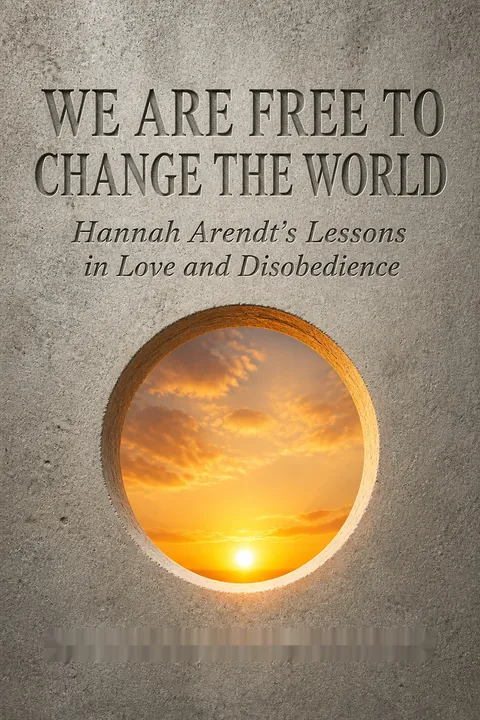
Stonebridge presents Arendt not as a source of ready-made political solutions but as a thinker whose strongest contribution is a method: face facts, preserve plurality, and judge without hiding behind doctrine. The biography gives that method force. Arendt’s statelessness makes her account of rights more than abstract legal theory; her experience of exile gives her an outsider’s view of political belonging; and the Eichmann trial turns the problem of judgment into a public conflict over how to name evil. The book’s central tension is that Arendt’s own standards are demanding and unevenly practiced. Her criticism of Little Rock exposes a failure of attention, while her broad analysis of racism and empire did not always give Black historical experience adequate presence. Stonebridge neither discards Arendt for this failure nor treats her confession as sufficient repair. That balance is crucial: an intellectual legacy should be tested by the standards it asks readers to apply.
The adaptation’s most useful synthesis is that freedom requires both inward and outward capacities. Private thinking makes independent judgment possible, but freedom becomes political only among others, through speech, association, and action. Refugees reveal what happens when the right to participate disappears; revolutions show that people can create a public world, but that it can be crushed or distorted; civil disobedience tests whether institutions honor their own promises. These ideas also explain why Arendt distrusts both sentimental appeals to unity and fantasies of total control. Her politics begins from human plurality and contingency, not from a perfect plan.
There is a productive limit to this vision. Public action can open freedom, but it cannot by itself guarantee material security, durable institutions, or justice for those whose voices are excluded. Arendt’s own errors demonstrate that plurality is not secured merely by praising it. The reader must ask who is present, who is interpreting, and who bears the cost of a political experiment. The book’s enduring challenge is therefore practical: protect shared facts and spaces for action while remaining willing to revise judgments when lived experience contradicts them.
Review Summary
We Are Free to Change the World is praised as an accessible and engaging exploration of Hannah Arendt's life and philosophy. Readers appreciate Stonebridge's ability to connect Arendt's ideas to contemporary issues, though some find the book assumes prior knowledge of Arendt. The author's approach, combining biography, philosophical analysis, and personal reflection, is widely commended. Critics note the book's relevance in understanding totalitarianism and political thought. While a few reviewers desire more depth on certain topics, most find it a compelling introduction to Arendt's work and its continued significance.
People Also Read








Glossary
the right to have rights
political membership that enables rightsArendt’s term for the basic right to belong to an organized political community where a person’s actions and opinions can be heard and protected. She developed it from the experience of refugees and stateless people, whose supposed universal human rights proved fragile without citizenship, legal standing, or a community responsible for enforcing them.
plurality
human life among distinct othersThe condition that people are equal as human beings yet distinct in identity, perspective, and experience. For Arendt, plurality is not a problem to eliminate through uniformity. It is the basis of politics, because people can speak, judge, and act together only when they share a world without becoming interchangeable.
natality
the capacity for new beginningsArendt’s term for the human capacity to begin something new, linked to the fact that each person is born into the world. Politically, natality appears when people act together in ways that cannot be fully predicted or controlled. It grounds hope in human initiative, not in a guaranteed historical outcome.
banality of evil
evil enabled by thoughtlessnessArendt’s description of the disturbing gap between Adolf Eichmann’s immense crimes and his shallow, clichéd way of speaking and judging. The phrase does not mean the crimes were minor or that Eichmann was innocent. It identifies a failure to think from another person’s standpoint, alongside the ordinary routines and choices through which mass violence can be carried out.
two-in-one
the self in inner dialogueArendt’s account of thinking as a silent conversation a person has with themselves. The thinker is both the one asking questions and the one who must answer for their conduct. This inner relationship can support moral judgment because a person must consider whether they can live with what they have done, rather than relying only on orders or public approval.
boomerang effect
imperial practices returning homeArendt’s description of how methods of racial domination and administrative cruelty developed through imperialism could return to Europe and shape political life there. The term links colonial violence to the conditions that made modern totalitarianism possible, challenging the idea that European atrocities were wholly separate from the history of empire.
holes of oblivion
systems designed to erase peopleArendt’s term for places and practices, including camps, detention, unmarked graves, and historical erasure, that make people disappear from public awareness. These are not merely images of forgetting. They describe efforts to remove people’s experiences and existence from the shared record, as though those lives had no place in human history.
enlarged mentality
judging from other viewpointsA form of critical imagination associated with Kant and adopted by Arendt. It requires a person to consider how the world appears from perspectives other than their own, without pretending to become another person or assuming that empathy alone provides knowledge. For Arendt, this practice supports judgment by testing private impressions against a wider human world.
isonomia
equal freedom to participateArendt uses this ancient Greek political idea to describe a community organized around citizens’ equal freedom to act, rather than rule by a sovereign authority. She associates it with forms of public participation in which people help govern together. It serves as an example of political equality grounded in shared action, not merely equal treatment by a distant government.
labor, work, and action
three forms of human activityArendt’s distinctions in The Human Condition. Labor consists of recurring activity needed to sustain life. Work creates objects and structures that give the human world relative durability. Action is speech and deed among people who share public space. The categories describe different aspects of human existence, rather than a ranking in which one makes the others unnecessary.
Download PDF
Download EPUB
.epub digital book format is ideal for reading ebooks on phones, tablets, and e-readers.








