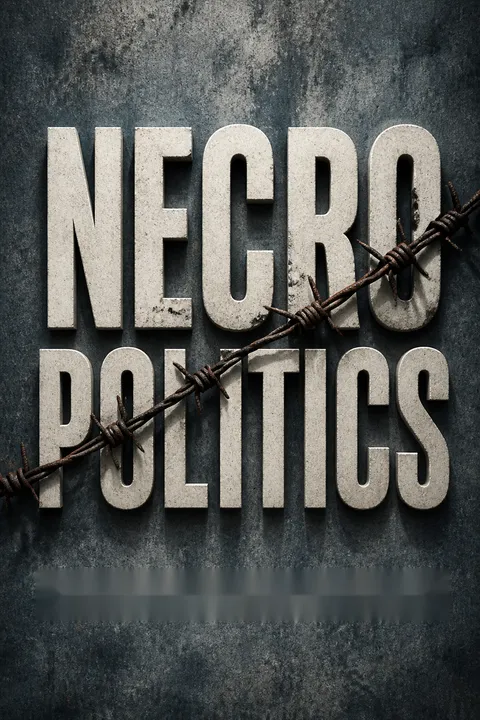


Key Takeaways
Judge democracy by who it excludes, and where it sends violence
Democracy has a shadow. Mbembe argues that democracy’s story of equal rights has long coexisted with spaces where those rights do not apply. The plantation and the colony were not simply failures of democratic ideals; they helped generate wealth and stability for democratic societies. The United States could proclaim equality while holding nearly two million people in slavery around 1830. Colonial extraction also helped finance the goods and institutions associated with European civility.
Violence travels outward. Law, citizenship, and public order were protected at home partly by exporting coercion to people treated as less than full members. The colony is therefore democracy’s hidden counterpart, not merely its opposite. Mbembe argues that this contradiction remains relevant when security systems, prisons, or camps place some populations beyond ordinary protections.
The argument turns hypocrisy into a question of structure: who benefits when coercion is displaced beyond the limits of ordinary citizenship? That question can be applied to supply chains, detention systems, and security policy without claiming that all democracies are identical to colonial regimes. The comparison is most useful when it identifies a mechanism, such as unequal legal protection, rather than collapsing historical differences. It also challenges a familiar habit of treating domestic peace as evidence that violence has disappeared.
Track who is made killable: sovereignty governs through death as well as life
Power over mortality. Biopower, a concept associated with Michel Foucault, describes power that manages and regulates life. Mbembe argues that it does not fully explain systems that deliberately expose populations to death or make survival itself precarious. He calls this power necropolitics: the authority to decide whose lives are protected, whose are treated as disposable, and who must live in conditions shaped by death.
Life inside death. Mbembe uses death-worlds for social conditions in which people remain alive but are confined to extreme insecurity, injury, and deprivation. The plantation, colonial occupation, and besieged Palestinian communities show different forms of this power. The point is not only that people are killed. It is that space, movement, infrastructure, and access to basic needs can be organized to make whole populations live close to death.
This lens expands political analysis beyond spectacular killings to the policies and infrastructures that distribute exposure to harm. Public health offers a useful parallel: life chances are shaped not only by medical care, but also by housing, mobility, and safety. The concept is strongest when tied to identifiable decisions and institutions. Used too broadly, it can blur distinctions between intentional killing, preventable neglect, and unequal risk, differences that matter for explanation and accountability.
When governments manufacture permanent enemies, emergency powers become everyday rule
Threat without an end. Mbembe describes a society of enmity, a political order organized around hostility to a constructed enemy. The enemy may be a terrorist, migrant, Muslim, or other figure associated with danger. Because the threat is treated as permanent and changeable, exceptional measures can become normal: surveillance, detention, expanded police powers, and restrictions on rights.
Two-sided escalation. Terrorist violence and counterterrorism are not morally equivalent, but Mbembe argues that they can reinforce a shared logic: each treats law as something to suspend in order to defeat an absolute threat. He asks when defensive force becomes an open-ended license for violence. The result is a state of insecurity, where fear is both a political condition and a justification for the security apparatus that claims to resolve it.
Emergency policy often gains public support by promising certainty in situations where uncertainty cannot be eliminated. That creates a feedback loop: visible security measures signal danger, while the danger justifies still more measures. The argument does not require denying real attacks or threats. It asks whether responses are proportionate, reviewable, and temporary. Those tests help distinguish protection that preserves political rights from protection that gradually makes rights conditional.
See border control as a system for trapping some people and accelerating others
Borders do more than divide. Mbembe uses borderization for the deliberate transformation of spaces into barriers that certain populations cannot cross. It includes walls and checkpoints, but also detention centers, biometric screening, deportation systems, and remote military force. The contradiction is stark: wars and destroyed infrastructure can force people to flee, while border systems then restrict their movement and treat them as intruders.
The camp becomes ordinary. Mbembe describes camps as part of a wider geography for sorting and containing displaced people. Citing an estimate by anthropologist Michel Agier, he notes roughly 400 such camps in the European Union before the large 2015 influx. The number of people held in the cited detention spaces rose from about 32,000 in 2011 to 47,000 in 2016. These figures are historical, but illustrate how exclusion becomes administrative routine.
The distinction between mobility and immobility is revealing: capital, data, and some travelers move rapidly, while others face walls, waiting rooms, and legal limbo. This makes border policy an infrastructure question as much as a question of national identity. The figures should be read as time-specific estimates, not current totals. More broadly, the concept directs attention to the outsourced systems and technologies that make exclusion less visible while extending its reach.
Notice racism in small humiliations before it hardens into official policy
Prejudice at close range. Nanoracism is Mbembe’s term for racism expressed through seemingly minor gestures, jokes, insinuations, and everyday challenges to another person’s right to belong. A person may be repeatedly asked to explain where they are from, why they are present, or when they plan to leave. Each incident can seem trivial in isolation, yet the repetition injures dignity and signals that some people are permanently suspect.
Systems give it force. These casual acts coexist with institutional practices such as racial profiling, immigration detention, and deportation. Mbembe’s point is that racism does not survive only through explicit biological theories or openly racist laws. It can become part of ordinary culture and administrative procedure, appearing neutral while placing unequal burdens on those marked as outsiders.
The focus on small interactions helps explain how exclusion can feel routine to those who impose it and exhausting to those who endure it. Research on chronic stress offers a useful connection: repeated low-level threats can accumulate rather than vanish when each episode ends. Still, attention to everyday slights should not flatten distinctions between an insult and state violence. The value of the concept is in showing how ordinary habits can normalize the categories that institutions later enforce.
Use Fanon's test for liberation: does struggle restore a capacity for life?
Violence can open a way. Frantz Fanon argued that colonial rule was already violent, and that decolonization could require force to dismantle the system and the internalized submission it produced. Mbembe emphasizes the danger in this argument: violence may break an oppressive order, but it can also become a self-perpetuating practice that destroys without creating anything new.
Healing reconnects. Fanon’s psychiatric work gives this tension human form. He treated colonized people traumatized by war, as well as French officers whose work included torture. One policeman who tortured others began acting violently at home. For Fanon, treatment meant more than controlling symptoms. It involved restoring speech, a sense of time, and relationships with other people. Liberation is incomplete if it wins power but leaves the social world shattered.
Fanon’s clinical perspective makes political violence legible through its effects on bodies, families, and memory, including the damage done to perpetrators. This resonates with trauma-informed care, which treats safety and restored agency as more than the absence of visible symptoms. The account also resists an easy moral formula: condemning resistance violence without confronting the violence it answers is inadequate, but celebrating violence as inherently cleansing is equally dangerous. The decisive question is what kind of shared life follows.
Treat algorithmic prediction as political judgment, not neutral calculation
Data makes categories. Mbembe argues that computational systems increasingly classify people, detect anomalies, and predict behavior. In systems shaped by security and finance, a person can become a pattern in a dataset, and a supposed enemy can be constructed through statistical inference. This shifts power toward those who define the categories, choose the data, and decide what counts as risk.
Calculation has limits. The book links algorithmic reasoning to a broader reduction of life to measurable information. When evidence and public deliberation are displaced by prediction, people may be governed through classifications they cannot see or challenge. Mbembe does not argue that computation is useless. He warns against treating measurable data as a complete account of reality, especially when decisions affect rights, movement, or access to resources.
A classification can become self-reinforcing: people flagged as risky receive closer scrutiny, generating more records that may appear to confirm the original flag. This is a reason to examine not only model accuracy, but also the consequences of errors, the quality of the data, and the ability to appeal a decision. The critique is not a demand to abandon measurement. It is a reminder that technical systems encode political choices and need public accountability.
Beware salvation stories that turn catastrophe into permission for destruction
The end can be seductive. Mbembe calls negative messianism a politics that abandons redemption and instead embraces survival, sacrifice, or destruction as the answer to an approaching catastrophe. He sees versions of it in apocalyptic politics, fantasies of collective purification, and technological promises to defeat death. These movements differ, but each can present the present as so ruined that ordinary obligations no longer matter.
Fear recruits sacrifice. When people believe disaster is inevitable, violence can appear not only justified but urgent. The proposed remedy may be a purified community, an authoritarian order, or an escape into technology. Mbembe’s warning is that such visions can intensify the damage they claim to solve. A politics focused only on surviving the end has little reason to repair relationships or preserve a world shared with others.
Apocalyptic narratives compress political time: if catastrophe is imminent, deliberation looks like weakness and costly tradeoffs disappear from view. That emotional structure can appeal across ideological lines, even when the promised futures are incompatible. The analysis is useful because it asks what a movement’s imagined rescue requires people to sacrifice. Yet not every catastrophe warning is irrational; ecological and political dangers can be real. The key distinction is between preparing responsibly and treating destruction as redemption.
Defend a shared world without pretending humanity has one fixed form
Humanity is made, not inherited. Mbembe challenges a universal humanism that often declared equality while excluding enslaved and colonized people from full recognition. He does not simply reject the idea of humanity. Drawing on Fanon and writers such as Édouard Glissant, he treats it as unfinished and formed through relations among people, places, and other living beings.
Difference need not mean separation. The book also considers Afrofuturism, a cultural movement that uses speculative futures, technology, and Black histories to question inherited definitions of the human. This opens a broader view of personhood as changeable and entangled with animals, machines, plants, and environments. The political task is not to erase difference, but to resist turning difference into a boundary that denies shared vulnerability or rights.
This approach offers a way beyond two unsatisfying options: a supposedly universal ideal that hides its exclusions, and separate identities treated as sealed worlds. Environmental thought adds a useful dimension because human life depends on nonhuman systems that political borders do not contain. The challenge is institutional: affirming entanglement does not itself settle who owes what to whom. A shared world needs concrete rules of responsibility, not only a more expansive vocabulary of belonging.
Practice solidarity without turning belonging into ownership
A passerby remains responsible. The ethics of the passerby describes a way of inhabiting places through both connection and distance. Mbembe does not romanticize exile or rootlessness. He argues that birthplace is an accident, not proof that one person has a greater claim to humanity than another. A person can make a genuine home in a place without claiming that it belongs only to people of a particular origin.
Movement creates obligations. The passerby arrives from somewhere and may move elsewhere, so hospitality becomes part of political life rather than a favor reserved for familiar people. Mbembe links this ethic to Fanon’s movement across Martinique, France, and Algeria, and to the possibility of a common world. Shared life requires both recognition and the freedom to move, alongside responsibility toward the places and people encountered.
The idea avoids equating ethical belonging with either possession or indifference. It also speaks to the tension between migration and attachment: people can care deeply for a place without treating newcomers as contamination. The principle is not a ready-made immigration policy, and movement is never equally available to everyone. Its force lies in making mobility and hospitality questions of justice, while preserving the fact that durable communities need mutual obligations.
Analysis
Necropolitics is a political theory built around a blunt question: who is permitted to live securely, and who is made to inhabit conditions organized around possible death? Mbembe’s answer is historical rather than abstract. He traces a line from plantation slavery and colonial occupation through prisons, security regimes, border controls, and digitally managed populations. Across these cases, the key mechanism is not simply violence. It is the classification of people into those whose vulnerability counts and those whose suffering can be ignored.
The book’s most important revision is to democratic history. Democracy’s violence is not presented as an accidental stain on an otherwise peaceful tradition. Its colonial and racial arrangements helped define who could participate in rights and who could be governed through exception. This argument makes the contemporary security state legible as part of a longer history, while insisting that old techniques return in altered forms. Walls, camps, surveillance, and remote warfare join a political economy that values movement for some and restricts it for others.
Fanon supplies the book’s ethical counterweight. His work shows that colonial violence damages both those subjected to it and those enlisted to administer it. Decolonization may require rupture, yet rupture alone cannot produce freedom. A political community must rebuild speech, recognition, and care, or the drive to destroy simply changes hands. The conclusion’s passerby captures this alternative: belonging through relation rather than purity, with solidarity joined to distance and responsibility.
The book is deliberately essayistic, and its concepts travel across history, psychoanalysis, political theory, ecology, and technology. That breadth is a strength, but it can make distinct forms of harm appear more alike than they are. Necropolitics is most illuminating when applied with historical specificity: who decides, by what institution, through which legal or material arrangements, and with what consequences? These questions preserve the framework’s force while making it useful for concrete analysis rather than a label for every injustice.
Review Summary
Necropolitics by Achille Mbembe explores the concept of necropower and its relation to modern states, colonialism, and violence. Readers appreciate Mbembe's insightful analysis of racism, brutality, and exploitation in contemporary society. The book's dense language and abstract concepts challenge some readers, while others find it thought-provoking and relevant. Critics praise Mbembe's candid writing style and his expansion of Foucault's biopolitics. The work is considered essential for understanding current global power dynamics, though some find it difficult to follow without prior knowledge of political theory.
People Also Read







Glossary
Necropolitics
Power organized around deathNecropolitics describes forms of power that determine who may live securely and who is exposed to death or to conditions that make life precarious. Mbembe uses it to analyze sovereignty exercised through killing, abandonment, occupation, and the production of populations treated as disposable.
Biopower
Power that manages lifeA concept associated with Michel Foucault, biopower refers to the management and regulation of life, including the health and capacities of populations. Mbembe argues that it does not fully account for political systems that make death, exposure to death, or survival under extreme conditions central instruments of power.
Death-worlds
Life organized around deathDeath-worlds are social conditions in which people remain alive but are subjected to circumstances that make life resemble a prolonged encounter with death. Mbembe uses the term for situations shaped by confinement, violence, deprivation, and the erosion of ordinary protections, including forms of occupation and siege.
Society of enmity
Politics organized around enemiesA society of enmity is a political order in which hostility and the struggle against an enemy become organizing principles. The enemy may be real or imagined, but is treated as an existential threat, helping to justify exclusion, exceptional powers, surveillance, and violence.
State of insecurity
Fear sustaining security ruleThe state of insecurity is the persistent condition of fear and perceived threat on which the security state depends. It is more than an emergency caused by a specific event: it becomes a public mood and political resource that legitimizes ongoing surveillance, control, and exceptional measures.
Nanoracism
Everyday, normalized racial prejudiceNanoracism is racism expressed through small, recurring acts such as jokes, insinuations, casual insults, and challenges to someone’s right to belong. Mbembe emphasizes that these acts can appear harmless or unconscious while accumulating into humiliation and reinforcing wider institutional forms of exclusion.
Borderization
Making spaces impassable to someBorderization is the process of turning spaces into barriers for selected populations. It includes physical borders as well as camps, checkpoints, digital identification, surveillance, and deportation systems. Mbembe presents it as an organized form of violence that restricts movement and produces spaces of exclusion.
Negative messianism
Redemption replaced by destructionNegative messianism is a politics shaped by catastrophic expectations but emptied of a meaningful promise of redemption. It may favor sacrifice, authoritarian survival, or destruction as a response to an imagined or actual end. Mbembe uses the term for visions that abandon repair and shared life in favor of purity or annihilation.
War machines
Mobile, shifting armed organizationsBorrowing the term from Gilles Deleuze and Félix Guattari, Mbembe uses war machines for armed formations that can split, merge, and change their relationship to states. They may combine military force, political authority, and economic extraction, operating through mobile networks rather than stable state institutions.
Ethics of the passerby
Belonging through movement and careThe ethics of the passerby treats human life as shaped by movement among places and encounters with others. It joins solidarity with detachment: people can inhabit and care for a place without claiming it as the exclusive property of a particular origin or identity.
Planetary condition
Life shared across Earth systemsThe planetary condition names a widened understanding of life in which humans share the Earth with animals, plants, technologies, and ecological forces. It challenges the idea that humanity alone defines the limits of the world, and frames political responsibility as extending across species and environments.
Download PDF
Download EPUB
.epub digital book format is ideal for reading ebooks on phones, tablets, and e-readers.








