

Key Takeaways
Make the reader's meaning easy to grasp, not your vocabulary impressive
Clarity outranks display. Devlin’s central aim is practical: help ordinary people express themselves correctly in conversation and writing without requiring scholarly training. He argues that a modest working vocabulary can handle everyday communication, and warns against choosing elaborate or foreign words when familiar ones say the same thing. His estimate that roughly 2,000 words suffice for ordinary needs is a claim from 1910, not a reliable modern measurement of vocabulary size.
Three tests for prose. He names purity, perspicuity, and precision: use accepted language, make the meaning unmistakable, and state it concisely. Together, these principles favor direct expression over pedantry. The point is not to make every sentence plain at any cost, but to ensure that style serves the thought rather than hiding it.
What's valuable here is the distinction between knowing words and making meaning travel. Plain-language practice in fields such as medicine and public administration follows the same logic: readers cannot act on information they cannot decode. Yet a small vocabulary is not always the most precise one. Technical terms can save time when writer and reader share them, and unfamiliar language can name genuinely new ideas. The useful test is therefore not whether a word is short, but whether it is the clearest fit for this reader and purpose.
Use grammar to track relationships, not merely label parts of speech
Grammar shows who does what. Devlin explains grammar as a way to see how words function together. A sentence needs a subject and a finite verb, a verb form that makes a statement, asks a question, or gives a command. In “The child opened the gate,” the subject acts, the verb names the action, and the gate receives it. Naming these roles helps a writer spot errors that can be hard to hear while speaking.
Pronouns need clear links. Devlin’s comic story about Billy Williams turns a horse ride into a chain of misunderstandings: each use of “him” could mean the horse or one of the men nearby. The joke demonstrates a practical rule: give pronouns unmistakable referents, and make sure verbs agree with their subjects.
Grammar is most useful as a model of relations, not as a vocabulary quiz. Parsing a sentence can reveal agency, responsibility, and cause: changing the subject can change who appears to have acted. This matters in everyday prose and especially in legal or institutional writing. At the same time, grammar instruction should describe how people use language as well as how formal writing is conventionally edited. A rule is a tool for making meaning clear, not proof that every other construction is unintelligent.
Place words to control emphasis and prevent comic ambiguity
Order directs attention. Devlin notes that sentence beginnings and endings attract emphasis, while related words are easier to understand when placed near each other. A modifier such as “only” can change a sentence’s focus depending on its position: “Only Maya sent three letters” points to the sender, while “Maya sent only three letters” points to the number. The words have not changed, but the emphasis has.
Choose a sentence shape. A loose sentence gives its main point early, then adds related information. A periodic sentence delays the main point until the end. Devlin favors the more direct shape in speech, where listeners may lose track of a long introduction, but recognizes that either form can suit written work. Paragraphs, too, should gather sentences around one connected idea.
Word order is a quiet form of guidance. Readers use position to infer what is central, what qualifies a claim, and which details belong together. This connects grammar to information design: a clear heading, a well-placed caveat, or a sentence that states its result first can reduce the effort required to follow an argument. Delayed conclusions can still create suspense or build a case, but they impose a memory burden. The choice should match the audience’s purpose, not a mechanical preference for short or direct sentences.
Revise until every phrase earns its place
Cut without thinning meaning. Devlin’s lists of errors repeatedly target extra words that add no information, such as redundant pairs and repeated ideas. He also warns against long detours that circle a point instead of stating it. His editing test is practical: remove a word or phrase when the sentence remains just as clear and forceful without it.
Check what a sentence implies. Misplaced modifiers, dangling participles, and poorly placed words like “only” can make readers infer something unintended. Devlin also condemns double negatives as errors in standard edited English. That advice does not describe every dialect: in some varieties, negative concord is a regular grammatical pattern rather than a failed attempt at logic. His broader lesson is to reread for the meaning a reader is likely to take away.
Revision is a form of quality control: it tests not only whether a sentence is grammatical, but whether it communicates the intended claim. The distinction matters because a sentence can be correct yet confusing, or concise yet incomplete. Devlin’s categorical treatment of double negatives reflects the prestige conventions of his era. Contemporary editing benefits from a sharper question: is the writer addressing a formal register that requires a particular convention, or judging a dialect by rules it was never designed to follow? Precision need not require social condescension.
Write from what you know, then adapt it to the reader
Start with observed life. Devlin advises beginners to write about familiar subjects: an event they witnessed, a place they know, or a person whose work they understand. He recommends studying good writers, imitating their methods rather than copying their wording, and revising carefully. His point is that firsthand attention gives a writer material that empty decoration cannot supply.
Fit the form to the audience. A personal letter should sound natural while respecting the relationship; a business letter should be concise, clear, and honest; a newspaper piece should offer current, relevant information in language readers can follow. Devlin treats reporting as open to people without advanced education, provided they observe carefully and tell readers what happened. His examples of writers who began with little formal schooling support this practical emphasis, though they do not prove that talent alone overcomes every barrier.
This is an early version of audience-centered communication: the writer begins with the reader’s needs, not with a performance of expertise. The advice also resembles field reporting and ethnographic observation, where detail comes from sustained attention to a real setting. But stories of celebrated writers rising from hardship can make structural barriers look easier to cross than they are. Practice and persistence matter; so do access, time, editorial support, and opportunity. The soundest lesson is to work from knowledge and keep improving, not to assume that effort guarantees publication.
Let figures of speech sharpen meaning, not smother it
Images can make ideas visible. Devlin describes a simile as an explicit comparison, while a metaphor transfers one thing’s qualities directly to another. Personification gives human qualities to something nonhuman; antithesis puts contrasting ideas side by side. These figures can turn an abstract point into something a reader can picture. Calling a crowded schedule “a traffic jam” is a compact metaphor that suggests delay and competing demands.
Restraint protects the image. Devlin cautions against stale comparisons, far-fetched ornament, and mixed metaphors that make one subject behave like several incompatible things. A figure should suit the tone and purpose of the writing. If the image draws more attention to itself than to the idea, it has become decoration rather than explanation.
Figurative language works partly by borrowing familiar structures to help readers understand less familiar ones. A good metaphor can compress a complicated relationship into an image that is easy to recall. It can also smuggle in assumptions: describing a debate as a “battle,” for example, makes conflict seem inevitable. Devlin’s emphasis on fit and restraint is therefore more than aesthetic advice. Writers should ask both whether an image clarifies and what perspective it quietly encourages the reader to adopt.
Treat slang as language in motion, not automatic failure
Separate slang from cant. Devlin uses “cant” for specialized language understood within a particular group or trade, and “slang” for informal expressions that circulate more widely. He warns writers that slang can be too local, coarse, or unclear for formal prose, while acknowledging that some expressions become ordinary vocabulary over time.
Words can outgrow their origins. The book recounts how “boycott” arose from the community’s refusal to work for an unpopular landlord named Captain Boycott. The crops were left to spoil, and the name came to describe organized withdrawal of support more generally. The story complicates a simple ban on slang: usage changes, and a once-unusual expression can become standard. Devlin’s judgments about class and refinement are dated, but his attention to audience and context remains useful.
The story of “boycott” captures a central fact of language: new words often spread because people need a name for a new practice. Sociolinguistics also shows that speech varieties carry identity and community knowledge, not merely errors. That does not make every slang expression suitable for every setting. The more useful distinction is between register and competence: informal language may be expressive and precise among its users, yet confusing or inappropriate for an unfamiliar audience. Writers gain control by knowing when a register fits, not by treating change as contamination.
Choose words for exact shades, not just dictionary neighbors
Near-synonyms are not twins. Devlin argues that words with broadly similar definitions can differ in tone, intensity, or typical use. His advice is to check a dictionary when uncertain, keep notes on unfamiliar words, and listen to how skilled speakers use them. A larger vocabulary can expand a writer’s choices, but the goal is not to display every word collected. It is to select the one that best carries the intended meaning.
Learn from models without borrowing their voice. Devlin recommends reading writers such as Addison, Macaulay, Goldsmith, Shakespeare, and the authors of the Bible for examples of clear or forceful expression. He especially values familiar, often short words for general audiences. Yet imitation should mean studying choices and structure, not lifting phrases or pretending to be another writer.
Word choice is a form of classification: selecting one term rather than another tells readers how to interpret an event or feeling. This makes the dictionary a starting point, not a final authority, because connotation and usage depend on context. Devlin’s preference for short, familiar words often improves accessibility, but specialized vocabulary can be indispensable when it distinguishes concepts that ordinary language blurs. The strongest writers can move between registers. Their skill lies in knowing when precision requires a plain word and when it requires a more exact one.
Treat English as a borrowed, changing toolkit, not a sealed code
English has many sources. Devlin traces its central Germanic base alongside words brought through Latin and French, including after the Norman conquest. He also describes contributions from Greek, Danish, Celtic, and other languages. In his account, everyday grammatical words are largely Germanic, while many terms for learning and specialized fields come through Greek or Latin. The result is not a single, untouched vocabulary, but a language assembled through contact and change.
History explains differences in style. Devlin praises the force of familiar Anglo-Saxon words while recognizing that English has absorbed words from many places. This history helps explain why two words may express related ideas but carry different tones or associations. His account reflects the scholarship and national outlook of 1910, so its broad historical claims should be read as a period explanation rather than a complete linguistic history.
English’s mixed vocabulary undercuts any simple idea that correctness means preserving a pure, unchanging language. Borrowing can fill gaps, mark cultural contact, or bring a specialized distinction into wider use. Still, origins alone do not determine whether a word is useful or clear today. A word’s history, current meaning, audience, and tone all matter. Devlin’s instinct to notice how language is built is valuable; his sharper claims about which sources make words refined reveal how language judgments can also reflect cultural prestige.
Analysis
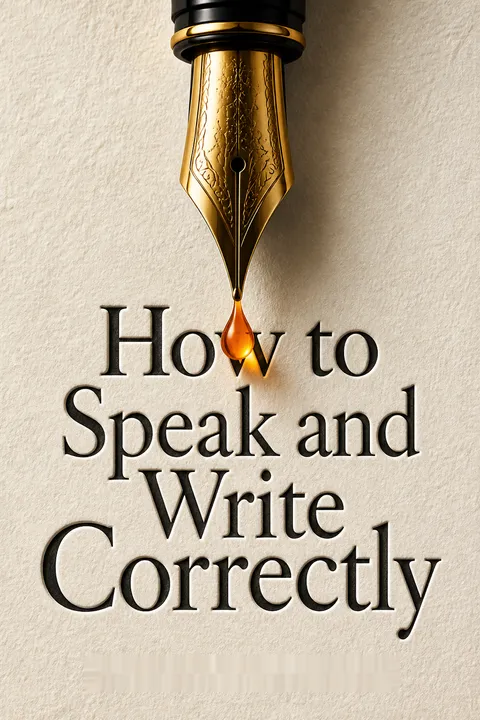
How to Speak and Write Correctly is a 1910 practical guide to grammar, composition, rhetoric, letters, journalism, and literary reading. Its 43,198 words are arranged as a reference manual, but an argument runs through the catalog of rules: language is a public tool, and a writer should make ideas clear to ordinary readers rather than use prose to advertise learning. That core is still useful, especially in its emphasis on choosing words carefully, placing related ideas together, and revising for ambiguity.
The book is difficult to adapt because it mixes durable craft advice with historical prescriptions and a strongly moralized view of speech. It treats some features of modern English, such as split infinitives and sentence-final prepositions, as errors, although these are widely accepted in contemporary usage. It also equates certain kinds of slang and nonstandard speech with poor refinement. Those judgments should not be mistaken for neutral facts about language. They reflect the social standards of the author's period and his assumptions about class, education, and respectable public speech.
There is also a productive contradiction in the book itself. Devlin praises simplicity and condemns inflated writing, yet some of his own passages are ornate, sermon-like, and much longer than his stated ideals recommend. That gap makes the best way to read the manual clear: treat its rules as prompts to ask whether a sentence works, not as commandments to memorize. Its most valuable practical ideas are reader-centered clarity, attention to context, exact word choice, and deliberate revision. Its historical claims about vocabulary, grammar, and literary greatness need more caution. The book is less a final authority on correct English than a lively record of one era's effort to make the language accessible, orderly, and socially legible.
Review Summary
How to Speak and Write Correctly receives mixed reviews, with an average rating of 3.62/5. Readers appreciate its practical advice on grammar and writing, particularly the sections on language history and literary masterpieces. However, many find parts of the book outdated and tedious, especially the grammar explanations and letter-writing sections. Some praise its timeless wisdom on clear communication, while others argue it's no longer relevant for modern readers. The book's list of great authors and works is popular, though some wish for more explanation behind the selections.
People Also Read









Glossary
Purity
Accepted, current languageDevlin's term for using words he considers reputable, widely understood, current, and grammatically proper. He excludes slang, provincial expressions, obsolete terms, foreign idioms, and words too new to have gained acceptance. The definition reflects the book's early twentieth-century standards, which sometimes treat social judgments about language as though they were neutral rules.
Perspicuity
Unmistakable expressionA quality of writing in which readers can understand the intended meaning without confusion. For Devlin, perspicuity requires clear wording, careful arrangement, and the removal of ambiguity, including language that could reasonably be interpreted in a different sense. It is one of the three essentials he identifies for effective English.
Precision
Concise, exact expressionDevlin's term for stating an idea accurately and economically, without unnecessary repetition or detours. Precision is not simply brevity: the sentence must retain enough information to be clear and complete. Alongside purity and perspicuity, it forms his basic standard for effective speech and writing.
Loose sentence
Main point stated earlyA sentence structure that presents its main idea near the beginning, then adds related details or qualifications. Devlin considers this form especially useful in speech because listeners can grasp the central statement before hearing its supporting information. He does not regard it as inherently better in every kind of writing.
Periodic sentence
Main point delayedA sentence structure that builds through introductory or dependent material before revealing its principal statement near the end. Devlin notes that the delayed conclusion can create emphasis in writing, but can be harder to follow in speech because listeners must hold the opening material in mind until the sentence resolves.
Cant
Insider group languageDevlin distinguishes cant from broadly circulating slang by describing cant as language associated with a particular group, trade, or profession. It may follow ordinary grammatical rules, but people outside the group may not understand it. His examples include specialized criminal and gambling vocabularies. The distinction is about who uses and understands the language, not simply whether it is grammatical.
Download PDF
Download EPUB
.epub digital book format is ideal for reading ebooks on phones, tablets, and e-readers.








