

Key Takeaways
Learn the fallacy, and you can spot when persuasion outruns proof
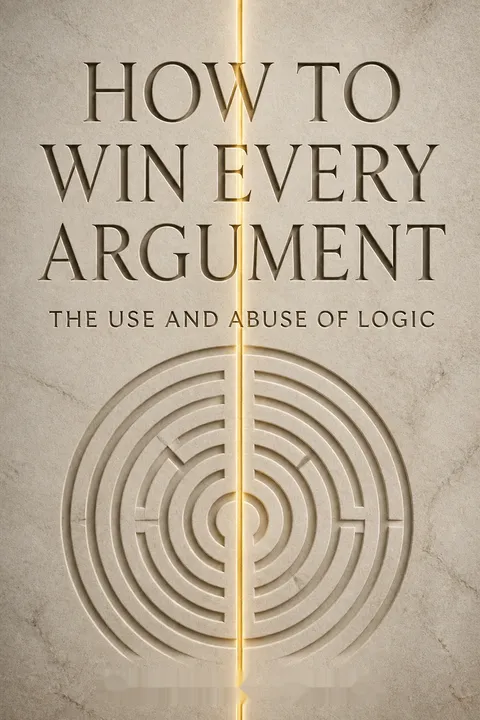
A field guide to persuasion. Pirie treats a fallacy broadly: a move in reasoning or language that makes a claim look better supported than it is. His alphabetical catalog ranges from faulty deductions to slippery wording and emotional appeals. Each entry explains the trick, illustrates it, and shows how a debater might use it, making the book deliberately double-edged.
Recognition is the defense. Pirie argues that knowing how a trick works can help readers resist it. The catalog distinguishes errors in logical structure from informal errors involving language or relevance. Those relevance errors may leave out needed information, add distractions, or smuggle in assumptions. The practical aim is not to collect Latin labels, but to ask what a speaker's evidence actually establishes.
What's striking is the book's premise that learning the anatomy of a bad argument can make people harder to fool. That is a form of metacognition: noticing not only what a speaker claims, but how the claim is being made to feel inevitable. The risk is that a fallacy name can become a shortcut for dismissing an argument. A stronger habit is to identify the exact missing premise, ambiguity, or unsupported leap, then explain why it matters.
Separate valid form from true premises before trusting a conclusion
Logic checks the route. A formally valid argument has a structure in which true premises would guarantee its conclusion. That does not mean the premises are true. For example, if dropping an egg breaks it, and someone dropped this egg, the break follows. But a broken egg does not prove that someone dropped it: it might have broken another way. That mistaken reversal is affirming the consequent.
Watch conditional claims. Denying the antecedent makes the opposite mistake: from the claim that overeating can cause illness, it concludes that someone who did not overeat cannot be ill. The book also examines syllogisms, arguments that connect two claims through a shared term. A conclusion can look tidy while the structure fails, or the structure can work while a premise is false.
This distinction is foundational in mathematics, law, and everyday diagnosis: a conclusion can follow correctly from assumptions that are themselves mistaken. The egg example also exposes a common causal error, treating one possible cause as the only cause. In real decisions, evidence rarely offers deductive certainty, so formal validity is a minimum standard rather than a complete method. Readers still need to ask whether the premises are credible and whether important alternatives remain.
Treat correlations and sequences as clues, not proof of causes
Timing is not causation. Post hoc ergo propter hoc is the error of assuming that because one event followed another, the first caused the second. Cum hoc ergo propter hoc assumes a cause because two things happened together. Pirie illustrates the danger with a correlation between children's handwriting neatness and shoe size. Both tended to increase with age, which offered a third explanation for their relationship.
Check the chance pattern. The book also warns against reading destiny into unlikely events after they have occurred. Some outcome must happen, even if each possible outcome seemed improbable beforehand. A related mistake is the gambler's fallacy: after repeated heads, expecting tails because it seems due. For independent coin tosses, the previous results do not change the odds of the next toss.
Causal reasoning improves when people ask what else could produce the observed pattern. Modern data analysis formalizes this instinct by testing alternative explanations and distinguishing association from intervention: if changing one factor does not change the outcome, the apparent link may be misleading. Still, correlation is not worthless. It can identify a pattern worth investigating, and repeated evidence can strengthen a causal case when paired with a plausible mechanism and careful comparisons.
Treat exact percentages as suspect when the thing measured is vague
Numbers can impersonate certainty. False precision occurs when a claim gives more numerical detail than the measurement can justify. Saying one group is a specific percentage more generous than another sounds scientific, but generosity has no obvious measuring scale. Pirie makes a similar point about studies that treat essay word choices as a direct measure of children's attitudes. The number may be exact while the interpretation remains uncertain.
Audit the evidence. Ask who was measured and whether the sample represents the larger group. The book recounts a poll that wrongly predicted an election because its telephone sample missed many voters who lacked phones. It also warns against arguments from ignorance, which treat a claim as true because it has not been disproved, or false because it has not been proved. The person making a claim must support it.
The distinction between measurement and interpretation sits at the heart of social science. A count can be reliable while the meaning assigned to it is contestable. This is why good analysis separates the observed indicator from the concept it is supposed to represent. The burden of proof is similarly practical: without it, any imaginable claim can demand endless refutation. Yet the burden can shift when both sides share evidence or when someone makes a specific accusation, so context matters.
Reject forced choices until you have named the missing options
Two choices may be a sales tactic. Bifurcation presents two alternatives as if they were the only possibilities. A bogus dilemma adds consequences that may be false or a choice that is incomplete. Pirie describes a debate in which a mother predicts that her son will be hated by either people or the gods, depending on whether he tells the truth. The son answers by challenging those predicted outcomes, showing that the dilemma is not compulsory.
Separate risk from inevitability. A slippery-slope argument claims that one step must lead to a disastrous chain of further steps. The book distinguishes this from a genuine sequence in which each consequence is supported. Its runaway-train example tests an argument that a lower speed limit saves lives: if saving lives is the only criterion, why stop at one limit rather than lower it further? The proposed stopping point needs its own justification.
False choices narrow attention, while vivid chains of consequences make a feared future feel certain. Decision science offers a useful counter-move: generate options before evaluating them, including compromise, delay, and doing nothing. But not every stark choice is false, and some policy changes really do alter incentives in ways that make later steps more likely. The key is to ask what mechanism connects one step to the next, rather than accepting or rejecting a slope by its dramatic imagery.
Make speakers keep the same meaning from premise to conclusion
Words can quietly change jobs. Equivocation occurs when a word shifts meaning within an argument. A claim about the purpose of life, for instance, can be made to sound like a claim about its ending if the word life changes sense. Ambiguous sentence construction, called amphiboly, creates a similar problem through grammar. Stress can also alter what a sentence implies, even when its wording stays unchanged.
Notice the escape routes. Loaded words attach approval or disapproval to otherwise neutral descriptions. A definitional retreat changes a term's meaning after an objection appears, while hedging leaves several interpretations available so the speaker can later claim the favorable one. These maneuvers can make a narrow promise sound broad or a disputed claim sound settled. Ask what the words meant when the argument began, and whether that meaning remains consistent.
Language is not merely a container for reasoning. Words carry social associations, and ambiguity lets audiences supply meanings the speaker never explicitly defends. This is especially powerful in politics and advertising, where a message must reach people with different assumptions. A useful discipline is to restate key claims in plain, testable terms before debating them. That discipline should not become pedantry, though: ordinary speech is flexible, and not every imprecise phrase conceals a deliberate trick.
Judge the claim on evidence, not the speaker's wealth, pain, or fame
Irrelevant status is not proof. An ad hominem attack targets the person making a claim rather than the claim's support. Related appeals treat wealth as evidence of being right, poverty as evidence of virtue, or a famous person's status as expertise in an unrelated field. Pity and fear can also sway a judgement about whether a claim is true, even when they may properly matter to what action should follow.
Separate truth from persuasion. Popular support does not establish a conclusion, nor does a threat make it rational. The book's example of a powerful ruler demanding compliance shows how force can replace argument rather than strengthen it. Credentials deserve attention when they match the subject, but a celebrity's fame in one field does not automatically make them an authority in another. Examine the reasoning and evidence first.
This principle protects open inquiry by preventing social rank, identity, or emotional pressure from deciding factual questions in advance. It also needs nuance. Expertise is not proof, but relevant expertise can be evidence, particularly when a reader cannot independently verify a technical claim. Likewise, emotion may not settle whether something happened, yet it can reveal which consequences deserve attention. The sound approach is not to exclude people or feelings, but to ask what evidential role each one legitimately plays.
Make the other side's real argument answerable, not easier to defeat
Distraction is not rebuttal. A straw man replaces an opponent's actual position with a weaker version. A red herring changes the subject to something more emotionally tempting, while ignoratio elenchi proves a related point that does not answer the question. Refuting one example also fails to disprove a general claim unless that example is essential to the case.
Watch for self-supporting claims. Begging the question occurs when an argument assumes what it is meant to establish. Circular reasoning is a tighter loop: a claim is supported by a source whose reliability is justified by that same claim. Pirie gives a public-planning example in which firms were asked to plan around a specified growth rate, then their combined plans were presented as confirmation of that rate. The conclusion had been built into the inputs.
A fair test of debate is whether each side would recognize its position in the other's summary. This resembles steelmanning, the practice of stating an opponent's strongest plausible case before responding. It reduces easy victories that leave the real disagreement untouched. Circular reasoning can be harder to avoid than it sounds, since knowledge often depends on networks of mutually supporting evidence. The warning is not to demand a single foundation for every belief, but to look for independent checks rather than a closed loop.
Compare trade-offs against real alternatives, not an imaginary perfect option
Judge the full choice. One-sided assessment lists only the advantages or only the costs of a proposal. Damning alternatives makes one option look good by criticizing its rivals, even though every option might be poor. Pirie argues that the status quo belongs in the comparison too: rejecting a new medicine because it has risks makes little sense without considering the risks of leaving patients untreated.
Keep general rules honest. A hasty generalization draws a broad conclusion from a few unrepresentative cases. Its opposite mistake applies a general pattern to an individual while ignoring relevant exceptions. Special pleading uses one standard for favored cases and another for everyone else. The phrase about an exception proving a rule cannot erase a real counterexample to an absolute claim. Ask whether the evidence supports the scope of the conclusion, and apply the same standard across cases.
This is a practical form of comparative reasoning: choices should be evaluated against available alternatives, not against perfection. In public policy, the costs of inaction can be as consequential as the costs of change. The same discipline helps in personal decisions, where a list of drawbacks can make any commitment seem foolish. Still, comparison requires shared criteria. Two options may distribute benefits and burdens differently, so a single overall score can conceal whose interests are being counted.
Analysis
Pirie's most useful contribution is not the Latin vocabulary but the shift in attention it encourages. Instead of asking whether a speaker sounds confident, compassionate, or technically impressive, readers learn to inspect the connection between evidence and conclusion. The catalog makes recurring failures visible: causes inferred from coincidence, conclusions smuggled into premises, alternatives erased, and opponents quietly rewritten.
Its breadth is also its chief limitation. The word fallacy covers both strict structural errors and rhetorical maneuvers that may be irrelevant in one setting but meaningful in another. An appeal to expert testimony is not automatically defective when the expert has relevant knowledge; emotional consequences may be germane to a policy choice even if they do not establish a factual claim. A label alone cannot settle these cases. The reader must explain precisely what the move does and what it fails to show.
The book's mischievous instruction in deceptive tactics sharpens this point. Fallacies are not just logic puzzles. They exploit attention, trust, group identity, and the desire to reach a conclusion quickly. Naming them can make manipulation easier to detect, but it can also encourage counter-manipulation or performative accusation. A better use of the catalog is diagnostic: identify the claim, reconstruct its assumptions, test alternative explanations, and ask what evidence could change the judgement.
That method also clarifies what the book cannot promise. No list of errors guarantees that every argument can be reduced to a clean proof. Real disagreements often involve uncertain evidence, competing values, or reasonable differences over risk. The strongest practical lesson is therefore modest but powerful: do not mistake persuasive force for evidential force, and do not mistake a fallacy label for a refutation. The work of argument begins after the label, with a careful account of the missing link.
Review Summary
How to Win Every Argument receives mixed reviews. Some praise its comprehensive coverage of logical fallacies and witty examples, finding it useful for debate and critical thinking. Others criticize its alphabetical organization, dry writing style, and lack of depth. Many readers express disappointment with the book's focus on using fallacies to win arguments rather than avoiding them. Some question the author's understanding of certain topics and argue that the book oversimplifies complex philosophical concepts. Overall, reviewers suggest it may be more suitable for those with prior knowledge of logic.
People Also Read







Glossary
Formal fallacies
Errors in logical structureFormal fallacies arise when the pattern of reasoning is defective, even if the individual statements sound plausible. Examples include affirming the consequent and denying the antecedent. Their diagnosis focuses on the argument's structure: the conclusion does not follow from the premises in the way the argument claims.
Informal fallacies
Errors beyond structureInformal fallacies arise from problems such as ambiguous wording, irrelevant appeals, omitted information, or unsupported assumptions. The reasoning may resemble a valid pattern, yet fail because the words shift meaning, the evidence is inadequate, or material unrelated to the conclusion influences acceptance.
Affirming the consequent
Reversing a conditionalThis error starts with an if-then claim, then treats the result as proof of the stated condition. If dropping an egg breaks it, and an egg is broken, it does not follow that it was dropped. Other causes may produce the same result.
Post hoc ergo propter hoc
Sequence mistaken for causeThis fallacy assumes that because one event happened before another, it caused the later event. The sequence may be coincidental, or both events may have another cause. Establishing causation requires more than noticing that one event came first.
Cum hoc ergo propter hoc
Correlation mistaken for causeThis fallacy treats two events that occur together as causally connected. Their correlation may be coincidental, or a third factor may influence both. The term names a warning against treating association alone as proof of a causal relationship.
Bifurcation
False two-option choiceBifurcation presents only two alternatives when more options exist. It can pressure an audience to choose the speaker's preferred position by making the other option appear unacceptable. The remedy is to identify possibilities the framing leaves out.
Equivocation
A word changes meaningEquivocation occurs when a key word is used with different meanings in the same argument, while the reasoning depends on those meanings being identical. The conclusion may seem to follow only because a term quietly shifts sense between premises.
Petitio principii
Assuming the conclusionAlso called begging the question, petitio principii occurs when an argument relies on a premise that already assumes the conclusion it is supposed to establish. The assumption may be disguised through different wording, but the argument has not supplied independent support.
Ignoratio elenchi
Proving the wrong pointThis fallacy occurs when an argument successfully establishes a conclusion that does not answer the issue under discussion. The reasoning may be sound for that separate claim, but it leaves the original proposition unproved or unrefuted.
Argumentum ad hominem
Attacking the claimantAn argumentum ad hominem tries to weaken a claim by attacking the person who makes it, rather than examining the claim's evidence and reasoning. Personal conduct can sometimes affect credibility, but it does not by itself establish whether a separate proposition is true.
Argumentum ad verecundiam
Appeal to false authorityThis fallacy uses an authority's status to support a claim outside that person's relevant expertise, or invokes an authority without establishing who they are or why their judgement applies. Relevant expert testimony can be useful evidence, but prestige alone is not a substitute for support.
Undistributed middle
Unshared category linkIn a syllogism, the middle term links the subject and predicate of the conclusion. The undistributed middle fallacy occurs when that shared term refers only to part of its category in both premises. The two groups may overlap with the category without overlapping with each other.
Secundum quid
Hasty generalizationSecundum quid draws a broad general conclusion from a small or unrepresentative set of cases. A few observations may reflect unusual circumstances rather than a pattern across the whole group. The term is a reminder to examine sample size and representativeness.
FAQ
What's "How to Win Every Argument: The Use and Abuse of Logic" about?
- Overview of Fallacies: The book by Madsen Pirie explores various logical fallacies, both in their use and misuse, to help readers understand how arguments can be constructed and deconstructed.
- Practical Guide: It serves as a practical guide for those who wish to win arguments by identifying and using logical fallacies effectively.
- Broad View of Fallacies: Pirie takes a broad view of fallacies, considering any trick of logic or language that misrepresents a statement as a fallacy.
- Educational and Entertaining: The book is both educational and entertaining, offering insights into the pleasure of identifying fallacies in everyday arguments.
Why should I read "How to Win Every Argument"?
- Improve Argument Skills: It helps readers improve their argumentation skills by understanding and identifying logical fallacies.
- Defensive and Offensive Capability: The book provides tools to defend against fallacies used by others and to use them effectively in arguments.
- Insight into Human Reasoning: It offers insights into human reasoning and the common errors people make in logic and argumentation.
- Engaging and Humorous: The book is written in an engaging and humorous style, making complex logical concepts accessible and enjoyable.
What are the key takeaways of "How to Win Every Argument"?
- Understanding Fallacies: A comprehensive understanding of various logical fallacies and how they can be used or misused in arguments.
- Application in Real Life: Practical advice on applying this knowledge in real-life situations to win arguments or defend against them.
- Critical Thinking Skills: Enhanced critical thinking skills by learning to identify and analyze fallacies in everyday discourse.
- Latin Tags: The book encourages learning Latin tags for fallacies, which can make one appear more erudite and authoritative in arguments.
What are the best quotes from "How to Win Every Argument" and what do they mean?
- "Sound reasoning is the basis of winning at argument." This emphasizes the importance of logical reasoning as the foundation for successful argumentation.
- "In the hands of the wrong person this is more of a weapon than a book." This highlights the dual nature of the book as both a tool for learning and a potential weapon for manipulation.
- "Knowledge of fallacies can thus provide a defensive as well as an offensive capability." This quote underscores the dual utility of understanding fallacies for both defending against and constructing arguments.
- "The fascination and the usefulness which they impart, however, should not be allowed to conceal the pleasure which identifying them can give." This suggests that while fallacies are useful, identifying them can also be an enjoyable intellectual exercise.
How does Madsen Pirie define a fallacy in "How to Win Every Argument"?
- Broad Definition: Pirie defines a fallacy as any trick of logic or language that allows a statement or claim to be misrepresented.
- Supporting Argument: Often, what appears to be a supporting argument does not support the contention at all.
- Ignorance or Deception: Fallacies can be committed out of genuine ignorance or with the intent to deceive.
- Logical and Linguistic Tricks: They include both logical errors and linguistic tricks that mislead or confuse.
What is the "Abusive Analogy" fallacy according to Madsen Pirie?
- Specialized Ad Hominem: It is a specialized version of the ad hominem argument where an analogy is used to insult or discredit an opponent.
- Comparison for Ridicule: The opponent or their behavior is compared to something unfavorable to elicit scorn from the audience.
- True but Fallacious: Even if the analogy is valid, it remains fallacious because it introduces unargued material to influence judgment.
- Subtle Influence: It relies on the audience's associations with the analogy to fill in the abuse without stating anything untrue.
What is the "Accent" fallacy as described in "How to Win Every Argument"?
- Dependence on Stress: The fallacy of accent depends on the meaning of statements changing based on the stress placed on words.
- Verbal Fallacy: It is primarily a verbal fallacy, as emphasis in speech can introduce unauthorized implications.
- Implications by Emphasis: The fallacy lies in the additional implications introduced by emphasis, which are not part of the accepted statement.
- Loophole Creation: It can be used to make prohibitions more permissive by implying that other actions are admissible.
How does Madsen Pirie explain the "Affirming the Consequent" fallacy?
- Confusion of Order: This fallacy confuses the order of cause and effect, assuming that if the effect is present, the cause must be too.
- Invalid Deduction: It is invalid because an event can have multiple causes, and the presence of the effect does not confirm a specific cause.
- Common in Law-Courts: It is often used in circumstantial evidence, where the presence of an effect is used to infer a specific cause.
- Imputing Motives: The fallacy is useful for imputing base motives by suggesting that actions caused by motives are evidence of those motives.
What is the "Analogical Fallacy" according to "How to Win Every Argument"?
- Assumption of Similarity: It assumes that things similar in one respect must be similar in others, leading to false conclusions.
- Communication Tool: While analogies are useful for communication, they are not reliable sources of knowledge.
- Historical Misinterpretation: The fallacy is common in historical interpretation, where civilizations are likened to living organisms.
- Exploiting Opponent's Analogy: It is effective against opponents by extending their analogy in a way that supports one's own argument.
What is the "Bifurcation" fallacy as described by Madsen Pirie?
- False Dichotomy: It presents only two alternatives when more exist, creating a false 'either/or' situation.
- Exclusion of Choices: The fallacy excludes relevant choices, limiting the field of discussion.
- Political and Ideological Use: It is used by political parties and ideologues to classify people into limited categories.
- Statistical Information: It often occurs in statistical information collection, where broad categories are used to simplify data.
How does "How to Win Every Argument" categorize fallacies?
- Five Categories: The book categorizes fallacies into five broad categories: formal, informal (linguistic), informal (relevance - omission), informal (relevance - intrusion), and informal (relevance - presumption).
- Formal Fallacies: These involve errors in the structure of logic, such as affirming the consequent and denying the antecedent.
- Informal Linguistic Fallacies: These involve ambiguities of language, such as accent and equivocation.
- Informal Relevance Fallacies: These include fallacies of omission, intrusion, and presumption, where relevant material is omitted, irrelevant material is introduced, or unwarranted presumptions are made.
What advice does Madsen Pirie give for using fallacies effectively?
- Learn Latin Tags: Learning Latin tags for fallacies can make one appear more erudite and authoritative in arguments.
- Use Fallacies as Tools: Fallacies can be used both defensively and offensively to win arguments or defend against them.
- Identify and Exploit: Identifying fallacies in opponents' arguments allows one to exploit them for advantage.
- Practice and Polishing: Practicing and polishing the use of fallacies helps build immunity to them and enhances argumentation skills.
Download PDF
Download EPUB
.epub digital book format is ideal for reading ebooks on phones, tablets, and e-readers.








