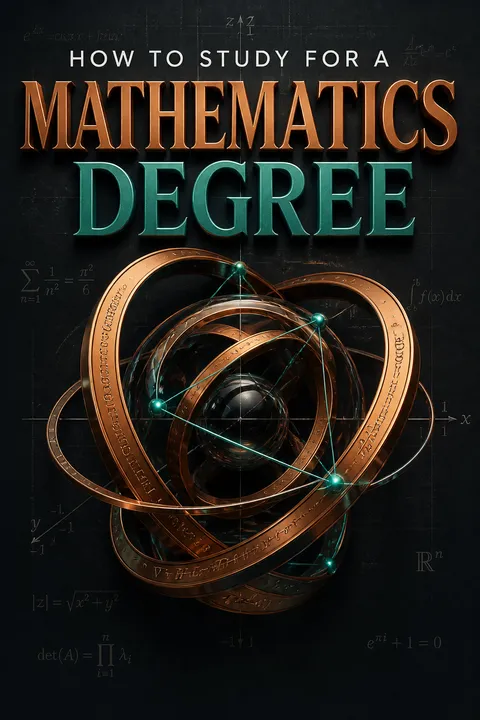


Key Takeaways
At university, mathematics stops telling you which procedure to use.
Fluency is only the start. Lecturers expect students to arrive able to manipulate algebra, differentiate, and integrate without relearning every basic technique. The new demand is deciding what method fits, recognizing when a familiar procedure needs adjustment, and noticing when a calculation can be avoided. A question may simply ask you to solve a problem, without naming the tool.
Practice making choices. After solving an exercise, ask why the method worked, what changes would make it fail, and whether another method would be simpler. Work from mixed problem sets, where the topic does not give away the procedure. When examples are sparse, use the definition or formula directly instead of waiting for a model solution to copy.
This transition is a shift from following instructions to selecting and adapting strategies, a distinction that appears in many expert fields. A musician does not merely know scales, and a doctor does not merely memorize procedures; both must judge which tool fits the case. The book’s emphasis on fluency is important because routine work consumes attention when it is not automatic. Still, independence should not be mistaken for refusing guidance. Worked examples remain useful, especially for beginners, when treated as objects to analyze rather than scripts to imitate.
Ask what kind of object the question expects before calculating.
Symbols can mislead. Similar-looking expressions may stand for different kinds of mathematical objects. A definite integral produces a number, while an indefinite integral represents a family of functions. The procedures used to evaluate them may look similar, but their answers are not interchangeable.
Check the requested result. In a linear algebra problem asking for the dimension of a transformation’s kernel, finding a basis is only an intermediate step. A basis is a collection of vectors; dimension is the number of vectors in that basis. The final answer must therefore be a number. Before starting, identify the objects in the question, what operation is being requested, and what type of answer would make sense. This simple check can expose a copied method that solves a neighboring problem instead of the one actually asked.
This habit resembles type-checking in programming: an expression can be syntactically plausible yet fail because its output is the wrong kind of thing. The comparison is useful because mathematical notation often compresses several layers of meaning into a few symbols. Naming the expected answer type forces a student to interpret the task before manipulating it. There is a limitation: object classification may itself be unfamiliar in advanced topics. In that situation, a diagram or a worked example can supply temporary orientation, provided the student still returns to the question’s exact demand.
Treat definitions as exact tests, not loose descriptions.
Definitions set the rules. Everyday words can have fuzzy meanings, but a mathematical definition specifies precisely which objects qualify. To understand one, test both examples and non-examples. The definition of an even integer, for instance, says it can be written as twice another integer. That form is more than a verbal description: it can be substituted into an argument to prove that an integer multiple of an even number is still even.
Intuition needs checking. A function that stays constant satisfies the standard definition of both increasing and decreasing, because the definitions allow equality. That may feel odd, but it is a consequence of the chosen rules. Likewise, a closed interval fails the definition of an open set at its endpoints, even though nearby interior points pass. Work through boundary cases rather than relying on the everyday sense of a word.
Definitions make shared reasoning possible: once a term has a precise meaning, different readers can test the same claim against the same criteria. This resembles operational definitions in science, where researchers specify how an idea will be measured before comparing results. The book also rightly shows that familiar intuition can misclassify edge cases. However, saying intuition must simply yield can sound too blunt. A productive response is to ask why mathematicians chose that definition and what the choice makes easier to prove. Understanding the reason turns an apparent oddity into a usable convention.
Read theorem logic literally, especially the order of quantifiers.
A theorem has a direction. In a statement of the form if A, then B, A is the premise and B is the conclusion. The reverse implication does not automatically follow. Everyday speech often blurs this distinction, but mathematical reasoning cannot. For example, a condition might guarantee an outcome without being the only way to obtain it.
Order changes meaning. Quantifiers specify whether a claim concerns every object or at least one. In the definition of an open set, each point may have its own suitable distance from the boundary. Reversing the order to demand one distance that works for every point makes a much stronger claim. When reading a theorem, mark its assumptions, conclusion, and quantifiers. If a statement is difficult to prove, rewriting it or considering its logically equivalent contrapositive can suggest a clearer route.
The emphasis on logical form addresses a genuine source of error: readers often import conversational assumptions that are not present in a formal statement. In law, scientific hypotheses, and everyday conditional reasoning, confusing a sufficient condition with a necessary one can lead to invalid conclusions. Quantifier order is especially easy to overlook because the sentences may differ by only a few words. A useful check is to invent a small example and ask whether it satisfies one reading but not the other. Formal notation helps, but it does not replace careful paraphrase.
Prove results to see how mathematical ideas fit together.
Proof is more than certainty. A proof establishes that a conclusion follows from definitions, assumptions, or earlier results. It also reveals how different claims belong to a connected theory. Showing that two even numbers add to an even number, for example, uses the definition of evenness and a repeatable pattern that also applies to other divisibility claims.
Examples inspire, proofs establish. Three consecutive integers always have a product divisible by six: among them, one is divisible by two and one by three. That observation suggests the argument, while the proof makes the reasoning explicit. Examples and diagrams can help generate ideas, but they cannot by themselves establish a claim for every case. Counterintuitive results sharpen this lesson. The harmonic series grows without bound despite its shrinking terms, and adding one metre to a rope around Earth raises it by about 16 centimetres.
Proofs function both as verification and as explanations of structure. This is close to the role of a derivation in physics: the result matters, but so does seeing which assumptions produce it and how it relates to other results. The harmonic series and rope examples are effective because they make intuition answerable to calculation rather than treating surprise as a defect. At the same time, a formal proof is not always the only route to understanding. Diagrams, numerical checks, and informal arguments can reveal patterns that a polished proof alone may conceal.
Practice proof strategies; nobody expects every clever idea to arrive instantly.
Start with structure. When a proof stalls, write the premises and conclusion using their definitions, then look for a valid path between them. A direct proof moves from assumptions to the result. A proof by contradiction assumes the desired conclusion is false and derives an impossibility. Mathematical induction proves an initial case, then shows that each case implies the next one.
Try useful moves. To prove uniqueness, suppose two objects have the required property and show they must be equal. To simplify an expression, adding and subtracting the same quantity can expose parts that are easier to handle. These ideas are not magic recipes. Exploratory work may include failed attempts, diagrams, and partial calculations. Writing them down helps manage the limited capacity of working memory. The final proof can be organized and polished after the reasoning is found.
This account separates the messy discovery process from the clean presentation of a proof, an important distinction in research and engineering as well as mathematics. Strategies reduce the intimidating sense that every proof is an entirely new invention. They also provide starting points without promising that a method will succeed. Cognitive science describes working memory as limited, which supports the practical advice to externalize intermediate steps. The caution is that a proof template can become another copying habit. Each step still needs checking against the definitions and assumptions of the current problem.
Read notes actively, then reconstruct the mathematics from its structure.
Mathematical reading is work. A set of lecture notes may state a definition or theorem in compact form while leaving examples and explanations for the lecture. Read the words, identify whether each passage is a definition, result, example, or proof, and look up terms you cannot explain. Move backward to earlier results when needed, and ahead to examples that clarify an abstract statement.
Build a map, not a pile. A running summary can show the order of topics; a concept map can show which definitions and theorems support which others. For revision, mark each item as secure, uncertain, or unfamiliar, then work first on uncertain material. Diagrams can help recover definitions and theorems from memory. For a long proof, remember its main moves and reconstruct routine algebra instead of memorizing every line word for word.
The approach combines comprehension, organization, and retrieval. In learning science, retrieval means trying to bring information to mind rather than repeatedly rereading it; the effort often reveals what is actually understood. Concept maps add another benefit by making dependencies visible, much like a map of prerequisites in a technical system. Yet summaries can become decorative paperwork if they only condense notes. Their value depends on using them to ask questions, reconstruct arguments, and identify gaps that matter for solving problems.
Write the solution twice: first to discover it, then to explain it.
Make reasoning visible. A correct answer does not always show how it was obtained. Clear writing identifies what is being assumed, explains why important steps follow, and distinguishes equality between expressions from implication between statements. Words such as let, hence, and because help a reader follow the argument; they are not unwanted essay-writing in disguise.
Revise for the reader. A useful method is to solve the problem in rough form, then reread the work aloud. Add missing reasons, introduce symbols before using them, and check that the final answer has the right form. This matters in exams because a well-laid-out argument lets a marker distinguish a small slip from a misunderstanding. It also makes personal notes usable months later, when the original train of thought has disappeared.
Clear mathematical writing is a form of error detection. Requiring each line to connect to the previous one can reveal that an operation was not reversible or that a symbol has changed meaning. This parallels reproducibility in science: a result is more trustworthy when its route can be inspected. The practical benefit extends beyond academic grading, since technical work often depends on colleagues understanding the reasoning behind a recommendation. The challenge is not to over-explain every routine step. Clarity means supplying the reasoning needed by the reader, not adding words indiscriminately.
Plan a sustainable week instead of promising yourself a perfect semester.
Plan at the right scale. A term calendar can reveal deadlines, tests, and busy weeks, but a detailed study plan for an entire term is likely to become obsolete. Instead, build a realistic weekly routine around classes, work, social commitments, energy levels, and preferred study locations. The book suggests roughly a 40-hour working week as one possible benchmark, including about 18 hours of lectures in a typical example. It is a reference point, not a universal quota.
Choose what matters now. At the start of each week, list tasks by module and look ahead for approaching deadlines. Keep regular study going during test weeks rather than abandoning every other subject. Leave buffer time before submissions, organize notes as they arrive, and accept that a session need not finish a whole problem sheet. A sensible plan is a tool for returning to work after disruption, not a promise never to be disrupted.
The strongest feature of this planning advice is its realism. It treats attention, energy, and social life as constraints to design around, rather than moral failures to overcome. Weekly planning also resembles implementation planning: a broad intention becomes a specific decision about when and where work happens. The suggested hours should not be mistaken for a scientific constant. Course difficulty, employment, disability, caregiving, and institutional schedules vary widely. The useful principle is to estimate capacity honestly, reserve time for important work, and adjust the plan when evidence shows it is not working.
When panic takes over, turn the workload into 30-minute actions.
Replace the cloud with a list. Panic can make every unfinished task feel urgent at once, leaving a student unable to begin. Write down each module, its nearest important task, and the relevant deadline. Select four priorities, choose one small action for each, and assign about 30 minutes to it. A task might be locating the notes needed for an assignment or reviewing one section before attempting practice questions.
Restart with evidence. After each block, record what was completed and what the next step is. The point is not to clear the whole backlog in two hours; it is to regain traction and see the work as a sequence of manageable decisions. A check-in with a trusted person can make progress visible. If panic continues because of a serious personal or health problem, use the university’s support services rather than treating distress as a scheduling problem.
The method works by reducing the number of simultaneous worries and lowering the threshold for action. That resembles behavioral activation, where a person begins with a manageable task rather than waiting to feel motivated. Short blocks also create quick feedback: the student can see what was possible and revise the next step. The approach is not a substitute for treatment or institutional accommodations when the cause is illness, trauma, or another serious difficulty. Its strength lies in offering a practical first move while leaving room to seek broader support.
Use tutors and peers before confusion hardens into isolation.
Independent does not mean alone. University students are expected to take initiative, but help is available through tutors, problems classes, lecturers, and mathematics support services. A focused question is easier to answer than a general claim of not understanding a whole module. Bring relevant notes, problem sheets, and your attempts, and identify the exact step or definition causing trouble.
Learn with other students. Study groups can make mathematical reasoning more social and help students calibrate how they are doing. A productive group gives each person room to explain, question, and try problems. If one person does all the talking while everyone else copies, the group is not building independent understanding. Asking for help is not evidence of incapacity; it is one of the ordinary ways students take responsibility for learning.
Mathematical understanding is often portrayed as solitary, but explaining an idea to another person forces hidden assumptions into the open. Peer discussion also gives students a chance to compare interpretations before a misunderstanding becomes entrenched. This resembles collaborative problem-solving in many technical workplaces, where independent expertise and shared checking complement each other. Still, groups are not automatically helpful. Differences in preparation, confidence, or speaking time can silence some members. Clear goals, individual attempts before discussion, and a norm of asking why can make collaboration more equitable.
Measure progress by durable understanding, not speed or class rank.
Difficulty is part of the transition. Students who were top performers at school may arrive among equally capable peers and wrongly conclude that they no longer belong. University mathematics moves faster, assumes more independence, and often requires time before a lecture makes sense. Being slow at first is not proof of lacking ability. Nor should a student infer that a classmate who appears effortless does no work or understands everything.
Choose depth strategically. The book argues that understanding a substantial portion of a module securely can be more valuable than shallow familiarity with every topic. It gives the example of mastering 70 percent of material well enough to score 90 percent on that portion, which yields more than weakly mastering everything and achieving 50 percent overall. Prioritize central ideas and uncertain material, then build outward. Speed is often an outcome of understanding, not a useful starting target.
The chapter offers a needed alternative to equating mathematical talent with instant answers. A growth-oriented account emphasizes what students can learn through effort, feedback, and strategy, rather than treating early performance as a fixed measure of capacity. The advice to prioritize depth is especially valuable when time is limited, though it depends on exam design and the structure of the course. Some foundational topics cannot safely be skipped because later work depends on them. Strategic study therefore means identifying both high-value material and prerequisites, not simply avoiding what feels difficult.
Analysis
The book’s central achievement is to make the undergraduate transition legible. Its subject is not primarily mathematical content, but the change in the student’s role: from executing procedures supplied by a teacher to interpreting abstractions, choosing methods, proving claims, and managing learning independently. The chapters on objects, definitions, logic, and proof form a conceptual progression. Students first learn to see mathematical entities as more than actions or symbols, then use precise definitions and logical structure to understand why general claims hold. Practical chapters extend the same argument into study habits: reading notes, planning weeks, asking for help, and recovering from panic all require active judgment rather than passive receipt of instruction.
The strongest practical insight is that difficulty should be diagnosed, not moralized. Confusion may arise because a new object type has appeared, a quantifier is being misread, or a familiar procedure no longer applies. That framing gives students something specific to do besides deciding they are not talented enough. The examples, from the misleading algebraic shortcut to the rope around Earth, make this point memorable by showing how plausible intuition can fail and how formal reasoning can repair it.
The adaptation also carries a productive tension. The book urges precision and deep understanding while accepting that students sometimes learn procedures pragmatically. That is realistic: no learner can understand every prerequisite at once. Its advice to prioritize substantial understanding is powerful, but should be applied with awareness that mathematics is cumulative and some apparently minor foundations support later topics. Similarly, its time targets and grading examples arise from a particular university context and should not be treated as universal standards.
Overall, the book presents mathematical maturity as a collection of learnable practices, not a mysterious gift. It asks students to notice what kind of thing they are handling, test their interpretations, write their reasoning clearly, and seek support while remaining responsible for their own progress. That combination is its most transferable lesson.
Review Summary
How to Study for a Mathematics Degree receives mostly positive reviews, with readers praising its insightful advice for transitioning to university-level mathematics. Many find it helpful for understanding what to expect in a math degree program and appreciate the author's anticipation of common questions and concerns. Some readers suggest it's most beneficial when read before starting university or early in the degree. A few critics note it may be less useful for advanced students or those in other disciplines. Overall, readers value the book's guidance on proofs, reading mathematics, and adjusting to university life.
People Also Read






Glossary
direct proof
Premises lead to conclusionA proof structure that begins by assuming the theorem’s premises and proceeds through valid deductions or manipulations until it reaches the conclusion. It is the most straightforward proof pattern, though discovering the argument may still involve exploratory examples, diagrams, or unsuccessful attempts.
proof by contradiction
Assume the oppositeA proof method that temporarily assumes the desired conclusion, or part of it, is false. The argument then derives a contradiction with the premises or with an established fact. Since the temporary assumption cannot be true, the original conclusion must hold.
proof by induction
Prove an ordered chainA method for proving a statement about every natural number in an ordered sequence. It establishes an initial case, then proves that whenever the statement holds for an arbitrary case k, it also holds for k plus one. The initial case and the repeating step together establish the statement for all cases in the sequence.
quantifiers
Specify how many objectsLogical expressions that state how many objects a mathematical claim concerns. The universal quantifier means that a claim applies to every object in a specified set; the existential quantifier means that at least one suitable object exists. When claims contain multiple quantifiers, their order can change the meaning.
concept map
Diagram of connected ideasA visual summary that places concepts, definitions, examples, and theorems in relation to one another. In a mathematical course, arrows can show which results depend on which earlier ideas. Creating a map requires selecting meaningful connections, so it can reveal the structure of a module rather than merely reproduce its list of topics.
reading for synthesis
See how topics connectA way of reading aimed at understanding how the material across a whole module fits together. Students summarize definitions, theorems, examples, and procedures, then track their relationships. Lists can preserve the order of material, while diagrams can display conceptual links and logical dependence.
FAQ
1. What is How to Study for a Mathematics Degree by Lara Alcock about?
- Comprehensive study guide: The book explains how to approach university-level mathematics, focusing on the transition from procedural school math to abstract reasoning, proofs, and independent study.
- Skills and mindset: It covers essential study skills, time management, and the mindset needed to succeed in a mathematics degree.
- Not a textbook: Rather than teaching specific math content, it provides strategies for learning, understanding, and thriving in undergraduate mathematics.
- Preparation for challenges: The book prepares students for both the intellectual and practical demands of university mathematics.
2. Why should I read How to Study for a Mathematics Degree by Lara Alcock?
- Bridges educational gaps: The book addresses the common struggles students face when moving from school to university mathematics, such as understanding proofs and abstract concepts.
- Research-based strategies: It draws on mathematics education research to offer practical advice and proven study techniques.
- Boosts efficiency and confidence: Readers learn how to study smarter, manage their time, and communicate mathematics clearly, leading to greater academic success and enjoyment.
- Normalizes challenges: The book reassures students that initial struggles are normal and provides strategies to overcome them.
3. What are the key takeaways from How to Study for a Mathematics Degree by Lara Alcock?
- Shift to abstraction: University mathematics requires a move from procedural calculation to abstract reasoning, focusing on definitions, theorems, and proofs.
- Active, independent learning: Success depends on developing skills for independent reading, writing, and synthesizing mathematical ideas.
- Effective study habits: Techniques like summarizing notes, creating concept maps, and prioritizing study topics are emphasized.
- Growth mindset: Persistence, flexibility, and learning from mistakes are crucial for adapting to the demands of a mathematics degree.
4. What are the main differences between school mathematics and university mathematics according to Lara Alcock?
- Procedures vs. proofs: School math emphasizes calculation and following instructions, while university math focuses on constructing and understanding proofs.
- Abstract thinking: University mathematics involves thinking about numbers, functions, and other concepts as abstract objects, often organized hierarchically.
- Greater responsibility: Students must make more decisions about which methods to use and how to approach problems, rather than relying on explicit instructions.
- Conceptual challenges: The shift to abstraction and formal reasoning can be a significant adjustment for many students.
5. How does Lara Alcock define and explain abstract objects in university mathematics?
- From processes to objects: Concepts like numbers and functions are initially understood as processes but are later treated as objects in their own right.
- Hierarchical structure: Mathematical objects are organized in layers, with higher-level objects depending on the understanding of lower-level ones.
- New object types: The book introduces relations, binary operations, and symmetries as mathematical objects, explaining their properties and significance.
- Importance for advanced math: Thinking of these entities as objects is essential for engaging with higher-level mathematics.
6. What advice does How to Study for a Mathematics Degree by Lara Alcock give about understanding and using mathematical definitions?
- Precision and operability: Mathematical definitions are exact, with no exceptions, and provide clear criteria for use in proofs.
- Inclusion and exclusion: Students should consider both examples that fit a definition and those that do not to fully grasp its boundaries.
- Adjusting intuition: Formal definitions may differ from everyday intuition, especially in boundary cases, requiring students to refine their understanding.
- Foundation for reasoning: Mastery of definitions is crucial for constructing and understanding proofs.
7. How does Lara Alcock describe the role and structure of theorems in university mathematics?
- Logical necessity: Theorems express relationships that must be true once definitions are established, often in “if… then…” form.
- Understanding through examples: Students are encouraged to examine examples and analyze the logical structure to comprehend theorems.
- Precise language: The book emphasizes the importance of using logical terms like “if,” “only if,” and quantifiers correctly.
- Avoiding misinterpretation: Everyday meanings of logical words can differ from their mathematical usage, so precision is essential.
8. What insights does How to Study for a Mathematics Degree by Lara Alcock provide about mathematical proofs and their importance?
- Proofs as logical arguments: Proofs demonstrate why theorems are true, starting from definitions and using logical deductions.
- Demystifying proofs: Many school-level calculations are simple proofs; university proofs are more formal but follow similar principles.
- Building coherent theory: Proofs help mathematicians understand how results fit into a larger, consistent framework.
- Practice in rigorous thinking: Engaging with proofs develops the logical reasoning skills central to advanced mathematics.
9. What are the common types of proofs and proof strategies discussed by Lara Alcock?
- Direct proof: Involves logically deducing the conclusion from the premises step-by-step.
- Proof by contradiction: Assumes the opposite of the desired result and shows this leads to a contradiction.
- Proof by induction: Proves a base case and then shows that if the statement holds for one case, it holds for the next, covering all natural numbers.
- Additional techniques: Includes proof by cases, uniqueness proofs, and algebraic manipulations to simplify arguments.
10. What strategies does Lara Alcock recommend for reading and understanding mathematics texts and notes?
- Active, independent reading: Students should develop skills to learn from written materials, not just lectures.
- Identifying structure: Recognize definitions, theorems, examples, and proofs to engage effectively with the material.
- Summarizing and mapping: Creating summary lists and concept maps helps synthesize information and see connections.
- Using examples and diagrams: Checking examples and using diagrams can clarify abstract concepts and aid memory.
11. How does How to Study for a Mathematics Degree by Lara Alcock address time management and overcoming panic?
- Planning and prioritization: The book suggests creating term and weekly plans, prioritizing tasks, and breaking study into manageable chunks.
- Realistic expectations: Students are encouraged to accept that not all tasks will be completed perfectly and that setbacks are normal.
- Dealing with panic: When overwhelmed, making a prioritized list and working through tasks in short, timed sessions can restore control.
- Seeking support: Utilizing university resources and checking progress with a trusted person can help manage stress and maintain progress.
12. What does Lara Alcock say about interacting with lecturers, tutors, and peers in a mathematics degree?
- Active engagement: Students should take initiative in seeking help, preparing questions, and using office hours or tutorials.
- Effective communication: Clear, polite communication—especially in emails and group settings—is important for productive interactions.
- Group study: Working with peers can enhance understanding, but students should avoid distractions and ensure meaningful engagement.
- Utilizing support services: The book encourages early and regular use of university resources like support centers and counseling for academic and personal growth.
Download PDF
Download EPUB
.epub digital book format is ideal for reading ebooks on phones, tablets, and e-readers.








