

Key Takeaways
Use quantum physics to explain the microscopic, not to excuse miracles
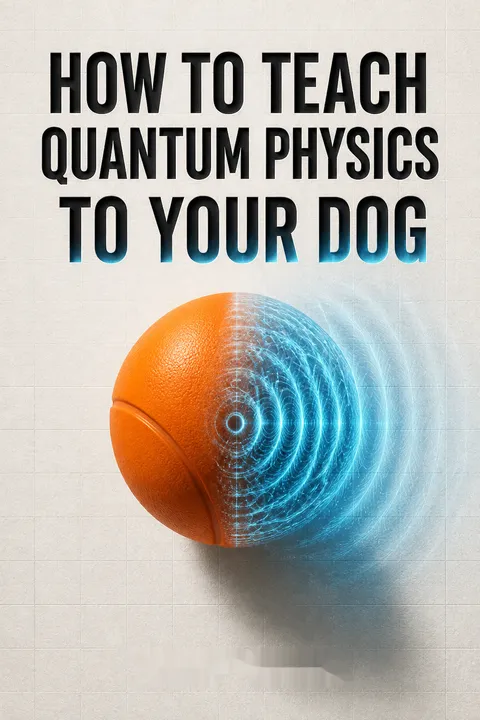
Start with wonder. The book’s guide is Emmy, a clever, treat-seeking dog who meets quantum physics with fewer assumptions about how reality ought to work. Her conversations with her physicist owner make strange ideas approachable, while reminding readers that strangeness is not evidence of magic. Quantum mechanics describes small-scale matter and light, and its predictions have been tested with extraordinary precision. It also underpins technologies such as computer chips and lasers.
Keep claims accountable. The same theory does not authorize promises of free energy, thought-powered healing, or psychic links. Quantum effects do not erase energy conservation, make large bodies behave like isolated particles, or let people choose random measurement outcomes. The book’s practical test is simple: ask whether a claim fits established physics and survives experiment, rather than being dazzled by scientific-sounding vocabulary.
What's striking is how the dog premise does more than supply jokes. It models intellectual humility: ordinary intuition is useful at human scale, but it is not a universal law. That distinction matters in public debates where counterintuitive science is often used to sell unsupported claims. A useful extension is to ask what a proposed quantum effect predicts numerically and what observation could prove it wrong. If no possible result would count against the claim, the problem is not that quantum physics is strange. The claim has stopped behaving like science.
Matter shows wave behavior when its wavelength matches the scale of an obstacle
One object, two kinds of evidence. Particle-wave duality means that light and matter show particle-like properties in some experiments and wave-like properties in others. Young’s double-slit experiment revealed interference in light. Einstein explained the photoelectric effect by treating light as packets called photons, while experiments by Davisson and Germer showed electrons producing diffraction patterns. De Broglie’s relation connects a particle’s wavelength to its momentum: greater momentum means a shorter wavelength.
Scale explains the everyday gap. A walking, 20-kilogram dog has a wavelength around 10⁻³⁵ meters, far too tiny to bend noticeably around a tree. In 1999, researchers observed wave behavior in molecules containing 60 carbon atoms. The dog’s wave nature is not absent; it is simply hidden by scale and environmental complexity.
This is a powerful lesson in scale-dependent explanation. A familiar object can obey microscopic laws without displaying their most dramatic signatures, just as fluid behavior emerges from molecules without making each molecule a miniature wave. The key question is not whether something is quantum, but whether its wavelength and isolation let quantum effects become visible. The book’s comparison makes that distinction memorable, though the phrase particle-wave duality can tempt readers to imagine particles literally switching identities. Quantum objects are better understood through the mathematical rules that predict both sets of observations.
Treat uncertainty as a feature of reality, not a flaw in observation
Not merely poor eyesight. The Heisenberg uncertainty principle says that position and momentum cannot both have arbitrarily precise values: ΔxΔp ≥ h/4π. A microscope analogy suggests that measuring an electron disturbs it, but the deeper account is that quantum wavefunctions cannot define both properties exactly. A localized wave packet requires combining waves with different momenta, so sharper position entails greater momentum uncertainty.
Atoms are not solar systems. The electron in hydrogen is better described as a probability cloud near the nucleus than as a planet following a definite track. Confinement also means a particle cannot be perfectly at rest. Its minimum residual energy is called zero-point energy. These ideas help explain atomic structure and why electrons can be shared between atoms, forming chemical bonds and enabling the behavior of solids.
The distinction between limited knowledge and indeterminate properties is philosophically consequential. It separates quantum uncertainty from ordinary measurement error, where better instruments can often narrow ignorance. The wave-packet picture also shows why uncertainty is structural rather than an arbitrary rule imposed on scientists. Still, the claim that properties are undefined should be presented as an interpretation of the formalism, not as a simple laboratory observation. Experiments establish probability patterns with great reliability; what those patterns imply about reality remains a deeper question.
Measurement determines outcomes and can erase the interference that reveals superposition
Possibilities can coexist. A superposition is a quantum state combining multiple possible outcomes. In the double-slit experiment, individual photons arrive as separate detections, yet many detections build an interference pattern, indicating that each photon’s alternatives contribute together. A photon polarized between horizontal and vertical can likewise be described as a combination of those states.
Which-path knowledge matters. In a quantum-eraser setup, different polarizers mark the slit a photon passes through. Once the paths can be distinguished, the interference pattern disappears. A further filter can remove that distinction and restore the pattern. Measurement is therefore not just passive watching: the experimental arrangement changes which quantum possibilities can interfere. The result is not that human attention magically controls matter, but that physical interactions and available information matter to the outcome.
The experiment links an abstract state to something visible: a pattern that appears or vanishes depending on whether alternatives remain indistinguishable. This resembles a broader principle in science: the design of a measurement determines which features a system can reveal. The crucial nuance is that information need not be consciously read by a person to matter. Physical interactions can encode path information in an apparatus or environment. That makes the lesson more precise than the popular slogan that consciousness creates reality.
Environmental interactions hide quantum interference without making quantum rules disappear
The environment scrambles patterns. Decoherence is the loss of observable interference when a quantum system interacts with its surroundings. In an interferometer, tiny, fluctuating interactions with air molecules shift the phases of light traveling along different paths. Repeated trials then blur the interference pattern, making the result look classical. Larger systems interact with more environmental particles, so their quantum coherence is especially difficult to preserve.
Interpretations tell different stories. The Copenhagen interpretation treats measurement as a collapse into one outcome and draws a sharp divide between quantum systems and classical measuring devices. Hugh Everett’s many-worlds interpretation instead says the wavefunction never collapses; different outcomes occupy separate branches that decoherence makes effectively unable to interact. Both yield the same experimental predictions, and the book notes that decoherence itself does not settle which interpretation is right.
Decoherence supplies a concrete mechanism for why delicate interference vanishes in ordinary surroundings, an important bridge between quantum theory and everyday experience. It also clarifies why the two interpretations are not competing laboratory recipes: their disagreement concerns what the shared mathematics means. One limitation deserves emphasis. Decoherence explains why branches stop producing visible interference, but by itself it does not explain why an observer experiences one particular result. The book preserves this open problem rather than presenting a tidy philosophical victory.
Repeatedly measure a quantum system to slow transitions or detect without absorption
Watching can alter change. The quantum Zeno effect occurs when repeated measurements inhibit a quantum system’s transition between states. In a 1990 experiment, Wayne Itano and colleagues used microwaves to move beryllium ions between energy states. With no intermediate measurements, the transition took 256 milliseconds. More frequent laser measurements reduced the number of ions that completed it; after 64 measurements, fewer than 1% made the transition.
Absence can reveal presence. The effect can also support quantum interrogation: a photon’s motion through an apparatus is repeatedly checked, and an absorbing object can prevent its transition. Researchers can infer the object is present even when it absorbs no photon. This is not a way to see anything without physical setup or risk, but a carefully arranged method for detecting fragile systems while minimizing disturbance.
The effect sharpens a central idea in experimental science: measurement is sometimes part of the system’s dynamics, not an external report about it. This has practical value when the object being studied is easily damaged, and it invites useful questions about how often and in what way a system is probed. The analogy to repeatedly interrupting a nap is memorable, but quantum Zeno behavior is not a general recipe for freezing any process. It depends on specific quantum dynamics and suitably timed measurements.
Entanglement defeats local hidden-variable models, but cannot send faster-than-light messages
Correlations exceed classical limits. Entanglement links the possible measurement results of two particles so that measuring one predicts a corresponding result for the other, even when they are far apart. Einstein, Podolsky, and Rosen argued that this suggested quantum mechanics was incomplete. John Bell later showed that theories with both pre-existing particle properties and only local influences impose limits on such correlations.
Experiments favor quantum predictions. In a simplified example in the book, a local hidden-variable model requires matching results at different detector settings at least one-third of the time, while quantum mechanics predicts one-quarter. Alain Aspect’s experiments in 1981 and 1982 found correlations beyond the local limit. These results support quantum nonlocality, but the outcomes are random, so entanglement cannot be used to send a chosen message faster than light.
Bell’s theorem turns a philosophical argument into a testable comparison between families of theories. Its enduring value is methodological: assumptions that seem self-evident, such as local causes and pre-existing values, can be translated into measurable constraints. The result does not mean that useful signals travel instantaneously. Correlation is not communication, because neither observer controls the random result needed to encode a message. This distinction helps keep the genuine strangeness of entanglement separate from science-fiction interpretations.
Teleport a quantum state, not an object, and send correction instructions classically
Transfer a state, not matter. Quantum teleportation uses a previously shared entangled pair to reproduce an unknown quantum state at a distant location. The sender makes a joint measurement on the state to be transferred and one member of the pair, then sends the measurement result through an ordinary communication channel. The receiver uses that information to adjust the other particle into the required state.
No perfect copying. The original state is changed in the process, consistent with the no-cloning theorem, which forbids making an exact copy of an unknown quantum state. Teleportation is therefore neither Star Trek transport nor faster-than-light transmission. A team led by Anton Zeilinger demonstrated photon teleportation in 1997, and in 2004 the group transferred photons across about 600 meters using optical fiber. Such methods may help connect quantum information systems.
The term teleportation is exciting but misleading unless the distinction between state and object stays in view. The protocol illustrates how entanglement can be a resource for information processing, while classical communication still enforces the speed-of-light limit. The no-cloning constraint is especially important: quantum information cannot simply be duplicated and backed up like an ordinary file. That makes reliable state transfer a real engineering problem, not a loophole in causality.
Quantum tunneling lets particles cross barriers, from microscopes to solar fusion
Forbidden is not impossible. Quantum tunneling is the chance that a particle will appear beyond an energy barrier it lacks the classical energy to cross. A particle’s wavefunction extends into the forbidden region; if the barrier is thin enough, some probability remains on the far side. The chance falls rapidly as the barrier thickens.
A tiny current maps atoms. A scanning tunneling microscope places a sharp metal tip extremely close to a conducting surface. Electrons tunnel across the gap, and the current changes sharply with distance. By scanning the tip, researchers can map surface features down to individual atoms. Tunneling also helps power the Sun: protons in its core can overcome their electrical repulsion through tunneling, enabling fusion at conditions where classical physics alone would predict too few reactions.
Tunneling is a striking example of a probability rule producing dependable technology and astrophysical consequences. The scanning microscope turns an effect usually treated as microscopic weirdness into a measuring tool, while stellar fusion shows that tiny probabilities can matter when enormous numbers of particles are involved. That last point is broadly useful: improbable events are not negligible if the number of opportunities is vast. Tunneling remains strongly scale-dependent, however, so it offers no realistic route for a dog to pass through a fence.
Virtual particles are measurable in their effects, not a loophole for free energy
A calculation with consequences. Quantum electrodynamics, or QED, describes interactions between light and charged particles. Its Feynman diagrams organize possible interaction processes, including contributions from virtual particles, which cannot be detected directly as ordinary particles. Their effects alter measurable properties. A 2008 electron experiment measured the magnetic g-factor as 2.00231930436146, in agreement with a QED calculation to fourteen decimal places.
Do not mistake a model for a machine. The book describes virtual particle pairs as brief fluctuations associated with energy-time uncertainty, but stresses that they cannot be harvested on demand for useful work. Zero-point energy likewise does not provide a free power source. The fact that quantum theory permits counterintuitive processes does not cancel energy conservation or validate claims of miraculous fuel, health, or wealth.
The precision of QED is a strong counterweight to the idea that quantum physics is simply a license for anything unusual. It shows how an abstract formalism can survive severe quantitative tests. A useful modern nuance is that virtual particles are components of a successful calculation, not tiny objects directly observed popping in and out like ordinary particles. Popular descriptions can make them sound more literal than the theory requires. Their measurable consequences are real; the imagery is explanatory shorthand.
Analysis
The book’s strongest achievement is its teaching strategy: it repeatedly turns a technical distinction into a concrete exchange between a physicist and a dog whose chief interests are food and chasing animals. Emmy’s misunderstandings are productive. She voices the tempting but wrong conclusion, allowing the explanation to separate quantum claims from familiar intuition without pretending the subject is easy. The result is not merely a catalogue of strange effects, but a progression from wave behavior and uncertainty to measurement, decoherence, entanglement, applications, and scientific misuse.
The central intellectual thread is that quantum mechanics changes what can be predicted and measured, while remaining mathematically disciplined. A photon can contribute to an interference pattern through alternatives that cannot be distinguished; entangled particles violate limits derived from local hidden-variable assumptions; tunneling gives nonzero probability beyond a classical barrier. These are not exceptions to all physical law. They are consequences of a framework whose predictions can be compared with experiments, from Bell tests to electron magnetic measurements.
The most important caveat concerns interpretation. The book clearly distinguishes experimental results from Copenhagen and many-worlds stories, but its occasional language about properties not existing before measurement can sound more settled than the evidence warrants. Decoherence accounts for the practical disappearance of interference, not by itself for why one definite experience occurs. Likewise, virtual particles are useful in QED calculations, but the popular picture of literal particles briefly borrowing energy should not be confused with a direct observation.
The final warning against quantum mysticism follows from the book’s broader lesson: unusual does not mean unconstrained. Quantum theory supports real technologies and revises common sense, but it does not confer a blank check on claims that evade testing. Its humor makes that boundary memorable without shrinking the genuine wonder of the physics.
Review Summary
How to Teach Quantum Physics to Your Dog receives mostly positive reviews for its accessible explanations of complex quantum concepts. Readers appreciate the author's clear writing style and use of everyday examples, though some find the dog dialogue gimmick tiresome. The book is praised for its depth and technical explanations, making it suitable for those with some prior physics knowledge. While some readers still struggle with the concepts, many find it an enjoyable and informative introduction to quantum physics.
People Also Read










Glossary
particle-wave duality
Particle and wave behaviorThe quantum feature in which light and matter display particle-like properties in some experiments and wave-like properties in others. Photons arrive as localized detections, yet can form interference patterns. Electrons behave as particles in some measurements and produce diffraction patterns consistent with a wavelength related to their momentum.
Heisenberg uncertainty principle
Limits paired precisionA mathematical relationship limiting how precisely certain pairs of properties can be specified together. The best-known form connects position and momentum: making position more precise requires greater momentum uncertainty. In the book’s account, this is not simply an instrument disturbing a particle, but a consequence of the wave structure used to describe quantum objects.
wavefunction
Encodes quantum probabilitiesA mathematical description of a quantum system. Its values allow physicists to calculate the probabilities of possible measurement outcomes, and the Schrödinger equation describes how it changes over time. A wavefunction can combine multiple possible states, producing effects such as interference before a measurement yields a particular result.
superposition state
Combination of possible statesA quantum state that combines two or more possible states, rather than representing a simple classical either-or choice. Superpositions can produce interference, as when single photons sent through a double slit build a wave-like pattern over many detections. Measurement yields one observed outcome, while interpretations differ over what that means.
decoherence
Environmental loss of interferenceThe process by which interactions with a system’s surroundings scramble the relationships between parts of a quantum wavefunction, making interference difficult or impossible to observe. It helps explain why large objects appear classical: they interact continually with their environments. Decoherence occurs across interpretations but does not, by itself, settle every question about measurement.
Copenhagen interpretation
Measurement-collapse interpretationA family of approaches associated with Niels Bohr and colleagues that treats quantum measurement as producing a definite outcome from a set of possibilities. In the version described in the book, quantum systems are distinguished from classical measuring apparatus, and measurement is associated with wavefunction collapse. Critics question where that boundary lies and how collapse occurs.
many-worlds interpretation
No-collapse branching interpretationHugh Everett’s interpretation in which the wavefunction always evolves according to the Schrödinger equation and never physically collapses. Different measurement outcomes occur in different branches of the universal wavefunction. Decoherence makes those branches effectively unable to interfere, while observers experience only one branch.
quantum Zeno effect
Measurements inhibit transitionsThe inhibition of a quantum system’s transition between states through repeated measurements. In an experiment with beryllium ions, frequent measurements reduced the probability that the ions would complete a transition driven by microwaves. The effect can also help detect an object while minimizing the chance that it absorbs a photon.
Bell’s theorem
Tests local hidden variablesJohn Bell’s result showing that theories based on local influences and predetermined measurement properties obey limits on correlations between distant particles. Quantum mechanics predicts correlations that can exceed those limits. Experiments, including Alain Aspect’s tests, support the quantum predictions and disfavor local hidden-variable explanations.
no-cloning theorem
Forbids unknown-state copyingA theorem showing that an unknown quantum state cannot be copied perfectly while leaving the original unchanged. Measuring the state can disturb it, preventing the straightforward scan-and-recreate method used for ordinary information. Quantum teleportation transfers a state using entanglement and classical communication, while changing the original state in the process.
quantum tunneling
Crossing an energy barrierA quantum process in which a particle has a nonzero probability of appearing beyond a barrier even when its energy is too low to cross it according to classical physics. The probability decreases rapidly as the barrier becomes thicker. Tunneling enables scanning tunneling microscopes and contributes to fusion in the Sun.
quantum electrodynamics
Light and charge interactionsOften abbreviated QED, this theory describes interactions between light and electrically charged particles. Feynman diagrams represent possible contributions to those interactions, including virtual-particle processes. QED produces extremely precise predictions, including for the electron’s magnetic g-factor, which has been measured in close agreement with theory.
FAQ
What's "How to Teach Quantum Physics to Your Dog" about?
- Unique Approach: The book uses a humorous and accessible approach to explain complex quantum physics concepts by framing them as conversations between the author, Chad Orzel, and his dog, Emmy.
- Educational Intent: It aims to make quantum physics understandable to a general audience by breaking down difficult topics into relatable and simple explanations.
- Core Topics: The book covers fundamental quantum physics concepts such as wave-particle duality, the uncertainty principle, quantum entanglement, and quantum tunneling.
- Engaging Format: By using a dog as a conversational partner, the book adds a playful element to learning, making it engaging and less intimidating for readers new to physics.
Why should I read "How to Teach Quantum Physics to Your Dog"?
- Simplified Learning: The book simplifies complex quantum physics concepts, making them accessible to those without a scientific background.
- Humorous and Engaging: The conversational style between the author and his dog adds humor and relatability, making the learning process enjoyable.
- Broad Coverage: It covers a wide range of quantum physics topics, providing a comprehensive introduction to the subject.
- Practical Insights: Readers gain insights into how quantum physics applies to everyday life and modern technology, enhancing their understanding of the world.
What are the key takeaways of "How to Teach Quantum Physics to Your Dog"?
- Quantum Duality: Understanding that particles can exhibit both wave-like and particle-like properties simultaneously.
- Uncertainty Principle: Recognizing the fundamental limits on measuring certain pairs of properties, such as position and momentum.
- Quantum Entanglement: Learning about the nonlocal connections between particles that can affect each other instantaneously over distances.
- Quantum Tunneling: Grasping how particles can pass through barriers they seemingly shouldn't be able to, due to their wave nature.
How does Chad Orzel explain wave-particle duality in the book?
- Concept Introduction: Orzel introduces wave-particle duality by explaining that both light and matter exhibit properties of waves and particles.
- Everyday Examples: He uses relatable examples, such as a dog chasing a squirrel, to illustrate how particles can behave like waves.
- Historical Context: The book discusses historical experiments, like Thomas Young's double-slit experiment, to show how wave-particle duality was discovered.
- Visual Aids: Diagrams and illustrations help clarify how particles can interfere with themselves, demonstrating their wave-like nature.
What is the Heisenberg Uncertainty Principle according to "How to Teach Quantum Physics to Your Dog"?
- Basic Definition: The principle states that it is impossible to know both the position and momentum of a particle with absolute certainty at the same time.
- Measurement Impact: Orzel explains that the act of measuring one property affects the precision with which the other can be known.
- Philosophical Implications: The principle challenges classical physics' deterministic view, introducing fundamental limits to what can be known.
- Real-World Examples: The book uses simple analogies, like a dog trying to find a bone, to illustrate the concept of uncertainty in everyday terms.
How does the book describe quantum entanglement?
- Entanglement Basics: Quantum entanglement is described as a phenomenon where two particles become linked, such that the state of one instantly influences the state of the other, regardless of distance.
- Einstein's Challenge: The book discusses Einstein's discomfort with entanglement, famously calling it "spooky action at a distance."
- Experimental Evidence: Orzel explains how experiments, like those testing Bell's theorem, have confirmed the reality of entanglement.
- Practical Implications: The book touches on potential applications of entanglement, such as quantum computing and cryptography.
What is quantum tunneling, and how is it explained in the book?
- Tunneling Concept: Quantum tunneling is the phenomenon where particles pass through barriers that they classically shouldn't be able to, due to their wave-like properties.
- Energy Barrier Analogy: Orzel uses the analogy of a dog trying to get through a fence to explain how particles can "tunnel" through energy barriers.
- Real-World Applications: The book discusses how tunneling is essential for technologies like semiconductors and nuclear fusion in stars.
- Wave Nature: Tunneling is possible because particles are described by wavefunctions that extend into classically forbidden regions.
How does Chad Orzel use his dog to explain quantum physics concepts?
- Conversational Style: The book is structured as a series of dialogues between Orzel and his dog, Emmy, making complex topics more relatable.
- Simplified Analogies: Emmy's questions and Orzel's answers use everyday scenarios to break down abstract concepts into understandable terms.
- Humor and Engagement: The playful interactions between Orzel and Emmy add humor, keeping readers engaged and making learning enjoyable.
- Accessible Language: The use of a dog's perspective helps simplify scientific jargon, making the content accessible to a wider audience.
What are some of the best quotes from "How to Teach Quantum Physics to Your Dog" and what do they mean?
- "Quantum physics is neat stuff." This quote captures the author's enthusiasm for the subject and sets the tone for the book's exploration of quantum phenomena.
- "Discussing quantum physics with my dog is useful because it helps me see how to discuss quantum mechanics with humans." This highlights the book's approach of using simple, relatable analogies to explain complex ideas.
- "If you can look at the world the way a dog does, as an endless source of surprise and wonder, then quantum mechanics will seem a lot more approachable." This quote encourages readers to adopt a curious and open-minded perspective when learning about quantum physics.
- "Quantum mechanics is not magic." This serves as a reminder that while quantum physics can seem mysterious, it is grounded in scientific principles and evidence.
How does "How to Teach Quantum Physics to Your Dog" address common misconceptions about quantum physics?
- Clarifying Misunderstandings: The book tackles misconceptions by explaining that quantum mechanics, while counterintuitive, is not magic and follows scientific laws.
- Debunking Myths: Orzel addresses myths about quantum physics, such as the idea of free energy or quantum healing, by emphasizing the importance of scientific evidence.
- Real-World Applications: The book highlights practical applications of quantum physics, showing how it underpins modern technology and scientific advancements.
- Scientific Rigor: Orzel stresses the precision and accuracy of quantum mechanics, which has been tested and confirmed through numerous experiments.
What is the significance of the Copenhagen interpretation in the book?
- Interpretation Overview: The Copenhagen interpretation is one of the main philosophical frameworks for understanding quantum mechanics, emphasizing the role of measurement in determining quantum states.
- Wavefunction Collapse: It introduces the concept of wavefunction collapse, where a quantum system's state becomes definite upon measurement.
- Philosophical Implications: The interpretation raises questions about the nature of reality and the role of observers in the quantum world.
- Critiques and Alternatives: The book discusses critiques of the Copenhagen interpretation and presents alternative views, such as the many-worlds interpretation.
How does "How to Teach Quantum Physics to Your Dog" explain the concept of virtual particles?
- Virtual Particles Defined: Virtual particles are temporary fluctuations that appear and disappear in a vacuum, allowed by the energy-time uncertainty principle.
- Role in QED: They play a crucial role in quantum electrodynamics (QED), affecting interactions between particles like electrons and photons.
- Experimental Evidence: The book explains how the effects of virtual particles are observed indirectly through precise measurements, such as the electron's g-factor.
- Conceptual Challenges: Orzel addresses the counterintuitive nature of virtual particles, emphasizing their importance in understanding fundamental forces and interactions.
Download PDF
Download EPUB
.epub digital book format is ideal for reading ebooks on phones, tablets, and e-readers.








