Key Takeaways
1. Propaganda as a Remedy for Loneliness
As Ellul wrote, “Propaganda is the true remedy for loneliness.”
Seeking belonging. Sefton Delmer's childhood in World War I Berlin, as the only British boy in a German school, revealed propaganda's fundamental appeal: it offers a powerful sense of belonging in times of profound social upheaval. Witnessing his German schoolmates transform from friends to "traitors" and feeling compelled to join patriotic chants, Delmer understood that propaganda isn't just about persuasion; it's about integrating individuals into a collective identity, especially when traditional community bonds are fractured. This need for connection, for a shared purpose, becomes particularly acute when people feel isolated or powerless.
Filling the void. Sociologist Jacques Ellul, whose work parallels Delmer's insights, argued that modern industrial societies, by displacing individuals from local communities, create a "violent need to be re-integrated into a community." Propaganda steps in to fill this void, offering a collective identity and an illusion of individual agency within a grand narrative. Delmer observed this in WWI Germany, where national newspapers and public events fused a newly unified, rapidly industrializing nation into a single "propaganda community," providing a shared emotional landscape.
Contemporary echoes. This phenomenon resonates today in "civic deserts" where old institutions have vanished, leaving people yearning for connection. Leaders like Putin, for instance, have successfully forged a "Putin majority" by offering a new collective identity after the collapse of the Soviet Union. Delmer's early experiences taught him that effective counter-propaganda must acknowledge and address this deep-seated human need for belonging, rather than simply dismissing it as irrational.
2. The Theatricality of Propaganda
“As I see it, Hitler’s personal tragedy and through him that of his country was that he came to believe in his act. He accepted as truth his own skilfully built propaganda myth that he was the miraculously infallible Führer Lightgod.”
Performance and artifice. Delmer, a former journalist in Weimar Berlin, observed that Nazi propaganda was a meticulously staged performance, a "circus" where leaders and followers alike played roles. He saw Hitler transform from a "tired and not very successful salesman" into the mesmerising Führer, striking poses and delivering orations that, while repetitive in content, stirred "aggressive exultation" in crowds. This theatricality extended to everyday life, with citizens performing "Heil Hitler" salutes to prove their loyalty, even if their conviction was shallow.
Cabaret of power. Delmer's experiences in Berlin's vibrant cabaret scene, where social identities were fluid and artifice was celebrated, sharpened his perception of propaganda's performative nature. He saw the Nazis as a grotesque cabaret, with figures like Röhm and Himmler appearing almost comically absurd. By portraying Nazism as an act, Delmer subtly undermined its awe-inspiring facade, revealing it as a flimsy, albeit sinister, performance designed to help followers enact fantasies of superiority and sadism.
Beyond hypnosis. Unlike theories that depicted crowds as hypnotized, Delmer believed people were rarely completely entranced. He noted how Germans "talked themselves into" wanting war in 1914, suggesting a conscious, albeit self-deceptive, participation. This insight—that people are conscious actors in a performance—became central to his counter-propaganda. He aimed not to break a spell, but to make people aware of the artifice, to "prick them awake" to the roles they were playing.
3. Exploiting the "Inner Pigdog"
“We must appeal to the inner pigdog inside every German in the name of his highest patriotic ideals, give him a patriotic reason for doing what he would like to do from self-interest, talk to him about his Führer and his Fatherland and all that sort of thing, and at the same time inject some item of news into his mind which will make him think, and if possible act, in a way that is contrary to the efficient conduct of Hitler’s war.”
Cynicism over idealism. Delmer rejected the BBC's "worthy intellectual émigrés" who preached liberal ideals to Germans, believing it was a "waste of breath." Instead, he aimed to exploit the "inner pigdog" (Schweinehund)—the self-interested, cynical, and resentful part of human nature. He understood that while Nazi propaganda demanded idealism and sacrifice, people's motivations were often far more pragmatic, driven by personal grievances and desires.
Targeting corruption. Delmer's "black propaganda" radio station, Gustav Siegfried Eins (GS1), focused relentlessly on the corruption and hypocrisy of Nazi Party officials, whom he dubbed the "Parteikommune." He gathered meticulous details about:
- Party bosses living lavishly while ordinary Germans suffered rationing.
- Officials accepting bribes and engaging in sexual depravity.
- The incompetence of Nazi bureaucrats.
This approach aimed to deepen the existing rift between the revered Wehrmacht (army) and the resented Party, giving Germans a "patriotic reason" to act on their self-interest.
Stimulating self-preservation. The goal was not to convert Germans to democracy, but to "poison the souls of individual Germans by guiding their attention... to the pleasures and benefits of avarice, crime, greed, the lusts of the flesh." By exposing the venality of the regime, Delmer hoped to accelerate its internal decay and encourage behaviors detrimental to the war effort, such as black-market trading or malingering, under the guise of patriotic concern.
4. Subverting from Within
Der Chef’s aim, Delmer explained to the king, was to subvert Nazi propaganda by carrying “Nazi ideology just one phrase further into the ridiculous, where it is harmful to Germany.”
Mimicry and exaggeration. Delmer's core strategy was to adopt the enemy's style and language, then push it "one phrase further into the ridiculous." This wasn't satire, which could alienate, but a subtle exaggeration that exposed the absurdity of the original. GS1's "der Chef" spoke like a foul-mouthed Prussian officer, using Nazi clichés and anti-Semitic slurs, but directed his outrage at the Nazi Party itself. This allowed listeners to feel they were eavesdropping on an insider, validating their own hidden resentments.
Weaponizing Nazi rhetoric. Delmer reverse-engineered Nazi propaganda, using its own hatreds and paranoias against it. For example, he would:
- Accuse Party leaders of being "secret Bolsheviks" or "Jews."
- Spin lurid tales of SS sexual depravity, using Nazi obsessions with "Aryan" purity against them.
- Portray the "healthy Nazi body politic" as infected by disease and corruption.
This approach allowed the propaganda to resonate with existing prejudices while subtly redirecting blame and undermining the regime's moral authority.
The power of the "out-of-tune" note. The honky-tonk piano intro to "der Chef," a slightly off-key version of the official Nazi news theme, perfectly encapsulated this strategy. It signaled a subtle subversion without outright rejection, inviting listeners to perceive the underlying absurdity of the original. This method aimed to create a moment of self-awareness, a "jolt" that made listeners question the performance they were witnessing and participating in, without directly attacking their identity.
5. Building Trust Through Utility and Intimacy
“Several expressed admiration to the cleverness of its use of cover, some saying that if an officer entered the room during an Atlantik news bulletin listeners were able to prove that they sincerely believed it to be an ordinary German station.”
Safe passage to reality. Delmer's Soldatensender Calais (Radio Atlantik) offered a "safe" environment for Germans to engage with information that challenged the official narrative. It broadcast on medium wave, like official Nazi stations, and even replayed Hitler's speeches, giving listeners an alibi if caught. The station's camouflaged nature became its attraction, allowing audiences to:
- Tune in without immediate suspicion from authorities or neighbors.
- Justify their listening by pretending it was a regular German station.
- Engage in a "triple masquerade" that stimulated independent thought.
Intimate and useful information. The Sender gained trust by providing highly specific, often intimate, and useful information that official Nazi media suppressed. This included:
- Precise details of RAF bombing targets, allowing families to check on loved ones.
- News of U-boat movements and promotions, often before official announcements.
- Scores of U-boat football leagues, showing an intimate knowledge of soldiers' lives.
- Advice on how to feign illness or desert, framed as self-preservation.
This utility made the station indispensable, fostering a bond of trust that transcended its known British origin.
Overcoming partisan divides. Delmer demonstrated that trust could be built even across the most extreme "partisan" divides. By speaking the audience's slang, understanding their world, and addressing their immediate concerns, the Sender became a trusted source. This contrasts sharply with modern media, where trust is often politicized. Delmer showed that when media is genuinely useful and intimately connected to an audience's reality, it can overcome deep-seated biases and even hostility.
6. The Danger of Deception and the "Boomerang" Effect
“That black boomerang I had feared had indeed returned to hit me full in the face.”
Inherent vulnerability. Delmer's "black propaganda" operations, while effective, were inherently vulnerable to exposure. "Der Chef" maintained its cover for about six months before the Nazis, aided by internal leaks, revealed its British origin. This highlights a fundamental risk: deceptive operations, no matter how sophisticated, are often discovered, leading to audience disillusionment and a broader erosion of trust in information.
Fostering distrust. The very act of deception, even for a "good cause," contributes to an environment of pervasive distrust. Delmer himself acknowledged that the exposure of British propaganda in WWI had been exploited by the Nazis to claim their defeat was due to "tricks and lies," not military failure. This "illusion of illusion-hungry Germans" fueled a desire for vengeance and another war, demonstrating how deception can boomerang, creating unintended and harmful long-term consequences.
Post-war co-option. Delmer's greatest regret was seeing his own propaganda legends co-opted after the war. His efforts to create the image of "good" German soldiers and an army in opposition to the Party, designed to encourage desertion, were later used to rehabilitate former Nazi officers into West German society. This "black boomerang" meant that his carefully crafted fictions became historical "facts," enabling the very authoritarian tendencies he had fought against. This illustrates the profound ethical and practical dilemma of using deception: it can be a powerful tool, but its long-term effects are unpredictable and can undermine the very values it purports to defend.
7. Countering the Death Drive with Self-Preservation
“A lust for self immolation is not infrequent among Germans. While it may lead to a willingness to fight on to a Nibelungen end it should not be impossible to divert this urge to an acceptance of surrender as a great self-sacrificing and honourable act of patriotism.”
Undermining heroic sacrifice. As the war worsened, Nazi propaganda increasingly glorified death and sacrifice for the "thousand-year Reich," appealing to a "death drive" (thanatos) that offered meaning in dissolution. Delmer's counter-propaganda aimed to dismantle this allure by promoting self-preservation. He sought to reframe surrender or defection not as cowardice, but as a "great self-sacrificing and honourable act of patriotism," a duty to fellow Germans.
"Illness Saves" and "Dead Letters." Delmer's team produced the "Krankheit rettet" (Illness Saves) manual, which provided soldiers with detailed instructions on how to fake illnesses and injuries to be sent home. This initiative:
- Tapped into soldiers' desire to escape the front without dishonor.
- Encouraged active deception, restoring a sense of agency.
- Forced German medics to distrust their patients, creating internal friction.
He also orchestrated "dead letters" to grieving families, claiming their sons had deserted to neutral countries and were sending food parcels home. This, while morally ambiguous, aimed to spread rumors of successful desertion and offer a tangible alternative to death.
The "Schweinehund" as rebellion. Delmer's approach implicitly redefined the "Schweinehund" (inner pigdog) not as a negative trait to be suppressed, but as a force for rebellion against a destructive regime. By appealing to basic self-interest and the desire to survive, he sought to break the psychological hold of propaganda that demanded ultimate sacrifice. This strategy aimed to shift the focus from a glorious, collective death to individual survival and the preservation of personal bonds, which were stronger than abstract national ideals.
8. Propaganda's Enduring Psychological Appeal
“Most people, although they seek to deny it, carry an imaginary enemy within themselves; and for this reason they are often over-ready to believe in a grievance of external origin.”
Universal vulnerabilities. Delmer and his contemporaries, like psychoanalyst Roger Money-Kyrle, understood that propaganda exploits universal human vulnerabilities. Money-Kyrle observed that Hitler's speeches took audiences on an emotional journey from humiliation to aggression, tapping into a readiness to blame external forces for internal dissatisfactions. This "grievance narrative" resonates because "most people... carry an imaginary enemy within themselves," making them susceptible to external scapegoats.
Sadomasochistic dynamics. Erich Fromm's analysis of Nazism as a form of sadomasochism further illuminates this. He argued that individuals unable to bear the burden of freedom yearn to submit to a "strong hand" (masochism) and project their self-destructive impulses outward as aggression (sadism). Delmer's use of sadomasochistic themes in "der Chef" was not just "bait"; it revealed the underlying psychological dynamics of Nazi power, where leaders devoured followers' attention and followers indulged in cruel impulses.
Repeating patterns. The book draws stark parallels between Nazi propaganda and contemporary authoritarian regimes. Putin's Russia, for instance, similarly exploits:
- A sense of national humiliation and a desire for "great power" status.
- The deification of a "strong hand" that both protects and punishes.
- The projection of internal problems onto external "enemies" (e.g., "Nazis" in Ukraine).
This demonstrates that the emotional notes played by propagandists across ages and ideologies remain remarkably consistent, tapping into deep-seated human needs for identity, security, and the release of aggression.
9. From Passivity to Agency
Delmer always believed that people were never fully entranced by propaganda. He thought there was always another person inside us all—grounded in reality—and ready to break free of the propagandists if there was enough reason to do so.
Challenging hypnosis. Unlike Goebbels, who viewed people as passive "gramophone records" to be manipulated, Delmer believed in the inherent, albeit often suppressed, agency of individuals. He aimed not to brainwash, but to stimulate curiosity, critical thought, and independent action. His methods were designed to create a "jolt into awareness," making people conscious of the roles they were playing and the artifice of the propaganda they consumed.
Active engagement. Delmer's propaganda required active participation from its audience. Tuning into the Soldatensender Calais, knowing it was British but pretending it was German, was a complex mental exercise that fostered self-awareness. This "triple masquerade" was a deliberate act of rebellion against the passive consumption demanded by Nazi media. It empowered listeners by giving them a safe space to:
- Question official narratives.
- Seek out alternative information.
- Engage in subtle acts of defiance.
Reconnecting with reality. By providing useful, accurate (even if selectively presented) information and exposing the regime's lies, Delmer aimed to reconnect Germans with reality. He showed how the Nazis' grand narratives were fabricated, their promises hollow, and their leaders corrupt. This process of demystification, coupled with encouragement for self-interested action, aimed to break the patterns of unthinking obedience and restore a sense of individual autonomy, proving that even in the most controlled environments, the human spirit could resist total ideological capture.
10. The Challenge for Democracies in Information Warfare
Delmer was always frustrated at how the media that claim to represent “democratic values” simply preach to the converted.
Breaking the echo chamber. Delmer's enduring frustration was with democratic media's tendency to "preach to the converted," failing to reach audiences susceptible to authoritarian propaganda. He would likely be even more dismayed by today's digital echo chambers, where social media and partisan news reinforce existing beliefs. He argued that to compete, democracies must break out of their bubbles and engage those who are apathetic to truth or drawn to strongmen.
Understanding motivations. The key, Delmer showed, is to understand the audience's underlying motivations—their fears, desires, and need for belonging—rather than simply lecturing them with facts. Direct fact-checks often fail when they challenge a deeply held political identity. Instead, counter-propaganda needs to:
- Speak the audience's language and address their immediate self-interests.
- Acknowledge their grievances, even if redirecting blame.
- Offer a compelling alternative community or identity.
Beyond moral superiority. Delmer's "cynical" approach, which embraced the "bloody operating theatre of our darkest desires," allowed him to experiment in ways that "moral" propaganda often shies away from. He demonstrated that effective counter-propaganda doesn't always rely on overt idealism but can subtly smuggle in democratic values by first meeting people where they are psychologically. The ultimate goal is to stimulate a desire for truth and agency, not to replace one cult with another, but to empower individuals to think for themselves in a world saturated with manipulation.
Last updated:
Review Summary
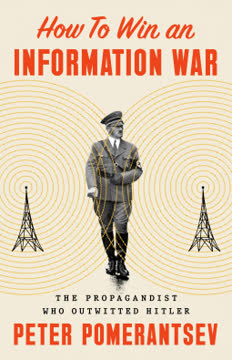
How to Win an Information War explores British WWII propagandist Sefton Delmer's efforts to counter Nazi messaging. Pomerantsev examines Delmer's tactics, drawing parallels to modern disinformation. Readers found the book fascinating, praising its historical insights and contemporary relevance. Some felt the modern connections were forced or underdeveloped. Many appreciated Pomerantsev's analysis of propaganda's psychological appeal and tactics. The book was seen as timely and thought-provoking, though opinions varied on its effectiveness in providing solutions for today's information wars.
Similar Books



Download PDF
Download EPUB
.epub digital book format is ideal for reading ebooks on phones, tablets, and e-readers.





