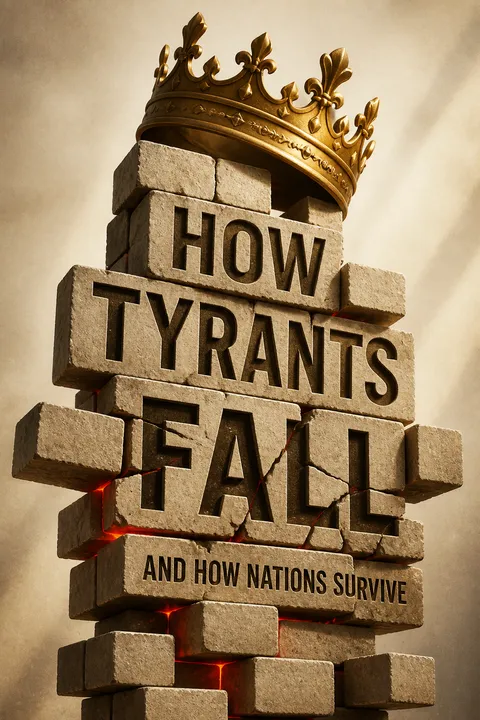


Key Takeaways
A golden gun cannot save a ruler once belief in his power breaks
Power depends on belief. In 2011, Muammar Gaddafi had ruled Libya for decades, commanded armed guards, and built tunnels beneath his compounds. When rebellion and foreign intervention stripped away his support, none of those defenses could save him. His gold-plated pistol became a symbol of power that no longer worked. Dirsus calls this the Golden Gun paradox: symbols and instruments of authority are useful only while others believe the ruler can enforce his will.
Tyranny is unusually dangerous. A study of 2,790 national rulers found that about 23 percent faced exile, imprisonment, or death after leaving office. Among personalist dictators, the figure rose to 69 percent. This helps explain why apparently secure rulers obsess over threats and resist giving up power.
What's striking is the gap between visible power and usable power. A palace, armed guard, or grand title can signal control, but each depends on people continuing to cooperate. This resembles a bank run: confidence itself helps sustain the system, and once confidence breaks, safeguards can fail quickly. The analogy also warns against treating a ruler's downfall as proof that the underlying political order has changed. A leader can lose authority in a moment while the institutions and armed networks that supported him remain.
For dictators, leaving office can be more dangerous than staying
The treadmill has no safe exit. Dirsus uses the dictator's treadmill to describe a ruler who must keep exerting effort to stay in power but cannot safely stop. A dictator may want retirement, yet leaving office can mean losing protection from prosecution, revenge, or rivals. Finding a successor creates another danger: that person must be strong enough to protect the former ruler, but strong enough to replace him too.
Nazarbayev learned the cost. Kazakhstan's Nursultan Nazarbayev stepped down in 2019 but tried to retain influence through his chosen successor, Kassym-Jomart Tokayev. During protests in 2022, Tokayev took over key party and security positions, and Nazarbayev's privileges and public honors were rolled back. Formal titles proved weaker than control of the state.
This is a problem of credible commitment: a promise is only reassuring if the promisor can still enforce it. A departing ruler cannot reliably guarantee that a successor will honor immunity or protect family assets. The same dilemma appears in firms and dynasties when a founder refuses to transfer authority while expecting a successor to remain loyal. The political stakes are far harsher, but the underlying design problem is recognizable: succession requires transferring enough power to make protection real, while accepting that transferred power can be used against its giver.
Watch the ruler's inner circle, not only the crowds outside
A small coalition can decide everything. The selectorate is the group with a meaningful role in choosing or sustaining a leader. Within it, the winning coalition is the smaller group whose support is necessary for the ruler to stay in power. In highly authoritarian systems, that coalition may be a handful of generals or senior officials. Across 473 authoritarian leaders who lost power between 1950 and 2012, 65 percent were removed by insiders.
Fear obscures loyalty. This is the dictator's dilemma: repression silences criticism, leaving the ruler unable to tell whether advisers are loyal or merely afraid. During North Korea's famine, the government protected politically important groups with comparatively generous food rations while people elsewhere starved. The regime's choices reflected whose support it needed most, not who was most hungry.
The model makes power easier to analyze by asking who can actually withdraw support, rather than who appears important on paper. It also explains why autocratic policy can seem irrational from the public's perspective while remaining strategic for the ruling coalition. Yet the coalition is not always a fixed list: crises can change who controls weapons, money, or information. Mapping power is therefore less like reading an organization chart and more like tracing dependencies as they shift.
Divide the military to prevent coups, and risk crippling it
The armed forces are both shield and threat. A ruler needs a capable military to defend the country, but generals and soldiers can also remove him. Coup-proofing means reorganizing security forces to make a coordinated military takeover harder. Dictators may create rival units, shuffle commanders, or place loyal guards near the capital. These steps make officers less able to trust or coordinate with one another.
The insurance has a cost. Saddam Hussein created the Republican Guard and other forces to counterbalance the regular army. Such fragmentation helped protect his rule, but political control could weaken military performance. Ghanaian president Kwame Nkrumah built a personal guard force, yet officers moved against him in 1966 while he was abroad. A counterweight that is too weak cannot stop a coup; building one can provoke the forces it is meant to deter.
This is a classic security dilemma: measures one actor takes for protection can make others feel more threatened and encourage preemptive action. The same logic applies beyond authoritarian politics, from rival armed institutions to organizations where leadership builds competing teams to prevent any one group gaining leverage. The book's useful distinction is between deterring a coup and creating an effective army. Those goals overlap, but they are not identical, and treating them as interchangeable can leave a state vulnerable in war.
Neglect the hinterland, and excluded elites may return as rebels
Exclusion can turn insiders into enemies. After an earthquake devastated Managua in 1972, Nicaragua's Anastasio Somoza directed reconstruction money through his own businesses and banks. His capture of aid angered business elites, while harsh repression and neglect deepened popular opposition. The Sandinista rebels gained strength as domestic resistance and foreign support converged. Somoza fled in 1979, then was assassinated in exile.
Rebellion needs more than anger. A rebel group needs recruits, weapons, money, and territory where it can survive. Natural resources such as diamonds can fund arms and fighters; cross-border sponsors can provide supplies; mountains and weak infrastructure can make government pursuit difficult. The book's cases of Chad and Nicaragua show how rulers who purge or exclude former allies may drive them beyond the capital, where they can return with an armed following.
This account treats rebellion as both political grievance and a problem of logistics. Anger alone rarely sustains an army; resources and safe operating space turn discontent into durable force. That distinction helps avoid a common analytical mistake, assuming poverty automatically produces revolt. The reverse also deserves attention: external funding may make a rebel group stronger without making its political goals more representative. Support can change who wins a conflict without settling whether the resulting government will serve the wider population.
An army trained to fear its ruler may fail against foreign enemies
Loyalty can hollow out military skill. Stalin's purges removed experienced Soviet officers, including General Mikhail Tukhachevsky, and elevated people judged safer for the regime. Fear made commanders conceal bad news and avoid initiative. During the Second World War, Soviet officers had incentives to disguise defeats rather than risk punishment. In other settings, commanders so afraid of making mistakes have hesitated when decisions were needed on the battlefield.
External threats alter the trade-off. A ruler can invest in internal security or in a military capable of fighting abroad, but often cannot maximize both. North Korea's artillery near Seoul illustrates one way a regime can deter attack without relying entirely on a highly effective conventional army. Nuclear weapons can serve a similar role, though acquiring them requires technical capacity and risks provoking outside pressure.
The central mechanism is organizational: punishment for bad news selects for concealment, while punishment for independent judgment selects for passivity. These are not simply personal flaws in a commander; they are predictable responses to incentives. A military can look formidable by size or equipment yet perform poorly when information and initiative are suppressed. Deterrence can compensate for some weaknesses, but it also shifts danger outward, since a credible threat may prevent attack while making any crisis more consequential.
Crackdowns can recruit the opposition, unless repression is overwhelming
Protest spreads when people see others act. This process, called diffusion, occurs when one demonstration encourages others to join or copy it. Erica Chenoweth's 3.5% rule summarizes research suggesting that campaigns with active participation by at least 3.5 percent of a population have not failed. The book adds an important caution: only 18 of 389 campaigns studied crossed that threshold, and some that did still failed.
Violence can backfire or succeed brutally. In Ukraine in 2013, police beat peaceful demonstrators, helping draw more people into the streets. In Leipzig in 1989, local officials and security forces hesitated to fire on a huge march, and the East German regime lost control. China's 1989 crackdown shows the other possibility: overwhelming force crushed protests, at terrible human cost. A partial crackdown can enlarge resistance; extreme violence can prevent participation.
The comparison makes clear that repression is not a single lever with a predictable result. Its effect depends on whether security forces obey, whether the public sees violence as illegitimate, and whether people can learn that others are resisting. The 3.5 percent figure is best read as a pattern, not a magic threshold: participation does not mechanically produce victory. The more durable lesson is that protest depends on coordination, and state violence can disrupt it or intensify it.
When every other route is blocked, assassination becomes more tempting
Success at control can create a new vulnerability. Coups and rebellions require coordination among many people; an assassination can require only one attacker. As a dictator weakens alternative routes to political change, opponents may see targeted killing as their remaining option. Between 1946 and 2010, one study counted 33 assassinated dictators and 103 failed attempts.
Protection cannot eliminate chance. Bodyguards, isolation, and carefully staged appearances can reduce risk, but trusted guards may become political actors themselves. New technologies also create distance between attacker and target: a 2018 drone attack at a Venezuelan military event showed how commercially available devices could threaten a leader without an attacker standing nearby. Foreign threats to kill a leader can be especially dangerous when that leader controls nuclear weapons.
The assassination chapter exposes a paradox of deterrence: making conventional opposition impossible can redirect resistance toward less predictable forms. It also cautions against confusing removal of a person with resolution of the conflict around him. Threatening a nuclear-armed ruler directly may raise the perceived stakes from political defeat to personal survival, narrowing room for restraint. The analysis is strongest when it treats assassination as a risk multiplier, not as a reliable method of political change.
A fallen dictator leaves a contest for power, not an empty throne
The old ruler's fall does not settle who governs. Only about 20 percent of fallen autocratic leaders between 1950 and 2012 were followed by democracy. Sudan shows why: after Omar al-Bashir was ousted in 2019, civilians celebrated, but rival military forces soon fought for control, and the promised democratic transition collapsed.
The path out matters. Research cited in the book found that 57 percent of successful nonviolent campaigns led to democracy, compared with fewer than 6 percent of violent changes. Nonviolent movements can bring broader participation and political experience, though they do not guarantee success. Succession rules can also limit conflict: among European monarchies from 1000 to 1800, rulers under primogeniture, succession by the eldest child, were more than twice as likely to remain in power as rulers under other systems.
The distinction between removing a ruler and replacing a political order is crucial. A vacuum is rarely empty; armed groups, party officials, and excluded citizens arrive with different resources and different goals. Broad participation can help establish legitimacy, but organization after victory matters just as much. The comparison of transition types should not be read as a universal forecast: selection effects and country differences matter. Still, it makes the costs of violence visible beyond the moment of overthrow.
Support people who can change the system, not just the leader
Outside pressure has limits. Sanctions may reduce money available for a ruler's allies, but they rarely persuade a dictator to surrender power directly. Their effects vary by regime type, resources, and geography. Foreign military intervention can remove a ruler, yet Iraq shows the danger of dismantling the institutions and security forces needed to run a country. Regime change is not the same as building a workable successor.
Strengthen local capacity instead. Dirsus argues that outsiders can weaken a ruler by limiting military and surveillance support, backing independent sources of information, and helping opposition groups coordinate and organize. The aim is not to manufacture dissent from abroad, but to support existing actors and prepare for instability. When force is considered, its likely cost, local legitimacy, and post-overthrow plan matter as much as the chance of toppling the incumbent.
The strategic shift is from asking how to remove a ruler to asking who can govern after removal. That reframing makes institutional capacity, public legitimacy, and information networks central rather than secondary. It also imposes discipline on outside powers: their commercial and security relationships can sustain the very regimes they criticize. The difficult limit is that patient support may not stop immediate atrocities, while force may produce a worse aftermath. No technique removes that moral and political trade-off.
Analysis
The book's central achievement is to make dictatorship legible as a system of dependencies rather than a story about one unusually powerful personality. A ruler needs a small circle to maintain control, but rewarding and protecting that circle weakens other parts of the state. The resulting choices connect elite politics, military effectiveness, rebellion, protest, and succession. The same survival strategies repeatedly generate new hazards: purging officers can protect the palace while damaging the army; dividing security forces can obstruct a coup while making them less effective; suppressing public organization can prevent protest while making a crisis harder to manage when one begins.
This model is especially useful because it explains why autocrats can appear both powerful and frightened. Their authority is not absolute. It rests on cooperation that is often concealed, conditional, and difficult to measure. The concept of the dictator's dilemma captures an information problem with real consequences: fear can produce obedience, but it also degrades the information needed to govern. The book's narrative case studies make these abstract incentives tangible without suggesting that every regime follows the same script.
The analysis also resists the comforting assumption that removing a tyrant creates freedom. The identity of the successor, the survival of institutions, the behavior of the armed forces, and the route by which power changes hands all shape what follows. That is a more demanding standard for judging intervention than simply asking whether the ruler has fallen.
There are limits. Historical cases and broad comparative statistics identify recurring patterns, not precise forecasts for a particular country. Categories such as personalist dictatorship or military regime can conceal meaningful internal differences, and authoritarian systems often manipulate the very information needed to classify them. The practical lesson is therefore not a universal recipe for overthrow. It is a disciplined way to ask who sustains a regime, what its survival strategies damage, and whether a proposed intervention improves the prospects for a stable political order rather than merely changing the person at the top.
Review Summary
How Tyrants Fall offers a comprehensive analysis of authoritarian regimes, their vulnerabilities, and eventual downfall. Readers praise Dirsus's engaging writing style, global perspective, and use of historical examples. The book explores the psychology of dictators, their strategies for maintaining power, and the complex dynamics leading to their demise. While some found certain topics underdeveloped, most reviewers commend the book's insights into tyrannical governance and its relevance to current global politics. Many recommend it as an enlightening read for those interested in political science and the nature of autocratic rule.
People Also Read



Glossary
Golden Gun paradox
Power depends on beliefThe idea that a ruler's symbols and instruments of authority have force only while others believe he can enforce his will. Gaddafi's golden pistol could not protect him once supporters and opponents no longer treated his power as inevitable. The image captures the gap between possessing the trappings of authority and being able to use authority effectively.
dictator's treadmill
A perilous hold on powerA metaphor for the predicament in which a dictator must keep working to preserve power but cannot safely stop. Leaving office may expose the ruler to prosecution, revenge, or loss of wealth, while a successor strong enough to offer protection may also become strong enough to displace him. The treadmill makes voluntary retirement exceptionally risky.
selectorate
People who sustain leadershipThe group of people with a meaningful role in selecting or sustaining a leader. The selectorate varies by political system: it may include voters in an electoral democracy or a much smaller set of officials, military leaders, and power brokers in an autocracy. The winning coalition is the subset whose support is essential for the leader to remain in power.
dictator's dilemma
Fear distorts political informationThe information problem created when a ruler uses repression to silence criticism. Because subordinates risk punishment for speaking honestly, the dictator cannot reliably distinguish genuine loyalty from outward compliance. The resulting uncertainty encourages suspicion and can lead rulers to make decisions based on distorted reports.
coup-proofing
Blocking military takeoversMeasures designed to make it harder for military or security forces to coordinate a coup. These can include creating rival units, rotating commanders, separating intelligence agencies, or placing loyal forces near the capital. Such arrangements may protect a ruler, but they can weaken military effectiveness and may provoke officers who feel threatened.
Icarus Effect
Purges turn supporters into threatsThe point at which elites who initially benefit from purges begin to fear that they may be targets themselves. Early purges can redistribute power and wealth to surviving insiders, giving them reasons to support them. As the purges become broader or less predictable, fear can outweigh those benefits and prompt elites to move against the ruler.
3.5% rule
A pattern in mass resistanceA research finding associated with Erica Chenoweth, suggesting that nonviolent resistance campaigns with active participation by at least 3.5 percent of a population have not failed. It is not a guarantee or a mechanical threshold. The book notes that few campaigns reached this level and that some campaigns above it still failed.
diffusion
Protest spreads between groupsThe spread of protest tactics, motivation, or practical knowledge from one place or group to another. When people see demonstrations elsewhere proceed without immediate defeat, they may join or adapt what others have learned. Diffusion can help solve the coordination problem that prevents people who oppose a regime from acting together.
FAQ
1. What is How Tyrants Fall: And How Nations Survive by Marcel Dirsus about?
- Comprehensive study of tyranny: The book analyzes how authoritarian regimes maintain power, the internal and external threats they face, and the mechanisms that lead to their downfall.
- Focus on regime survival and collapse: Dirsus explores the strategies tyrants use to survive, the role of elites, military, and masses, and what happens to nations after a tyrant falls.
- Historical and contemporary examples: Drawing on political science research and real-world cases, the book illustrates its arguments with examples from Libya, Kazakhstan, China, Ukraine, and more.
- Explores aftermath and risks: It also discusses the risks of chaos, civil war, or new forms of tyranny that can follow the fall of a dictator.
2. Why should I read How Tyrants Fall by Marcel Dirsus?
- Understanding authoritarian resilience: The book provides a nuanced explanation of why dictatorships often appear stable despite underlying fragility and opposition.
- Relevance to current events: It connects historical patterns to contemporary issues, helping readers make sense of global political developments and regime changes.
- Practical insights for change: Dirsus offers guidance on how tyrants can be weakened or toppled, and the complexities involved in regime change.
- Valuable for diverse audiences: Policymakers, scholars, and anyone interested in political stability, civil resistance, or international relations will find actionable insights.
3. What are the key takeaways from How Tyrants Fall by Marcel Dirsus?
- Tyranny is inherently unstable: Dictatorships require constant vigilance and balancing of competing interests, making voluntary exit dangerous for tyrants.
- Internal threats are paramount: Most tyrants fall due to betrayal or loss of support from elites and military insiders, not from popular uprisings alone.
- Coup-proofing has trade-offs: Efforts to prevent coups often weaken the military’s effectiveness against external threats, creating a central dilemma for dictators.
- Regime change is risky: The aftermath of a tyrant’s fall is unpredictable, with high risks of instability, violence, or the rise of another autocrat.
4. What are the main strategies tyrants use to stay in power according to Marcel Dirsus?
- Managing elites and military: Tyrants use patronage, repression, and parallel security structures to maintain loyalty and prevent coups.
- Controlling the masses: Propaganda, cults of personality, and selective repression suppress dissent and create an illusion of legitimacy.
- Exploiting external support: Security guarantees from foreign powers can bolster regimes but also create dependencies and moral hazards.
- Balancing rewards and fear: Tyrants must carefully distribute privileges while using purges and violence to deter betrayal, maintaining a delicate equilibrium.
5. How does How Tyrants Fall by Marcel Dirsus explain the “dictator’s treadmill” and “dictator’s dilemma”?
- Dictator’s treadmill: Tyrants are trapped in a cycle of constant vigilance, where stepping down is often more dangerous than clinging to power.
- Dictator’s dilemma: Fear and repression silence honest feedback, so tyrants never truly know who is loyal, leading to the promotion of sycophants and increased risk of mistakes.
- Balancing act: Managing elites requires a mix of rewards and repression, but excessive purges can backfire and provoke elite defection (“Icarus Effect”).
- Perpetual insecurity: These dynamics make authoritarian rule inherently precarious, despite outward appearances of strength.
6. What is the “Golden Gun paradox” in How Tyrants Fall by Marcel Dirsus?
- Definition of the paradox: The “Golden Gun paradox” illustrates that symbols of power, like a golden gun, only have meaning as long as people believe in the tyrant’s authority.
- Example of Gaddafi: Muammar Gaddafi’s golden gun symbolized his rule, but when rebels captured him, the symbol became meaningless—power depends on perception, not objects.
- Fragility of authoritarian power: The paradox highlights that a dictator’s power is ultimately based on legitimacy and support, not just force or wealth.
- Broader implication: When belief in the regime fades, even the most powerful symbols and tools become useless.
7. How do tyrants “coup-proof” their regimes according to Marcel Dirsus?
- Divide and weaken the military: Tyrants split armed forces into competing factions and create parallel security units to prevent unified opposition.
- Reduce trust among commanders: Frequent reshuffling and fragmentation of intelligence agencies prevent alliances and coordinated coups.
- Spoil loyalists and use identity: Parallel forces are better equipped and paid, and ethnic stacking ensures loyalty from favored groups.
- Trade-off with effectiveness: These measures increase regime security but often reduce the military’s ability to defend against external threats.
8. How do rebels and insurgencies threaten tyrants in How Tyrants Fall by Marcel Dirsus?
- Requirements for rebellion: Rebels need people, weapons, and money, often relying on natural resources, black markets, or foreign sponsors.
- Geography and state strength: Difficult terrain and porous borders aid insurgencies, but modern states’ surveillance and military power make rebellion challenging.
- Civil wars and foreign involvement: External powers often support either rebels or regimes, complicating conflicts and increasing suffering.
- Regime responses: Tyrants may buy off rebels or engage in prolonged, brutal wars that do not guarantee regime change.
9. What role do foreign powers play in the survival or fall of tyrants according to Marcel Dirsus?
- Covert and overt interventions: External states may attempt to overthrow dictators through covert operations, support for rebels, or direct military action.
- Security guarantees and alliances: Some regimes rely on powerful allies for protection, reducing the risk of coups or invasions (e.g., US bases in Gulf monarchies).
- Trade-offs and vulnerabilities: Dependence on foreign powers can provoke domestic resentment and limit a tyrant’s autonomy.
- Sanctions and isolation: International pressure can weaken regimes but may also entrench authoritarianism if not carefully managed.
10. How do popular uprisings and protests contribute to the fall of tyrants in How Tyrants Fall by Marcel Dirsus?
- Protests as coordination solutions: Mass protests help overcome the coordination problem in authoritarian regimes, making resistance more effective.
- Non-violent participation advantage: Non-violent movements can mobilize diverse groups quickly, overwhelming regimes unprepared for mass dissent.
- The 3.5% rule: Research cited in the book shows that no regime has survived once 3.5% of the population actively participates in a peak protest event.
- Risks of violent repression: Using force against protestors can backfire, radicalizing opposition and increasing the likelihood of regime collapse.
11. What happens after a tyrant falls, according to How Tyrants Fall by Marcel Dirsus?
- High risk of instability: The aftermath often involves power struggles, violence, or the rise of another dictator, with only about 20% of cases leading to democracy.
- Succession challenges: Personalized regimes lack clear succession rules, causing uncertainty and conflict when the leader is gone.
- Mode of exit matters: Non-violent overthrows are more likely to result in democracy, while violent removals often lead to continued authoritarianism or chaos.
- Long-term rebuilding: Regime change is just the beginning; rebuilding institutions and society is a complex, ongoing process.
12. What are the best quotes from How Tyrants Fall by Marcel Dirsus and what do they mean?
- “Political power lies with those who don’t need to use guns.” This challenges the idea that violence is the ultimate source of power, emphasizing the importance of legitimacy and consent.
- “No revolutions have failed once 3.5% of the population has actively participated in an observable peak event.” Highlights the critical mass needed for successful non-violent uprisings.
- “Assassination was ‘incompatible with American principles, international order and morality’.” Reflects the ethical and legal complexities of tyrannicide in international relations.
- “A revolution is like getting an empty new house; you still have to fix it up and furnish it.” Reminds readers that regime change is only the start of a long, difficult process of rebuilding society.
Download PDF
Download EPUB
.epub digital book format is ideal for reading ebooks on phones, tablets, and e-readers.








