

Key Takeaways
Treat political identity as a survival need, not just a policy preference.
Exile offered no alternative. When Trump left the White House in 2021, family members hoped he would step away from politics, rebuild his business, and let the Trump brand cool. He did not seem to accept that he had lost. Mar-a-Lago became a substitute White House, where members applauded him and visitors brought flattery, schemes, and attention. The book’s central interpretation is that being president was not merely a job he wanted. It was the role that made his life coherent.
The campaign never really stopped. If 2020 had not ended in Trump’s mind, another run was less a decision than a continuation. That helps explain why advisers found little room for ordinary discussions of whether he should run, or what he might do instead.
What's striking is the book's portrait of political ambition as identity maintenance. Social psychology often finds that people defend beliefs most fiercely when those beliefs protect their sense of self, not simply because the evidence is strong. That lens clarifies why defeat could be treated as an intolerable personal erasure. It also complicates any account based only on strategy or policy. Still, intimate motives are difficult to establish from reported scenes, and identity is not a substitute for voters' varied reasons for supporting a candidate.
Refusing defeat can turn disgrace into a durable source of power.
Loss became grievance. In the months after the 2020 election, Trump repeatedly insisted that the result had been stolen, while people around him largely accepted that he had lost. Rather than retreat, he kept the dispute at the center of conversation. The book argues that refusing to accept humiliation can recast it as persecution, giving a defeated figure a new role: not the loser, but the wronged champion.
The refusal changed party incentives. Many Republican leaders who had condemned Trump after January 6 later defended him as his campaign revived. Potential rivals hesitated to challenge a figure who seemed immune to the normal costs of defeat. The result was not simply personal resilience. It was a political environment in which loyalty to the grievance became a test of belonging.
This dynamic resembles a broader feature of group politics: shared grievance can strengthen identity even when it does not persuade outsiders. The story shows how a claim can serve as a social signal, separating loyal supporters from disloyal elites. That helps explain its durability better than treating it as a failed factual argument alone. Yet the mechanism has limits. A committed base can reward defiance while other voters remain unmoved or become more alarmed. Political power can grow inside one coalition even as broader legitimacy erodes.
Turn legal jeopardy into political spectacle, and punishment can become proof.
An indictment became a campaign event. Before Manhattan prosecutors announced Trump’s first criminal indictment, he publicly predicted it and urged supporters to protest. His team feared the legal blow, but the announcement produced a rush of Republican defenses and fundraising. The campaign raised four million dollars in the first day, with about a quarter from new donors. Trump’s team described this conflicting picture as a split screen: the legal threat looked grave, while the political response looked favorable.
The process supplied the story. Court appearances became carefully staged journeys, with motorcades, cameras, rallies, and statements. Trump framed prosecution as evidence that opponents feared his candidacy. Across four indictments, the campaign repeatedly translated legal peril into a demonstration of conflict and attention.
The conversion of punishment into proof is a recognizable form of identity-protective reasoning: supporters interpret an attack on their leader as an attack on their group. Modern media systems amplify this because conflict reliably attracts coverage, while a fundraising response can make intensity look like consensus. The book is persuasive about the campaign's ability to exploit that feedback loop. A useful distinction, however, is between mobilizing existing supporters and persuading undecided voters. Donations and headlines demonstrate attention, not necessarily expanded agreement.
Build campaign guardrails around the candidate, not assumptions of self-control.
The professionals managed the margins. Susie Wiles and Chris LaCivita brought experience and a more orderly operation than Trump’s earlier campaigns. Their work helped contain costs, organize the primary strategy, and weaken Ron DeSantis. But Trump remained the campaign’s largest variable, often acting on impulse and resisting advice.
Private channels could outrank the organization. Natalie Harp printed articles for him on the golf course, often selecting material that affirmed his views. She became a gatekeeper for information and a conduit for messages. Boris Epshteyn repeatedly reassured Trump that legal trouble would disappear, while other lawyers struggled to give him unwelcome assessments. The professionals could run a competent operation, but they could not control who had his ear or what reached him.
This is an organizational-design problem as much as a personality story. A leader's information diet shapes what decisions seem rational; concentrated access can quietly become concentrated power. The book's contrast between disciplined campaign staff and informal gatekeepers shows why a chart of official roles may not reveal who actually influences decisions. Yet the arrangement also had functional value: personal loyalty can speed communication and keep a volatile principal engaged. The danger emerges when loyalty filters out correction, leaving the organization informed about the leader's preferences but poorly informed about reality.
In attention politics, even absurd stunts can erase the competition.
Visibility was the operating plan. Trump’s team often sought to keep him in the news rather than build a conventional issue-by-issue campaign. He skipped Republican debates, then staged alternative events that drew coverage away from his rivals. When Republicans considered him for Speaker of the House, an idea with little practical chance, he let the speculation circulate. It distracted reporters from his trial and from the primary field.
The spectacle had its own merchandise. His Atlanta mug shot became a global image, paired with a campaign slogan and put on products. At rallies, carefully arranged lighting, flags, motorcades, and camera positions made him look presidential. The audience was often treated as a fan base, not just a voting bloc. The tactic could dominate the news cycle without requiring a detailed policy argument.
The book captures a media environment where attention is scarce and conflict is a reliable way to claim it. In that setting, an event's political value may come less from its practical outcome than from its capacity to displace competing stories. This resembles the logic of spectacle in entertainment markets, where being discussed can matter before anyone decides whether the performance was good. But attention is not fully controllable: a stunt can redirect coverage toward the candidate's weaknesses, and repetition can exhaust audiences. The tactic works best when spectacle reinforces an identity supporters already recognize.
A media defense can win headlines while worsening the courtroom case.
Performance clashed with procedure. Trump repeatedly argued that legal and media tactics were interchangeable. In court, he attacked judges, prosecutors, witnesses, and his own lawyers, while using breaks to speak to cameras. His lawyers worried that public outbursts could provoke judges or harm his position. In the New York fraud trial, he attended despite having already lost the central issue before trial, and his conduct helped keep the case in the news.
The consequences were real. A jury found him liable for sexual abuse in the E. Jean Carroll case, and a later defamation trial awarded Carroll $83 million. In the business-fraud case, the court imposed a judgment totaling about $454 million with interest. In the hush-money case, he was convicted on 34 felony counts. The public narrative and legal outcome did not move together.
The crucial distinction is between audiences. A rally crowd may reward defiance, while a judge evaluates compliance and a jury weighs evidence. A communications tactic that succeeds with one audience can impose costs with another. The book illustrates this mismatch vividly, especially when courtroom aggression sustains media attention but does not undo adverse rulings. The nuance is that legal strategy can include public communication, particularly for a candidate arguing that prosecution is political. The risk is treating the political payoff as if it were a legal defense.
Do not mistake repeated lucky escapes for a reliable strategy.
Contingency repeatedly rescued the campaign. Court schedules shifted, appeals delayed major cases, and an appeals court reduced the bond required in the New York fraud judgment from $454 million to $175 million. The Supreme Court's immunity ruling further delayed the January 6 prosecution. These changes eased immediate pressure, though they did not establish that Trump’s legal arguments were sound or that every case had vanished.
The campaign often planned after events began. Staff and lawyers were frequently surprised by developments, and Trump’s informal legal operation relied on optimistic assurances. The book presents a striking contrast: the campaign sometimes benefited from professional organization, but its survival also depended on outside decisions and unpredictable events. What looked like mastery from the outside could be a mixture of improvisation, delay, and fortune.
This is a useful corrective to hindsight bias. Once an outcome is known, observers tend to turn a chain of accidents into a story of inevitability or skill. The narrative instead draws attention to contingency: court decisions, opponents' missteps, and shifting events altered the terrain. In complex systems, resilience often comes from surviving shocks, not from predicting them. Still, luck alone cannot explain the campaign's durability. A skilled organization can exploit unexpected openings, while a poorly prepared one may squander them. The hard question is how much credit belongs to adaptation and how much to chance.
Prepare for the opponent who replaces your entire campaign premise.
The strategy was built around Biden. Trump and his advisers spent months portraying the incumbent as too old to serve, while assuming he would remain the opponent. When Biden withdrew and endorsed Kamala Harris, the campaign had little research ready and no tested plan for the new matchup. Harris quickly energized Democrats, drew extensive media attention, and narrowed the polling gap.
Trump kept fighting the old race. He continued attacking Biden and struggled to find a message that worked against Harris. Rather than consistently focus on the economy or immigration, he often returned to personal attacks about her intelligence, race, and gender. The campaign's earlier confidence had become an echo chamber: it had predicted Biden might leave, yet failed to prepare for what that possibility would mean.
Scenario planning is valuable precisely because prediction is unreliable. The campaign's blind spot was not failing to forecast every detail, but treating a known possibility as too inconvenient to prepare for. This is common in organizations that optimize around one opponent, customer, or threat: success makes the existing model feel self-confirming. The book also shows the countervailing advantage of improvisation, since Trump could rapidly command attention. But improvisation is not the same as adaptation. A response that generates headlines may still leave the underlying strategic problem untouched.
Trump's victory promoted the yes-men who made his all-or-nothing bet.
The comeback rewrote the status of insiders. Trump returned from his 2021 exile to win the 2024 election after four criminal indictments, a felony conviction, and two assassination attempts. The book describes the result as a victory for a campaign that turned legal threats into political conflict and kept Trump at the center of attention.
Loyalty gained institutional power. Susie Wiles, whose campaign management had imposed unusual order, was named chief of staff. Boris Epshteyn, despite legal exposure and widespread distrust among colleagues, became a central legal adviser. His strategy of assuring Trump that he could withstand the legal attacks had survived the campaign. The ending is not a tidy triumph of competence: it shows professional management and unconditional loyalty both rewarded, even though they served very different purposes.
The ending makes a sharp distinction between winning an election and resolving the conditions that shaped it. Wiles represents operational competence; Epshteyn represents personal access and affirmation. Their rise suggests that a successful coalition can reward both, even when their methods conflict. Political science offers a useful lens here: organizations often distribute power among competing factions to preserve the leader's control, rather than settling on one coherent governing approach. That can be effective for campaigning, but it leaves open whether loyalty that protects a candidate from correction can also support durable administration.
Analysis
The book's strongest contribution is its close-grained account of how political power can grow through a mismatch between private disorder and public performance. Trump is depicted as impulsive, poorly served by lawyers, and surrounded by competing courtiers, yet that apparent weakness does not simply diminish him. His refusal to accept defeat gives supporters a story of persecution; legal jeopardy supplies recurring scenes; media attention turns those scenes into campaign material. The narrative's repeated split between legal danger and political benefit is more illuminating than a simple claim that scandal either helps or hurts.
Its account also complicates the familiar image of Trump as a singular political strategist. The campaign's professionals, especially Wiles and LaCivita, build a more organized operation, but the book emphasizes how often their plans are disrupted by the candidate, informal advisers, and events beyond their control. The 2024 race is therefore presented as a contest between management and contingency, not merely persuasion and policy. Biden's withdrawal exposes the cost of treating a likely scenario as an inconvenience rather than a planning case. The narrative suggests that apparent inevitability can make a campaign less adaptive precisely when it feels strongest. The method has limits. Much of the intimacy rests on anonymous sources and reconstructed private conversations, while the author often interprets motives from behavior. That produces vivid scenes, but readers cannot always separate direct observation from a source's self-serving account or the writer's inference. The book's sharp, satirical portrait also risks making every participant legible as a type: sycophant, professional, grifter, or rival. Political behavior is rarely so cleanly sorted. The result is best read as an unusually detailed interpretation of Trumpworld, not as a neutral transcript of every private event. Its lasting analytical value lies in showing how attention, loyalty, and institutional conflict can interact, while leaving the reader alert to the distance between the reported scene and what it can prove.
Review Summary
Readers found All or Nothing to be a gossipy, insider look at Trump's 2024 campaign and presidency. Many praised Wolff's writing style and insights into Trump's inner circle, though some questioned the sourcing and bias. The book was seen as entertaining but potentially lacking in new information for those following politics closely. Criticisms included disjointed writing and a focus on sensationalism. Overall, reviewers found it a compelling if sometimes frustrating read that captured the chaos of Trump's world.
People Also Read


Glossary
split screen
contrasting political realitiesThe book's recurring way of describing two apparently opposed realities that operate at once. Trump could face grave legal or financial danger while benefiting politically from the attention and support those threats generated. The term emphasizes that legal vulnerability and electoral strength do not automatically cancel each other out.
Trump time
impulsive political timingThe book uses this term for Trump's experience of events as immediate, fluid, and driven by his attention rather than by a conventional campaign calendar. Plans could be abruptly displaced by a new grievance, media opportunity, or personal concern. Staff had to manage both the official schedule and his changing sense of what mattered now.
catch-and-kill
buying stories to suppress themA tabloid practice in which a publication buys the rights to a potentially damaging story, not to publish it, but to prevent another outlet from doing so. The book describes National Enquirer executives using this approach around stories involving Trump during the 2016 campaign, making the practice central to the prosecution's account of the hush-money arrangement.
the buffet
power through informal accessA metaphor drawn from Trump International's lavish club buffet, where access to Trump and his social world appeared to operate outside formal campaign roles. The book uses it to evoke the uneven distribution of privilege in Trumpworld: some staff members avoided claiming access, while favored insiders could bring guests and enjoy benefits at Trump's expense.
FAQ
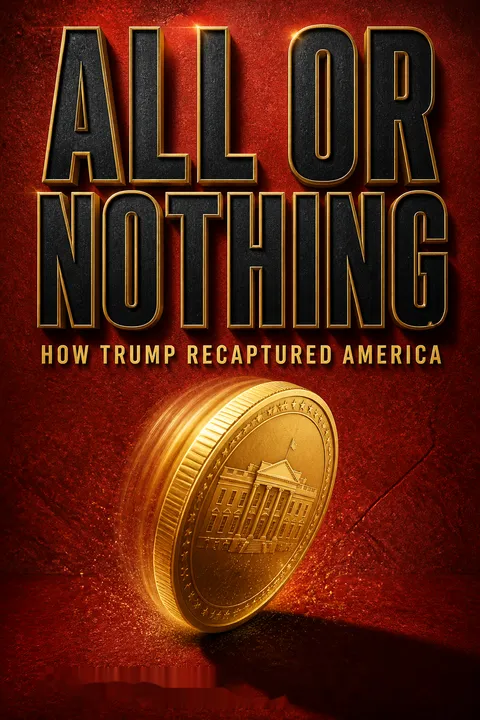
What’s All or Nothing: How Trump Recaptured America by Michael Wolff about?
- Comprehensive campaign chronicle: The book provides an insider’s account of Donald Trump’s 2024 presidential campaign, focusing on his legal battles, campaign strategies, and the personal and political dynamics surrounding him.
- Legal and political drama: It details Trump’s criminal trial in New York, the interplay between his legal troubles and campaign messaging, and the unprecedented fusion of courtroom drama with political theater.
- Key figures and events: Wolff explores the roles of campaign managers, legal advisers, family members, and loyal aides, while covering pivotal events like debates, conventions, and assassination attempts.
- Intimate portrait of Trump: The narrative offers a close-up look at Trump’s character, moods, and leadership style, revealing both his resilience and the chaos within his inner circle.
Why should I read All or Nothing: How Trump Recaptured America by Michael Wolff?
- Unprecedented insider access: Wolff’s reporting provides rare, behind-the-scenes details about Trump’s campaign, legal team, and personal relationships, offering a nuanced understanding of contemporary American politics.
- Balanced and multifaceted portrayal: The book neither glorifies nor vilifies Trump, instead presenting a complex portrait that helps readers grasp the forces shaping his political resurgence.
- Context for 2024 election: By chronicling the campaign, legal battles, and major events, the book situates the 2024 election within the broader landscape of American political polarization and media spectacle.
- Essential for political observers: Anyone interested in the intersection of law, media, and politics will find the book’s analysis of Trump’s strategies and the campaign’s internal dynamics invaluable.
What are the key takeaways from All or Nothing: How Trump Recaptured America by Michael Wolff?
- Legal and political battles intertwined: Trump’s criminal trial and campaign are deeply connected, with legal setbacks influencing campaign dynamics and vice versa, shaping public perception and strategy.
- Campaign chaos and resilience: The campaign is marked by internal conflict, power struggles, and a mix of professional operatives and chaotic personalities, reflecting Trump’s own unpredictability.
- Media and legal strategy fusion: Trump’s mantra that “our legal strategy is our media strategy” blurs the lines between courtroom defense and public relations, turning legal challenges into political opportunities.
- Personal relationships impact politics: The book highlights the complex roles of family members, loyal aides, and confidants, showing how personal dynamics affect campaign cohesion and decision-making.
Who are the key figures in Donald Trump’s campaign and legal team in All or Nothing: How Trump Recaptured America by Michael Wolff?
- Susie Wiles and Chris LaCivita: These campaign managers provide organization and discipline, acting as stabilizing forces amid internal chaos and power struggles.
- Boris Epshteyn: A controversial legal adviser and Trump loyalist, often seen as the “new Roy Cohn,” who manages much of Trump’s legal messaging and wields significant influence.
- Alina Habba and Todd Blanche: Lawyers involved in Trump’s legal defense, with Habba’s loyalty valued over experience and Blanche leading the Stormy Daniels trial defense.
- Natalie Harp: A devoted aide who controls Trump’s information flow and social media, becoming a key gatekeeper and influencer within the campaign.
- Corey Lewandowski and other rivals: Figures like Lewandowski and outside influencers such as Ike Perlmutter and Elon Musk add to the campaign’s internal complexity and factional battles.
How does Michael Wolff describe Donald Trump’s legal strategy and its connection to media in All or Nothing: How Trump Recaptured America?
- Legal strategy as media spectacle: Trump’s approach fuses legal defense with media dominance, using court appearances and indictments to energize his base and control news cycles.
- Blurring traditional boundaries: The mantra “our legal strategy is our media strategy” dissolves the separation between courtroom tactics and public relations, making every legal event a campaign opportunity.
- Aggressive public messaging: Trump and his team use social media, public statements, and courtroom drama to shape narratives, often complicating traditional legal strategies.
- Impact on legal proceedings: This approach leads to unconventional tactics, frequent outbursts, and a focus on spectacle over legal decorum, sometimes to the frustration of his legal team.
What major legal cases and indictments are covered in All or Nothing: How Trump Recaptured America by Michael Wolff?
- New York criminal indictment: The first-ever criminal indictment of a U.S. president, related to hush money payments to Stormy Daniels and falsified business records.
- E. Jean Carroll civil trial: A defamation and sexual abuse case resulting in significant financial judgments against Trump.
- Georgia RICO indictment: State-level charges involving election interference under the Racketeer Influenced and Corrupt Organizations Act.
- Federal January 6 indictment: Charges related to the Capitol attack and efforts to overturn the 2020 election, considered Trump’s most serious legal threat.
- Boxes indictment and civil fraud: Federal charges for mishandling classified documents and a New York civil fraud trial over inflated real estate valuations.
How does All or Nothing: How Trump Recaptured America by Michael Wolff portray the internal dynamics and power struggles within Trump’s campaign?
- Tension between professionalism and chaos: The campaign is a battleground between experienced operatives and erratic loyalists, creating a volatile environment.
- Factional battles and leaks: Rivalries, especially between Wiles/LaCivita and Lewandowski/Habba, lead to leaks, attempted takeovers, and ongoing instability.
- Influence of outside figures: Billionaires, media moguls, and tech leaders like Elon Musk play behind-the-scenes roles, affecting decisions and internal dynamics.
- Impact on effectiveness: Despite the chaos, Wiles and LaCivita maintain relative stability, but the power struggles often undermine messaging and organization.
How does Michael Wolff depict Donald Trump’s personality and leadership style in All or Nothing: How Trump Recaptured America?
- Unyielding self-image: Trump sees himself as uniquely destined and above ordinary rules, refusing to acknowledge defeat or legal jeopardy.
- Mercurial moods: His temperament swings rapidly from fury to charm to self-pity, making him unpredictable and difficult to manage.
- Obsessive and performative: He fixates on themes like the stolen election and legal persecution, using media and public appearances as stages for personal drama.
- Reliance on loyalty: Trump surrounds himself with sycophants, values loyalty above competence, and is deeply suspicious of dissent within his circle.
What role do family members and close aides play in Donald Trump’s campaign, according to All or Nothing: How Trump Recaptured America by Michael Wolff?
- Melania Trump’s absence: Melania is largely absent from the campaign and court appearances, fueling speculation about marital strain and signaling personal discord.
- Children’s involvement: Don Jr., Eric, and Tiffany are active in the campaign, while Ivanka and Barron are notably distant; Lara Trump plays a public role with her own ambitions.
- Loyal aides as gatekeepers: Figures like Natalie Harp and Boris Epshteyn filter information and provide unwavering support, creating a bubble around Trump.
- Family as employees: Many family members act more as staff than relatives, reflecting fractured personal relationships that impact campaign cohesion.
How does All or Nothing: How Trump Recaptured America by Michael Wolff portray the 2024 presidential debates and conventions?
- Debates as pivotal moments: The book covers Trump’s preparation and performance, including a chaotic debate with Kamala Harris and a vice-presidential debate featuring JD Vance.
- Conventions as theater: The Republican convention is depicted as a celebration of Trump’s resilience, especially after the assassination attempt, while the Democratic convention highlights Harris’s rise.
- Media and public reactions: Both events generate intense coverage, shaping public perceptions and influencing campaign momentum.
- Contrast in styles: Trump’s appearances are theatrical and controversial, while Harris’s are calculated and controlled, reflecting broader campaign strategies.
What impact did assassination attempts have on Donald Trump’s campaign, according to All or Nothing: How Trump Recaptured America by Michael Wolff?
- Butler, Pennsylvania shooting: The first attempt, where Trump was grazed by a bullet, is portrayed as a miraculous survival that boosts his image and energizes supporters.
- Second attempt and security: A subsequent plot in Florida leads to heightened security and reinforces Trump’s narrative of being targeted by deep conspiracies.
- Political and psychological effects: The attempts deepen Trump’s sense of persecution, fuel his combative rhetoric, and contribute to his fatigue and paranoia.
- Campaign leverage: These events are used for fundraising and media attention, shaping the campaign’s tone and Trump’s personal state.
What are the most important concepts and strategies in All or Nothing: How Trump Recaptured America by Michael Wolff?
- Legal strategy as media strategy: Trump’s fusion of legal defense and media spectacle is central, turning legal challenges into political opportunities.
- Campaign chaos vs. discipline: The tension between professional management and chaotic loyalists defines the campaign’s internal dynamics.
- Victimhood and resilience narrative: Trump’s portrayal of himself as a persecuted outsider fuels his base and shapes public perception.
- Personal relationships as power structures: The roles of family, loyal aides, and outside influencers are crucial in understanding the campaign’s decision-making and effectiveness.
Download PDF
Download EPUB
.epub digital book format is ideal for reading ebooks on phones, tablets, and e-readers.








