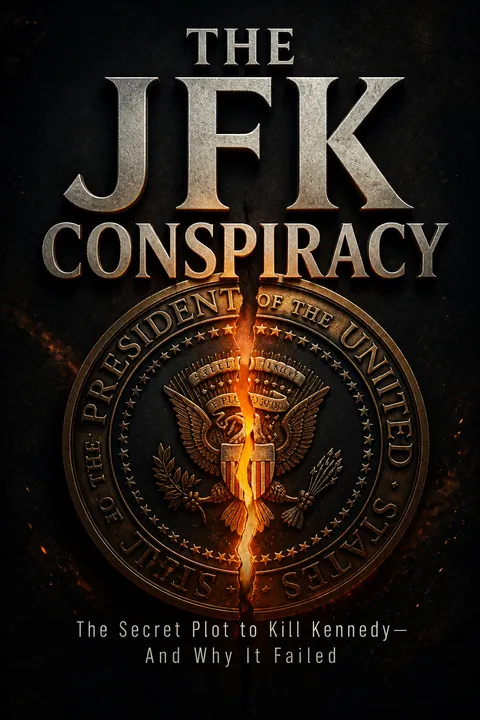


Key Takeaways
A would-be president survived because a mother and child changed the attacker's mind.
A plot in motion. In December 1960, Richard Pavlick, a retired postal worker consumed by anti-Kennedy anger, waited outside the Kennedy estate in a Buick packed with dynamite. He had planned to ram the car into the President-elect's vehicle and trigger the explosives. As Kennedy left for Mass, Jacqueline and their daughter Caroline came into view. Pavlick later said he held back because he did not want to kill them.
A narrow escape. Days later, police arrested him after the Secret Service connected clues from a New Hampshire postmaster, a suspicious encounter at church, and Pavlick's car. The plot's failure depended on both a reported change of heart and a chain of people noticing warning signs. It was not simply a security system working as designed.
What's striking is how much the story depends on a counterfactual: Pavlick had the means and opportunity, but his later account says he stopped when he saw Jackie and Caroline. That explanation comes from his own statements after arrest, so it deserves careful attribution rather than the certainty of a recorded moment. The broader lesson is still powerful. Prevention often rests on several imperfect layers, including human judgment, routine observation, and luck. A single layer can fail without making the whole system useless, but luck should never be mistaken for a dependable safeguard.
Treat prejudice as political infrastructure, not merely personal hostility.
A familiar script. Kennedy's Catholicism became a campaign weapon in 1960. The Reverend Norman Vincent Peale publicly questioned whether a Catholic President could act independently, while the effort behind his group had been organized in secret by evangelist Billy Graham. The book traces this suspicion to a longer history in which anti-Catholicism was bundled with hostility toward immigrants, Jews, and Black Americans.
Old fears, new election. The Ku Klux Klan's 1920s revival cast Protestant identity as a test of American belonging. In 1928, Catholic Democrat Al Smith faced cross-burnings and anti-Catholic propaganda before losing decisively. Kennedy confronted that legacy directly in Houston, arguing for a strict separation of church and state and equal religious freedom. His response shifted the focus from his private faith to the public principle at stake.
The episode shows how prejudice can operate through institutions and respectable language, not only through openly extremist groups. A claim framed as a question about loyalty can make exclusion sound like prudent caution. Political scientists describe this kind of boundary-making as a struggle over who counts as a legitimate member of the nation. The historical link does not mean every critic shared the Klan's ideology, and the book's account is strongest when it distinguishes actors and tactics. It nevertheless makes clear that euphemistic attacks can carry the force of older, more explicit bigotry.
A small-town postmaster connected clues the security system had not yet joined.
A pattern, not proof. Belmont Postmaster Thomas Murphy listened as Pavlick complained about Kennedy, described his trip to Hyannis Port, and criticized the President-elect's security. Then Pavlick left town, sent mail from Washington, and asked that future mail be forwarded to Florida. Murphy noticed that the destinations tracked Kennedy's movements and reported his concern to postal authorities.
The trail travels. Murphy's information moved through postal officials, prosecutors, and Secret Service agents. His warning helped investigators look for Pavlick, but it did not immediately locate him. When a later postcard named Palm Springs, Murphy realized Pavlick likely meant Palm Beach. The book's point is not that Murphy solved the case alone. His attention supplied an early signal that became useful only when other people investigated and connected it to additional evidence.
Murphy's contribution resembles a basic principle in intelligence analysis: isolated observations gain value when they form a pattern. His evidence was ambiguous. Travel, political complaints, and odd remarks could each have innocent explanations. Treating any one as decisive would invite false alarms; dismissing all of them would invite danger. The useful practice is to preserve and share observations so specialists can assess them in context. Murphy's story also exposes a common institutional weakness: frontline workers may see anomalies first, while formal systems need time, channels, and corroboration to act.
Presidential security improved only after ordinary vigilance met coordinated intelligence.
A porous perimeter. The Secret Service had only hours to prepare the Palm Beach estate, with its open beach, nearby water traffic, and exposed entrance. Agents added a Coast Guard patrol, armed lookouts, and a change to the road in front of the gate. Yet Kennedy liked greeting crowds and often departed from plans, complicating protection.
One detail mattered. At Mass, Agent Gerald Blaine noticed an oddly dressed man approaching Kennedy and calmly steered him away. Blaine recorded the man's Buick and license plate. Days later, when headquarters circulated Pavlick's description and plate number, agents recognized the match. Local police then detained him. The arrest depended on several different forms of vigilance: physical precautions, an agent's observation, accurate record-keeping, and information shared across agencies.
Security is not a wall around a person; it is a changing relationship between a target, a setting, and the public. Kennedy's warmth created political connection while making predictable protection harder. The case illustrates why security planning combines barriers with observation and communication, rather than relying on any single measure. It also reveals a tension that remains unresolved: excessive protection can isolate leaders from citizens, while too little can make public access dangerous. The appropriate balance depends on threat and context, not on treating openness or restriction as an absolute virtue.
Kennedy's 0.17-percent victory rode a new coalition of youth, television, and immigrants.
A close election, a changing country. Kennedy beat Richard Nixon in the popular vote by 118,574 votes, a margin of 0.17 percent. His campaign made youth a strength: by September, 61 percent of voters aged twenty-one to twenty-nine favored him. Television amplified his ease on camera, especially in the first televised presidential debates, while his image of generational change appealed to voters impatient with the status quo.
A wider invitation. The campaign also organized Latino outreach under the name Viva Kennedy, an effort that coordinated with local groups and encouraged voter participation. Kennedy's Catholic and immigrant background helped him speak to communities often overlooked by national campaigns. These elements did not erase divisions. They made the election a contest over which groups, generations, and cultural identities would shape the country's future.
The campaign shows that electoral coalitions are built through both policy and recognition. Television made personality unusually visible, while targeted outreach signaled that Latino voters belonged in the political calculation. Those techniques expanded participation, but they also made politics more dependent on image and media performance. A candidate's appeal to young voters or marginalized groups does not guarantee that governing will fulfill their hopes. The 0.17-percent margin is a useful corrective to the later impression that Kennedy's victory represented a settled national consensus.
On PT-109, Kennedy turned survival into a sequence of concrete decisions.
A leader in the water. In 1943, a Japanese destroyer struck Kennedy's patrol boat, PT-109, splitting it apart and killing two crew members. Kennedy and the survivors spent days in hostile waters without food or reliable water. He chose to swim three miles while towing badly burned crewman Patrick McMahon by a strap held in his teeth. Later, when attempts to signal ships failed, Kennedy and his men moved between small islands in search of food, water, and rescue.
Make the next move. On Naru Island, Kennedy found supplies and a canoe. Unable to communicate with local scouts, he carved a rescue message into a coconut and sent it with them. Allied forces eventually rescued the eleven surviving crew members. The ordeal established a public story of courage, but its details also show leadership as repeated decisions under severe uncertainty.
The episode is compelling because it replaces the abstract image of bravery with observable choices: identify a goal, improvise with limited materials, and keep the group moving. That resembles crisis leadership in emergency medicine and disaster response, where teams must act before complete information is available. Still, surviving a military catastrophe is not a comprehensive test of presidential judgment. The PT-109 story explains Kennedy's reputation and some of his instincts, but it cannot by itself establish that those instincts were wise in every political setting.
Treat a public icon as a person carrying invisible work and private costs.
The image had a price. Jacqueline Kennedy's fluency, poise, and camera appeal became assets to the campaign, but public attention also narrowed her privacy. After a difficult Caesarean delivery, she faced hospital scrutiny, her son's christening, an exhausting White House tour, and travel to Florida while still recovering. She wanted ordinary solitude and time with her children, yet crowds and photographers followed the family almost everywhere.
More than a symbol. Jackie also studied the White House's history and planned its restoration, envisioning it as a cultural and historical institution, not merely a residence. Her work was often carried out while the public focused on clothing, charm, and the Kennedy marriage. Clint Hill's account of accompanying her shows the practical labor behind the polished image: managing schedules, safety, family needs, and public expectations.
The story highlights a form of labor that political narratives often hide: the emotional and logistical work expected of a leader's spouse. Gender studies calls this invisible labor because it supports public institutions while receiving limited recognition as work. Jackie exercised agency through journalism, political outreach, and the White House restoration, even as the role constrained her choices. The account should not reduce her to either victimhood or glamour. Her significance lies partly in how she used a tightly controlled public position to pursue cultural goals of her own.
Camelot was a constructed memory frame, not a complete account of Kennedy.
A story after loss. After Kennedy's assassination, Jackie invited journalist Theodore White to interview her for Life magazine. She shared intimate memories, then insisted he include the song from the musical Camelot that her husband loved. Its image of a brief, shining kingdom gave grief a memorable shape. White's article helped attach that name to the Kennedy years, turning a musical reference into a public shorthand for the lost White House.
Memory selects. The image of the handsome President, glamorous First Lady, and young children preserved the era's promise, but it left out much of the private strain and political complexity. The book presents Jackie as a skilled interpreter of history as well as one of its subjects. Her intervention helped determine what the public remembered, without making that remembered version the whole truth.
Collective memory rarely preserves a life in full; it organizes events into symbols that can be repeated and shared. Camelot offered a compact narrative of promise interrupted, a powerful form of meaning-making after public trauma. Such a frame can keep ideals alive, but it can also crowd out inconvenient evidence. The distinction is not between a truthful memory and a false one. It is between a story that illuminates one dimension and a story mistaken for a complete historical account.
Make democratic handoffs visible, especially when rivals distrust each other.
Ritual has a purpose. Kennedy and outgoing President Dwight Eisenhower had exchanged insults during the campaign, yet they met privately during the transition to discuss foreign affairs and national security. Eisenhower explained emergency procedures, offered advice, and later praised Kennedy's preparation. Their public cooperation demonstrated that electoral competition did not have to become a refusal to transfer power.
Continuity without agreement. The transition still involved friction, uncertainty, and the hurried creation of a new administration. But the meeting affirmed a basic democratic norm: opponents can disagree sharply and still recognize the legitimacy of the process. In an election decided by a tiny popular-vote margin, that visible acceptance mattered. The book places the peaceful transfer alongside a campaign marked by religious hostility and fears about the country's direction.
Political institutions depend partly on norms that are not enforced by law alone. Public rituals, meetings, and concessions help make abstract rules legible to citizens and reassure officials that cooperation remains possible. The Eisenhower-Kennedy encounter is valuable precisely because the men did not need to become friends or agree on policy. Its limit is equally important: a gracious handoff cannot resolve the conflicts that produced the election. It creates a stable starting point from which those conflicts can be addressed through legitimate institutions.
Honor Kennedy's civic ideal without mistaking inspiring rhetoric for a complete record.
Promise and performance. Kennedy's 1961 Inaugural Address urged civic responsibility and national service. The speech helped define his public ideal, but his short presidency produced a mixed record: the Bay of Pigs invasion failed, the Cuban Missile Crisis was handled successfully, and he advanced the Peace Corps and space program. On civil rights, memorable statements were not matched by substantial legislative results during his term.
An unfinished test. Kennedy was assassinated in Dallas in 1963, less than three years after taking office. Clint Hill, who had protected Jackie, ran toward the presidential limousine after the shots, but could not save Kennedy. The book closes by holding together the inspiring promise, the political shortcomings, and the loss of a presidency whose full record can never be known.
The distinction between an ideal and a record is essential to serious political judgment. Rhetoric can clarify values and mobilize action, but outcomes depend on institutions, coalitions, and decisions that speeches cannot substitute for. Kennedy's death intensifies the temptation to judge him by potential rather than completed work. That temptation is understandable, yet it should not erase the gap between commitment and achievement, particularly on civil rights. The ideal remains worth evaluating on its merits, even when the person associated with it was inconsistent or incomplete.
Analysis
The book's engine is a near miss, but its subject is larger than an assassination plot. The opening image of dynamite outside a future President's home creates a suspenseful question: why did the attack fail? The answer is not a single heroic intervention. It is a chain of contingent events: a would-be attacker reportedly hesitates when he sees Jackie and Caroline, a church agent notices him, a postmaster treats strange remarks as meaningful, and several agencies eventually connect the evidence. The plot becomes a study in how fragile prevention can be.
That story unfolds against the 1960 election's deeper fracture. Kennedy's Catholicism, youth, immigrant identity, and support for civil rights placed him at the center of arguments about who belonged in America. His campaign used television and personal charisma to embody change, while opposition drew on older forms of religious and racial exclusion. The contrast makes his tiny popular-vote margin more revealing than the electoral tally alone: the country was not united behind a new era, even when the imagery suggested it might be.
The narrative also complicates the familiar Kennedy portrait. PT-109 supplies a credible account of courage and improvisation. The transition shows an energetic President-elect who resists routine and enjoys public contact, complicating protection. Jackie appears not simply as a polished partner but as a journalist, cultural advocate, new mother, and person pressed into public performance. Her post-assassination use of Camelot demonstrates that political memory is shaped, not merely inherited.
The book's strongest interpretive choice is to keep idealism and contradiction in view. Kennedy's language could enlarge civic imagination, while his record on civil rights remained limited and his private behavior harmed those closest to him. His early death leaves an unavoidable gap between achievement and imagined possibility. The adaptation's central caution is to resist treating either the myth or the critique as the whole story. Public ideals can inspire action, but historical judgment still depends on what leaders did, what institutions allowed, and whose costs remained unseen.
Review Summary
The JFK Conspiracy receives high praise from readers, with an average rating of 4.24 out of 5. Reviewers appreciate the book's engaging narrative style, historical insights, and focus on a little-known assassination attempt on Kennedy before his inauguration. Many find it a page-turner that offers new information about JFK and Jackie Kennedy. Readers commend the authors for making history accessible and compelling. Some note the book's relevance to current political climates and its balanced portrayal of historical figures. Minor criticisms include occasional choppiness and information overload.
Glossary
PT-109
Kennedy's wartime patrol boatPT-109 was a U.S. Navy motor-torpedo patrol boat commanded by John F. Kennedy in the Solomon Islands during World War II. A Japanese destroyer struck and destroyed it in August 1943. Kennedy and the surviving crew were stranded for days, and Kennedy helped rescue injured men and relay a message that brought Allied assistance.
New Frontier
Kennedy's campaign visionThe New Frontier was the phrase Kennedy used to describe the challenges and opportunities facing the United States in the 1960s. It linked scientific and space exploration with problems such as war, prejudice, and poverty. In the campaign, the phrase made Kennedy's youth and call for change into a political identity.
Viva Kennedy
Latino voter outreach campaignViva Kennedy was the name used for a 1960 campaign effort aimed at Latino voters. It grew from local organizations that encouraged Kennedy's candidacy and urged greater direct outreach. The campaign coordinated events and voter efforts across communities including Mexican Americans in the Southwest, Cuban Americans in Florida, and Puerto Ricans in New York.
Conference of Citizens for Religious Freedom
Anti-Kennedy Protestant groupThe Conference of Citizens for Religious Freedom was an organization of Protestant leaders that publicly questioned whether a Catholic could serve independently as President. The book describes its planning at a secret meeting convened by Billy Graham in Switzerland. Norman Vincent Peale served as its public spokesperson, while its statements brought anti-Catholic fears into national campaign coverage.
Halfback
Secret Service follow-up carHalfback was the Secret Service nickname for a large Cadillac convertible used behind the President's limousine in motorcades. Its elevated running boards let agents stand on the sides, watch the limousine, and move quickly toward it or into a crowd. Clint Hill was standing on Halfback when Kennedy was shot in Dallas.
Camelot
Kennedy-era public mythCamelot began as the title and setting of a musical about King Arthur. After Kennedy's assassination, Jacqueline Kennedy invoked a song from the musical in an interview with Theodore White. The reference became a popular way to remember the Kennedy White House as a brief, idealized era of promise, though it did not capture the full complexity of the presidency.
About the Author
Download PDF
Download EPUB
.epub digital book format is ideal for reading ebooks on phones, tablets, and e-readers.








