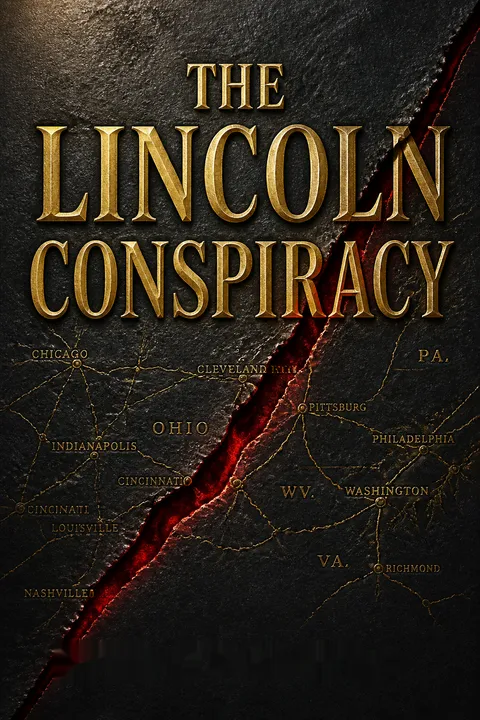


Key Takeaways
Treat an assassination warning as a systems problem, not a rumor.
The danger had a route. In February 1861, Lincoln was expected to arrive in Baltimore by train, cross the city in a carriage, then board another train to Washington. A group of proslavery secessionists planned to exploit the crowded station transfer, when Lincoln would be exposed and the police escort might be absent. Railroad president Samuel Felton hired detective Allan Pinkerton after hearing that tracks and bridges could be sabotaged. Pinkerton’s agents uncovered a more direct danger: the intended target was Lincoln himself.
Evidence has limits. The main plot was supported by contemporaneous reports from Pinkerton and his agents, as well as a separate investigation connected to William Seward and General Winfield Scott. Some vivid details, especially a secret meeting and its ballot ritual, rest on Pinkerton’s later account and cannot be firmly verified. The book argues that the threat was real while acknowledging that not every scene is equally well documented.
What's striking is how a threat becomes legible through ordinary infrastructure: train schedules, transfer points, bridge access, and police assignments. Modern security analysis often asks not only who intends harm, but where a routine process creates a vulnerable bottleneck. The book’s strongest case rests on independent investigators reaching similar conclusions, a form of corroboration more persuasive than a single dramatic witness. Still, corroboration supports the existence of danger, not every cinematic detail. Readers gain a useful habit here: separate the broad conclusion from the precision of the reconstruction.
Name slavery plainly: it was secession's engine and the conspirators' cause.
The stakes were human. By the mid-1850s, roughly 3.5 million people were enslaved in the United States. Cotton and other plantation crops made forced labor central to the Southern economy, while law, politics, and religious argument defended white supremacy. In South Carolina, enslaved people made up 57 percent of the population. State declarations of secession named slavery as a central cause, describing Lincoln’s election and opposition to slavery’s expansion as threats to Southern interests.
The plot shared that purpose. Baltimore’s conspirators cast Lincoln as an enemy because they believed his administration would endanger the slaveholding order. Their language of Southern rights obscured the rights denied to enslaved people. The distinction matters: this was not simply a regional quarrel over abstract constitutional authority. The immediate political crisis concerned whether slavery could spread, endure, and remain protected by the nation.
The book usefully tests political slogans against the interests they defend. A claim about rights becomes clearer when the reader asks whose rights are protected, and whose are excluded. That question also prevents a common historical flattening: not every white Northerner was an abolitionist, and Lincoln’s initial policy was narrower than immediate emancipation. Yet those qualifications do not make slavery incidental. The secession documents and the conspirators’ stated purpose place human bondage at the center of the conflict, not at its margins.
See Lincoln's authority as earned through hardship, learning, and empathy.
A rough beginning shaped him. Lincoln grew up poor on the frontier, lost his mother as a child and his sister when he was eighteen, and spent much of his youth doing hard manual labor. His formal schooling totaled less than a year. He taught himself by borrowing books and practicing sums and writing wherever he could, eventually reading works from the Bible to Shakespeare and histories of the United States.
His attention went beyond himself. Accounts from family and friends describe him as unusually distressed by animal suffering. As an adult, he once ruined his clothes to rescue a pig trapped in mud. The book connects this habit of noticing vulnerability with his lifelong response to grief, including the losses of his mother, sister, and son. That biography does not explain every political choice, but it helps make sense of his capacity to recognize suffering in others.
The most persuasive version of this story avoids treating hardship as a magical source of virtue. Poverty and bereavement can narrow a person’s world as easily as deepen it. What matters here is Lincoln’s particular response: persistent self-education, humor, and attention to the vulnerable. Those qualities resemble forms of practical intelligence, built by observing people and circumstances rather than by credentials alone. The animal stories are revealing, though they cannot prove a direct line from private kindness to public policy. They show a disposition, not a guarantee.
Distinguish opposing slavery's expansion from demanding its immediate abolition.
Lincoln’s position had boundaries. Before becoming President, he argued that slavery was morally wrong and should not spread into western territories. He also maintained that the federal government could not abolish it in states where it already existed. He did not then advocate full political equality for Black Americans, and at times he expressed views that fell short of equality.
Frederick Douglass saw the gap. A formerly enslaved abolitionist and influential writer, Douglass welcomed Lincoln’s nomination as a possible advance but criticized the Republican platform as too cautious. He wanted slavery ended, not merely contained, and challenged the idea that constitutional restraint justified leaving millions in bondage. Their disagreement clarifies the difference between a step that limits an institution and a demand to abolish it. Lincoln’s later actions unfolded amid war, political pressure, and sustained abolitionist advocacy.
This contrast resists two easy stories: that Lincoln began as a complete abolitionist, or that his caution made him irrelevant to emancipation. Political leadership often operates inside legal and electoral constraints, but constraints can also become excuses for delay. Douglass’s criticism keeps the moral standard visible, while Lincoln’s position shows how policy can move through institutions without yet satisfying justice. Reading both together is more illuminating than turning either man into a symbol who never changed or never compromised.
Build a coalition by becoming the acceptable second choice.
Lincoln was an unlikely nominee. After losing his 1858 Senate race to Stephen Douglas, he remained little known outside Illinois. At the 1860 Republican convention, Senator William Seward was the front-runner. Lincoln’s campaign team understood that many delegates had another first choice, so they worked to make Lincoln an acceptable alternative: antislavery, but not identified with the party’s most radical wing; Midwestern, rather than tied to the Northeastern political establishment; and regarded as personally honest.
A simple image traveled. Illinois supporters promoted him as the Rail Splitter, a self-made man whose frontier labor distinguished him from polished insiders. The story of the rails was political theater, not a complete account of his credentials, but it gave distant voters a memorable identity. When the Democratic Party split over slavery, Lincoln’s broad acceptability helped him win the nomination and the general election.
The convention shows coalition-building as a problem of reducing vetoes. A candidate need not inspire every faction most; sometimes the winning strategy is to be the person few factions find disqualifying. The Rail Splitter image made that strategic advantage emotionally legible, translating a complicated political profile into a recognizable character. Branding can clarify, but it can also simplify. Lincoln’s success depended on more than an appealing story: party division, delegate bargaining, and regional electoral arithmetic made the story politically useful.
Use unconventional talent where conventional institutions cannot see the threat.
The investigation crossed social boundaries. Pinkerton built a private detective agency after gaining experience investigating counterfeiters and other criminals. In 1856, he hired Kate Warne, the nation’s first woman detective, after she argued that women could enter social settings closed to male investigators and earn people’s confidence. Her work in an earlier fraud case helped prove her value, and she later became a leading agent in the Lincoln investigation.
The official inquiry missed openings. A congressional committee questioned Baltimore figures, including militia leader Cypriano Ferrandini and socialite Otis Hillard. Both denied knowing of plans to attack Lincoln. The committee did not press them effectively. Pinkerton’s agents, posing as Southern sympathizers, cultivated Hillard and traced his connections to Ferrandini. The contrast is not simply between public and private investigators. It is between a formal hearing that accepted evasions and fieldwork designed to test them.
The case highlights a practical weakness in institutions: access and trust are not distributed evenly. Warne’s role mattered because her gender, presentation, and social skill opened doors that male agents could not easily enter. At the same time, unconventional methods are not automatically reliable or ethical. Undercover work depends on deception and can produce mistaken conclusions. Its value here came from corroboration across people, locations, and records, rather than from the mere fact that agents went undercover.
Protect a leader by changing the route, not staging a showdown.
The first plan was rejected. Pinkerton and Lincoln adviser Norman Judd proposed that Lincoln leave Philadelphia early and travel overnight to Washington. Lincoln refused to miss scheduled appearances at Independence Hall and in Harrisburg. He reconsidered after learning that Seward and Scott’s separate investigators had reached a similar conclusion about Baltimore. With only a few people informed, Lincoln left the public itinerary after his Harrisburg event.
Small safeguards made secrecy work. Lincoln changed his clothes and hat, rode in a hired carriage, and entered a public sleeper car under a disguise as an invalid. Pinkerton arranged to cut telegraph links between key cities, monitor the railroad for sabotage, and use a sealed parcel to ensure the train would not depart without Lincoln. He reached Washington before dawn, hours ahead of the published schedule. The measures were improvised, layered, and dependent on trusted coordination.
The operation resembles risk reduction more than heroism. Instead of testing whether the conspirators would act, the team altered the conditions that made an attack possible: timing, visibility, communications, and transport. Redundant precautions matter because any single concealment could fail. The plan also carried costs. Lincoln risked ridicule, and secrecy limited who could help. The episode suggests that courage is not always a public display; sometimes responsible leadership means accepting reputational damage to avoid preventable bloodshed.
Preserving the Union meant choices with no clean, peaceful option.
Secession accelerated before Lincoln took office. South Carolina voted to leave the Union in December 1860, followed by several other states. Their stated reasons centered on slavery and the fear that Lincoln would restrict it. Lincoln initially underestimated how quickly the crisis would deepen. In office, he faced the dilemma of Fort Sumter, a federal fort in South Carolina with dwindling supplies and a hostile force surrounding it.
Either choice carried danger. Surrendering the fort could look like accepting Confederate authority. Sending troops to resupply it could be treated as an invasion and provoke war. Lincoln chose a limited naval attempt to deliver provisions, while notifying South Carolina in advance. Confederate forces opened fire on April 12, 1861. The fort fell, and Lincoln called for troops. The failed assassination plot had ended, but the national crisis had not.
Fort Sumter reveals a classic commitment problem: each side interpreted the other’s defensive measures as evidence of aggression, making restraint difficult to trust. Lincoln’s advance notice was an attempt to make his limited aim clear, but clarity could not control how Confederate leaders chose to respond. The book does not present the war as an inevitable force of nature. It shows decisions, threats, and political incentives interacting. That distinction preserves agency, especially the agency of those who chose to defend slavery by force.
Lincoln's 1861 escape preserved a presidency, not his life or peace.
Survival created room for change. As the war continued, Lincoln issued the Emancipation Proclamation, declaring enslaved people in rebelling areas free and opening the Union Army to Black soldiers. The order did not free everyone, including people enslaved in loyal border states, but it shifted the war’s purpose and helped advance abolition. Lincoln later supported the Thirteenth Amendment, which abolished slavery throughout the United States. Frederick Douglass remained an outspoken critic when policy fell short, while also pressing Lincoln directly on Black soldiers’ treatment and rights.
The threat never disappeared. Lincoln was killed by John Wilkes Booth in 1865, after the Confederacy’s defeat was near. The book links Booth’s white supremacist motive to the ideology behind the Baltimore conspiracy, though the men and plots were distinct. A counterfactual remains unknowable: no one can say exactly how another President would have handled the war or emancipation.
The ending corrects the temptation to make one rescue the master cause of history. Lincoln’s survival mattered, but emancipation also depended on enslaved people’s resistance, Black soldiers’ service, abolitionist pressure, military outcomes, and political action. Douglass helps keep that broader cast in view. The book’s counterfactual questions are emotionally powerful, but answers would be speculation. Its firmer insight is narrower and more useful: historical outcomes can hinge on contingent events, while the people who shape them remain part of a larger struggle.
Analysis
The book’s central achievement is to make a short, obscure episode illuminate a much larger political breakdown. Its suspense depends on concrete logistics: rail connections, transfer stations, telegraph wires, and who controls the police. These details make the attempted assassination feel less like a melodramatic interruption than a consequence of political extremism exploiting ordinary systems. The story also places slavery where the record places it, at the center of secessionist grievance and the plotters’ imagined defense of Southern society.
Its historical method deserves careful attention. The narrative draws on contemporaneous field reports, congressional testimony, private letters, newspapers, and later recollections. Those sources do not carry equal weight. Pinkerton’s reports and his agents’ surviving notes offer near-contemporaneous evidence, while some of the most theatrical details of the conspirators’ secret ceremony appear only in Pinkerton’s later memoir. The book acknowledges this unevenness, though its scene-by-scene storytelling can make uncertain episodes feel more settled than they are. The soundest conclusion is that the danger was credible and independently corroborated, not that every reported detail can be verified.
The narrative also resists a simple great-man account. Lincoln’s survival mattered, but his presidency unfolded amid pressure from abolitionists, enslaved people seeking freedom, Black soldiers, political allies, and opponents willing to use violence. Douglass is crucial because his criticism shows that Lincoln’s early antislavery position was limited and contested. This keeps later emancipation from seeming like the automatic expression of a fully formed plan.
The enduring value of the story is its attention to contingency without claiming that history is random. A secret train ride did not itself cause emancipation or Union victory. It kept one possible future open. The distinction is important: individuals can matter enormously, but their influence operates through institutions, coalitions, and movements that no individual wholly controls.
Review Summary
The Lincoln Conspiracy receives high praise for its engaging storytelling and historical detail. Readers appreciate learning about the little-known assassination plot against Lincoln before his inauguration. The book is lauded for its well-researched narrative, blending history with suspense. Many reviewers note its relevance to current events and its ability to make history accessible and exciting. Some critics find the writing style repetitive or overly dramatic, but most agree it's a compelling read that offers new insights into Lincoln and the political climate of his time.
People Also Read

Glossary
Baltimore Plot
Plan to kill LincolnThe alleged February 1861 conspiracy to assassinate President-elect Abraham Lincoln while he crossed Baltimore on his way to Washington. Investigators believed plotters planned to exploit a crowded transfer between railroad stations. The book treats the threat as credible and independently corroborated, while noting that some dramatic details survive only in later accounts.
Knights of the Golden Circle
Proslavery secret societyA secret society founded in the 1850s and organized through local chapters called castles. Its white supremacist ideology defended Southern interests and slavery, and its original expansionist ambitions included spreading slavery into Mexico and the Caribbean. Some Baltimore conspirators belonged to the organization, though the book finds no evidence that its national leadership directed the assassination plan.
National Volunteers
Pro-Southern militia networkA paramilitary organization active in Baltimore and the Washington region. After Lincoln’s election, its members organized around resistance to the incoming administration and the defense of Southern interests. The group included or connected local militia companies, including the Constitutional Guards. Investigators linked National Volunteers to plans to obstruct Lincoln’s passage through Baltimore.
Underground Railroad
Network aiding escapes from slaveryA loose network of people, homes, and routes that helped enslaved people escape to freedom, often by moving north toward Canada. It was not a single formal railway. Allan Pinkerton and his family sheltered fugitives and helped arrange onward travel despite the legal risk created by the Fugitive Slave Act.
Female Detective Bureau
Pinkerton's women investigatorsA unit within the Pinkerton National Detective Agency created after Kate Warne demonstrated that women could succeed in undercover investigations. Warne led the bureau, which included agents such as Hattie Lawton. Their work used access to social settings and relationships unavailable to male investigators, including contact with the families and companions of suspects.
Treason Committee
Congressional inquiry into conspiraciesThe popular name for a special House committee formed to investigate alleged hostile organizations and plots against the government in Washington. It questioned witnesses in closed sessions about threats to seize the capital or prevent Lincoln’s inauguration. The book emphasizes that its questioning failed to expose the danger posed by Baltimore conspirators.
Team of Rivals
Cabinet drawn from former opponentsA descriptive name for Lincoln’s decision to appoint former rivals from the Republican nomination contest to major cabinet positions. William Seward became Secretary of State, Salmon Chase Secretary of the Treasury, and Edward Bates Attorney General. The strategy aimed to unite party factions and bring experienced political figures into an administration facing secession.
About the Author
Download PDF
Download EPUB
.epub digital book format is ideal for reading ebooks on phones, tablets, and e-readers.








