

Key Takeaways
A nation without naval protection pays in ships, trade, and human freedom
The danger was personal. In 1785, Algerian corsairs seized the American merchant ship Dauphin and enslaved its crew. Captain Richard O’Brien spent ten years in captivity; several sailors died from disease, exposure, and forced labor. Thomas Jefferson feared the same fate for his young daughter, Polly, when arranging her voyage to France. Trade was national security. After independence, American ships no longer benefited from British protection, and insurance rates rose to twenty times those paid by European ships. Mediterranean trade mattered to American exports and employment, yet the country had no navy to protect it. A threat to merchant shipping was therefore also a threat to the young nation’s economic survival and its citizens’ safety.
The episode makes state capacity tangible: a government’s principles mean little to sailors if it cannot protect them beyond its borders. In modern terms, maritime security resembles the infrastructure behind insurance and trade. Its value is easy to overlook until a disruption makes ordinary commerce dangerous or unaffordable. The story also shows why personal and national interests converged for Jefferson. His concern for Polly sharpened a policy problem already visible in shipping losses. Still, protection is not automatically virtuous; a state can use security arguments to expand power. The useful question is whether force addresses a specific threat and remains accountable to public authority.
Tribute could buy a pause, but repeated demands made peace more expensive
The bargain kept shifting. In 1786, John Adams favored paying for peace, while Jefferson doubted that the Barbary rulers would honor agreements and preferred a navy. European powers routinely paid tribute, but American payments were insufficient to satisfy the rulers’ demands. Negotiations did sometimes secure releases: diplomat Joel Barlow helped free eighty-five surviving American captives from Algiers. Yet the wider settlement required borrowed money and gifts worth close to a million dollars, roughly one eighth of the federal government’s annual spending. A treaty was not enforcement. When payments arrived late or rulers wanted more, threats returned. The United States had to weigh a costly war against a costly system that left its trade exposed and its promises vulnerable to renegotiation.
This is a classic commitment problem. If one side can demand new payment after receiving the last one, the agreement rewards escalation rather than stable cooperation. Tribute may nevertheless be rational when war is unaffordable, captives need rescue, or a state needs time to build capacity. Adams’s caution was not simply cowardice, and Jefferson’s preference for force was not cost-free. The book’s strongest insight is that neither payment nor military action works as a slogan. Each must be judged by whether it changes the other party’s incentives, protects people, and produces terms that can actually be maintained.
Build military capacity before a crisis, because ships take years to arrive
Preparation outlasted policy. The United States initially had no navy, and Congress rejected military action partly because the treasury was nearly empty. After Algerian attacks intensified, Congress authorized six frigates in 1794, with construction spread across northern and southern ports. It took years before the first ships were ready. Meanwhile, the government reached a peace agreement with Algiers and might have stopped construction. George Washington argued for continuing it, a decision that left the country with warships when promised payments failed and the peace weakened. The ships did not instantly solve the problem, but they gave later presidents options beyond paying, retreating, or asking merchants to accept the risk alone.
Military readiness is a form of strategic time management. Ships, trained crews, and command systems cannot be improvised at the moment a crisis peaks, much as emergency services cannot be created after a disaster begins. Washington’s choice also illustrates the value of preserving options: continuing shipbuilding did not force war, but it prevented diplomacy from being the only available tool. The counterweight is fiscal discipline. Readiness can become an open-ended claim on public money, so capability should be matched to clearly defined risks and reviewed against alternatives. In this case, delayed preparation narrowed America’s choices precisely when demands were rising.
A warship signals strength only when its position and orders support it
The symbol was trapped. In 1800, Captain William Bainbridge brought the USS George Washington to Algiers with tribute. The ship was moored beneath the fortress guns, which left it badly exposed. The dey used the overdue payment to demand that Bainbridge carry his ambassador, attendants, enslaved Africans, livestock, and exotic animals to Constantinople. He also ordered the American flag lowered. Bainbridge had little room to refuse without risking his crew and a renewed war. Appearance was not leverage. The armed frigate was meant to demonstrate American power, but its vulnerable position and unclear limits let the dey dictate its use. The humiliating voyage showed that a display of force can fail when commanders cannot safely act on it.
This incident is a lesson in operational credibility. Power depends not only on equipment but also on where it is placed, what its operators are authorized to do, and whether the other side believes those orders. The same principle applies to negotiations, cybersecurity, and crisis response: a visible safeguard can invite testing if its limits are obvious. Bainbridge’s predicament also deserves a fair reading. Refusing might have meant capture or war, so the episode was not a simple test of personal nerve. Effective strategy must account for geography, information, and the safety of people who bear the immediate risk.
Pair diplomacy with force the other side believes you can use
Limited force changed the conversation. In 1801, Jefferson sent a small squadron toward the Mediterranean, initially under restrictive orders. The USS Enterprise, commanded by Andrew Sterett, encountered the Tripolitan warship Tripoli. Its crew repeatedly lowered its flag, then resumed firing. Sterett continued the engagement until the enemy ship surrendered, leaving about thirty dead and thirty wounded, while the Americans suffered no casualties. His orders did not permit him to capture the vessel, so he disabled it and let it limp home. Force could also stay restrained. In 1803, Commodore Edward Preble brought a powerful squadron to Morocco. Faced with that display and a credible possibility of attack, the sultan restored the treaty without a battle or new tribute.
These encounters distinguish coercive diplomacy from mere intimidation. A threat becomes persuasive when capability, willingness, and a comprehensible objective align. Sterett’s fight demonstrated capability, while Preble’s posture in Morocco showed how strength could support a negotiated settlement without firing. Yet deterrence is fragile: an adversary may misread restraint as weakness, or a limited action may escalate beyond its intended scope. The useful standard is not maximum force but credible, proportionate force attached to a clear demand. The book presents military success as a turning point, while the episodes also show that disciplined restraint can be part of the same strategy.
Leadership and logistics determine whether naval power works beyond the harbor
Ships need active command. Commodore Richard Morris spent months delayed in Gibraltar and other friendly ports while American merchant vessels remained exposed. One ship was captured within sight of the USS Constellation, and a blockade repeatedly lost force when the fleet left its station. Consul William Eaton reported that Morris had spent only nineteen days off Tripoli during a seventeen-month assignment. A court-martial found him insufficiently diligent and capable, and he was dismissed. Preble changed the tempo. He received broad discretion, imposed detailed rules aboard the Constitution, coordinated with diplomats, and planned operations rather than treating deployment as a cruise. His effectiveness came not from firepower alone but from preparation, discipline, and willingness to act under imperfect conditions.
The contrast points to a familiar organizational truth: resources do not create outcomes unless leaders turn them into coordinated action. Logistics, decision rights, and accountability are part of capability, not administrative details beneath it. Preble’s 107 standing orders signal attention to shipboard discipline, while Morris’s delays show how discretion without execution can hollow out a mission. There is a caveat: the book’s sharp portrait of Morris partly relies on Eaton, who had personal reasons to resent him. Even with that bias in view, the larger record described here supports the central distinction between possessing a fleet and keeping it effectively present.
Destroy a captured asset before the enemy can turn it against you
The lost frigate became a threat. In 1803, the USS Philadelphia ran aground near Tripoli and surrendered. Its crew became captives, and the Tripolitans refitted the powerful ship for possible use against the Americans. Commodore Preble decided that it had to be destroyed. Using intelligence secretly sent by captive Captain Bainbridge, Lieutenant Stephen Decatur led seventy-five men into Tripoli harbor aboard the disguised former merchant ship Intrepid. They boarded the Philadelphia at night, overcame its guards, and set it ablaze under the fortress guns. The raiders escaped with one man wounded and none killed. The victory had a cost. The prisoners were not rescued, and their treatment worsened after the raid, but the Philadelphia could no longer fight for Tripoli.
The raid is an example of denial strategy: when an adversary’s asset cannot be recovered safely, destroying its usefulness may be more valuable than capturing territory or winning a conventional engagement. Bainbridge’s intelligence and Decatur’s execution made a risky operation possible, showing how information and initiative can compensate for numerical limits. But tactical success does not erase human costs. The captive sailors faced harsher conditions, and the raid did not free them. This distinction matters beyond war: disabling a threat can solve one operational problem while leaving the people, institutions, and political causes behind it untouched.
A small expedition can win ground only by building trust with local allies
The march depended on a coalition. In 1805, William Eaton and the exiled Hamet Qaramanli set out from Egypt toward Derne with roughly ten Americans, including Marine Lieutenant Presley O’Bannon, alongside Tripolitans, Greek and Arab mercenaries, and Bedouin fighters. The force crossed more than five hundred miles of difficult terrain in fifty-two days. Its numbers grew, but hunger, desertion, and disputes over pay repeatedly threatened to end the campaign. At Derne, American ships supported an attack from the sea while Hamet’s forces pressed from another direction. O’Bannon led the assault on the town’s defenses and raised the American flag over the captured position. The victory depended on local participation, naval support, and persistence, not on a large American army.
The expedition resembles coalition operations in which local knowledge, political legitimacy, and external resources must work together. Eaton could not supply all three himself. Hamet offered a claim to rule, regional allies supplied manpower, and American ships provided firepower and transport. The alliance was also fragile: different participants had different motives, and food shortages nearly broke it. A campaign’s success should therefore be measured not only by a dramatic capture but by whether partners remain secure and committed afterward. This account sometimes centers American initiative more than local agency, even though the march and battle plainly depended on people who were not American.
A battlefield victory is not a political settlement, and the terms matter
Derne did not decide the war. After Eaton and Hamet captured the city, Tripoli’s ruler, Yusuf, feared that the campaign might threaten his throne. Diplomat Tobias Lear negotiated peace instead of pressing the advantage. The agreement secured the release of American captives, including the imprisoned crew of the Philadelphia, but the United States paid $60,000 and withdrew from Derne. Hamet was abandoned, despite his role in the campaign and promises made to him. The Senate later ratified the treaty, although critics condemned the way it had been obtained. The outcome met urgent goals, especially freeing the prisoners and ending the fighting, but it fell short of Eaton’s plan to restore Hamet and replace Yusuf.
This is a compact study of the gap between military leverage and political choice. Lear had to decide whether the immediate release of captives outweighed the chance of extracting broader concessions. His bargain was defensible as crisis management, yet costly to Hamet and the allies who had risked their lives. Such settlements raise a durable ethical question: whose security counts when a government negotiates? The book’s drama makes the betrayal vivid, but political outcomes are rarely reducible to one official’s motives. The episode is most useful as a reminder that battlefield gains create bargaining power, not automatic control over the final agreement.
Make treaties durable by enforcing them when the next crisis comes
The first peace was incomplete. During the War of 1812, Barbary rulers again took American prisoners, showing that the 1805 settlement had not permanently ended the danger. In 1815, after the war with Britain, Stephen Decatur returned to the region with the largest American naval force yet sent overseas. He quickly defeated Algerian ships and negotiated agreements that ended tribute payments, secured American shipping rights, and demanded compensation for stolen goods. He also obtained the release of prisoners from other nations, including British sailors. The sequence matters: the First Barbary War established American naval experience and leverage, but the later expedition made the terms more durable. The story closes not with a single battle, but with renewed enforcement.
The ending complicates the book’s early contrast between tribute and war. The first conflict produced meaningful gains, but those gains required continued capacity and a second campaign before tribute was fully rejected. This resembles treaty enforcement more broadly: agreements endure when parties expect violations to carry a cost, while also seeing a path to cooperation. Decatur’s release of foreign captives adds a further dimension, showing how power can be used to press beyond narrow national advantage. Still, the narrative’s claim that the Barbary Wars closed a centuries-old practice should be read as a broad summary, not as proof that coercive maritime predation vanished everywhere.
Analysis
This is a narrative history organized around a strategic argument: a new republic could not secure commerce, citizens, or diplomatic standing through declarations of principle alone. The story moves from Richard O’Brien’s enslavement, through Jefferson’s dispute with Adams over tribute and war, to naval operations, the raid on the Philadelphia, Eaton’s march to Derne, and the final 1815 settlement. Its memorable episodes make abstract questions of state capacity and credibility visible through individual decisions.
The central tension is not simply peace against war. Tribute sometimes freed captives and bought time, but repeated demands weakened its value. Military force created leverage, yet the fleet’s first efforts were constrained by narrow orders, poor leadership, distance, disease, and unreliable logistics. The strongest strategic lesson is therefore institutional: credible diplomacy depends on prepared forces, clear authority, capable command, and realistic political objectives. The book’s own story supports that more nuanced reading than a simple celebration of military resolve.
The account also calls for historical care. The Barbary states were political actors with distinct rulers and interests, and their corsair systems were tied to commerce, enslavement, and state revenue. Treating the conflict as a timeless contest between Christianity and Islam risks turning a particular history into a sweeping civilizational claim. The narrative itself supplies reasons for greater precision: European powers also paid tribute, leaders bargained and broke treaties for political advantage, and Eaton worked with Muslim allies against a Muslim ruler.
Finally, the 1805 treaty reveals that victory has multiple constituencies. It freed American captives and ended the immediate war, but required payment and abandoned Hamet and his supporters. The subsequent return to conflict, followed by Decatur’s 1815 expedition, makes the larger lesson plain: battlefield success, diplomatic settlement, and durable peace are separate achievements. The book is most persuasive when it keeps those distinctions in view.
Review Summary
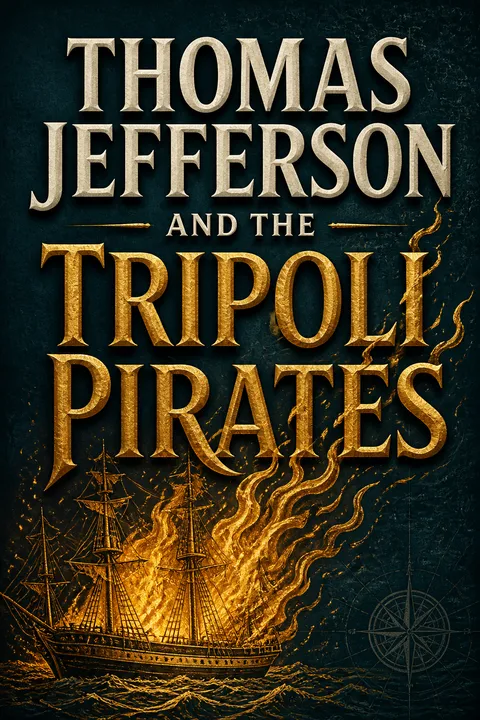
Thomas Jefferson and the Tripoli Pirates receives mixed reviews. Some praise it as an engaging account of early American naval history, highlighting forgotten heroes and events. Others criticize it as simplistic, biased, and potentially Islamophobic. Supporters appreciate the book's accessibility and relevance to current events, while detractors argue it lacks historical depth and nuance. Many reviewers note the authors' conservative background influences the narrative. Despite divided opinions, most agree the book sheds light on an often-overlooked period of American history and raises interesting questions about diplomacy, military action, and religious conflict.
People Also Read




Glossary
Barbary States
North African coastal politiesThe book uses this term for Morocco, Algiers, Tunis, and Tripoli, the North African states whose rulers negotiated with or fought the United States. They had different leaders and policies, though the narrative groups them because their corsair forces threatened shipping and their governments demanded tribute or payments for peace.
corsair
State-backed maritime raiderA corsair was a sailor who raided ships under the authority or protection of a political ruler. In this account, corsairs captured merchant vessels, cargo, and people, while rulers received a share of the proceeds. The term distinguishes these organized raiders from pirates acting entirely on their own, although the book sometimes uses both labels.
Bashaw
Tripoli's ruler's titleBashaw, also rendered pasha, is the title used in the book for the ruler of Tripoli. Yusuf Qaramanli held power during the First Barbary War, while his exiled brother Hamet claimed the throne. The book uses the title to distinguish Tripoli’s ruler from the dey of Algiers and the bey of Tunis.
bagnio
Prison for captivesA bagnio was a place where captives were confined. In the book, the term refers to the prison in Tripoli where many of the Philadelphia’s crew were held after their ship was captured. Conditions were crowded and harsh, and prisoners could be forced into labor while awaiting ransom, exchange, or release.
infernal machine
Explosive fire shipThe book uses this term for the Intrepid after it was loaded with gunpowder, shells, and scrap metal for a planned attack on Tripoli harbor. The vessel was intended to explode near the enemy fleet. Its September 1804 mission ended in a blast that killed its crew, without visibly destroying the harbor defenses.
Mameluke sword
Curved ceremonial swordA Mameluke sword is a curved sword associated in the book with the Mamelukes, a military and political group in Egypt. After the victory at Derne, the Virginia General Assembly presented Marine Lieutenant Presley O’Bannon with a sword modeled on this style. The Marine Corps later adopted the Mameluke sword as part of officers’ dress uniform.
About the Author
Other books by Brian Kilmeade
Download PDF
Download EPUB
.epub digital book format is ideal for reading ebooks on phones, tablets, and e-readers.








