

Key Takeaways
When outgunned, make information your army's force multiplier
New York was the prize. In 1776, the British seized New York City and Long Island, gaining a strategic harbor and a route along the Hudson. Washington's forces were smaller, less trained, and poorly supplied. After the Battle of Brooklyn, he escaped with his army under cover of fog, but a failed solo intelligence mission ended with Nathan Hale's execution. Washington concluded that Patriots could not reliably win by matching British strength. They needed to learn British plans and choose when, where, and whether to fight.
Survival became strategy. The Culper Ring gathered observations that helped Washington anticipate danger and exploit British uncertainty. Intelligence did not make the Continental Army invincible, nor did it replace soldiers, supplies, or allies. It helped a weaker force avoid being forced into the enemy's preferred kind of battle.
What's striking is the shift from treating intelligence as a preliminary to combat to treating it as a way to determine which combat is worth attempting. That resembles asymmetric strategy in business and military planning: a weaker side can conserve scarce resources by choosing the timing and terrain of competition. But information is not power by itself. It becomes useful only when leaders can interpret it, trust its source, and act before circumstances change. The book's strongest case is therefore not that spies won the war alone, but that they helped Washington preserve options when brute force offered few.
Replace the doomed lone scout with a chain of trusted locals
Hale's failure changed the design. Nathan Hale entered British-held territory alone in 1776, with little local knowledge and a weak cover story. Captured and hanged, he demonstrated the danger of asking one person to gather, carry, and protect intelligence. In 1778, Benjamin Tallmadge recruited his Long Island acquaintance Abraham Woodhull to organize a more durable network.
Each person had a role. Robert Townsend observed British activity in Manhattan, Woodhull gathered information on Long Island, Austin Roe and other couriers moved messages, and Caleb Brewster used his knowledge of the Sound to ferry them to Connecticut. Tallmadge then carried intelligence toward Washington. The route could take about two weeks, but local familiarity and multiple handoffs made it harder to trace than one conspicuous outsider's mission.
The network's design resembles distributed systems: several people perform limited tasks, so no single participant must control the whole operation. That can improve resilience, especially when local knowledge is unevenly distributed. It also creates coordination costs. Every extra handoff can delay a message, introduce errors, or expose another participant. The relevant lesson is not simply to add more people, but to assign roles according to access and capability, then make the path between them deliberate. The Culpers' strengths came from complementary positions, not from a large or professionally trained staff.
Make the spy look like someone who already belongs
Ordinary work created access. Woodhull's regular visits to Manhattan could be explained by family ties and trade. Townsend had a shop and later wrote local pieces for James Rivington's Loyalist newspaper, which gave him reasons to ask questions and spend time around British officers. Rivington's coffeehouse drew the very people whose conversations mattered. These were not disguises assembled from scratch. They were existing roles that made observation look routine.
Familiarity reduced suspicion. Townsend's employment at a paper known for supporting the Crown helped conceal his own Patriot sympathies. The agents relied on credible habits, local relationships, and plausible reasons to travel. A cover worked best when it explained not just a name, but a person's presence, contacts, and daily behavior.
This is a lesson in social camouflage: people tend to notice deviations from expectation more readily than familiar behavior. In organizational terms, access often comes from occupying a legitimate role near the information, not from dramatic acts of infiltration. The approach also has a limit. A convincing cover can create access without guaranteeing accurate information, and a role can become dangerous when circumstances change. Townsend's work was possible because his merchant and journalist identities were real, but the same visibility that gave him access could have connected him to suspicious movements.
Separate identities, knowledge, and couriers to limit one capture's damage
Security came in layers. The Culpers used aliases, coded numbers, invisible writing, and indirect delivery. Tallmadge assigned code numbers to people and places using a dictionary, while a special ink developed by Sir James Jay could be revealed only with a matching chemical reagent, called a sympathetic stain. Washington also suggested concealing intelligence in ordinary books or familiar letters rather than sending suspicious-looking dispatches.
Not everyone knew everything. Townsend insisted that few people learn his identity, and Washington himself did not know every agent's real name. Couriers passed messages along without necessarily understanding the entire operation. This compartmentalization limited what a captured person could reveal, though it could make coordination slower and more fragile. When couriers panicked or messages were destroyed, the ring's safeguards also became obstacles.
The ring treated secrecy as a system property rather than a single clever trick. That anticipates a principle used in security engineering: limit the damage any one compromised account or person can cause. Yet secrecy has a price. Restricted knowledge makes it harder to correct misunderstandings, build trust across a network, or respond quickly to a missing link. The Culpers' experience shows why secure operations need both compartmentalization and clear procedures. A code that protects a message is useful only if the intended recipient can identify, decode, and act on it.
Treat intelligence as useful only when it arrives in time to act
Good reports could still be late. The Culpers' route from Manhattan through Long Island and Connecticut sometimes took roughly two weeks. Storms, British searches, privateers, and anxious couriers slowed it further. Jonas Hawkins once destroyed letters because he feared capture. A later attempt to speed delivery through a young Townsend cousin ended in confusion: the courier was detained, and the message arrived in poor condition.
Washington felt the delay. In 1780, he complained that reports often confirmed information he had already received, too late to change his immediate decisions. The ring temporarily faltered, and Townsend withdrew. But when the French fleet's arrival made New York intelligence urgent, Washington restored the channel. He accepted that slower, credible information could be more valuable than none, especially when it clarified an uncertain situation.
This is a problem of information latency. In fields such as emergency response, finance, and public health, the value of a report often falls as the decision window closes. Yet speed is not the only measure of usefulness: a delayed report can still verify other sources, reveal patterns, or prevent a false conclusion. Washington's frustration reflects a real tradeoff between timeliness and reliability. The practical question is not whether intelligence is fast in the abstract, but whether it arrives early enough for a particular decision and trustworthy enough to justify the risk of acting on it.
Turn intelligence into strategic leverage, not merely warning
A report can shape the enemy's choices. In 1780, the ring reported British preparations after a French fleet reached Rhode Island. Washington judged that a direct attack on New York was too risky. He then arranged for false plans suggesting an American assault to fall into British hands. Clinton recalled forces toward New York, while the French troops landed without the feared interference. The information helped Washington choose a deception rather than a battle.
The West Point plot required corroboration. Reports from the ring gave Tallmadge context for suspicious developments, but the decisive evidence came when British officer John André was captured carrying papers from Benedict Arnold. Arnold's plan to surrender West Point collapsed. The ring's value lay partly in helping Washington and Tallmadge interpret events, not in supplying a single report that solved everything.
The French landing episode shows intelligence working in two directions: it informs a decision and helps create a false picture for the opponent. This is closer to strategic communication than simple surveillance. The West Point episode also illustrates the value of combining sources. A suspicious pattern becomes more persuasive when it aligns with documents, timing, and independent observations. Still, deception is a risky tool. It depends on an adversary believing the planted story and reacting as expected. The episode is a case of calculated uncertainty, not a guarantee that misinformation will produce the desired response.
Disrupt enemy systems by targeting currency and communications
The targets were larger than troop positions. In 1779, Townsend warned Washington that the British had obtained paper made for new American currency. If used to print convincing counterfeits, it could weaken the Continental Army's purchasing power and undermine confidence in American credit. Congress responded by cancelling existing bills in March 1780, a costly measure intended to contain a greater danger.
Communications mattered at Yorktown, too. James Rivington later obtained a copy of the British naval codebook and passed it through Allen McLane to Washington. It reached French Admiral de Grasse, helping the French anticipate British fleet movements during the Yorktown campaign. These episodes show the ring looking beyond battlefield maps to the financial and informational systems that made military action possible.
The ring's most consequential targets were sometimes infrastructure rather than people: currency, shipping, and codes. That broadens the meaning of intelligence from finding out where an army is to understanding what lets it function. Modern systems analysis makes the same point: logistics, trust, and communication can be strategic bottlenecks. The book presents the counterfeit paper and codebook as major successes, while the precise chain of discovery is not equally clear in every case. The general lesson remains strong, but causal claims should distinguish a documented contribution from a complete explanation of victory.
Protect sources even when secrecy costs speed, certainty, and credit
The danger reached into private life. Woodhull's father was beaten during an attempt to arrest Abraham. Townsend worked under British occupation and later stopped spying amid fears of exposure. In 1780, Woodhull reported that a trusted friend had been imprisoned, and Townsend withdrew from Manhattan. The book suggests this may have been Agent 355, a woman identified only by her code number and social description, but her identity and fate remain unverified.
Anonymity was part of the bargain. Washington honored the spies' demand for secrecy, even though it meant he never met Townsend, his most valuable New York source. The agents' protection sometimes slowed communication and left them without public recognition. Their work was not a glamorous adventure: it involved surveillance, fear, disrupted livelihoods, and the possibility that family members would suffer for their choices.
The story puts a human face on a familiar ethical tension: an organization can depend on people whose contributions must remain invisible. Protecting sources is not just operational prudence; it is a duty owed to those who accept unusual risks. At the same time, secrecy can isolate participants and make later recognition difficult. Agent 355 makes that dilemma especially stark because the record cannot tell whether she survived. The respectful approach is to acknowledge her likely role without converting uncertainty into biography. Commemoration need not pretend to know what the evidence cannot establish.
Separate documented evidence from the legends built around it
The ring was rediscovered through records. In 1929, historian Morton Pennypacker compared newly found Townsend family papers with Culper letters and identified Robert Townsend as Culper Junior through handwriting. The discovery connected reports once attributed to anonymous sources with a real merchant who had kept his work secret. After the war, Townsend never publicly claimed credit, and Washington's 1790 tour of Long Island did not produce the hoped-for meeting between the two men.
Some details remain uncertain. The authors note that much of the dialogue in their narrative is reconstructed. Agent 355's identity is unknown, and familiar stories about signals from Anna Strong's laundry lack firm evidence in the account. The ring's importance is better supported than every colorful scene told about it.
Historical narrative has to make fragmentary evidence legible, but vividness can blur the boundary between a documented event and a plausible reconstruction. The authors' note about fictionalized dialogue, and their admissions of uncertainty around Agent 355, offer readers useful warnings. Pennypacker's handwriting comparison shows the opposite virtue: a specific, testable clue can transform an archival puzzle. The strongest reading holds both points together. The Culper Ring's role is substantial, while individual motives, conversations, and some legendary methods require caution. Good history can be compelling without treating every uncertainty as a mystery already solved.
Analysis
The book's central argument is that Washington's intelligence operation helped a militarily weaker army survive by improving its choices. Its story moves from Nathan Hale's isolated and fatal mission to a network built around local knowledge, plausible occupations, specialized couriers, and carefully restricted information. The ring is compelling precisely because it was not a polished modern agency. Its members were merchants, a tavern keeper, a boatman, a newspaper publisher, and an unidentified woman, all working within ordinary routines that placed them near useful information.
The account's most persuasive contributions are concrete. It shows how New York's strategic importance made observation valuable, how the agents' reports shaped Washington's response to the French arrival, and how Rivington's access to British circles yielded the naval codebook associated with Yorktown. The West Point episode is more complex: the ring's intelligence formed context, while André's capture and the papers on him provided direct evidence. This distinction matters because historical causation is rarely the product of one source or one heroic act.
The narrative also reveals a tension between security and utility. Compartmentalization protected identities, but the circuitous route slowed messages. Washington sometimes wanted more speed than the network could safely offer. The agents' fear, missed appointments, and withdrawals are not side details; they show that intelligence depends on human beings whose attention, finances, families, and courage have limits.
The book's patriotic framing gives these obscure operatives a deserved place in public memory, but its strongest historical value comes when it marks the boundary between evidence and inference. Townsend's identity is supported by surviving documents and handwriting analysis. Agent 355's identity and fate remain unknown, and some dramatic scenes are explicitly reconstructed. The ring's contribution is significant without needing to claim that espionage alone won the Revolution. Its deeper lesson is that reliable knowledge can preserve options, expose vulnerabilities, and make a coalition's strength count at the moment it matters.
Review Summary
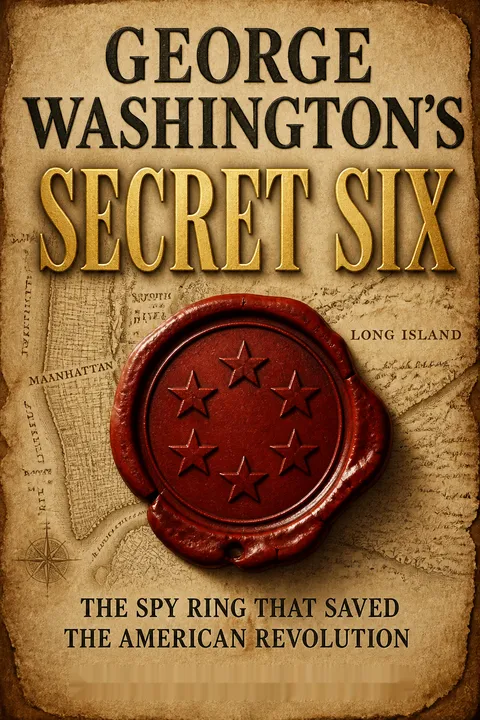
George Washington's Secret Six receives mixed reviews. Many praise its accessible writing and fascinating subject matter, highlighting the little-known Culper spy ring's importance in the American Revolution. However, critics argue the book oversimplifies history, includes fictional dialogue, and lacks scholarly rigor. Some take issue with the authors' backgrounds and writing style. Despite these criticisms, readers generally find the story of Washington's spies intriguing and appreciate learning about this overlooked aspect of Revolutionary history. The book's patriotic tone and focus on unsung heroes resonates with many readers.
People Also Read




Glossary
Culper Ring
Washington's New York spy networkA clandestine intelligence network organized under Benjamin Tallmadge during the Revolutionary War. Its members gathered information in British-held New York and Long Island, then passed reports through couriers toward Washington. The core included Abraham Woodhull, Robert Townsend, Austin Roe, Caleb Brewster, James Rivington, and an unidentified woman known as Agent 355.
Agent 355
An unidentified female agentThe code number used in Culper correspondence for a woman described as a lady and associated with the network. The book suggests she may have had access to New York's Loyalist social circles, where officers and their associates shared information. Her name, exact activities, and fate are unconfirmed, including the possibility that she was imprisoned.
sympathetic stain
Reagent revealing secret inkA chemical solution used to make a particular invisible ink legible. Sir James Jay developed the ink and its matching reagent, which were supplied to Washington's intelligence operation. A letter written with the ink could appear blank unless the recipient knew how to reveal it, making the method more secure than familiar household substances.
dead-drop
A concealed message handoffA method of transferring information by leaving it at a previously agreed location for another person to retrieve, without the two needing to meet. The Culpers considered using a field near Austin Roe's home for this purpose. It reduced the need for visible contact, but a passerby could discover the papers before the intended courier arrived.
invisible ink
Writing hidden from casual viewInk that dries without leaving a plainly visible message and becomes readable only after a specified treatment. The Culper agents used a specialized formula and its matching reagent to conceal reports. Washington also recommended hiding such writing in books or ordinary letters, so that a message's carrier would not look like an obvious intelligence dispatch.
numerical code
Numbers substituted for namesThe Culper network's system for replacing people, locations, and other words with assigned numbers. Tallmadge built the list using a dictionary, giving operatives and places codes that could be inserted into correspondence. The system reduced the danger of intercepted names, although readers still needed the codebook and context to interpret the messages accurately.
FAQ
What's George Washington's Secret Six about?
- Focus on espionage: The book tells the story of the Culper Spy Ring, a group of spies who provided crucial intelligence to George Washington during the American Revolution.
- Historical context: It explores the challenges faced by Washington and his army, particularly in New York, and how intelligence gathering was essential for their survival and success.
- Profiles of spies: The narrative highlights the lives and contributions of the six key members of the spy ring, showcasing their bravery and ingenuity.
Why should I read George Washington's Secret Six?
- Engaging storytelling: The book combines historical facts with compelling narratives, making it an engaging read for those interested in American history and espionage.
- Insight into espionage: It provides a unique perspective on the role of spies in warfare, illustrating how intelligence can turn the tide of battle.
- Inspiration from ordinary citizens: The story emphasizes how ordinary people can perform extraordinary acts of bravery, inspiring readers to appreciate the contributions of unsung heroes.
What are the key takeaways of George Washington's Secret Six?
- Importance of intelligence: The book underscores the critical role that espionage played in the American Revolution, particularly in the context of the Culper Spy Ring.
- Collaboration and trust: It highlights the necessity of collaboration among spies and the trust they had to place in one another to succeed in their missions.
- Adaptability in warfare: The narrative illustrates how adapting strategies, such as using coded messages and disguises, was essential for the survival of the American cause.
Who were the members of the Culper Spy Ring?
- Key figures: The ring consisted of six main members: Abraham Woodhull (Culper Senior), Robert Townsend (Culper Junior), Caleb Brewster, Austin Roe, James Rivington, and Agent 355, an unidentified woman.
- Diverse backgrounds: Each member brought unique skills and backgrounds, from merchants to farmers, showcasing the diverse nature of the American populace involved in the war effort.
- Collective efforts: Together, they gathered crucial intelligence that helped Washington make informed decisions, ultimately contributing to the American victory.
What methods did the spies use in George Washington's Secret Six?
- Coded messages: The spies developed a numerical code to communicate sensitive information, ensuring that their correspondence remained secure from British interception.
- Invisible ink: They utilized invisible ink to conceal messages, allowing them to send intelligence without raising suspicion.
- Dead drops: The spies employed dead drop techniques, where messages were left in predetermined locations for others to retrieve, minimizing direct contact and risk of capture.
What challenges did the Culper Spy Ring face?
- Risk of capture: The spies operated in enemy territory, constantly facing the threat of being discovered and executed if caught.
- Communication difficulties: The need for secure and timely communication was a significant challenge, as delays could lead to missed opportunities or critical intelligence being lost.
- Internal tensions: The ring experienced internal conflicts and doubts, particularly regarding the reliability of couriers and the pressure to deliver accurate information.
What role did George Washington play in the spy ring?
- Strategic leader: Washington recognized the importance of intelligence and actively sought to establish a reliable spy network to gather information on British movements.
- Supportive figure: He provided guidance and resources to the Culper Spy Ring, ensuring they had the means to operate effectively.
- Trust in spies: Washington placed significant trust in the ring's members, relying on their reports to make critical military decisions throughout the war.
How did the Culper Ring impact the American Revolution?
- Crucial intelligence: The information gathered by the ring provided Washington with insights into British plans and troop movements, which were vital for strategic decision-making.
- Foiling British plans: The ring's intelligence efforts contributed to significant victories, including the successful siege at Yorktown.
- Legacy of espionage: The success of the Culper Spy Ring set a precedent for future intelligence operations in American military history, highlighting the importance of espionage in warfare.
What role did Agent 355 play in the Culper Ring?
- Key informant: Agent 355 was a crucial member of the ring, providing intelligence from within British circles.
- Challenges of her position: As a woman in a male-dominated society, she faced unique challenges in her role.
- Legacy: Although her true identity remains unknown, Agent 355's contributions were significant in the overall success of the Culper Ring.
What were the consequences of Benedict Arnold's betrayal?
- Impact on the Culper Ring: Arnold's treachery put the entire spy network at risk, as he could potentially expose their identities.
- Shift in British strategy: Arnold's defection to the British army allowed him to provide them with inside information.
- Public perception: Arnold became synonymous with treason, and his actions led to a deep mistrust of Loyalists and former Tories.
How did the spies maintain their secrecy in George Washington's Secret Six?
- Use of pseudonyms: Each member of the Culper Spy Ring operated under code names to protect their identities.
- Coded communication: They developed a complex system of codes and ciphers to ensure that their messages could not be easily deciphered by the British.
- Disguises and cover stories: The spies often used disguises and cover stories to blend in with Loyalist society.
What are the best quotes from George Washington's Secret Six and what do they mean?
- “Washington did not really outfight the British, he simply outspied us!”: This quote underscores the critical role of espionage in the American victory.
- “All Americans owe a tremendous debt of gratitude to George Washington’s secret six.”: This statement reflects the book's theme of honoring the unsung heroes of the Revolution.
- “Their humility stopped them from seeking fame or fortune because their love of country sparked their exploits.”: This quote highlights the motivations of the spies, showcasing their dedication to the American cause over personal gain.
About the Author
Other books by Brian Kilmeade

Download PDF
Download EPUB
.epub digital book format is ideal for reading ebooks on phones, tablets, and e-readers.








