

Plot Summary
Night Comes to Cimarron
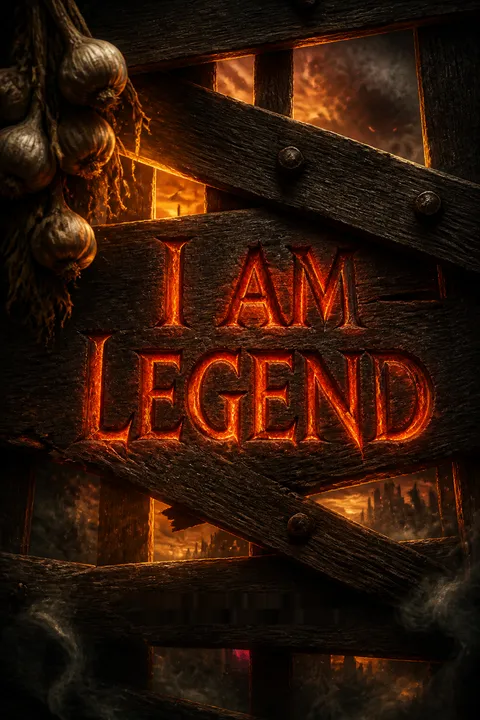
Each day, Robert Neville repairs the boards on his Los Angeles home, strings garlic over its windows, and sharpens wooden stakes before sunset. A hothouse, water tank, generator, and freezer keep him supplied; classical music and whisky occupy the hours he cannot fill with work. At night, the infected gather outside.
Some seem like mindless corpses, while others are still alive but driven by the plague. Ben Cortman, Neville's former coworker, is among them, calling for Neville to come out. Neville stays behind the bolted door, but the women outside and the pounding stones make the house feel less like shelter than a sealed box. Each morning the crowd leaves, and he begins the same lonely routine again.
The opening makes survival look less like triumph than maintenance. Neville's defenses work, but they demand constant labor and cannot protect him from the sounds and memories that invade the house. His tools also reveal a mind split between practical control and emotional collapse: he can repair a generator or shape a stake, yet has no method for easing loneliness. Ben Cortman's familiar face sharpens the isolation. The danger is not an unknown monster alone, but a former colleague who has become part of the nightly threat. Neville's routine keeps him alive while narrowing his world to a cycle of preparation, endurance, and morning cleanup.
Sunlight Opens a Door
Neville spends daylight hours removing bodies and searching empty buildings for supplies, killing infected sleepers when he finds them. At a family crypt, he discovers a vampire dead on the floor, though no stake or garlic has touched it. He realizes the sunlight entering through the open door may have killed it.
To test the idea, he drags a sleeping infected woman outside and watches her die in the sun. The result offers his first promising alternative to staking, but he has lost track of time while experimenting. When he checks his watch, it has stopped. He turns for home with sunset approaching, suddenly aware that a discovery can be useless if it leaves him outside after dark.
The discovery matters because Neville shifts from repeating inherited rules to testing observable causes. Sunlight appears to offer a clean, impersonal answer, but his experiment also exposes the cost of treating people as specimens. He watches a woman die because he wants certainty, then learns that knowledge does not excuse poor judgment or protect the investigator. The stopped watch turns scientific curiosity into immediate danger. Matheson binds thought to survival: Neville can reason his way toward an explanation, but he remains vulnerable to ordinary failures of attention, timekeeping, and planning.
The Open Garage
As Neville races back, he sees vampires gathering around his home and realizes he left the garage open. He drives through the crowd, then loops around the block to draw his pursuers away from the entrance. Ben Cortman claws at him beside the station wagon before Neville knocks him down and reaches the porch.
Neville gets inside, but the attackers crush the car, break the generator wiring, and leave the house without power. In a burst of rage, he opens the door and fires into the crowd, then fights with his hands until a wound forces him back indoors. When the door is barred again, Neville collapses in the dark, grieving the destruction of the fragile order he had built.
The failed return dismantles the illusion that Neville's precautions amount to mastery. His plan to divert the attackers works only narrowly, and the cost is substantial: transportation, electricity, and food storage all become precarious. His outburst through the door is not a strategic choice so much as accumulated fury breaking through self-control. The attackers are frightening, but so is Neville's willingness to meet them with indiscriminate violence. His house is both a practical defense and a psychological structure. When its systems fail, he is left with the grief and anger that his routines had kept at a distance.
The Burial He Refused
After repairing the house, Neville is pulled back into memories of the plague's first months. His daughter, Kathy, becomes ill, and authorities take her body to the communal fires before he can accept what has happened. His wife, Virginia, survives longer, but the disease kills her too.
Refusing to let officials burn her, Neville secretly sews her into a blanket and buries her in an abandoned lot. She returns at night, changed by the infection and drawn to his blood. Neville recognizes her only after she enters the house, then drives a stake into her. The memory explains why he flinches from family reminders and why every infected woman he finds can reopen the same wound.
Neville's past gives his present brutality a personal history without making it morally simple. Public health rules demand the destruction of infected bodies, but his refusal to surrender Virginia to the fire is an act of love and defiance that exposes others to risk. When she returns, grief cannot restore the person he remembers; intimacy becomes a source of danger. The plague has converted domestic space into a place where care and threat occupy the same room. His later insistence on procedure may be a defense against repeating this helplessness, but it cannot undo the losses that shaped it.
Legends Under the Lens
Neville resumes investigating the rules that have kept him alive. He extracts garlic's active oil and injects it into an infected woman, but it does not kill her. A cross frightens another captive, while Neville's experiments with running water offer no reliable barrier. These failures push him to question which defenses are physical and which depend on belief.
He also finds that staking some vampires causes their bodies to collapse almost instantly, a sight that recalls Virginia and drives him back to drink. His observations do not yet form a system. They leave him with a sharper problem: the vampire seems to obey several rules, but those rules may come from different causes.
This phase of inquiry unsettles the boundary between empirical fact and cultural expectation. Garlic can repel without killing, a cross can provoke terror, and a stake can produce a result that looks supernatural. Neville's desire for one universal explanation repeatedly outruns his evidence. His reactions to the experiments also show that research is not emotionally neutral: the decomposing body recalls his wife's return, while his own frustration sends him toward alcohol. The book treats explanation as a discipline of restraint. Neville must learn not only to ask what works, but to distinguish mechanism from interpretation and certainty from the relief of having an answer.
A Germ Named Vampiris
Neville carries books from the public library to his home and studies blood, bacteria, and the lymphatic system. After destroying a faulty microscope, he finds a better one and learns to prepare slides. A blood sample finally reveals a rod-shaped bacillus, which he names vampiris. He reasons that the organism needs blood, can enter dormancy when conditions worsen, and can spread through insects and spores carried by dust storms.
The discovery replaces a purely supernatural account with a biological one, though it does not explain every legend. Neville's research also restores a measure of purpose: for the first time in months, he can direct his attention toward a problem rather than simply waiting for night.
The microscope changes Neville's position from hunted survivor to investigator, but the discovery offers no immediate cure and no return to the world he knew. Scientific naming gives the threat a shape without making it manageable. His theory connects dust, insects, blood, and dormancy, converting scattered details into a plausible chain of transmission. Yet the bacillus also complicates blame: the vampire may be a host and vector rather than the original source of the catastrophe. Neville's renewed purpose is psychologically significant because it gives him a future tense. Work does not remove grief, but it briefly makes tomorrow something other than another repetition.
The Dog Who Returned
After a drinking binge leaves Neville physically and mentally spent, he sees a wounded dog crossing his lawn in daylight. He coaxes it back with food, waits as it learns to approach, and eventually brings it into the house when it grows sick. The dog remains frightened, especially at night, when it tries to dig into the floor as if seeking shelter in the earth.
Neville holds it through its panic and tends to it, but it dies within a week. He buries it and returns to his research, less willing to make hope into a promise. A memory of a revival meeting also helps him see how fear and belief may explain some vampire behavior.
The dog gives Neville a relationship in which his habits of observation and care can briefly serve someone besides himself. Yet it does not become a reward for his endurance; its fear remains, and his treatment cannot defeat the infection. The loss tests the difference between companionship and possession. Neville wants the dog to trust him, but he cannot control what has already happened to its body. Afterward, the remembered revival meeting offers a new interpretive tool: terror can alter perception and behavior. His growing insight is therefore both scientific and psychological, grounded in failure rather than easy hope.
Ruth Crosses the Field
Years into his isolation, Neville sees a red-haired woman walking through a field in daylight. He runs after her, frightening her badly enough that she fights him and tears his face before he gets her to his house. She identifies herself as Ruth and says her husband and two children are gone. Neville doubts her account when garlic makes her retch, but her exhaustion could explain the reaction, so he does not send her back outside.
They eat, drink wine, and discuss the disease. Ruth questions his certainty about killing infected people, while Neville explains his experiments and his immunity. Later, after he wakes from a nightmare of Virginia, the two find comfort in each other's presence, and Ruth agrees to a blood test.
Ruth's arrival reveals how thoroughly solitude has reshaped Neville's instincts. He has long imagined another person as salvation, yet his first response is pursuit, force, and suspicion. His treatment of Ruth repeats the logic of his experiments: uncertainty becomes a reason to test her, even when she is frightened and exhausted. Her questions challenge the moral confidence he has built around survival. Their moment of comfort does not erase the imbalance between them, but it reopens Neville to dependence and feeling. Trust here is not spontaneous; it emerges painfully through the recognition that another person's fear may be as real as his own.
The Blood Test Betrayal
The blood slide shows Neville that Ruth carries the infection. Before he can act on the result, she strikes him with a mallet and escapes, leaving a letter and one of her pills. She admits that she was sent to spy on him because he killed her husband, but says her feelings changed while they were together.
Her note explains that a new community has learned to live with the bacillus through a medicine made with blood and a drug; its members can endure brief exposure to sunlight. Neville studies the pill and the sample again, then recognizes that the organism has mutated. His discovery means the infected are no longer simply doomed bodies awaiting death.
The betrayal forces Neville to revise not only his judgment of Ruth but his entire model of the plague. His evidence was accurate, yet his conclusion that infection meant inevitable death was not. The pill embodies a social achievement he had not imagined possible: people have altered their relationship to the disease rather than merely resisting it. Ruth's confession also makes private feeling inseparable from political necessity. Her affection does not erase her mission, and her mission does not make the affection false. The scene's deepest rupture is epistemic: Neville must accept that his hard-won expertise has become outdated.
The Night Society Arrives
By January 1979, Neville has had time to consider Ruth's warning, but he remains in the house where he has lived for years. One night, organized survivors arrive with spotlights, guns, and pikes. They kill the remaining vampires in the street, including Ben Cortman, whose repeated returns had become part of Neville's nightly world.
Neville watches, disturbed by the attackers' apparent relish, and realizes Cortman belongs to neither side in any simple way. When the group axes its way into his home, Neville first expects a hearing, then understands that they intend to seize him. He fires in panic, is shot in the chest, and dragged from the house, wounded and unable to resist.
The raid makes social change visible as an organized force rather than an abstract prediction. The newcomers do not merely survive the old world; they enforce a new boundary between those they consider viable and those they consider dangerous. Neville's response to Cortman's death complicates his identity as a vampire hunter. Years of hostility have not erased his recognition of the familiar figure who once shared his ordinary life. His failed attempt to surrender also exposes the gap between his expectation of justice and the new society's fear of him. The house that once protected Neville has become a landmark of the violence they associate with his name.
A Legend in Daylight
Neville wakes in a barred room, his chest badly wounded and the new community gathered outside. Ruth visits as a ranking officer and explains that the crowd wants him executed. She says the survivors fear the man who killed their infected relatives, even though he acted according to the knowledge and dangers of his time.
Neville finally understands that they see him as a monster from the old order, just as he once saw the vampires as monsters. Ruth slips him pills to ease his end. Looking at the white faces beyond the bars, he recognizes that he has become a terrifying figure in their story. He swallows the medicine, accepting that the world has made him its legend.
The ending completes the novel's reversal by changing the standard against which normality is measured. Neville's immunity once made him the surviving human among monsters; now the majority regards his immunity and history as signs of monstrosity. This does not mean his earlier actions were harmless, nor that the new society's violence is justified. It shows how fear, power, and collective memory decide which acts count as protection and which become persecution. Ruth's final assistance preserves a personal bond within institutional roles, while Neville's recognition gives the title its force: legend is made by the people who survive to tell the story.
Analysis
I Am Legend turns the familiar monster story into a dispute over who gets to define the human. Neville begins with a clear division: he is alive and normal, while the vampires are threats to be studied or destroyed. The novel gradually makes that division less secure. Scientific investigation reveals that many vampire traits have biological causes, while fear and cultural belief account for others. Knowledge enlarges Neville's understanding, but it does not grant him moral innocence. He kills infected people because he believes they will die and return, yet the emergence of a treatment shows that his certainty was limited by isolation and the knowledge available to him.
The structure makes loneliness a practical condition as well as an emotion. Neville's generator, garlic, freezer, and daily repairs keep him alive, but every useful system binds him more tightly to a house full of reminders. The dog briefly gives his care a recipient; Ruth gives him the possibility of mutual recognition. Both connections expose what survival alone cannot supply. Their importance lies not in solving his isolation, but in showing how far it has altered his capacity to meet another being without control or suspicion.
The ending reverses the genre's moral vantage point. A society able to survive the bacillus sees Neville as the dangerous remnant of an older order. Its fear of him echoes his fear of the vampires, and its violence is justified by the same language of survival he once used. The title names this shift: Neville becomes a legend because the new majority makes him an object of dread. Matheson's final challenge is not that all judgments are equivalent, but that normality depends on who survives to establish the standard. A person may be both historically understandable and terrifying to those who inherit the consequences.
Review Summary
I Am Legend receives a 4.05 rating from 151,973 reviews. Readers praise Matheson's innovative vampire pandemic story about Robert Neville, seemingly Earth's last human. The novel explores isolation, loneliness, and depression through Neville's daily survival routine: staking vampires, researching cures, and battling alcoholism. Reviewers highlight the shocking ending that redefines heroism and monstrosity, revealing Neville as the true legend—a monster to the new vampire society. Most agree the book vastly surpasses film adaptations, particularly the Will Smith version, which missed the story's profound message about normalcy, evolution, and perspective.
People Also Read







Characters
Robert Neville
The isolated investigatorNeville is a thirty-six-year-old survivor who lives alone in a fortified Los Angeles home after a plague turns much of humanity into vampires. Practical, mechanically capable, and intellectually curious, he builds defenses and studies the disease because routine and research give shape to days otherwise dominated by fear. Grief over his wife and daughter remains beneath his self-reliance, though he often tries to suppress it with alcohol and work. His scientific confidence can become impatience with people, especially when he treats uncertain strangers as problems to test. Neville's central tension is between the need to preserve himself and the human capacity to care, trust, and revise what he thinks he knows.
Ruth
The guarded survivorRuth is a young woman Neville encounters in daylight after years without human company. She is wary, physically depleted, and guarded about her past, but she can question Neville's assumptions with a clarity he has lost through isolation. Her experiences have made her attentive to vulnerability and to the practical choices a community must make to survive. Around Neville, she balances self-protection with a capacity for tenderness, even as their different histories make trust difficult. Ruth represents a possible human connection, but not an uncomplicated rescue: she brings knowledge and loyalties that belong to a world beyond Neville's house.
Virginia Neville
Neville's lost partnerVirginia is Neville's wife and Kathy's mother. Before the plague, she shares the ordinary domestic life that Neville's later routines preserve in fragments: meals, a home, and plans for their child's safety. She is practical and dislikes being treated as fragile, even when illness weakens her. Neville's memories of her are tender but also shaped by helplessness and guilt, since the outbreak turns family care into a series of decisions made under public rules and private desperation. Virginia stands at the heart of the life Neville cannot recover, and her memory influences how he responds to infected women and to intimacy.
Kathy Neville
Neville's young daughterKathy is the young daughter of Robert and Virginia Neville. She belongs to the domestic world Neville remembers before the plague, and his concern for her safety shapes the family's decisions as the disease spreads. Her smallness in his memories makes the catastrophe especially difficult to contain within scientific explanation. Neville preserves the traces of her life in the house, even as he tries to avoid rooms that sharpen his grief. Kathy's role is brief but emotionally central: she represents the ordinary future that the adults' protective plans cannot secure.
Ben Cortman
The relentless pursuerBen Cortman was Neville's coworker and neighbor before the plague. Now he returns night after night to Neville's house, making him both a physical threat and a remnant of ordinary life. His persistence distinguishes him from the less memorable infected who gather outside, and Neville develops a strange familiarity with his habits. The contrast between Ben's former sociability and his present pursuit troubles Neville's sense of what remains of a person after infection. Ben's recurring presence gives the nightly siege a personal face rather than letting it become an anonymous spectacle.
Freda Cortman
Ben's absent companionFreda is Ben Cortman's wife. Neville remembers her as part of the neighborhood life that existed before the plague, and his brief visit to the Cortman home makes her presence part of the landscape of loss. She is not developed as a separate viewpoint character, but her domestic traces underline how thoroughly the outbreak has emptied familiar homes.
The dog
A wary companionThe stray dog appears on Neville's lawn, wounded and suspicious of human contact. Its caution is understandable in a world where nights belong to predators and people have disappeared. Neville's slow attempts to earn its trust bring tenderness back into his daily routine, while the dog's nighttime fear reveals that the plague has changed more than human behavior. The animal gives Neville a relationship that depends on patience rather than argument, exposing both his capacity to care and the limits of what care can accomplish.
Ruth's husband
A lost family anchorRuth's husband is a survivor from the world beyond Neville's neighborhood. Although he never appears directly, Ruth's account of her family and the plague gives him an important place in her history. He represents the ordinary bonds that people carry into a changed society, and his connection to Neville's past complicates the trust between the two survivors.
Dr. Busch
The medical authorityDr. Busch is a physician Neville recalls while trying to understand how to kill vampires. His medical advice helps shape Neville's early methods, though Neville eventually questions the assumptions behind the accepted rules. The doctor represents the fragmented expertise left behind by a society that collapsed before it could fully understand the plague.
Fritz Neville
The exacting fatherFritz Neville is Robert's father, remembered for his mechanical skill and logical habits. Robert resists identifying with him, yet discovers that his own methodical approach to investigation resembles the temperament he once rejected. Fritz appears through memory rather than action, helping explain Neville's mixture of technical competence, stubbornness, and discomfort with inherited authority.
The revival preacher
A voice of public fearThe preacher leads a revival meeting Neville remembers from the plague's spread. He offers religious certainty to people overwhelmed by a disease they cannot explain. Neville later uses the scene to consider how terror and belief can shape the behavior of the infected. The preacher's role is brief, but his fervent explanations show how communities reach for familiar stories when ordinary knowledge fails.
Plot Devices
Neville's fortified house
A barricaded survival systemNeville's home is equipped with boarded windows, garlic, a generator, water storage, a hothouse, and a freezer. These practical defenses let him survive the nights and give him a place to work, sleep, and study. Their usefulness depends on constant repair, so safety becomes a demanding routine rather than a permanent state. The house also confines Neville with memories of his family and the sounds of the vampires outside. When the attackers destroy his car and damage the power system, the house's limits become visible: a refuge can delay danger without restoring the society that made refuge unnecessary.
Vampire folklore
A map of uncertain defensesGarlic, crosses, stakes, mirrors, running water, and sunlight enter the story as inherited rules for confronting vampires. Neville tests these beliefs rather than accepting them as a single supernatural system. Some have physical effects, some depend on the infected person's psychology, and others prove unreliable. Their changing meanings make folklore both a practical survival manual and a misleading explanation. As Neville investigates, the old stories do not simply vanish; they become clues to the biological and psychological processes that people had previously described through legend.
The vampiris bacillus
Science beneath superstitionThe bacillus Neville finds in a blood sample provides a biological basis for the plague. His research connects it to blood, dormant infection, sunlight, insects, and dust-borne spores. Further investigation shows that the effects of staking depend on the germ's interaction with air, while some apparent supernatural rules arise from fear and belief. The organism's capacity to change becomes crucial when Neville encounters a community able to live with the infection. The bacillus is not just an answer to the vampire legend; it is a reminder that a correct explanation can still become obsolete as the world changes.
The stray dog
A test of human tendernessThe dog brings Neville a living companion after years of isolation. Its fear requires him to wait, remain still, and earn trust gradually, giving his daily life a new focus. When it becomes ill, Neville tries to care for it with the same practical attention he brings to his experiments, but affection cannot guarantee recovery. The dog therefore tests the limits of Neville's belief that work and knowledge can solve every problem. Its presence makes his loneliness concrete and briefly reconnects him with a form of ordinary care.
Ruth's pill
Proof of an altered futureThe pill Ruth leaves behind contains defibrinated blood and a drug that allows infected people to live with the bacillus. It gives Neville material evidence for her account of a new society and forces him to test his assumptions again. Its discovery links individual survival to collective adaptation: the infected are not all the same, and the disease has not remained fixed. The pill does not undo Neville's losses or make his previous actions disappear. Instead, it shows that the future has moved beyond the categories on which he built his life.
About the Author


Download PDF
Download EPUB
.epub digital book format is ideal for reading ebooks on phones, tablets, and e-readers.








