

Key Takeaways
Protect privacy even when you have nothing to hide
Privacy protects the innocent too. In 2020, police killed Breonna Taylor during a botched raid on her home. Taylor was not the subject of the investigation, and the suspected former boyfriend was already in custody. Her case makes the “nothing to hide” argument painfully concrete: ordinary people can be harmed by mistaken suspicions and unchecked authority, not only by their own wrongdoing. The book also recounts Rahinah Ibrahim, who was wrongly placed on a terror watch list after an FBI agent checked the wrong box.
Privacy keeps choices open. Confidentiality can protect abuse survivors, encourage people to seek HIV testing or crisis support, and let whistleblowers report misconduct. It also supports the presumption of innocence: people should not lose basic protections because someone suspects them of a crime.
Privacy is often defended as a shield against exposure, but it is also a safeguard against administrative error. Databases turn mistakes into durable classifications, and those classifications can affect movement, safety, and opportunity. This makes privacy a form of due-process infrastructure, not merely a personal preference. The argument is strongest when it avoids implying that every collection of information is equally harmful. The practical question is whether collection is necessary, limited, and open to correction, and whether people can challenge the decisions made from it.
Make surveillance prove its safety claims before expanding it
More collection is not proof of more safety. A 2016 US Army War College report judged the country’s post-9/11 counterterrorism efforts largely ineffective against their stated objectives. The book cites an estimated cost of nearly $6 trillion for the global campaign through 2019, while noting that extremist groups grew in number. That record does not establish that surveillance alone caused failure, but it challenges the assumption that a larger security apparatus automatically produces better protection.
History warns against permanent emergency. From McCarthy-era investigations to COINTELPRO, authorities have monitored people for political beliefs and dissent, often damaging lives without demonstrating a public-safety gain. Meanwhile, pandemic preparedness suffered from neglect. The contrast raises a basic question: which threats receive resources, and what measurable results justify them?
The key contribution here is a demand for evidence, not a claim that surveillance can never help an investigation. Security policy often rewards visible activity, such as collecting more records, while the harder outcome is preventing harm without creating new risks. A sound evaluation would compare surveillance with less intrusive options, track false leads and collateral damage, and set a time limit for emergency powers. Without those measures, “safety” can become a slogan that protects programs from scrutiny rather than a result that can be tested.
Follow your data through companies as well as government agencies
Private systems feed public power. The book describes a data-broker industry worth an estimated $200 billion, built by combining information from many sources into detailed profiles. Cambridge Analytica used Facebook-derived data, voter records, and purchased consumer information to target political messages. The example shows how routine digital activity can become a tool for influencing people who never knowingly supplied data for that purpose.
Convenience can build surveillance networks. Ring doorbells record activity near homes, store footage in Amazon’s cloud, and have been linked to police access programs. Smart televisions and other connected devices can also gather intimate information, while weak security can expose it to hackers. Corporate monitoring is not separate from government surveillance when companies collect, store, analyze, or provide data to authorities.
The public-private boundary is a poor guide to where power actually sits. A company may collect information for advertising, a contractor may analyze it, and a public agency may later use it for enforcement. Each handoff can make responsibility harder to see. This resembles a supply chain with weak accountability at every junction. The analysis becomes especially useful when it asks not only who owns the database, but who can query it, how long records persist, and whether people can refuse without losing access to essential services.
Treat metadata as a revealing portrait, not harmless technical residue
Connections can disclose intimate facts. Metadata is information about a communication or file, such as who contacted whom, when, for how long, and sometimes where. Researchers examining email headers and timestamps could infer social relationships and daily rhythms without reading message content. Phone records can similarly reveal patterns of association. Enough indirect clues can identify a person and expose aspects of health, finances, politics, or personal relationships.
Scale magnifies the risk. The NSA collected millions of phone records, even though a government oversight board found no instance in which the program made a concrete difference to a counterterrorism investigation. The book also describes a flawed analytical program used to identify suspected militants, with potentially lethal consequences. Metadata is useful for legitimate organization and research, but its apparent distance from message content does not make it innocuous.
Metadata illustrates a broader problem in data protection: sensitivity depends on what information can be inferred, not only on what a record explicitly says. A contact list may appear mundane until it reveals a support network, medical relationship, or political group. This is a relational privacy issue, since one person’s data can expose other people too. At the same time, inference is not certainty. Systems should distinguish a probabilistic clue from verified evidence, especially when the resulting decisions can restrict rights or threaten lives.
Defend encryption as basic security, not a mark of suspicion
Encryption protects ordinary life. It scrambles information so only someone with the right key can read it. The book notes that governments, lawyers, journalists, businesses, and human-rights advocates all rely on it. Tor, which routes browsing through multiple relays to make activity harder to trace, was developed with US government funding and is used for legitimate private access. At one New Hampshire library, staff installed Tor so patrons could research sensitive subjects without being tracked; community pressure helped restore it after officials objected.
Backdoors create shared weaknesses. A secret access route intended for police can also become a target for criminals or hostile governments. The book challenges claims that encryption makes crime impossible to solve, noting that officials struggled to provide examples where phone access was essential to solving cited cases.
Encryption is a rare case where individual protection and public security can reinforce each other. Strong locks protect both the person using a device and the institution whose information passes through it. The tension is real: investigators sometimes need evidence held on a device. But designing a universal weakness does not neatly target only suspects. A more disciplined debate separates lawful, case-specific access from the idea that everyone’s security should be weakened in advance.
Assume observation changes behavior, even when no one intervenes
Being watched can make people self-censor. In a Newcastle University study, patrons paid nearly three times as much for coffee and tea when a sign showed watching eyes instead of flowers. The book also describes research in which children took less candy when they could see their reflection. The point is not that every camera changes every action, but that the feeling of observation can influence behavior without a direct order.
Digital scrutiny reaches speech and curiosity. After Edward Snowden’s disclosures, visits to Wikipedia pages about terrorism-related topics fell by 20 percent, according to a study cited in the book. Surveys also found that some writers and internet users avoided subjects or conversations they feared could look suspicious. When people hold unpopular views, the perceived risk of isolation or scrutiny can make silence feel safer.
This is a useful bridge between individual psychology and political freedom. A person need not be arrested to be constrained; anticipation alone can narrow what they read, say, or explore. The effect is likely to vary by context, personality, and trust in institutions, so a single study cannot measure the whole social cost. Still, the pattern matters because democratic participation depends on people testing ideas before they know whether others approve. Surveillance can quietly make conformity the lower-risk choice.
Check who bears the cost when surveillance systems make mistakes
Errors follow existing inequalities. The book recounts NYPD monitoring of Muslim neighborhoods, mosques, and student groups without evidence that those communities were linked to wrongdoing. It also describes police use of social-media tools to track Black Lives Matter protesters and other activists. In schools, monitoring software and threat-scoring systems can misread teenagers’ jokes, slang, or online boasting, with disciplinary consequences that fall unevenly on students of color.
Prediction can recycle past policing. Predictive policing uses historical records to estimate where crime may occur or who may be involved. If the source records reflect unequal enforcement, the algorithm can direct more attention to the same communities, generating more recorded incidents and reinforcing the original pattern. Chicago ended a gun-violence prediction program after scrutiny found serious problems with its data and use.
A system can be statistically consistent and still be unjust if the records it learns from were produced by unequal enforcement. That is why accuracy alone is an inadequate standard. Evaluations must ask who is watched, who is flagged, and who can contest a label. The book’s examples also show why public consultation matters: people most exposed to surveillance may prefer conflict mediation or community services over another prediction tool. Their priorities are evidence about what safety means, not merely resistance to technology.
Treat biometric and location records as lasting, fallible identifiers
A body is not a resettable password. Biometric systems identify people through features such as faces, fingerprints, voices, or DNA. Researchers used printed masks to fool facial-recognition checkpoints, while other demonstrations recreated fingerprints from photographs. A breach involving a biometric database exposed more than a million users’ records. Unlike a password, a fingerprint or face cannot simply be replaced after compromise, and recognition errors have been found to disproportionately affect some groups.
Tracking can join separate settings. The book describes Baltimore’s aerial surveillance experiment, in which aircraft recorded movement across most of the city and investigators could connect those trails to other cameras and license-plate records. It also argues that Social Security numbers and REAL ID requirements already function as widely used identifiers. Each system may have a specific purpose, but linked records can make movement and identity increasingly traceable.
Biometrics and location trails change the stakes because they connect identity to the body and to daily movement. The resulting risk is not limited to hackers: broad access, weak oversight, and mistaken matches can also cause harm. Yet reliability and privacy are separate questions. Even a perfectly accurate system can enable pervasive tracking, while an inaccurate one adds wrongful suspicion. Good safeguards therefore need limits on collection and use, not merely promises to improve the technology.
Treat legal safeguards as contested, not self-enforcing
Rights need technical and institutional support. The book describes journalists whose records were seized during leak investigations, and lawyers who changed how they communicated with clients because they feared monitoring. It also explains parallel construction: investigators may use information from secret surveillance to start a case, then conceal its origin by creating a separate investigative trail. That can make it difficult for defendants to challenge how evidence was obtained.
Oversight can fail at the point of understanding. The author argues that lawmakers and courts often lack the technical knowledge to assess digital systems, while privacy lawsuits can be dismissed because plaintiffs cannot prove covert monitoring occurred. The result is a gap between formal protections and practical recourse. Constitutional principles matter, but they cannot protect people effectively if institutions cannot see, test, or review the systems affecting them.
Legal rights are not self-executing; they depend on procedures that let people discover violations and challenge decisions. Secret surveillance creates an unusual accountability problem because the evidence needed to sue may itself be inaccessible. Technical literacy is therefore part of legal competence, not an optional specialty. A stronger system would pair independent expertise with adversarial review, clear records of access, and meaningful remedies. The book’s case is persuasive, though it also points toward a difficult balance: secrecy can sometimes protect investigations, but secrecy without review invites abuse.
Combine personal privacy habits with collective pressure for better design
Privacy can be built into systems. Privacy by Design means embedding protections in technology and business processes from the start, rather than adding them after a product has collected data. The book describes protections such as strong default settings, security throughout a record’s lifecycle, transparency, and timely deletion. It argues that companies have little incentive to adopt these protections voluntarily when their business depends on collecting more information.
Small steps help, but shared action matters. The book recommends auditing devices, using open-source and privacy-focused tools, choosing strong unique passwords, enabling two-factor authentication, encrypting communications, and keeping only necessary information. Hasan Elahi, an artist questioned by the FBI, responded by publishing a detailed account of his movements. His unusual project illustrates one way to reclaim control, while the book stresses that durable change also requires public pressure, informed lawmakers, and oversight.
The closing argument avoids two unhelpful extremes: personal privacy is not entirely within individual control, but helplessness is not inevitable. Individual tools reduce exposure; collective pressure can change the defaults that shape millions of users’ choices. Privacy by Design is strongest when treated as an enforceable engineering obligation rather than a voluntary principle. The remaining challenge is distribution: protections should not require technical expertise, spare money, or the ability to abandon essential services.
Analysis
The book’s strongest organizing idea is that surveillance is not a single act by a single actor. It is an ecosystem: devices collect, companies infer, brokers trade, government agencies obtain access, and algorithms turn records into decisions. This shifts the discussion away from the familiar image of a watcher peering through a window and toward a more ordinary, scalable process of data reuse. Its examples make the political stakes tangible: a wrong database entry, an exposed source, a watched mosque, or a camera network can convert routine information into consequential power.
The argument also benefits from separating three questions that public debate often collapses: Can a system collect information? Can it infer something useful from it? And should anyone act on that inference? A large dataset may be technically impressive while producing weak intelligence, biased classifications, or no meaningful reduction in harm. That distinction sharpens the book’s criticism of surveillance justified by safety claims. A useful qualification is that surveillance is not uniformly harmful, and the book does not need to prove that every monitoring practice fails. Targeted investigation can be legitimate, and records can help solve crimes. The stronger standard is proportionality: a specific purpose, credible evidence of effectiveness, minimal collection, a defined retention period, independent oversight, and a way to correct errors. Those conditions also make the book’s critique harder to dismiss as a simple rejection of technology.
The central political insight is that privacy protects the space in which people can experiment, associate, seek help, and challenge authority without first proving their innocence. Its practical prescription follows: make privacy a design requirement and an institutional responsibility, while giving individuals tools to reduce exposure. The result is not perfect secrecy. It is a better balance between useful information and accountable power.
Review Summary
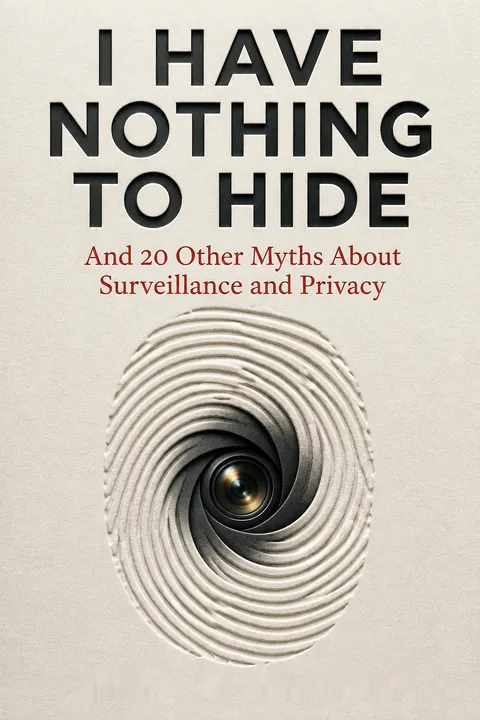
"I Have Nothing to Hide" receives mixed reviews, with an average rating of 3.65/5. Readers appreciate the book's focus on privacy and surveillance issues, praising its concise format and well-researched content. Many find it eye-opening and informative, particularly for those unfamiliar with the topic. However, some criticize the writing style, America-centric approach, and lack of balanced arguments. Several reviewers note the book's tendency towards fear-mongering, while others commend its ability to challenge common privacy myths. Overall, it's considered a thought-provoking read that raises important questions about data collection and personal privacy.
People Also Read






Glossary
Metadata
Information about other dataMetadata describes attributes of a digital record or communication, such as its sender, recipient, time, duration, or location. It can help organize and retrieve information, but patterns across many records can also reveal relationships, routines, and personal circumstances. The book argues that metadata should not be treated as harmless merely because it does not contain the message itself.
Internet of Things
Networked physical devicesThe Internet of Things, or IoT, is the network of physical objects equipped with sensors, software, and internet connectivity. Household appliances, cameras, vehicles, and infrastructure can collect information and exchange it with other systems. The book emphasizes that each connected device can create a point of access for data collection, security failures, or surveillance.
Captology
Technology designed to persuadeCaptology is the study and practice of using computers and digital products to influence people’s attitudes or behavior. In the book, it describes design techniques that encourage repeated engagement, such as notifications and reward cycles. These techniques can capture attention while also prompting users to disclose more information, often in ways that benefit the platform.
Privacy by Design
Privacy built into systemsPrivacy by Design is a framework for embedding privacy protections into technology, infrastructure, and business practices from the beginning. It favors preventive safeguards, strong default settings, end-to-end security, transparency, and respect for user interests. The book contrasts this approach with adding privacy measures after a product or service has already been designed to collect data.
Predictive policing
Forecasting crime with dataPredictive policing uses data analysis to estimate where crime may occur or which people may be involved in or victimized by crime. Place-based systems identify locations and times for police attention; person-based systems assign risk to individuals or groups. The book warns that historical records may reflect biased policing, causing predictions to reproduce and intensify existing patterns.
Parallel construction
Concealing surveillance evidence originsParallel construction is the practice of using information from a concealed investigative source to begin an investigation, then creating a separate account of how evidence was found. The original surveillance source may be hidden from defendants and their lawyers. The book argues this can obstruct challenges to how evidence was obtained and weaken protections against improper searches.
Hawthorne effect
Behavior changes under observationThe Hawthorne effect refers to people altering their behavior when they know they are being observed. The term arose from studies of workers whose conduct changed during research on workplace conditions. In the book, it helps explain why surveillance can influence behavior without direct intervention, including encouraging self-restraint, conformity, or avoidance of sensitive subjects.
Spiral of silence
Unpopular views go unspokenThe spiral of silence is a pattern in which people become less willing to express opinions they believe are unpopular, partly from fear of isolation or social consequences. The book connects this tendency to surveillance: people who think their online speech may be monitored can be especially reluctant to voice views that differ from the perceived majority.
Download PDF
Download EPUB
.epub digital book format is ideal for reading ebooks on phones, tablets, and e-readers.








