

Key Takeaways
Read Ibn Khaldun as a medieval Muslim thinker, not a modern theorist in costume.
Start with the difference. Robert Irwin’s intellectual biography asks readers to encounter Ibn Khaldun in his own fourteenth-century world, rather than award him modern titles such as sociologist, rationalist, or early Marxist. His best-known work, the Muqaddima, is an extensive introduction to a history of peoples and dynasties. It considers how societies form, how power changes hands, and how knowledge about the past should be tested.
Strangeness is instructive. The book treats Ibn Khaldun’s religious commitments, supernatural beliefs, and medieval assumptions as central to his thought, not embarrassing leftovers to edit out. Irwin argues that the distance between Ibn Khaldun’s world and ours is part of the value: it makes readers examine assumptions that can otherwise feel universal.
What's valuable here is a form of intellectual hospitality: understanding a thinker first on the terms available in his own time. That approach resists the familiar habit of turning historical figures into premature versions of people alive today. It also makes comparison more useful, because similarities and differences can both be seen clearly. The caution is that contextualizing a thinker should not make his ideas untouchable. Irwin’s account is strongest when it preserves the distance while still asking which claims are persuasive, which are historically bounded, and which fail even by the standards of their own evidence.
Let ruins provoke questions, then test historical claims against what could happen.
Ruins invite interpretation. Ibn Khaldun grew up among North African remains of cities and settlements that had once supported larger populations. Irwin opens with the legendary City of Brass, where travelers find abandoned palaces and warnings about the vanished rulers who built them. Such stories gave ruins moral force: wealth, power, and life do not last. Ibn Khaldun’s chronicle was called the Kitab al-‘Ibar, a title linked to lessons and admonitions drawn from events.
Plausibility checks stories. Ibn Khaldun argued that historians err through partisanship, credulity, and ignorance of what is possible. He rejected fantastic accounts, including a city supposedly made entirely of copper, by asking whether the geography and practical details made sense. His approach sought causes and comparisons, not merely a chain of reported events. Yet he read ruins chiefly as moral evidence, not as an archaeologist would.
This combines two different ways of reading the past. A ruin can prompt ethical reflection, but it cannot by itself prove why a society declined. Ibn Khaldun’s demand for plausibility anticipates an important habit of source criticism: claims should be assessed against context, causation, and material constraints. His own practice, as Irwin shows, was uneven. He could reject a legend on practical grounds while accepting other reports that fit religious tradition. That tension is useful rather than fatal: historical reasoning is not simply the absence of belief, but the disciplined examination of how belief shapes what counts as credible.
Watch tribal solidarity found dynasties, then see settled comfort weaken them.
A cycle of power. Ibn Khaldun’s central social term, ‘asabiyya, means the solidarity that binds a group and enables it to act together. In his account, desert and highland communities develop strong ties through shared hardship. A group with sufficient cohesion can conquer a city and establish a dynasty. Religious commitment can reinforce its unity, especially among movements seeking to replace an existing regime.
Victory changes the victors. Rulers and followers who settle into urban life acquire wealth, luxury, and new dependencies. Their original bonds weaken, and rulers increasingly rely on paid soldiers and heavier taxation. The weakened dynasty becomes vulnerable to a more cohesive challenger. Ibn Khaldun often describes this decline as unfolding across three or four generations. Irwin emphasizes that the pattern does not explain every dynasty: the Merinids, for example, lasted longer than the simple cycle predicts.
The model’s lasting insight is that political power depends on collective capacity, not only on a ruler’s personality or institutions. It also highlights a real analytical problem: success can alter the alliances and habits that made success possible. But the cycle should be treated as a hypothesis about particular societies, not a universal law. Irwin notes cases that complicate it, and the category of nomad versus city dweller can blur in practice. Groups farmed, moved seasonally, traded, and served rulers in overlapping ways. The model is most useful when it directs attention to changing relations, rather than turning tribal identity into destiny.
Read social causes alongside divine purpose, not as a secular substitute for it.
History has a religious aim. For Ibn Khaldun, past events were not only material for explaining how societies function. They were also warnings that should guide people toward obedience to God and salvation. He investigated political and social causes, but did not imagine that these displaced divine will. In his view, God could act through the ordinary processes by which a dynasty gained strength, became corrupt, and fell.
Law shaped his method. Ibn Khaldun was trained in the Maliki madhhab, a school of Sunni Islamic jurisprudence influential in North Africa. Legal scholarship taught him to assess testimony, precedent, and analogy. He adapted related habits of judgment to historical reports, asking whether a claimed event fit the circumstances. Irwin therefore resists readings that make Ibn Khaldun a secular social scientist in disguise. His reasoning can look analytical while remaining morally and religiously grounded.
This is a reminder that explanation and ultimate meaning are not always competing projects. Ibn Khaldun could investigate political mechanisms while interpreting their operation as part of a divinely governed world. That combination challenges the assumption that social analysis becomes rigorous only when religious purpose is removed. At the same time, the two kinds of explanation can be difficult to distinguish: if God works through every cause, theological purpose may not tell a historian which proximate explanation is best. Irwin’s contextual reading helps preserve the distinction without forcing Ibn Khaldun into either a modern secular category or a purely devotional one.
A dangerous court career gave Ibn Khaldun a front-row view of dynastic failure.
Politics was perilous work. Born in Tunis in 1332, Ibn Khaldun served successive rulers in North Africa as a secretary, diplomat, judge, and negotiator with tribes. The region’s competing dynasties repeatedly changed hands, and political defeat could mean imprisonment, exile, or death. The Black Death reached Tunis when he was seventeen, killing his parents, teachers, and friends. His younger brother and close friend Ibn al-Khatib were later killed amid political conflict.
Withdrawal made room to write. In 1375, after years of shifting between courts, Ibn Khaldun took refuge in a remote fortress in western Algeria. There he began the Muqaddima and the wider chronicle it introduced. He returned to public life, then moved to Cairo in 1382, where he taught and served several times as chief Maliki judge. In 1401, while Timur besieged Damascus, Ibn Khaldun met the conqueror and discussed North Africa with him.
His biography makes the theory less like an abstract diagram and more like an attempt to understand a life lived amid unstable authority. Experience as a court insider gave him practical knowledge of bargains, rival claims, and the military importance of tribal allies. It does not follow that his theory is simply disguised autobiography: the book’s arguments range far beyond his own career, and the evidence does not establish a single motive for writing it. Still, his unusual position matters. He moved between urban institutions and frontier politics, giving him a view of both the state’s ambitions and its dependence on forces it could not fully control.
Treat labor and population as sources of wealth, while asking who captures it.
Cooperation creates surplus. Ibn Khaldun argues that people need one another to meet basic needs. When they work together, divide tasks, and produce more than they consume, a larger population can support more crafts, services, and trade. Urban density can therefore bring greater prosperity and specialization. He also connects labor to value, while recognizing that scarcity and demand affect what goods earn.
Wealth can undermine its base. In his account, rulers who grow accustomed to luxury and expanded military costs impose new taxes and levies. These burdens discourage work and trade, weakening the revenue they were meant to secure. Irwin corrects a modern misreading: Ronald Reagan cited Ibn Khaldun as support for lower tax rates, but Ibn Khaldun’s argument concerns the moral and political decline of a dynasty as well as taxation. His economics is not a modern theory of markets.
The important connection is between production and the political conditions that allow people to keep producing. Ibn Khaldun sees wealth as socially made, then vulnerable to the institutions that claim, distribute, or seize it. That is a richer question than simply asking whether taxes are high or low. His analysis also has a limit: he gives more attention to towns, crafts, and trade than to the full range of rural economic life. The result is an insightful account of how power can erode revenue, but not a comprehensive economic system that can be transferred unchanged to contemporary policy.
Keep prophecy, magic, and supernatural belief inside his account of knowledge.
The unseen was real to him. Ibn Khaldun accepted that dreams, sorcery, jinn, and certain forms of divination could be genuine, even while condemning sorcery as religiously forbidden. He distrusted alchemy and treasure hunting, which he regarded as false or socially damaging, and questioned predictions that could provoke rebellions. His intellectual world included both scrutiny of historical reports and a supernatural order affirmed by religion.
A device for questions. The za’iraja was a circular divination system that converted a question into letters and numbers, then used a prescribed procedure to generate a verse-like answer. Ibn Khaldun devoted considerable attention to explaining it, though he struggled to make its operation convincing. He was also preoccupied with malahim, prophetic writings about dynasties and the end of time. These interests show why describing him simply as a modern rationalist distorts the range of his thought.
A useful distinction here is between skepticism about a particular claim and skepticism as a complete worldview. Ibn Khaldun tested legends for plausibility, but he did so within a cosmos where revelation and supernatural agency were accepted possibilities. That is not the same as modern empirical science, though it does include habits of comparison and criticism. His concern that predictions could destabilize political order also reveals that knowledge claims have consequences. The challenge is to avoid both romanticizing his occult interests and treating them as irrelevant curiosities. They show what his culture regarded as knowledge, danger, and the limits of human foresight.
Teach through guided repetition; a crowded library cannot replace a living teacher.
Learning required a guide. Ibn Khaldun objected to the growing mass of commentaries, summaries, and technical terminology. A student could spend a lifetime navigating books without mastering a subject. He favored a teacher who first presented a manageable outline, then revisited the material at increasing depth. Knowledge was transmitted through teachers and their chains of authority, not simply gathered by reading alone.
Memory formed the learner. He valued memorizing strong examples of classical Arabic poetry and prose. Memorization, in his view, developed linguistic command and shaped character; it was not merely a test of recall. He was wary of studying small technical disciplines at the expense of foundational religious learning and broad understanding. This approach reflects an educational culture built around oral explanation, repetition, and mastery, rather than the modern ideal of unlimited access to written information.
The principle remains useful: access to information is not equivalent to understanding, and a sequence of explanation, practice, and revision can make difficult material navigable. Contemporary learning theory similarly distinguishes active retrieval from passive exposure, though Ibn Khaldun’s educational priorities were grounded in his religious and literary world. His distrust of books should not be mistaken for a rejection of writing. He wrote a vast work himself. The sharper point is that texts do not interpret themselves, and an education measured by the number of pages consumed may conceal shallow mastery.
Before claiming Ibn Khaldun as a pioneer, inspect the modern agenda doing the claiming.
His reputation changed hands. Ibn Khaldun had little influence on many historians immediately after his death. Ottoman writers later used his account of dynastic rise and decline to reflect on their own empire. In the nineteenth century, European scholars translated and publicized his work. French colonial scholars sometimes used selective readings to portray North Africa as trapped in destructive Arab and Berber conflict.
Modern labels reveal their users. Later writers presented him as a sociologist, Marxist precursor, philosopher, or religious jurist. Irwin examines these competing portraits rather than treating any one as settled fact. Some interpretations illuminate real features of the Muqaddima, but each can also flatten what does not fit. Ibn Khaldun’s afterlife is therefore part of the biography: readers repeatedly make his medieval work answer questions shaped by their own political and intellectual moments.
The book’s account of reception is a lesson in how intellectual authority is constructed. Translation does not merely carry a text across languages; choices about terminology and emphasis can make a thinker appear more or less modern. Colonial accounts could turn a complex regional history into evidence for a political story, while later theories could recruit Ibn Khaldun as an ancestor. This does not mean that every comparison is illegitimate. It means comparisons should specify what is shared, what is different, and who benefits from the analogy. The most responsible reading preserves both his genuine analytical power and his historical particularity.
Analysis
Irwin’s biography is not chiefly an effort to settle whether Ibn Khaldun deserves the title of sociologist. Its more consequential move is to expose the cost of asking that question as though modern disciplinary categories were neutral. Ibn Khaldun’s account of social cohesion, political succession, labor, and urban growth is strikingly systematic, but it is woven into Maliki legal reasoning, Qur’anic moral purpose, Sufi concerns, and beliefs about divination and supernatural agency. Removing those elements can make the work easier to recognize, but also less accurate.
The book’s strongest narrative thread is the meeting between lived instability and theoretical ambition. Ibn Khaldun served rulers whose survival depended on alliances with tribes they could neither fully govern nor ignore. His withdrawal to a remote fortress was not a retreat from politics in the intellectual sense. It created distance from court rivalry and time to formulate patterns from a world he had repeatedly navigated. The pattern he identified, cohesive challengers replacing comfortable dynasties, captures an important mechanism, but Irwin shows why it should not be mistaken for a universal law. The historical cases vary, and the author’s vocabulary shifts across contexts.
The biography is also candid about the gap between theory and practice. The Muqaddima promises a new method for judging historical reports, while the chronicle it introduces can remain conventional and imperfect. Ibn Khaldun sometimes rejects fabulous stories and elsewhere accepts claims that modern readers would regard as implausible. Those tensions make the book more valuable as intellectual history, not less. They reveal a thinker testing the boundaries of what his culture allowed as evidence.
The result is a double argument: Ibn Khaldun’s ideas are powerful enough to invite modern comparison, and their power is diminished when comparison becomes appropriation. Readers gain most by treating his work as neither timeless social science nor a museum relic, but as a serious, situated attempt to understand how societies become powerful, morally compromised, and vulnerable.
Review Summary
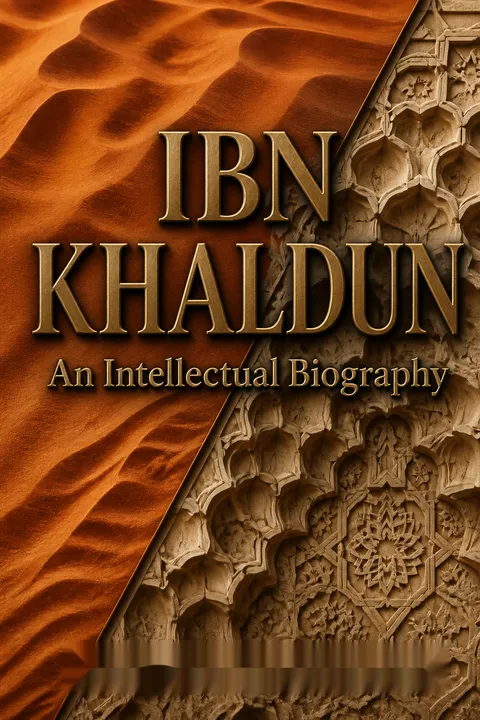
Ibn Khaldun: An Intellectual Biography presents a comprehensive exploration of the 14th-century Muslim scholar's life and ideas. The book situates Ibn Khaldun in his historical context, examining his contributions to fields like historiography and sociology. While some readers found it insightful and well-researched, others felt it lacked depth or misrepresented Ibn Khaldun's significance. The author's approach of presenting Ibn Khaldun as a product of his time, rather than a proto-modern thinker, was appreciated by many. Overall, the book offers a nuanced perspective on Ibn Khaldun's intellectual legacy and its reception through history.
People Also Read


Glossary
Muqaddima
Introduction to historyIbn Khaldun’s long theoretical introduction to his wider historical chronicle. It examines human society, nomadic and settled life, dynasties, towns, economic activity, and the sciences. Its best-known arguments explain how group solidarity can help a dynasty rise and how political and social change can weaken it.
‘asabiyya
Group solidarityIbn Khaldun’s term for the cohesion that binds a group and enables it to act collectively. Shared kinship, proximity, hardship, and sometimes religious commitment can strengthen it. In his model, powerful group solidarity can help a challenger seize authority and establish a dynasty, though it may weaken as rulers and followers settle into urban luxury.
‘umran
Human social organizationA broad term Ibn Khaldun uses for human social life and civilization. It includes the ways people cooperate, earn livelihoods, form communities, build towns, and organize political authority. Its scope is wider than the modern idea of a city or a single civilization, and it provides the general subject of the Muqaddima.
‘ibra
Lesson from historyA moral warning, example, or lesson drawn from events. Ibn Khaldun’s historical writing treats the past not merely as a record but as material for reflection on human conduct, political power, and divine judgment. The plural, ‘ibar, appears in the title of his chronicle.
Maliki madhhab
Sunni legal schoolOne of the major schools of Sunni Islamic jurisprudence, named for the jurist Malik ibn Anas. It was dominant in North Africa and Andalusia, where Ibn Khaldun was educated and later served as a judge. Its legal methods and traditions formed part of the intellectual background to his approach to evaluating reports.
hikma
Wisdom literatureA term that can mean wisdom, wise counsel, or knowledge expressed through exemplary sayings and stories. In the Muqaddima, it includes advice associated with rulers, sages, and scholars. Irwin stresses that translating hikma simply as philosophy can misrepresent its range and its moral, literary, and practical uses.
malahim
Prophecies about upheavalProphetic writings that forecast the fate of dynasties, political communities, or the world near the end of time. Ibn Khaldun discusses such texts, often written in obscure verse and attributed to famous figures. He doubts many claims of authorship and accuracy, while taking the genre seriously as part of his society’s intellectual life.
za’iraja
Divination circleA circular device used to answer questions through a procedure involving letters, numbers, astrological positions, and verse. The questioner’s words are transformed through a set of operations into an answer. Ibn Khaldun describes the device at length, but its workings remain difficult to follow and he is uncertain about the source of its apparent insight.
FAQ
1. What is Ibn Khaldun: An Intellectual Biography by Robert Irwin about?
- Comprehensive intellectual biography: The book explores the life, works, and thought of Ibn Khaldun, focusing on his major work, the Muqaddima, and its intellectual context.
- Historical and cultural context: It situates Ibn Khaldun within the political, social, and religious milieu of fourteenth-century North Africa and Mamluk Egypt.
- Wide thematic scope: The biography covers Ibn Khaldun’s views on history, sociology, economics, Sufism, the occult, pedagogy, and his political career, as well as the afterlife and reception of his ideas.
2. Why should I read Ibn Khaldun: An Intellectual Biography by Robert Irwin?
- Nuanced portrait of Ibn Khaldun: Irwin provides a complex and balanced view, moving beyond Westernized interpretations to show Ibn Khaldun as a product of his time and culture.
- Explains foundational concepts: The book clarifies Ibn Khaldun’s pioneering ideas on history, society, and economics, making them accessible to modern readers.
- Contextualizes his legacy: It traces the influence and misinterpretation of Ibn Khaldun’s work in both the Islamic world and the West, highlighting ongoing debates about his significance.
3. Who was Ibn Khaldun and why is he significant according to Robert Irwin?
- Historian and social thinker: Ibn Khaldun was a fourteenth-century North African historian, jurist, and social theorist who sought to explain the rise and fall of civilizations.
- Pioneer of historiography and sociology: He is often regarded as a precursor to modern sociology and historiography due to his systematic approach to history and society.
- Multifaceted intellectual: Ibn Khaldun was also a Sufi mystic, a Maliki jurist, and a thinker engaged with the occult and Islamic theology, making him a complex figure.
4. What is the Muqaddima and what role does it play in Robert Irwin’s biography of Ibn Khaldun?
- Foundational text: The Muqaddima is Ibn Khaldun’s major work, serving as an introduction to history and social science that attempts to uncover the laws governing human society.
- Encyclopedic in scope: It covers topics such as history, economics, sociology, pedagogy, dreams, the occult, and political theory.
- Central to his legacy: Irwin’s biography emphasizes the Muqaddima’s role in shaping Ibn Khaldun’s intellectual legacy and its blend of rational analysis with supernatural beliefs.
5. How does Robert Irwin describe Ibn Khaldun’s methodology in history and its relation to Islamic jurisprudence?
- Inspired by Islamic jurisprudence: Ibn Khaldun modeled his historical method on the principles of Islamic law (fiqh), using critical assessment of sources and cause-effect reasoning.
- Critique of earlier historians: He identified partisanship, gullibility, and ignorance of what is possible as main causes of historical error, advocating for rational analysis.
- Limits of reason: While valuing logic, Ibn Khaldun accepted theological limits, emphasizing God’s will in causality and warning against overreaching speculation.
6. What is Ibn Khaldun’s concept of ‘asabiyya and why is it important in his thought as explained by Robert Irwin?
- Definition of ‘asabiyya: ‘Asabiyya is social cohesion or group solidarity, often linked to kinship or tribal bonds, that enables groups to gain and maintain political power.
- Engine of historical change: Ibn Khaldun saw ‘asabiyya as the key force behind the rise of new dynasties and civilizations, especially among nomadic tribes.
- Cyclical and dynamic: ‘Asabiyya is a creative social energy that eventually wanes, leading to decline and the rise of new groups.
7. How does Ibn Khaldun’s cyclical theory of history work according to Robert Irwin?
- Rise and fall of dynasties: Societies and dynasties rise and fall in cycles, driven by social cohesion (‘asabiyya), economic factors, and moral decay.
- Three to four generation cycle: Ibn Khaldun theorized that dynasties typically last three to four generations, moving from conquest to decadence.
- Role of nomads and cities: Nomadic tribes with strong ‘asabiyya conquer cities, but their solidarity weakens over time, leading to decline and eventual replacement.
8. How does Robert Irwin explain Ibn Khaldun’s views on nomads and their role in history?
- Nomads as agents of change: Ibn Khaldun saw nomads as the driving force behind the rise of new dynasties, bringing fresh ‘asabiyya and religious zeal.
- Virtues and vices: He praised nomads for their austerity, courage, and healthy lifestyle, but also acknowledged their destructiveness and role in causing ruin.
- Ambivalence in assessment: While admiring their virtues, Ibn Khaldun recognized the devastation nomadic invasions could bring, especially in North Africa.
9. What are Ibn Khaldun’s economic ideas as highlighted in Robert Irwin’s biography?
- Labor as source of value: Ibn Khaldun wrote that labor is the basis of value and urban prosperity.
- Critique of luxury and taxation: He condemned luxury, hoarding, and excessive taxation, emphasizing their role in social and economic decline.
- Misinterpretation of his economics: Irwin clarifies that Ibn Khaldun’s economic ideas were more about moral and political decay than about technical economic models like the Laffer curve.
10. How does Robert Irwin describe Ibn Khaldun’s engagement with Sufism and the occult?
- Likely a Sufi: Irwin argues that Ibn Khaldun was almost certainly a Sufi, though he was cautious and did not openly claim the title.
- Interest in the occult: The Muqaddima discusses magic, dreams, talismans, and supernatural phenomena, reflecting the medieval Islamic worldview.
- Critical but believing stance: Ibn Khaldun admitted the reality of sorcery and Sufi miracles but distinguished between illicit and morally sanctioned supernatural acts.
11. What does Robert Irwin say about Ibn Khaldun’s teaching and writing style?
- Dedicated teacher: Ibn Khaldun spent much of his life teaching, often in small groups, emphasizing oral transmission and memorization.
- Pedagogical philosophy: He advocated gradual learning, prioritizing religious sciences and wisdom (hikma) over auxiliary subjects like logic and grammar.
- Distinct literary style: His writing was didactic and repetitive, possibly reflecting the oral nature of his lectures rather than ornate classical Arabic prose.
12. What are the key takeaways and final reflections from Ibn Khaldun: An Intellectual Biography by Robert Irwin?
- Complex and contradictory thinker: Ibn Khaldun combined rational analysis with religious and occult beliefs, making him a challenging figure to fully understand.
- Not a modern sociologist: Attempts to portray him as a precursor of modern social sciences often overlook his medieval Islamic context and worldview.
- Enduring relevance: Despite inconsistencies and cultural distance, Ibn Khaldun’s insights into social cohesion, economic cycles, and historical change remain valuable and influential today.
Download PDF
Download EPUB
.epub digital book format is ideal for reading ebooks on phones, tablets, and e-readers.








