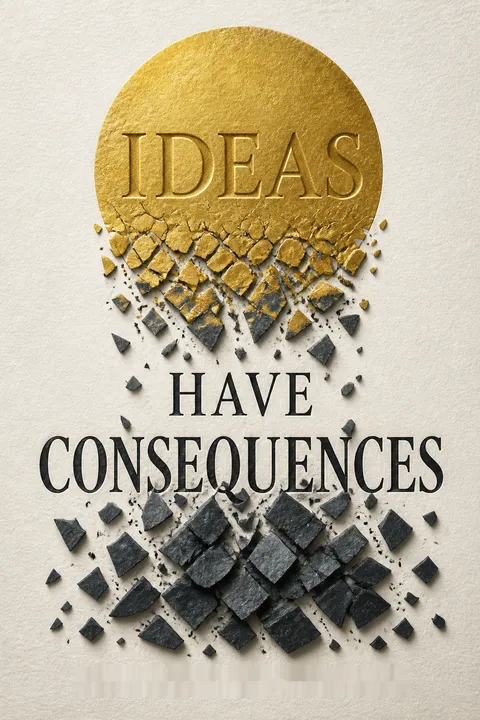


Key Takeaways
Treat your deepest assumptions as blueprints because institutions inherit their shape.
Beliefs set the direction. Weaver argues that ideas are not decorations added to practical life. They shape what people count as real, valuable, and worth governing. He traces modern disorder to nominalism, the medieval claim that universals are names rather than realities existing independently of particular things. In his account, that shift helped move Western thought toward treating sensory evidence as the whole of reality, then toward relativism and materialism.
A long chain follows. Weaver links those premises to explanations of human life through nature, economic incentives, and eventually behavior. He sees the result in institutions that prize measurable output over moral purpose. This is a powerful way to ask what assumptions sit beneath a policy or technology, though his single-root history is a thesis, not an uncontested account of how modernity developed.
The enduring value here is the invitation to trace consequences upstream. A rule that rewards only measurable output can slowly redefine what an organization considers success, even when no one explicitly endorses that philosophy. This resembles institutional analysis, where incentives and procedures shape conduct beyond individual intentions. The caution is that ideas rarely travel in a straight line from philosophy to social outcome. Economic interests, political conflict, and scientific discoveries also reshape beliefs. Weaver's causal chain works best as a diagnostic question, not as a complete history.
Build a shared moral center before asking reason alone to unite people.
Reason needs orientation. Weaver distinguishes daily opinions from deeper convictions and, beneath both, a person's intuitive picture of what reality is for. He calls this underlying picture the metaphysical dream. It gives shared events a common meaning and helps people decide what deserves loyalty or restraint. In his view, sentiment comes before reasoning: people care about a question before they begin to argue about it.
Feeling needs discipline. A common vision is not an invitation to indulge every emotion. Myth, religion, and philosophy give feeling a structure, so compassion does not collapse into sentimentality and anger does not become indiscriminate violence. Weaver points to medieval disputes over universals as arguments about the foundations of a shared world, not merely abstract puzzles. Without some agreement about ends, he argues, a society can still occupy the same territory while losing its common moral language.
This insight connects with the study of social trust: shared rules work more reliably when people believe they serve a legitimate common purpose. A pluralistic society need not share one theology, but it does need some overlapping commitments, such as fair procedure, human dignity, or limits on power. Weaver is persuasive about the need for common ground, less so when he treats religious or metaphysical unity as its only durable source. Shared civic practices can also create belonging without requiring identical ultimate beliefs.
Give authority to knowledge and virtue, not popularity alone.
Distinctions organize society. Weaver argues that a society requires recognized differences in role and responsibility. He distinguishes equality before the law from the claim that people have identical abilities, duties, or social standing. In his account, authority should rest on knowledge and demonstrated character, while fraternity binds people in different positions through mutual obligations. He contrasts this with a consumer society, where people are treated chiefly as units of appetite.
Selection still matters. Weaver sees education as a way to cultivate judgment and prepare people for responsibility. He cites the American founders' use of a written Constitution as a restraint on immediate majority impulses, and notes Jefferson's interest in educational systems that recognized differences in ability. His case is strongest as a warning that popularity alone cannot establish competence. It is weaker when it slides from functional distinctions into defending inherited social rank.
Modern institutions face the same tension between democratic legitimacy and specialized competence. A hospital, court, or engineering team cannot make every decision by popularity, yet experts also need public accountability because expertise does not confer moral infallibility. Weaver's distinction between equal legal standing and unequal knowledge helps clarify the debate. His framework needs a safeguard, however: open routes into positions of responsibility, and transparent standards for evaluating them. Otherwise, appeals to virtue and hierarchy can simply protect privilege.
Specialization without synthesis turns expertise into disconnected facts.
Expertise can lose the whole. Weaver describes a movement from the philosophic scholar, who sought to connect fields through general principles, to the gentleman educated for broad responsibility, and then to the specialist focused on a narrow domain. He does not argue that detailed knowledge is useless. He argues that facts without a framework can leave people unable to judge what those facts mean or what purposes their work serves.
Responsibility gets divided. His stark example is Oak Ridge during the Second World War, where about 70,000 people worked on the atomic bomb project, most with little knowledge of its purpose. Weaver uses this to show how large organizations can distribute tasks while obscuring ethical accountability. The example supports his concern, but specialization can also produce reliable knowledge when institutions build strong communication and ethical review across fields.
The problem resembles a familiar organizational failure: people can perform their assigned task competently while no one owns the consequences of the whole system. The remedy is not to make every worker an expert in everything. It is to create channels for asking how a task connects to shared ends, and to protect people who raise ethical concerns. Weaver's warning also needs balance: broad education cannot replace technical competence. Durable judgment depends on both depth and the ability to connect that depth to consequences.
Make work answer to a standard beyond wages, status, or self-expression.
Work can serve an ideal. Weaver contrasts craftsmanship aimed at excellent execution with labor treated only as a commodity exchanged for money. In the first view, the worker measures success against a standard built into the task. He argues that this sense of purpose can sustain care, patience, and pride. When employers, workers, or institutions focus only on bargaining for advantage, he sees work losing its connection to shared responsibility.
Form also disciplines art. Weaver applies a similar argument to literature, music, and painting. He reads movements that elevate spontaneous feeling or immediate sensation over structure as signs of a wider loss of restraint. His account of jazz in particular reflects the cultural prejudices of his period, rather than a neutral test of artistic value. The broader question remains useful: does a work's form help shape its feeling, or merely display it?
The distinction between doing a task for its own standards and doing it only for external reward echoes research on motivation and craftsmanship, though neither motive operates alone. Pay matters, and ideals can be exploited to excuse poor conditions or underpayment. A healthier account joins fair compensation to meaningful standards of quality and responsibility. Weaver's art criticism is a reminder to inspect the critic as well as the artwork: an appeal to form can defend genuine rigor, but it can also disguise cultural exclusion.
Audit the media's framing, not just its facts.
Information arrives interpreted. Weaver calls the combined influence of the press, movies, and radio the Great Stereopticon. The term describes a system that selects images of life and presents them in ways likely to shape what audiences imitate or consider normal. In 1948, he argues that headlines, dramatic conflict, familiar slogans, and the rapid flow of broadcasts can cue reactions before people reflect on the assumptions behind them.
Attention is not understanding. Weaver worries that constant updates keep events isolated from history and from one another. A report of tragedy followed by an advertisement or comedy segment, for example, can flatten distinctions of importance. His critique does not require believing that every media source is deliberately deceptive. It asks readers to notice selection, tone, and context, and to distinguish access to many facts from the harder work of judging their significance.
Media research often separates what a message says from what it makes salient. Repetition and framing can influence which problems feel urgent, even when individual facts are accurate. Weaver's metaphor anticipates this distinction, while his suspicion of mass media can overstate how passive audiences are. People interpret, resist, and discuss what they see. A practical response is to compare sources, seek context, and slow down before reacting. In today's algorithmic feeds, the same questions apply to personalized selection as well as traditional editorial choices.
Trade comfort for purposeful effort before comfort makes you politically dependent.
Ease can distort expectations. Weaver's spoiled-child psychology describes people taught to expect material satisfaction without seeing the labor, limits, or trade-offs that make it possible. He argues that advertising, technology, and political promises can encourage the belief that happiness should be delivered without hardship. When ordinary setbacks arrive, people may blame enemies instead of recognizing the unavoidable conditions of human life.
Effort can mean service. Weaver recounts an Oklahoma farmer who went to work in shipyards after Pearl Harbor, assuming that people should contribute when the country was in danger. He did not initially understand that his weekly paychecks were wages. The story illustrates a conception of duty not reducible to immediate personal gain. Weaver's warning about comfort is strongest when directed at entitlement; it should not be taken to mean that poverty or preventable hardship is virtuous.
The useful distinction is between comfort as a legitimate good and comfort as the sole measure of a good life. Purposeful effort can build capability and solidarity, while chronic insecurity can make both harder to sustain. Behavioral research on delayed rewards supports the general idea that people need practice tolerating effort, but it does not show that comfort automatically weakens character. Weaver's political prediction, that a comfort-seeking public invites coercive rule, is a warning rather than a law. Secure conditions and meaningful responsibility can coexist.
Defend personal property when it protects responsibility, dissent, and future-minded work.
Ownership can anchor independence. Weaver calls private property the last metaphysical right because, in his account, it is treated as a right that does not need to prove its value solely through usefulness to the state. He especially defends tangible property tied to a person's labor and decisions, such as a home, farm, or local business. Such ownership can provide a private sphere from which a person may act, plan, and disagree with government.
Scale changes the meaning. Weaver distinguishes personal ownership from abstract shares in vast, anonymous corporations. When ownership and responsibility are separated, he argues, property loses its personal character and concentrated business can become easier for the state to direct. He favors broadly distributed small holdings, not corporate monopoly. The proposal links independence with responsibility, though the book does not fully explain how to distribute property fairly or protect those who lack it.
Property can serve as a source of autonomy when it gives people practical control over important parts of their lives. It can also concentrate power, exclude others, and transfer advantage across generations. Weaver's distinction between personal possession and distant corporate ownership helps identify different political effects, but size alone cannot settle whether ownership is just. A useful modern test is whether a property arrangement disperses decision-making and responsibility, or leaves those affected with little voice and no meaningful alternative.
Restore public language through poetry, precise definitions, and honest disagreement.
Words carry judgments. Weaver argues that language does more than label neutral facts. Terms such as a payment to the unemployed can frame the same act as assistance or as earned protection, revealing different beliefs about responsibility. He objects to attempts to strip words of all evaluation, because people still need concepts with which to classify actions and debate their purposes.
Train both feeling and logic. Weaver proposes two kinds of education: literature and rhetoric to refine emotional judgment, and logic and dialectic to define terms, test claims, and expose contradictions. He favors poetry because metaphor can connect particular events to broader meanings. He also recommends translation, including study of Greek and Latin, as practice in choosing words carefully. Precision cannot guarantee agreement, but without shared definitions, political disagreement easily becomes people talking past one another.
Language is both a tool for describing reality and a means of organizing attention. That is why clarity matters in public life, but why perfect neutrality is impossible: even a definition selects what counts as relevant. Weaver is right that empty appeals to communication cannot repair disagreements about values. His solution should not turn precision into a gatekeeping test. Clear definitions, evidence, and good-faith listening can make disagreement more productive without requiring everyone to share the same vocabulary of ultimate truths.
Practice piety as respect for nature, persons, and inherited experience.
Respect sets limits. Weaver uses piety to mean disciplined respect for realities beyond the self. He applies it to nature, other people, and the past. The point is not to refuse all change, but to question the assumption that whatever can be altered should be altered. He warns that technological interventions can produce consequences their designers do not understand, and that treating opponents as people without legitimate claims makes cruelty easier to justify.
Memory makes judgment possible. Weaver argues that the past supplies evidence about human limits and the consequences of earlier choices. He also values chivalric restraints in conflict, especially distinctions between combatants and civilians. His appeal to inherited order is not consistently persuasive: he also rejects sex equality and assigns women narrowly defined roles. Respect for what exists can restrain arrogance, but tradition itself must remain open to moral scrutiny.
This idea connects with precautionary thinking in environmental ethics: when systems are complex and consequences uncertain, humility can be a practical discipline rather than a rejection of science. Respect for other people likewise places limits on what majorities or states may do to them. Yet reverence for the past is not sufficient justification for preserving every inherited arrangement. Weaver's own gender prescriptions show why traditions need both memory and criticism. Piety is most useful when it restrains domination without making injustice untouchable.
Analysis
Ideas Have Consequences is a postwar work of cultural philosophy organized as a descent and a proposed return. Weaver begins with a diagnosis: when a culture loses confidence in realities and standards beyond individual preference, it struggles to explain why anything should limit appetite or power. From that premise he traces a cascade through education, work, art, mass media, political authority, and ordinary character. His proposed repairs are concrete as well as metaphysical: preserve independent property, educate through language and literature, and cultivate respect for nature, other people, and history.
The book's central strength is its insistence that technologies and institutions carry moral assumptions. A factory that divides work until no one sees the whole, or a media system that presents events as disconnected bursts, can weaken responsibility without requiring a villain's plan. Weaver's questions about ends, accountability, and the framing of public information remain valuable precisely because they examine systems as well as individuals.
Its central weakness is explanatory overreach. Weaver turns a difficult historical transformation into a largely single-origin story beginning with medieval nominalism. That structure gives the book force, but it compresses competing religious, economic, political, and scientific causes into one philosophical lineage. His account also treats hierarchy as a prerequisite for social order without adequately distinguishing functional expertise from inherited privilege. The idealization of the Old South is especially compromised by its failure to reckon with slavery and the social order that depended on it. His dismissal of jazz and his prescription of restrictive gender roles reveal how easily his defense of form and nature can become a defense of exclusion.
The most productive reading therefore neither accepts Weaver's decline narrative whole nor dismisses it as nostalgia. It separates his diagnostic tools from his preferred social order. Ask which ideas a policy assumes, who bears responsibility when institutions divide decisions, and whether technological power has outrun moral judgment. Then test proposed traditions against equal dignity and historical evidence. The book's title is strongest as a demand for that scrutiny, not as proof that one doctrine explains the modern world.
Review Summary
Ideas Have Consequences is a thought-provoking and controversial book that analyzes the decline of Western civilization. Weaver argues that the shift from philosophical realism to nominalism in the 14th century led to moral relativism and societal fragmentation. He critiques modern society's focus on materialism, egalitarianism, and instant gratification. While some readers find his arguments insightful and prophetic, others criticize his elitist and conservative views. The book is praised for its dense prose and challenging ideas, but also criticized for its dated references and dismissive attitude towards certain cultural elements.
People Also Read





Glossary
nominalism
Universals are namesThe philosophical position that general categories, such as kinds or shared qualities, do not exist independently of particular things but are names or concepts used to group them. Weaver treats nominalism as a turning point: if universals are only names, he argues, objective standards beyond sensory experience become harder to defend. His historical account of its effects is a central, contested part of the book.
metaphysical dream
An underlying picture of realityWeaver's term for a person's intuitive sense of what reality is fundamentally like and what human life is for. It sits beneath everyday opinions and more explicit beliefs, giving them their deepest standards of meaning and value. In his account, a shared metaphysical dream helps people interpret experience and sustain a common culture.
Great Stereopticon
Mass media's picture machineWeaver's name for the combined cultural influence of the press, motion pictures, and radio. Like a projection device, these media select and frame images of life for large audiences. Weaver argues that their repeated stories and cues can shape public judgment, encourage imitation, and keep people focused on sensation rather than reflection.
spoiled-child psychology
Expectation without earned rewardWeaver's description of a social attitude in which people expect comfort and material satisfaction without recognizing the effort, limits, and duties involved. He argues that advertising, technology, and political promises can foster this expectation. When reality frustrates it, people may blame others and demand immediate redress rather than accept hardship as part of human life.
metaphysical community
Community joined by shared meaningA community held together not only by living in the same place or sharing practical interests, but by a common orientation toward reality and value. Weaver contrasts it with an empirical community, which consists simply of people occupying the same territory. Shared beliefs and sentiments, in his account, make durable trust and cooperation possible.
presentism
Living within the immediate momentWeaver's term for a narrowed sense of time that treats the present as detached from the past and future. He argues that presentism weakens memory, historical judgment, and the ability to consider long-term consequences. Because it privileges immediate experience, he links it to materialism and to the fragmentation of cultural understanding.
the last metaphysical right
Property beyond utility testsWeaver's description of private property as a right whose legitimacy should not depend entirely on its usefulness to the state or society. He particularly defends small-scale, tangible ownership that connects a person to responsibility, work, and a private sphere. He distinguishes this from anonymous corporate ownership, which he sees as weakening personal control.
piety
Respectful restraint toward existenceWeaver uses piety broadly for a disciplined respect toward realities beyond the self. It includes regard for nature, other people, and the past, each of which has an existence and order a person cannot simply remake at will. He presents piety as a restraint on arrogance, domination, and impatience, while his own applications include claims that require critical examination.
Download PDF
Download EPUB
.epub digital book format is ideal for reading ebooks on phones, tablets, and e-readers.








