

Key Takeaways
Treat pregnancy loss as healthcare, grief, and reproductive life, not a moral category.
One spectrum, many experiences. Rebecca Little and Colleen Long begin with their own losses: Rebecca delivered a stillborn son, then later ended a wanted pregnancy after fatal diagnoses; Colleen went to an abortion clinic after learning her baby had died. Both were left with grief, confusion, and questions about what words or care applied. Their experiences show why pregnancy loss cannot be reduced to a single story or a judgment about intent.
Common does not mean simple. The book groups ectopic pregnancy, miscarriage, stillbirth, termination for medical reasons, selective reduction, and abortion within the broad reality of pregnancy ending. An estimated 10 to 20 percent of known pregnancies end in miscarriage, and stillbirth affects about one in 175 births. Yet people’s feelings, medical needs, and circumstances vary widely.
The book’s central move is to separate shared needs from identical experiences. People who have different kinds of loss may all need honest medical explanations, respectful language, and support, without being asked to feel the same way. This resembles a useful distinction in public health: categories can help organize services, but they should not erase individual circumstances. The risk is that one umbrella term can itself flatten meaningful differences. Its value depends on keeping the range visible while refusing to rank whose loss deserves compassion.
Let patients name a pregnancy before clinicians label its loss.
Words carry emotional weight. Embryo and fetus are clinical terms, while baby carries intimate meaning. Sociolinguists call these different registers, or forms of language suited to different settings. English also has a lexical gap: no widely accepted word for a developing pregnancy that acknowledges emotional attachment without equating it with a born infant. Medical phrases such as products of conception can feel cold or dismissive to someone grieving.
Follow the patient’s lead. A loss may be called miscarriage, stillbirth, abortion, or simply a pregnancy loss, depending on medical facts and personal meaning. The authors describe patients startled to find spontaneous abortion in their charts, even though that is standard medical terminology. They argue that clinicians should ask what language a patient prefers, rather than assuming that a technical label is emotionally neutral.
Language here is not cosmetic. It influences whether a patient feels understood, and whether a medical conversation can address both procedure and meaning. Patient-led wording is a practical form of respect, much like using a person’s chosen name. It also avoids a false solution: replacing every clinical term with baby can impose attachment on someone who does not want it. The better principle is not one universal vocabulary, but a brief question that gives the patient control over how the experience is described.
Stop treating a planned pregnancy as a guaranteed baby.
Control changed expectations. For much of history, people often did not know they were pregnant until quickening, the first felt fetal movement, usually around sixteen to twenty weeks. Early miscarriages could pass like a late or heavy period. Reliable birth control, legal abortion, home pregnancy tests, and ultrasound changed when pregnancy became visible and how early people could form expectations.
Choice is not a promise. A planned pregnancy is still subject to biological uncertainty. The book traces how modern confidence in medicine and reproductive control helped turn a loss into a perceived personal failure: if someone deliberately continued a pregnancy, people assumed it should end with a healthy baby. That assumption ignores the frequency of miscarriage and leaves the bereaved person searching for something they supposedly did wrong.
The history makes a subtle point about technology: earlier knowledge can increase agency while also deepening attachment and making loss more visible. Information does not cause the loss, but it changes the experience of it. That is a genuine tradeoff, not an argument for withholding pregnancy tests or scans. The more useful response is to pair early detection with honest counseling about uncertainty. Societies often mistake the ability to plan for the ability to guarantee outcomes, a confusion that appears in medicine well beyond pregnancy.
Ask who disappears when pregnancy is pictured as a fetus alone.
Images tell a selective story. The authors trace the rise of public fetal imagery from museum displays and idealized models to widely circulated photographs and, later, routine sonograms. Some famous images presented fetuses removed from dead bodies or pregnancies that could not continue, while omitting the pregnant person and the medical circumstances. Ultrasounds made pregnancy visible to parents, but they also helped turn the fetus into a seemingly separate figure.
A picture can frame policy. Political campaigns use images and terms such as fetal heartbeat to suggest a clear, autonomous life from the earliest stages. The book notes that the phrase is political, not a precise clinical description of a fully formed heart. Meanwhile, the pregnant person can fade from the image, even though the fetus depends on their body and health.
Visual framing works before argument: an image can make one moral interpretation feel obvious while hiding the context needed to assess it. This is familiar in journalism and law, where what a photograph excludes can matter as much as what it shows. Still, the book’s critique should not be mistaken for a claim that ultrasound attachment is fake or merely political. A sonogram can carry real personal meaning. The important distinction is between an individual’s relationship to an image and a public campaign using that image to settle everyone’s moral choices.
Demand evidence and care built around patients medicine has overlooked.
Knowledge has been unevenly produced. Women and people of color were systematically excluded from federally funded medical research until 1993. Inclusion has improved, but a cited review of clinical trials from 2016 to 2019 found that women made up an average of 41.2 percent of participants, with representation varying by condition. Researchers also often fail to analyze results by sex, leaving uncertainty about how medications affect women and pregnant patients.
Inequity shapes outcomes. The book links current disparities to a history of racist and sexist medicine, including experiments on enslaved Black women. In 2021, the US maternal mortality rate was 32.9 deaths per 100,000 live births; the cited rate for Black women was 69.9. Black, Indigenous, and Hispanic patients are also more likely to face complications and dismissal of their concerns.
The evidence gap is not simply a shortage of facts. It is a product of decisions about whose bodies count as typical, whose pain is believed, and which questions receive funding. That makes data quality an issue of justice as well as scientific rigor. Better representation alone is not enough if results are pooled and differences disappear in analysis. The book’s account also cautions against treating race as a biological explanation for inequity. The relevant mechanisms include unequal care, chronic discrimination, and institutional practices, not an inherent defect in patients.
Write pregnancy laws around clinical judgment, not imaginary clean lines.
Medical categories overlap. Miscarriage and abortion can involve the same medications and procedures, including uterine aspiration and dilation and evacuation. Yet laws often treat them as separate, easily distinguishable events. A so-called fetal heartbeat may be detected during a pregnancy that is miscarrying, and doctors cannot always tell from symptoms alone how a pregnancy will end.
Legal uncertainty delays care. After the Supreme Court overturned Roe v. Wade, doctors in restrictive states faced the risk of prosecution for intervening too soon or interpreting an exception incorrectly. The book describes patients sent home while bleeding and others forced to wait for clearer signs of danger. The authors argue that laws that limit medical discretion can turn routine miscarriage treatment into a legal calculation, with consequences for both health and trust.
This is a case where legal abstraction collides with clinical time. Legislatures can write bright lines, but bodies often present uncertainty, changing symptoms, and decisions that cannot safely wait for certainty. The resulting caution is predictable when clinicians face serious penalties, even if lawmakers say miscarriage care remains legal. A sounder policy would preserve professional judgment, require transparent standards, and allow review without making urgent care depend on a lawyer’s interpretation. The book’s account is especially persuasive because the same procedure can carry different legal meanings depending on intent and jurisdiction.
Treat addiction and pregnancy complications with care, not criminal prosecution.
Uncertainty can become accusation. Brittney Poolaw miscarried at about seventeen weeks in Oklahoma and was convicted of manslaughter after methamphetamine was found in her system and in fetal tissue. The medical examiner also identified an abdominal abnormality, placental infection, and partial placental separation, and could not say methamphetamine caused those conditions. The case illustrates how a loss with multiple possible causes can be turned into a criminal story.
Punishment does not provide treatment. The authors describe a long history of pregnancy-related prosecutions, often directed at poor women and women of color. In Oklahoma, only eighteen of forty-five women charged with pregnancy-related crimes from 2017 to 2021 received drug treatment as part of their cases. The book argues that substance use raises real health concerns, but prosecution is a poor substitute for accessible treatment and medical support.
The distinction between recognizing risk and assigning blame is essential. Public health systems can respond to substance use with treatment, prenatal care, and harm reduction, while criminal courts demand a causal account that medical evidence may not support. That mismatch invites unequal enforcement and discourages people from seeking care. The book does not deny that substance exposure can harm fetal development. Its stronger point is that concern for health cannot justify claims of criminal responsibility when causation is uncertain and support is withheld.
Let grief follow the person, not a calendar or hierarchy.
There is no standard grief schedule. People may mourn an early miscarriage, feel relief after another loss, or carry the effects of stillbirth for years. The book calls grief that lacks public recognition disenfranchised grief. Miscarriage can also involve prospective grieving, mourning imagined futures that will not happen. Neither gestational age nor the apparent severity of an event reliably measures a person’s attachment or pain.
Silence breeds blame. Many people wait to announce a pregnancy until a supposedly safe milestone, then feel isolated if they must share the loss. A 2015 survey found that most respondents thought miscarriage occurred in 5 percent or fewer pregnancies, far below the estimated 10 to 20 percent of known pregnancies. The authors advise against minimizing phrases and encourage specific, ongoing offers of help.
Grief is partly private emotion and partly a social process. When a loss is hidden or treated as too small to count, the person must manage both the pain and the burden of proving that the pain is legitimate. This does not mean everyone should announce a pregnancy early or mourn publicly. Privacy can be protective, and some people feel relief rather than sorrow. A humane culture makes room for both choices, instead of turning disclosure into a test of courage or sadness into a measure of love.
Build practical rituals and continuing support around bereaved parents.
Care should continue after delivery. Parents in shock may not absorb every choice offered in a hospital. They may later wish they had photographs, handprints, time with the baby, or a clear explanation of physical recovery. The book describes bereavement-trained staff, cooling bassinets that give families more time, and the Butterfly Suite, a room designed for parents whose baby has died. These supports are unevenly available, often dependent on fundraising or individual advocates.
Ritual can be personal. Some families hold funerals, plant a tree, wear memorial jewelry, or take part in a Buddhist Jizo ceremony for children who died. Others prefer no formal ritual. Friends can help by using the baby’s name if known, listening, bringing food, caring for other children, and checking in on anniversaries without demanding a response.
Rituals offer social recognition: they give other people a concrete way to show that a loss matters. The book’s examples are strongest when they preserve choice, rather than prescribe one religious or emotional script. Practical support matters just as much. Food, childcare, leave, and follow-up care convert sympathy into resources, while a photograph or memorial object can help make an otherwise invisible experience shareable. These supports should be treated as part of healthcare and workplace policy, not as charitable extras that depend on a particularly determined family.
Analysis
The book’s most important contribution is to show that pregnancy loss is not a marginal exception to reproductive life. It is part of that life, yet medicine, law, media, and everyday conversation repeatedly sort pregnancy into two deceptively neat outcomes: a healthy birth or an intentional abortion. The authors explain how this binary became plausible through early pregnancy testing, ultrasound imagery, political language, and an American belief that planning should produce control. When pregnancy ends differently, the person who carried it is left to absorb both grief and the suspicion that something went wrong because of them.
The historical account strengthens the argument by showing that today’s norms are not timeless. Earlier Americans often understood pregnancy through quickening, and miscarriage did not carry the same assumptions of personal failure. Reproductive policy also has a history shaped by professional power, racism, and efforts to control who could reproduce. Medical progress has saved lives, but its benefits have never been distributed equally. That history gives present-day disparities context without treating them as inevitable.
The book is particularly effective when it connects language to practical consequences. A chart label, a statute, or a missing death certificate can affect whether someone receives treatment, is investigated, can take leave, or has a recognized place to mourn. The legal problem is not merely that laws are restrictive. It is that pregnancy complications do not reliably fit the categories lawmakers use, while clinicians must make decisions in real time.
There are limits to the evidence. The more than one hundred personal accounts offer depth and variation, not a representative survey of all people who experience loss. The legal landscape described is also a snapshot from a rapidly changing period after Dobbs. Still, the book’s method suits its subject: it demonstrates how abstract categories are lived through bodies, institutions, and relationships. Its humane conclusion is not that every loss means the same thing, but that no person should have to defend their grief or risk their health to receive care.
Review Summary
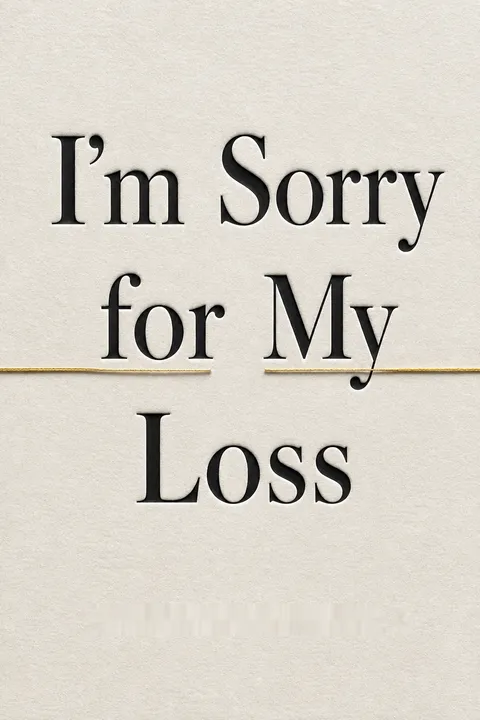
"I'm Sorry for My Loss" is a powerful and timely examination of reproductive care in America, praised for its comprehensive research, personal narratives, and intersectional approach. Readers appreciate the authors' humor and sensitivity in addressing pregnancy loss, abortion rights, and systemic healthcare issues. The book is described as eye-opening, informative, and emotionally impactful, offering historical context and current perspectives on a critical topic. Many reviewers consider it essential reading for understanding reproductive justice and supporting those who have experienced loss.
People Also Read





Glossary
Termination for medical reasons (TFMR)
Ending a medically compromised pregnancyA community term for ending a pregnancy after a serious fetal diagnosis or because continuing the pregnancy threatens the pregnant person’s health. The term is not a standard medical-chart label. People who use it may describe the experience as abortion, pregnancy loss, or both, and the phrase does not imply that every person facing a diagnosis makes the same decision.
lexical gap
A concept without a common wordA linguistic absence: a culture has an idea or experience, but its language lacks a widely accepted word for it. The book applies the term to the difficulty of naming an emotionally significant pregnancy that is neither simply a born baby nor an impersonal medical entity. That gap can leave people relying on words with very different emotional and political meanings.
relational model of pregnancy
Meaning shaped by the relationshipAn approach in which the meaning of a pregnancy depends partly on the pregnant person’s relationship to it and the circumstances surrounding it, rather than being fixed solely by biological stage. It allows someone to feel deep attachment to one pregnancy, detachment from another, or changing emotions within the same pregnancy, without treating those differences as contradictions.
calling into personhood
Assigning personhood through relationshipThe idea that an embryo or fetus may acquire personal meaning through the relationship a pregnant person forms with it. Personhood, in this account, is not automatically experienced in the same way in every pregnancy or at one universal developmental moment. The concept helps explain why people may cherish one pregnancy while not assigning the same emotional status to another.
disenfranchised grief
Grief denied public recognitionA term for grief that is not openly acknowledged, socially supported, or publicly mourned. Pregnancy loss can fit this pattern when others minimize the event, avoid speaking about it, or assume the grieving person should quickly move on. The lack of recognition can compound distress by making someone feel that their loss is not legitimate.
prospective grieving
Mourning an imagined futureGrief focused on the future that a person had expected but will not experience. In pregnancy loss, this can include mourning imagined milestones, family life, or the child a person hoped to raise, even when memories of a shared life are limited or absent. The concept distinguishes this experience from grief rooted mainly in a long history of memories.
cultural confinement period
Pregnancy kept socially hiddenA phrase used to describe the customary advice to keep a pregnancy private, often until after the first trimester or another perceived safe milestone. The practice is meant to avoid having to announce a loss, but it can also leave people hiding ordinary pregnancy needs and enduring a loss without support.
reproductive justice
Rights to have and raise childrenA framework developed by women of color that goes beyond access to abortion. It includes the right to bodily autonomy, to decide whether and when to have children, and to raise children in safe and sustainable communities. The framework emphasizes that reproductive freedom depends on material conditions, healthcare access, and protection from discrimination.
ring theory
Direct support toward the person in crisisA model for offering support during a crisis. The person most affected is at the center, with family, friends, and others in surrounding circles. Comfort and practical help should move inward toward the person in crisis, while people seek their own emotional support from those farther out. The principle prevents the bereaved person from having to comfort others about their loss.
The Turnaway Study
Study of abortion access and outcomesA longitudinal study that followed people who sought abortions, including those who received one and those who were turned away because they were beyond a clinic’s gestational limit. The book cites the study to challenge claims that abortion itself reliably harms mental health and to discuss the consequences of being denied care. It is used as evidence about the effects of access, not as a study of every kind of pregnancy loss.
FAQ
1. What is I'm Sorry for My Loss by Rebecca Little and Colleen Long about?
- Comprehensive look at reproductive care: The book examines pregnancy loss in America, including miscarriage, stillbirth, and abortion, through medical, legal, social, and cultural lenses.
- Personal and collective narratives: Little and Long share their own stories and those of others, highlighting the emotional and systemic challenges faced by people experiencing pregnancy loss.
- Analysis of language and politics: The authors explore how language, history, and politics shape perceptions and care around pregnancy loss.
- Advocacy for compassionate care: The book calls for improved medical, legal, and emotional support, aiming to reduce stigma and misinformation.
2. Why should I read I'm Sorry for My Loss by Rebecca Little and Colleen Long?
- Breaks cultural silence: The book addresses the taboo and misunderstanding surrounding pregnancy loss, providing language and context often missing from public discourse.
- Explains legal and medical complexities: It clarifies how laws, especially after the Dobbs decision, affect miscarriage and abortion care, and highlights disparities in healthcare.
- Empowers with knowledge: Readers gain tools to advocate for themselves or others and navigate a complex healthcare landscape.
- Fosters empathy and understanding: The book offers validation and visibility to those affected by pregnancy loss, helping readers support others more effectively.
3. What are the key takeaways from I'm Sorry for My Loss by Rebecca Little and Colleen Long?
- Pregnancy loss is common and complex: The book reveals the prevalence and multifaceted nature of miscarriage, stillbirth, and abortion, challenging cultural silence and stigma.
- Language matters deeply: The authors show how terminology shapes experiences, grief, and public debates, advocating for more inclusive and precise language.
- Legal and systemic barriers persist: Restrictive laws and systemic inequities disproportionately harm marginalized groups and complicate access to care.
- Need for compassionate, integrated care: The book calls for better training, legal protections, and public education to support those experiencing pregnancy loss.
4. What are the main types of pregnancy loss discussed in I'm Sorry for My Loss by Rebecca Little and Colleen Long?
- Miscarriage: Loss before 20 weeks, often in the first trimester, with causes ranging from chromosomal abnormalities to environmental factors.
- Stillbirth: Loss after 20 weeks gestation, with many causes unknown; the book highlights emotional impact and disparities, especially among Black women.
- Terminations for Medical Reasons (TFMR): Elective terminations due to fetal anomalies or maternal health risks, often conflated with abortion in public debates.
- Abortion: Explored both as a medical procedure and as a politicized issue, with attention to its intersection with other forms of pregnancy loss.
5. How does I'm Sorry for My Loss by Rebecca Little and Colleen Long address the impact of abortion laws on pregnancy loss and reproductive healthcare?
- Criminalization of pregnancy loss: The book details how restrictive laws can lead to homicide or manslaughter charges for pregnancy loss, disproportionately affecting women of color and those with substance use issues.
- Restricted access to care: Post-Roe abortion bans have reduced access to essential reproductive and emergency care, including for miscarriages and ectopic pregnancies.
- Legal confusion and fear: Vague laws create uncertainty for both patients and providers, leading to delayed or denied care and increased health risks.
- Impact on healthcare providers: Doctors may hesitate or refuse necessary care due to legal risks, worsening outcomes and disparities.
6. What does I'm Sorry for My Loss by Rebecca Little and Colleen Long say about the language and terminology used around pregnancy and loss?
- Inadequacy of current language: American English lacks precise, emotionally appropriate words for pregnancy loss, leading to confusion and stigma.
- Political and emotional weight: Terms like "miscarriage," "abortion," "fetus," and "baby" carry significant baggage, influencing how loss is perceived and validated.
- Relational model of pregnancy: The book introduces this concept, recognizing that each pregnancy and loss is experienced uniquely, without political or moral judgment.
- Advocacy for inclusive language: The authors urge the use of terms that respect bodily autonomy and diverse identities, including transgender and nonbinary people.
7. How does I'm Sorry for My Loss by Rebecca Little and Colleen Long explore the history of reproductive care in America?
- From communal to medicalized childbirth: The book traces the shift from female-centered, communal childbirth to increased medical intervention and secrecy, especially during the Victorian era.
- Impact of slavery and racism: It details how the exploitation and control of enslaved Black women’s reproduction laid the groundwork for ongoing racial disparities.
- Legal and professional shifts: The 19th and 20th centuries saw doctors professionalize childbirth, outlaw abortion and contraception, and shift control from women and midwives to male physicians and the state.
- Persistent inequities: Despite reforms, disparities in care and outcomes remain, especially for marginalized groups.
8. What are the medical and systemic challenges in reproductive healthcare highlighted in I'm Sorry for My Loss by Rebecca Little and Colleen Long?
- Gender and racial biases: The book shows how medical research and care have historically excluded women and people of color, leading to disparities in diagnosis, treatment, and outcomes.
- Lack of standardized care: There is inconsistency in miscarriage and stillbirth management, postpartum support, and bereavement care across hospitals and states.
- Shortages and training gaps: The authors discuss shortages of trained providers, especially in abortion and perinatal palliative care, worsened by restrictive laws and stigma.
- Need for better data and protocols: The book calls for more inclusive research and improved clinical guidelines.
9. How does I'm Sorry for My Loss by Rebecca Little and Colleen Long address the cultural narratives and silence around pregnancy loss?
- Silence, stigma, and shame: The book discusses how these factors isolate grieving parents and perpetuate misinformation and guilt.
- Cultural expectations: It critiques societal scripts that demand quiet, brief grief and the ideal of the self-sacrificing mother, marginalizing diverse emotional responses.
- Breaking the silence: The authors highlight the growing movement of loss parents sharing stories publicly, creating supportive communities and challenging taboos.
- Role of public education: The book advocates for normalizing conversations about pregnancy loss in schools, clinics, and communities.
10. What role do images of the fetus play in shaping abortion and miscarriage narratives in I'm Sorry for My Loss by Rebecca Little and Colleen Long?
- Evolution of fetal imagery: The book traces the shift from scientific specimens to idealized sculptures and photographs that humanize the fetus and separate it from the mother.
- Ultrasounds and bonding: Sonograms personalize the fetus, often used politically to emphasize fetal personhood and influence abortion debates, but can also cause trauma for those experiencing loss.
- Weaponization in politics: Antiabortion campaigns use fetal imagery to frame abortion as murder, shaping public opinion and legal language.
- Challenge for abortion rights advocates: The book notes the difficulty in countering the powerful narrative created by these images.
11. How does I'm Sorry for My Loss by Rebecca Little and Colleen Long explore grief, mourning, and memorialization after pregnancy loss?
- Complex, disenfranchised grief: The book explains that grief after pregnancy loss is often intangible, prolonged, and complicated by societal silence and lack of rituals.
- Keepsakes and rituals: It describes the growing market for memorial objects and the creation of personalized mourning rituals, including cultural and religious practices like the Japanese mizuko kuyo ceremony.
- Need for support and recognition: The authors stress the importance of trauma-informed postpartum care, community support, and workplace accommodations.
- Validation of diverse grief: The book encourages allowing individuals to grieve in their own way and time.
12. What practical advice does I'm Sorry for My Loss by Rebecca Little and Colleen Long offer for supporting those who experience pregnancy loss?
- What not to say: The book lists harmful phrases to avoid, such as "Everything happens for a reason" or "At least you can have another," which can invalidate grief.
- How to offer support: It recommends acknowledging the baby by name, offering concrete help (meals, childcare), listening without judgment, and checking in over time.
- Creating space for diverse emotions: The authors encourage allowing individuals to grieve in their own way and time, recognizing that grief is unique and ongoing.
- Advocacy for systemic change: The book calls for improved grief support, public education, and addressing systemic inequities in reproductive healthcare.
Download PDF
Download EPUB
.epub digital book format is ideal for reading ebooks on phones, tablets, and e-readers.








