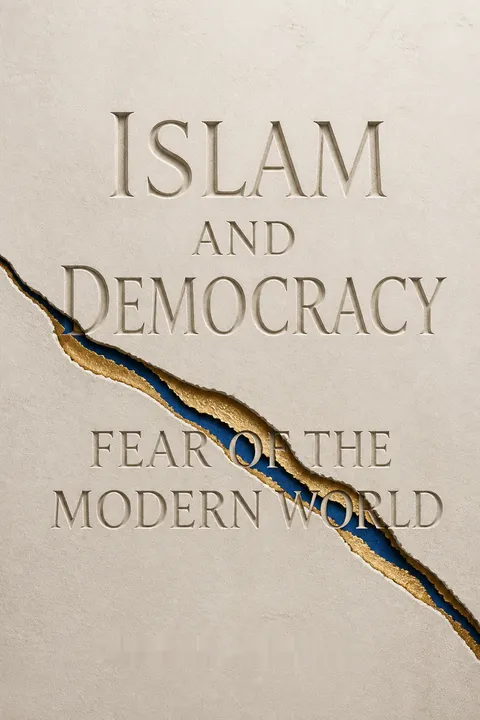


Key Takeaways
Treat democracy as a buried argument within Islam, not a Western infection
A mirror, not an invasion. Mernissi argues that democracy feels foreign partly because it reflects a question Muslim political history has repeatedly suppressed: whether individuals may judge their rulers and take part in decisions. The Gulf War sharpened that contradiction. Many Arabs had watched the fall of the Berlin Wall as proof that ordinary people could defeat authoritarian power, then saw Western governments bomb Baghdad while invoking democracy and human rights. For Mernissi, the resulting fear was not simply fear of the West. It was fear of facing both external violence and the region's own history of silencing dissent.
Fear has political uses. Leaders can attach old anxieties about foreignness to modern demands for representation, making democracy appear like a threat to religious identity. Mernissi asks readers to investigate that maneuver rather than accept the opposition between Islam and democracy as self-evident.
What's striking is the book's account of political fear as a mirror effect: an outside power can provoke anxiety not only through its actions, but by making an internal contradiction harder to ignore. This resembles a familiar problem in postcolonial politics, where a demand associated with the former colonizer can still answer a real local need. The Gulf War example also prevents a simple celebration of democracy's Western champions. Yet the mirror metaphor cannot explain every rejection of democratic institutions. Material insecurity, foreign intervention, and distrust of state power can be reasons in their own right, not merely disguises for suppressed self-knowledge.
Restore reason and personal judgment before dissent collapses into violence
Two kinds of opposition. Mernissi distinguishes between violent rebellion and a rationalist tradition that challenges authority through reason and personal judgment. She traces the first to the Kharijites, early dissenters who argued that unjust rulers need not be obeyed and sometimes answered them with assassination. The second includes the Muctazila, who debated whether people are responsible for their actions and whether rulers derive authority from the community.
A leader must be challengeable. In Mernissi's account, the ideal imam, or Muslim community leader, is not infallible. His legitimacy depends on justice, so followers can question him. She recalls Imam Malik, who continued to defend his position after a ruler had him beaten. When rational argument is censored, protest can be reduced to a violent struggle over who occupies the throne. Restoring reason means giving the public a role beyond choosing between obedience and revolt.
This distinction offers a useful political model: dissent is not inherently democratic or violent. Its form depends partly on whether people have credible channels to contest power. Modern institutional design makes the same point through independent courts, legislatures, and protections for opposition. Mernissi's historical contrast is persuasive as a reminder that Islamic intellectual life included more than obedience. It should not be read as a tidy story in which reason once flourished and was then simply erased. Traditions contain competing interpretations, and political arguments can invoke rationality while still excluding people from power.
Make rights understandable in schools, media, and everyday civic life
A signature is not education. Mernissi notes that many Muslim states signed international human rights agreements while failing to explain their principles to citizens. Article 18 of the Universal Declaration of Human Rights protects freedom of thought, conscience, and religion. In her account, governments often kept such ideas distant from public discussion, even as official media promoted obedience and presented democracy as alien.
Institutions need their meaning. A constitution or parliament cannot secure participation if citizens are not taught what freedom of opinion entails or how to exercise it. Mernissi describes how governments could praise modernization while retaining control over schools, television, and political decisions. She argues that a secular state need not suppress religion. Its central task is to prevent government from using public institutions to impose one religious interpretation, while protecting citizens' ability to believe and disagree.
The distinction between formal rights and usable rights remains crucial. Legal protections become meaningful when people can understand them, invoke them, and expect institutions to respond. Civic education, public-interest journalism, and accessible legal processes are therefore not decorative additions to democracy; they are part of its operating infrastructure. Mernissi also usefully separates secular government from state atheism, a distinction often lost in polarized debate. Still, education alone cannot neutralize authoritarianism. A government may teach civic vocabulary while punishing citizens who put that vocabulary into practice.
Answer economic exclusion with enforceable rights, not only sacred consolation
Mina's anger has a history. Mernissi recounts meeting Mina, a carpet weaver whose wrist was broken at work. After ten years in the factory, she had no contract, medical coverage, or compensation. When she and a coworker sought help from a labor inspector, he informed their employer. The women were fired and blacklisted. Mina turned to God as her defender, expressing the injustice her union and inspector had failed to address.
Dignity needs institutions. Mernissi does not dismiss Mina's faith. Islam gives her a language for naming injustice and insisting that her suffering matters. But spiritual recognition cannot replace labor protections, social insurance, or reliable representation. The book links religious protest to blocked opportunity: when people cannot claim rights through ordinary systems, religious language may become the available way to voice grievance and recover dignity.
Mina's story shows why political behavior cannot be understood through belief alone. Her appeal to God is not proof that she rejects practical remedies; it follows the collapse of the remedies she tried. This resonates with the idea of institutional trust: people are more likely to use formal channels when those channels protect them rather than expose them to retaliation. The account also cautions against treating faith as either a substitute for reform or an obstacle to it. At the same time, one worker's experience cannot stand for every believer's political motives; economic grievance is powerful, but not exhaustive.
Use public argument to challenge authority and build shared economic stakes
Jadal makes disagreement visible. Mernissi uses the Arabic term jadal for reasoned argument and controversy. She traces it to Islamic writing on disputation and highlights Al Jazeera programs that put opposing views into direct conversation. Karim, a poorly paid, unemployed university graduate who taught himself English through satellite television and internet access, argues that peaceful opportunity can make violence less attractive.
Saladin's lesson is reciprocity. Karim invokes the medieval ruler Saladin's peace agreement after the Crusades, which allowed people from both sides to travel and trade securely. He applies that principle to modern business: investment in Arab information technology training and jobs could benefit Arab youth and create customers and skilled workers. Mernissi presents debate and shared prosperity as alternatives to propaganda and conflict, not as guarantees that disagreement disappears.
The strongest connection here is between media access and political capacity. Seeing rival arguments can help audiences assess claims rather than receive a single official account. Economic interdependence adds another layer: cooperation is more durable when both sides gain something concrete. But open debate is not automatically fair debate. Ownership, editorial choices, access to airtime, and the ability to answer powerful speakers shape whose arguments travel. Nor can job creation alone explain or end political violence. Karim's proposal is best understood as one practical peace strategy, not a universal cure.
Judge political freedom by whether women can act as citizens
Women expose the boundary. Mernissi argues that women become targets when political crisis is blamed on social disorder. Across the history she discusses, rulers restricted women's movement along with other measures meant to restore order. The veil, or hijab, therefore carries political meaning in her analysis: it can mark who is permitted to enter public life and who is expected to remain dependent.
Education changes the stakes. Women entering universities, professions, and public debate challenge more than custom. They claim individual authority and citizenship. Mernissi describes educated women organizing protests in Pakistan and Algeria, and notes that women formed 50 percent of medical students in Tunisia in 1987. These figures belong to the book's period, but illustrate her larger point: women are not simply symbols in disputes between religious and secular camps. They are participants demanding a voice in law and government.
Mernissi makes gender a diagnostic of political power rather than a side issue. Who can study, work, travel, vote, and speak publicly reveals how broadly citizenship is distributed. The analysis also explains why control of women's lives can become a convenient response to economic or political upheaval: it shifts attention from institutional failure to visible bodies. The nuance is that clothing does not carry one fixed political meaning. A veil may be chosen, imposed, or worn for mixed reasons. Defending women's agency requires listening to women themselves, rather than treating unveiling as the only evidence of freedom.
Invest oil wealth in knowledge instead of weapons that deepen dependence
Hardware is not sovereignty. Mernissi argues that Arab states spent heavily on imported weapons while neglecting scientific research, education, and employment. She cites the 1980s figure that the Middle East received nearly 40 percent of global arms transfers in 1983. The Gulf War, she says, exposed the weakness of this strategy: enormous military purchases did not prevent governments from relying on Western protection.
Knowledge creates capacity. The book contrasts arms purchases with investment in engineers, information technology, and scientific institutions. Mernissi also uses the Muslim calendar, tarikh, which means both calendar and history, as a symbol of dependence: political and economic life increasingly follows systems controlled elsewhere. Her point is not that technology itself is foreign, but that buying finished products without developing local expertise leaves societies as consumers rather than makers.
This argument connects security to industrial policy: a state that imports strategic tools without building the knowledge to design, maintain, or adapt them remains vulnerable despite its arsenal. It also reframes education as a public investment with economic and political returns. The historical arms figures should not be mistaken for current statistics, and the book's contrast between Japan and Arab states simplifies different national circumstances. Even so, the core question remains sharp: which expenditures build durable local capability, and which mainly sustain dependence on suppliers?
Revisit sacred history without reducing it to obedience or nostalgia
A tradition contains arguments. Mernissi examines terms that organize her account of Islamic political thought. Rahma means mercy or tenderness; hawa can mean desire or personal inclination; hudud are limits or boundaries. She interprets the early Islamic ideal as a balance between individual desire and care for the community, while noting how rulers could present obedience as the only authentic religious position.
The past is not a single script. Mernissi also studies the jahiliyya, the pre-Islamic period often described as an age of ignorance. She argues that refusing to examine this past can turn it into a dark, frightening blank, while idealizing a supposedly perfect Islamic past can serve present-day authority. Her historical readings are interpretive, not a claim that one account settles Islamic history. Their purpose is to recover forgotten debates about reason, freedom, justice, and responsibility.
The method is valuable because it treats religious vocabulary as politically active: words shape which actions appear legitimate and which seem forbidden. Historical memory is never merely stored; institutions select, teach, and sometimes suppress it. Mernissi's close attention to Arabic terms can reveal assumptions that translations flatten. Yet etymology and symbolic interpretation cannot, by themselves, establish how a whole society thinks. The most productive use of her reading is as an invitation to debate inherited meanings, not as a final account of Islam's essence.
Make shared identity a mirror for individuals, not a cage around them
The ending is a shared discovery. Mernissi closes with the Persian poet Attar's tale of birds searching for the Simorgh, a legendary being. After a long and dangerous journey, the thirty surviving birds discover that the name Simorgh can also be read as “thirty birds,” and that the being they sought reflects them. The story offers an image of community formed through individual lives rather than by erasing their differences.
Belonging need not require sameness. Mernissi applies this vision to a world connected by migration, media, science, and trade. She challenges both authoritarian leaders who demand uniform obedience and Western powers that preach universal values while acting in narrow national interests. The alternative is reciprocal exchange: people and cultures remain distinct, yet participate in shaping common institutions and shared prosperity.
The Simorgh story offers a model of collective identity that avoids two familiar traps: isolation, where difference becomes a wall, and forced assimilation, where belonging requires sameness. Its political force lies in asking whether institutions can reflect the people who compose them. That question applies to media, international agreements, and economic partnerships alike. The metaphor is aspirational, not a substitute for resolving unequal power. A shared mirror can still be controlled by those who decide whose image appears, so participation and accountability remain essential.
Analysis
Mernissi's book is at once political sociology, feminist criticism, intellectual history, and memoir. Its central move is to reinterpret fear. The West frightens not only because of its military and economic power, but because the language of individual rights exposes arguments that have been suppressed within Muslim political life. That reframing matters: it rejects the idea that democracy is simply an imported package, while also refusing to excuse Western violence because it is wrapped in democratic rhetoric.
The book's most compelling evidence is often small and embodied. Mina's failed attempt to secure labor rights makes clear why religious language can carry political protest. Karim's self-education through satellite television and internet access shows how media can redistribute confidence, not merely information. Mernissi's historical accounts of rulers, scholars, and women connect such present-day lives to long struggles over who may speak and decide. The argument gains force by moving between intimate scenes and large structures, especially arms spending, unemployment, education, and media control.
Its method also needs careful handling. Mernissi uses Arabic vocabulary, religious history, and symbolic interpretation to recover neglected possibilities, but her claims about what a term or historical episode means are readings, not uncontested facts. At times, “Arab” and “Muslim” move close together despite the diversity she herself acknowledges. Her statistical examples largely describe the late twentieth century and cannot be treated as current conditions. The argument is strongest when it opens a question, such as whether leaders are accountable or whether women can exercise citizenship, rather than when it implies a single explanation for political behavior.
The book's lasting contribution is its insistence that cultural interpretation and material politics belong together. Freedom requires more than symbolic recognition: it needs institutions, education, work, and public debate. Conversely, material reforms cannot be sustained if citizens are taught that questioning authority is a betrayal of faith. Mernissi offers neither a simple secular cure nor a nostalgic religious answer. She asks readers to recover contested traditions and build shared power without demanding sameness.
Review Summary
Islam and Democracy receives mostly positive reviews for its insightful analysis of the complex relationship between Islam and modernity. Readers appreciate Mernissi's linguistic approach, personal anecdotes, and historical context. The book explores fears of democracy in the Arab world, the impact of the Gulf War, and the role of women in Islamic societies. While some find it dated, many praise its relevance and thought-provoking content. Critics note its occasionally rambling style and feminist focus, but overall, readers find it a valuable contribution to understanding Islam's challenges with modernization.
People Also Read







Glossary
jadal
Reasoned public argumentJadal is the practice of arguing through ordered reasoning and courteous controversy. Mernissi connects it to Islamic intellectual traditions that valued debate as a way to distinguish sound claims from impossible ones. In her discussion of Al Jazeera, televised exchanges between opposing positions revive jadal by letting audiences hear disagreement and form their own judgments.
media imam
Unchallenged screen authorityMernissi uses media imam for a political or religious leader whose authority is magnified by modern media. A screen can present a leader's message without giving opponents comparable access, making the leader seem stronger and less accountable than the vulnerable, challengeable imam described in traditional political theory. The term highlights how media form can reshape political legitimacy.
Kharijites
Rebels against unjust rulersThe Kharijites were early Muslim dissenters whose name refers to leaving or breaking away from obedience. Mernissi presents them as a tradition of resistance to unjust rulers that could turn to assassination or violent rebellion. She contrasts this approach with rationalist dissent, which seeks to challenge arbitrary authority through reason and personal judgment rather than simply replacing one ruler with another.
rationalist tradition
Reasoned challenge to powerMernissi's rationalist tradition refers to Muslim thinkers who emphasized reason, personal judgment, and human responsibility in religious and political questions. She associates it especially with the Muctazila, who debated free will and the community's role in choosing a leader. In her account, suppressing this tradition narrowed legitimate opposition and left violent rebellion more visible.
rahma
Mercy and tendernessRahma means mercy, tenderness, compassion, and forgiveness. Mernissi emphasizes its linguistic association with the womb and its role as an ideal of care within families and the Muslim community. In her political reading, rahma names the social responsibility that should protect people from indifference and injustice, rather than merely a private spiritual feeling.
hawa
Desire or personal inclinationHawa can mean desire, passion, or personal inclination. Mernissi discusses it as a force that may conflict with the community's interests when individual advantage overwhelms concern for others. She does not present it as something that must simply disappear. Her account emphasizes managing desire within limits while maintaining a balance between individual life and collective responsibility.
hudud
Religious or social boundariesHudud means limits or boundaries. In Mernissi's analysis, the term extends beyond legal limits to the symbolic divisions that organize social life, including boundaries between men and women, the individual and the group, and the Muslim community and the outside world. She examines how appeals to protecting boundaries can provide security, but can also restrict freedom and preserve hierarchy.
jahiliyya
Pre-Islamic era of ignoranceJahiliyya is the conventional term for the pre-Islamic period in Arabia, often translated as an age of ignorance. Mernissi treats it as a charged historical and symbolic category, associated in Islamic memory with disorder and violence. She argues that refusing to examine the period can make it a frightening blank, while critical study can reveal how memories of it shape present anxieties.
tarikh
Calendar and historyTarikh means both calendar and history. Mernissi uses the double meaning to connect control of time with the ability to locate a society's past and organize its present. She discusses the Muslim calendar, which begins with the Prophet's migration to Medina, and treats dependence on external technological systems for timing as a symbol of wider dependence in knowledge and power.
Simorgh
Collective identity reflecting individualsThe Simorgh is a legendary bird in the Persian poet Attar's tale of birds searching for a wondrous being. At the journey's end, the surviving birds discover that the Simorgh reflects them, and its name evokes the Persian phrase for thirty birds. Mernissi uses the story as an image of community whose shared identity includes, rather than erases, individual differences.
Download PDF
Download EPUB
.epub digital book format is ideal for reading ebooks on phones, tablets, and e-readers.








