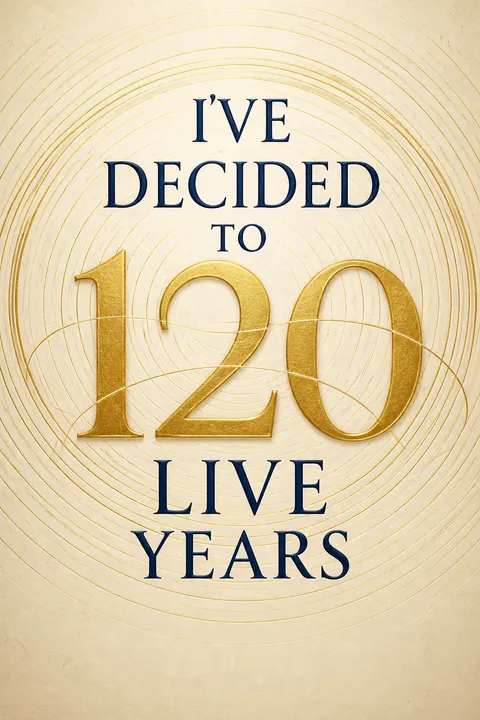


Key Takeaways
Use 120 as a planning horizon, not a promise of lifespan
A decision changes the horizon. In his late sixties, Ilchi Lee realized his plans stopped at 80. His father had remained active into his eighties but later became frail, while meeting a vigorous 102-year-old who walked daily made a much longer life feel imaginable. Lee chose 120, not because he could guarantee reaching it, but because planning for decades ahead forced him to ask what those years should be for.
Purpose comes before the number. Lee links his choice to a project intended to benefit others, and says a meaningful reason to live longer encourages attention to health, habits, and future goals. The book treats 120 as a planning device, not a medical promise. Readers are invited to choose a meaningful horizon and design for it while accepting that no one controls the exact length of life.
The most useful part of the 120-year premise is its effect on planning, not its biological prediction. A distant horizon can interrupt the assumption that retirement means life is nearly over and make neglected ambitions newly relevant. This resembles future-self thinking in behavioral science: people are more likely to protect their future when it feels connected to the present. But a chosen age cannot overcome illness, genetics, or unequal access to care. The premise works best as a prompt for purpose and preparation, not as a test of optimism or personal discipline.
Trade the first half's status race for the second half's wholeness
Two different scoreboards. Lee describes the first 60 years as a period organized around success: education, work, money, status, and family responsibilities. These pursuits can build skills and contribute to society, yet a life measured only by winning can leave people dependent on roles and recognition. Retirement may remove the job title and daily structure without supplying a new reason to get up.
Completion is an inward measure. Lee proposes that the second half of life aim at completion, meaning a felt sense that one's life is whole and has been lived according to its deepest values. Unlike status or possessions, this measure is not awarded by other people. It depends on whether a person can look back with satisfaction, integrity, and fewer regrets. The shift is from accumulating proof of worth to living and sharing what matters.
This distinction gives aging a developmental task rather than treating it as a slow exit from adult life. It also resembles the difference between extrinsic goals, such as status, and intrinsic goals, such as connection and contribution, which psychologists often associate with more durable well-being. The framework is compelling without requiring success to be dismissed: financial security and professional achievement can support a life, even if they cannot fully define it. Nor does retirement automatically create freedom. Care responsibilities, poverty, and health constraints shape what completion can look like for different people.
Turn your past into instruction, not a life sentence
Reflection should produce direction. Lee recommends deliberately reviewing the first half of life: important choices, hard periods, achievements, regrets, values, and relationships. Writing answers down can make patterns easier to see. The aim is not to deny harm or invent a happier past, but to interpret experience in a way that informs future action.
Meaning can restore agency. Lee invokes Viktor Frankl, the psychiatrist who survived Nazi concentration camps after losing much of his family. Frankl's experience led him to emphasize that people can sometimes choose how they respond even when circumstances are beyond their control. Lee also recounts a newspaper essay by 95-year-old university founder Seokgyu Kang, who regretted treating retirement as the end of his meaningful life and decided to begin studying a language. His lesson was that another beginning need not wait for ideal conditions.
Life review has a practical advantage: it converts memory into evidence about what energizes, wounds, or matters to a person. Narrative psychology similarly examines how people organize events into stories that support identity and future choices. The important boundary is that reframing must not become denial. Frankl's story concerns extreme coercion, and meaning-making should not imply that victims are responsible for suffering or that attitude alone determines survival. Used carefully, the method asks what can still be chosen without pretending that everything was chosen.
Train for independence with movement woven into ordinary hours
Movement protects capacity. Lee argues that physical strength supports autonomy and makes other goals easier to pursue. He describes sarcopenia, the age-related loss of muscle, and emphasizes that inactivity can accelerate the decline people often attribute to age alone. The book cites research associating 150 minutes of moderate weekly exercise with a 3.4-year life expectancy increase, while stressing that even less activity may help.
Make exercise fit real life. Lee's One-Minute Exercise inserts a brief bout of movement into the day, often once an hour, with examples such as squats or push-ups adapted to ability. Longevity Walking is his walking practice, which emphasizes upright posture, parallel feet, and attention to each step. These routines are invitations to move more, not substitutes for medical care or individualized advice, especially for people with illness, pain, or disability.
The practical strength here is the focus on accumulated movement rather than the fantasy of a perfect gym routine. Breaking up long sitting periods may make activity more accessible, while resistance exercise is especially relevant to preserving strength and everyday function. The book's examples are deliberately simple, but exercise guidance cannot be universal: balance problems, joint conditions, and cardiovascular disease can change what is safe. The better principle is consistent, appropriately scaled movement, ideally with clinical guidance when health conditions make self-directed exercise uncertain.
Find older-age joy in contribution, insight, and making things
Dig beyond familiar rewards. Lee argues that a life centered only on comfort, possessions, or control may feel increasingly empty. He identifies three sources of deeper joy: Hongik, a Korean idea of acting for the benefit of many; awakening to patterns in life and nature; and creation, which includes art but also improving ordinary situations or starting something new.
Contribution can revive identity. Alyse Gutter, a widow in her seventies, found renewed energy by teaching yoga to older adults and people with visual impairments. The work gave her a way to turn grief into understanding and connection. Lee does not present service as requiring wealth or grand gestures. Skills, experience, attention, and time can all be shared. The point is not to stay busy for its own sake, but to use activity in ways that feel valuable to oneself and useful to others.
The book's account of joy moves beyond mood toward engagement: making, learning, and helping give days a structure and a reason to matter. This fits research on prosocial behavior, which finds that helping others can support well-being, particularly when the activity is chosen and feels meaningful. Service should not become a new obligation imposed on older adults, however. People need rest, boundaries, and material security too. The strongest version of Hongik is reciprocal: contribution is welcomed, sustainable, and valued rather than treated as unpaid labor that replaces social support.
Peace grows when you loosen your grip on status and people
Notice what weighs you down. Lee groups common attachments into material wealth, reputation or power, and relationships held through control or resentment. He suggests that attachment can turn affection into possessiveness, while old grievances can keep a person trapped in anger. His meditation exercise asks readers to imagine their concerns as objects in a cup, then picture tipping them out. The image is a way to notice and release emotional burdens, not a claim that difficult feelings vanish on command.
Take responsibility without self-blame. Lee recommends looking for one's own part in conflicts and choosing actions that restore agency. That can make an apology or a new boundary possible. But responsibility for one's next step is not the same as responsibility for another person's abuse or wrongdoing. Forgiveness is not mandatory, and safety, accountability, and support may matter more than reconciliation.
The distinction between caring and controlling is psychologically useful: attachment becomes harmful when another person's choices are treated as a threat to one's own stability. The imagery of setting burdens down may help make an abstract emotional process concrete. The section needs a careful reading, though. Recasting oneself as responsible can restore a sense of agency in ordinary conflict, but applied to abuse or coercion it can wrongly shift blame onto the harmed person. Letting go should mean loosening the hold of resentment, not erasing facts or excusing harm.
Practice solitude without confusing it with harmful isolation
Some aloneness is existential. Lee distinguishes the loneliness of lacking meaningful relationships from a deeper solitude that can arise when aging brings death and impermanence into view. He argues that avoiding this feeling through constant distraction may prevent reflection, while meeting it directly can bring clarity about what matters. He calls the more connected, reflective experience brilliant solitude, describing time alone in nature or meditation as a chance to feel part of something larger.
Solitude is not a social substitute. The book cites 2010 US census data showing that 28 percent of people over 65 lived alone and notes associations between isolation and poorer physical and mental health. Its argument is not that older people should withdraw. Rather, social connection and private reflection serve different needs: one offers companionship and support, the other space to encounter one's own thoughts.
This distinction matters because being alone and feeling lonely are not identical experiences. Chosen solitude can support reflection, while unwanted isolation can damage health and reduce access to help. The book's spiritual interpretation gives existential aloneness a possible meaning, but that interpretation will not fit everyone, and it should not romanticize loneliness caused by bereavement, disability, or exclusion. A useful practice pairs intentional time alone with relationships that provide genuine reciprocity and face-to-face presence.
Give your brain a meaningful future and difficult work
Hope gives attention a direction. Lee argues that hopes and goals keep people engaged with life and encourage habits that support brain health. He cites a 14-year study of more than 6,000 people in which those reporting a purpose in life had a 15 percent lower risk of death than those without one. He also describes research linking negative attitudes about aging with worse memory or physical performance. These findings support purpose as a valuable part of well-being, not a guarantee of longevity.
Challenge keeps learning alive. Lee's Brain Education is a self-development approach that combines attention to the body, emotional patterns, and personal goals. He recommends learning unfamiliar skills, persisting through difficulty, and giving oneself clear, encouraging messages. A new goal could be a creative project, a class, or a contribution to a community. The useful test is whether the activity invites sustained curiosity rather than merely filling time.
The link between purpose and health is plausible partly because purpose can organize behavior: people with meaningful aims may move, connect, and care for themselves more consistently. The brain's capacity to change with experience also makes later-life learning a reasonable investment. Yet the cited association does not prove that purpose alone causes longer life; health, income, and social opportunity may influence both purpose and outcomes. Encouragement is most useful when it expands real options, not when it suggests that people who struggle simply failed to think positively.
Let elderhood serve people and the living planet
A long life has public consequences. Lee asks older adults to become mentors who share experience, tolerance, and practical wisdom with younger generations. He also extends responsibility beyond family, arguing that human health depends on the condition of the natural world. His Earth Citizen Spirit describes seeing oneself first as part of the shared planetary home, with duties to people, animals, and ecosystems.
Make the idea visible in daily life. Hanabuchi Keiko, introduced as an 84-year-old Japanese teacher, began leading exercise groups after retirement and shared life lessons with participants of different ages. Her example shows how a person's abilities can remain useful beyond a former job title. Lee's larger appeal is that older adults can use time and experience for community contribution and environmental care, leaving successors a healthier place to live.
The book's most expansive move is to connect personal longevity with obligations beyond the self. Interdependence is not only a spiritual idea: air, water, food systems, and public health cross household and national boundaries. That makes environmental care a credible part of a good-aging agenda. At the same time, individual virtue cannot replace policy, infrastructure, or institutional accountability. Elders can contribute as mentors and citizens, but communities must create accessible roles and ensure that care for the planet is a shared responsibility rather than a private burden.
Analysis
This book is part longevity argument, part spiritual philosophy, and part practical guide to designing life after retirement. Its central intervention is not a proven method for reaching 120. It is a change in time perspective: imagining decades ahead makes old age something to prepare for, rather than a short epilogue. From that premise, Lee builds a second life-stage ideal around completion, a personal sense of wholeness grounded in reflection, self-cultivation, contribution, and connection with nature.
The strongest feature is the way the book links private choices to social purpose. Exercise is not only maintenance; it can preserve the capacity to act. Reflection is not nostalgia; it can shape future commitments. Service is not simply charity; it can offer a new source of identity when work-based status disappears. The stories of Susan Gerace, Seokgyu Kang, and Hanabuchi Keiko give these claims human scale and show that renewed purpose can take forms as different as volunteering, learning, and teaching.
The distinction between success and completion is memorable, but it can be too neat. Many people need to keep working after retirement, and material security is not a shallow concern when housing, healthcare, or food are uncertain. Likewise, aging is not simply a choice between decline and vitality. Disability, chronic illness, caregiving, and unequal access to safe exercise shape what is possible. A useful reading treats agency as real but bounded.
The book also combines plausible health advice with spiritual claims drawn from Korean Sundo, including its account of energy centers and the soul's transformation after death. These traditions can provide meaning and practice for believers, but they are not equivalent to established biomedical explanations. The most trustworthy takeaway is therefore broader than a lifespan target: use available time to protect capacity, deepen relationships, pursue meaningful work, and contribute to a world that sustains life. The book asks its reader not merely how long to live, but what a long life should be for.
Review Summary
"I've Decided to Live 120 Years" receives mostly positive reviews, with readers praising its inspirational message and practical advice for living a longer, more fulfilling life. Many appreciate the book's emphasis on finding purpose and meaning in later years. Some readers find the concepts eye-opening and life-changing, while others appreciate the blend of Eastern philosophy and scientific insights. Critics argue that the book contains pseudoscience and lacks scientific rigor. Overall, reviewers found the book thought-provoking and valuable for readers of all ages seeking to improve their longevity and quality of life.
People Also Read


Glossary
120-year life
A long-range life planLee's term for choosing a long lifespan as a planning horizon, rather than predicting or guaranteeing an age of death. The imagined horizon prompts people to design meaningful later decades, care for their health, and take responsibility for future-oriented projects. Its central function is motivational and philosophical, not a clinically validated life-extension prescription.
Completion
A life felt as wholeLee's proposed central aim for the second half of life, in contrast with success measured through external achievement, status, or accumulation. Completion means living in line with one's deepest values, developing inner maturity, and reaching a personal sense of fulfillment and peace. It is an inward judgment rather than a social award or measurable medical state.
Sundo
Korean mind-body cultivationA traditional Korean system of mind-body training that Lee draws on to explain energy, meditation, self-cultivation, and spiritual development. In the book, Sundo presents the body as a means of developing the soul and describes practices involving movement, breathing, and attention. Its metaphysical claims belong to the tradition and are distinct from biomedical evidence.
Chunhwa
Soul's completion at deathIn Lee's account of Sundo, Chunhwa is the completion or transformation of the soul, associated with a peaceful death and the soul's return to the Source of life. It is also described as a lifelong process of cultivating wholeness, not simply an event at the end of life. This is a spiritual belief, not an established account of death.
Dahnjon
Body's energy centerA Sundo term for a field where ki energy is concentrated. Lee describes three main centers: lower in the abdomen, middle in the chest, and upper in the brain. They are associated respectively with physical, emotional, and mental power. This energy map organizes the book's spiritual framework and resembles, but is not identical to, chakra systems.
Jungchoong
Vitality of the lower centerA Sundo term for a developed state of the lower dahnjon, associated in Lee's framework with physical vitality and strength. It is one of three named qualities used to describe development across the body's lower, middle, and upper energy centers. The term functions within the book's traditional energy model rather than as a biomedical measurement.
Kijang
Maturity of the heart centerA Sundo term for the mature, expansive energy associated with the middle dahnjon in the chest. Lee connects it with heart power, including love, empathy, and the capacity to embrace others. In his account, its development helps move a person from self-focused striving toward sharing and benevolence.
Shinmyung
Clarity of the upper centerA Sundo term for the bright, developed energy associated with the upper dahnjon in the brain. Lee connects Shinmyung with wisdom, insight, and spiritual awareness. It is presented as the culmination of a traditional energy-development model, not as a neurological term or a clinically measurable state.
Hongik
Benefit for the wider goodA Korean concept that Lee translates as living for the benefit of many people, rather than restricting care to personal advantage or one's immediate family. He presents Hongik as a source of joy and a way to develop the heart through sharing skills, time, love, and resources. In the book, it gives service a spiritual and social purpose.
Brain Education
A brain-based self-development systemLee's approach to developing human potential through body awareness, emotional self-regulation, reflection, goal-setting, and action. The book describes it as training that helps people recognize and shift unhelpful patterns, clarify what they want, and redesign their lives. It is the author's program and should not be confused with a standard clinical treatment.
One-Minute Exercise
Brief hourly movement practiceA routine proposed by Lee in which a person pauses during the day for a short bout of movement, often about one minute each hour. Suggested activities include simple strength or aerobic movements adapted to individual ability. The aim is to interrupt prolonged sitting and make physical activity part of ordinary life, not to replace a complete exercise plan.
Longevity Walking
Attentive posture-based walkingLee's walking method emphasizes upright alignment, feet placed roughly parallel, and attention to how each step meets the ground. He presents it as a way to make walking a deliberate practice for strength, balance, and vitality. The method reflects his Sundo energy framework; claims about healing specific conditions should not substitute for medical evaluation.
Brilliant solitude
Reflective, connected alonenessLee's phrase for solitude that is consciously faced and experienced as a source of reflection, insight, and connection with nature or life beyond the individual self. It differs from unwanted loneliness and social isolation, which the book recognizes as harmful. The concept reframes chosen time alone as meaningful without suggesting that people no longer need relationships.
Earth Citizen Spirit
Identity rooted in planetary belongingLee's term for seeing oneself as a member of the Earth community before identifying only with a nation, race, or religion. It joins a sense of shared belonging with practical responsibility toward people, animals, and the natural environment. The book treats it as a daily ethic, expressed through local acts as well as broader community involvement.
Download PDF
Download EPUB
.epub digital book format is ideal for reading ebooks on phones, tablets, and e-readers.








