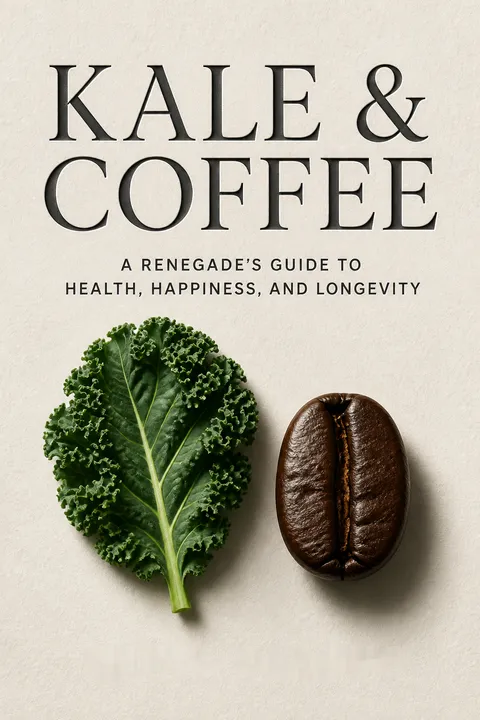


Key Takeaways
Choose a livable diet over the fantasy of dietary purity
Purity failed the author. Gianni once treated raw vegan eating as the highest form of health. After years of restriction, he felt exhausted and discovered troubling blood-test results. He abandoned the rules and swung toward unrestricted eating, gaining 38 pounds in 547 days and feeling worse again. Neither extreme gave him what he wanted: lasting health without constant anxiety about food. His turning point was not finding a perfect diet, but deciding to keep what helped and drop what did not.
Make health sustainable. Gianni’s “kale and coffee” idea is permission to pursue nourishing habits without treating every pleasure as a failure. The goal is a way of eating and living that supports health while remaining enjoyable enough to continue.
What's striking is how the two extremes expose a shared mistake: treating a food philosophy as a substitute for feedback. Strict rules can create identity and certainty, while unrestricted eating can feel like freedom, but neither guarantees well-being. This resembles a broader lesson from behavior change: a plan that cannot survive ordinary life is not a durable plan. Gianni's personal reversal makes that point vividly, although one person's experience cannot establish which diets work for other people. The useful principle is not to split the difference mechanically, but to judge a routine by its effects and its sustainability.
Borrow longevity patterns, not someone else's exact menu
Cultures eat differently. Gianni travels to Peru to observe the Q’ero, whose traditional foods include potatoes, corn, alpaca, and trout. The region alone has more than 400 kinds of potatoes. He also considers five Blue Zone populations, communities known for unusually high longevity: Sardinians, Nicoyans, Seventh-Day Adventists in Loma Linda, Okinawans, and Ikarians. Their staple foods differ, shaped by local crops, traditions, and climate. Even the Okinawans and Q’ero, both associated with potato-heavy diets, eat different varieties.
Look for shared patterns. The book finds more common ground in habits than in recipes: plenty of plants, seasonal or local foods, modest meat, and avoiding much of the highly processed modern diet. Gianni argues that these are clues, not a universal menu to copy.
The distinction between a pattern and a prescription is important. A food that supports one community may not fit another person's preferences, access, physiology, or cultural context. The Blue Zone comparison also reminds readers that longevity is produced by more than ingredients: social life, movement, and daily routines travel alongside diet, making single-food explanations unreliable. The book's pattern-based reading is therefore more useful than a search for a magic staple. Its evidence remains observational, however, so these cultures offer hypotheses about healthy living, not controlled proof that any one habit causes long life.
Use repeated health data to test what your diet is doing
Track change over time. After his raw-food period, Gianni’s cholesterol was 111 and his pregnenolone, a hormone precursor, measured 5. After he changed his diet, those numbers rose: his cholesterol reached 175 in 2012, while pregnenolone reached 111. Later, during his anything-goes phase, cholesterol climbed to 222 and pregnenolone fell to 77. For him, those changing results helped reveal that both his restrictive diet and his later excess were poor fits.
Treat tests as clues. The book recommends discussing relevant blood work with a qualified practitioner, then repeating it to see whether markers move. A single result is only a snapshot, and the author stresses that changes in health should be considered alongside symptoms and daily experience.
Repeated measurement is a stronger habit than relying on memory or dietary ideology. In research terms, it turns a vague impression into a personal time series. Yet a changing marker does not by itself show which food caused the change, and a biomarker is not the same thing as how someone feels or functions. Reference ranges and clinical meaning also require professional interpretation. The section's most defensible lesson is modest: when a health decision has measurable consequences, establish a baseline and review trends with a clinician rather than treating a single lab result as a verdict.
Reduce processed food, but investigate toxins without panic
The label is not the whole story. Gianni sends 13 foods from his household for heavy-metal testing. One sample, his green tea, shows 1,570 parts per billion of lead. He has the lab repeat the test, then compares three other teas. Their reported lead levels range from 69.7 parts per billion in a Japanese tea to 1,790 in a Hawaiian one. He switches brands and also stops eating a seaweed snack that tested high in cadmium.
Respond to specific findings. The experiment reinforces the book's preference for less processed food and attention to where food comes from. Gianni also suggests reducing exposure to possible contaminants at home, for example by using glass containers and filtering water. The results concern particular products and samples, not every food in a category.
The consumer-investigation angle makes an invisible risk concrete, but it also shows why measurement needs context. A concentration result alone does not establish how much a person consumes, absorbs, or is harmed by. Testing multiple products is more informative than treating one alarming result as a verdict on all tea. The broader lesson resembles precautionary decision-making: reduce avoidable exposures when the cost is low, while resisting the leap from detection to danger. That balance protects people both from complacency and from the anxiety that can grow when every ordinary product becomes a suspected hazard.
Eat mostly plants, and make animal foods a deliberate choice
Quality changes the question. Gianni describes learning to butcher a lamb after years as a vegan. The experience makes the animal behind a meal harder to ignore. He argues that industrially raised meat is not equivalent to meat from animals raised on pasture, and cites research reporting two to five times more omega-3 fats in some grass-fed beef than grain-fed beef. He also notes the environmental and animal-welfare costs of intensive farming.
Keep the pattern plant-rich. The long-lived communities he studies eat substantially less meat than the typical American, and he recommends plants as the dietary foundation. He personally found animal foods helpful after his vegan period, particularly given concerns about B12, iron, and other nutrients. But he does not insist that everyone eat meat: people choosing vegan diets should monitor nutrition and avoid relying on highly processed substitutes.
This section is strongest when it separates three questions that are often collapsed: whether animal foods can provide useful nutrients, how animals are raised, and how much meat belongs in a diet. These questions have different ethical and health dimensions. Better farming practices may improve animal conditions and change a food's nutrient profile, but that does not prove a particular meat intake improves long-term health. Nor does the author's difficulty with vegan eating show that all vegan diets fail. A plant-forward pattern with deliberate sourcing leaves room for individual needs without turning either veganism or meat eating into a universal rule.
Test personal responses before declaring carbs, gluten, or coffee harmful
Food effects vary. Gianni argues that both a low-carbohydrate, higher-fat diet and a high-carbohydrate, low-fat diet may work when built around whole foods. He warns against combining abundant fat with abundant refined carbohydrates and sugar. His gluten reaction after beer leads him to reduce wheat, but he also describes research suggesting that some symptoms blamed on gluten may come from FODMAPs, fermentable carbohydrates found in many foods. Celiac disease affects about one percent of the population, according to the book.
Notice your own results. Gianni's nearly 90-day coffee experiment ended early after jitters, clammy hands, bloodshot eyes, and aching fingers. His discussions of salt and alcohol likewise favor context and restraint over blanket bans. He presents these as personal tests and interpretations, not a license to ignore medical advice or established diagnoses.
The value here is the shift from food tribes to testable questions: what was eaten, what changed, and what else might explain the response? Elimination and reintroduction can help identify patterns, but they are vulnerable to expectation effects and confounding changes. Gluten avoidance is medically important for celiac disease, while self-reported symptoms may have other causes. Likewise, caffeine tolerance varies, but a pleasant feeling does not make coffee necessary or harmless for everyone. The book's flexibility is useful when paired with careful observation, not when it becomes a reason to dismiss well-supported clinical guidance.
Choose exercise you can recover from, then build gradually
Harder is not automatically better. Gianni enters a ten-mile Tough Mudder, including icy water and electric-shock obstacles, after gaining weight and wanting fast results. Earlier, he had run a marathon before his body was prepared and needed eight months of rehabilitation. A later CrossFit workout left him dizzy, nauseated, and sore for days. These episodes challenge the belief that a workout must be punishing to count.
Build a repeatable practice. The book favors movement people enjoy, gradual progression, and attention to recovery. Gianni uses Phil Maffetone’s 180 Formula to estimate a personal aerobic training limit and describes staying below an exhausting intensity as a way to train more sustainably. Walking, running, and other activities can all fit, provided the effort matches present fitness rather than an imagined ideal.
The narrative captures a common mismatch between motivation and capacity: an ambitious goal can help someone begin, yet the training needed to reach it must respect current conditioning. This is a useful corrective to exercise as punishment. The emphasis on recoverability also shifts the measure of success from one dramatic session to consistency across weeks. Heart-rate formulas can help some people monitor effort, but no single estimate is appropriate for every condition or goal. The principle worth retaining is gradual, enjoyable movement with enough recovery to return tomorrow.
Practice a stress tool that changes your response, not just your schedule
Interpretation shapes distress. At an airport, Gianni panics as his toddler cries during a long delay. His wife stays calm because she sees their child as safe and expressing frustration, not as a crisis. He calls this contrast the Annmarie Effect: the same event can feel very different depending on how it is interpreted.
Find a tool that fits. Gianni describes the Emotional Freedom Technique, or EFT, in which a person taps selected points on the body while focusing on a stressful feeling. He also reports feeling calmer after taking holy basil, an herb known as tulsi. The book cites a veterans study reporting lower cortisol after tapping, while acknowledging that much of the holy-basil evidence it discusses comes from animal research. These are options to investigate, not guaranteed treatments.
The airport example neatly separates an event from its appraisal, a distinction central to cognitive approaches to emotion. That does not mean distress is imaginary or that reframing can erase structural problems, illness, or trauma. It does suggest that noticing an interpretation can create room for a different response. EFT's tapping ritual may also offer a focused, embodied way to attend to emotion, though the evidence base is less settled than the confidence of some advocates implies. Holy basil deserves similar caution, particularly because herbal products can vary and may interact with medication.
Use short resets as experiments, not lifelong punishment
A break can reveal a pattern. At a medically supervised clinic, Gianni spends five days drinking only water. He reports feeling more energetic and mentally clear, while the clinic uses fasting with patients for conditions including high blood pressure. The experience leads him to identify three areas to address: dependence on stimulants, digestive irritation, and emotional stress. He does not present the fast as the only route to change.
Return to ordinary life. His closing process is Assess, Detox, Retox, Repeat: establish a baseline, make a temporary change, resume life without guilt, and reassess. The 21-day Jumpstart applies this logic through a brief cleanse, daily green smoothies, short food-elimination periods followed by reintroduction, exercise monitoring, stress practice, and a media break.
The reset-and-reassess structure is more psychologically durable than a permanent purity test: temporary experiments can generate information without turning every lapse into failure. Still, the word detox can suggest that fasting removes unspecified toxins, a claim not established by the personal experience described here. Water-only fasting can also carry medical risks and should not be treated as a casual challenge. The most transferable parts of the framework are baseline measurement, limited experiments, deliberate reintroduction, and reflection. Those steps preserve curiosity while reducing the temptation to mistake intensity for evidence.
Keep your brain learning, and judge health on a long horizon
His grandfather defied the wellness script. Gianni's grandfather lived to 95 without following health gurus. He smoked for years, ate sweets, and lived near industrial pollution, yet remained active, worked on projects, used a computer, and kept making plans. A label on his monitor expressed his conviction that mental resilience mattered to physical life.
Stay mentally engaged. Gianni connects this example to the Nun Study, which examined older nuns and found that those whose early writing showed richer, more complex ideas were less likely to develop dementia and tended to live longer. He also cites a study of older adults linking active cognitive lives with longer life and less time with impairment. His practical point is to keep learning, working, and making plans, while judging health by decades rather than a short-term target.
The grandfather's story is memorable precisely because it resists tidy wellness narratives. It does not show that diet, smoking, or pollution are irrelevant; it shows that a life cannot be reduced to a checklist. Research on cognitive activity also faces a causal puzzle: education, income, health, and social connection can influence both mental engagement and survival. Still, learning and meaningful projects have value beyond longevity. A long horizon can make health choices less frantic, while the grandfather's example adds a human dimension: the aim is not simply to extend life, but to remain engaged in it.
Analysis
Kale and Coffee is part memoir, part consumer investigation, and part practical health guide. Its narrative engine is a sequence of reversals: a raw-food evangelist becomes exhausted, an ex-vegan gains weight after rejecting restriction, and an aspiring health expert learns that conviction is not the same as evidence. The RV trip, farm visits, butcher class, lab tests, exercise experiments, and family stories keep abstract nutrition disputes tied to lived consequences.
The book's most durable contribution is methodological rather than dietary. It asks readers to distrust both industry marketing and health-guru certainty, then replace allegiance with observation. That is a valuable response to a marketplace in which every food category can be framed as poison or salvation. The book also usefully distinguishes broad dietary patterns from exact menus, and sustainable exercise from heroic overexertion. Its final cycle of assessment, temporary change, return to ordinary life, and reassessment captures the intended spirit: health is iterative, not a purity contest. The limitation is that the method is more rigorous in principle than in execution. Gianni's personal experiments are vivid but uncontrolled, and changes in weight, mood, or blood markers can have many causes. Observations from long-lived cultures cannot isolate diet from social structure, movement, geography, and other conditions. Some of the book's medical claims rely on early or limited evidence, particularly around supplements, detoxification, and individual dietary requirements. Its health recommendations therefore need selective reading, not wholesale adoption.
A balanced interpretation preserves the book's curiosity while improving its standards of inference. Personal response is meaningful evidence about comfort and adherence, but it is not a replacement for clinical diagnosis or well-designed research. Repeated measures, qualified interpretation, and modest experiments are safer guides than dramatic anecdotes. The book is most useful when it teaches readers how to question a claim, notice their own experience, and choose habits they can sustain, rather than when it presents one mechanism or protocol as settled science.
Review Summary
Readers appreciate Gianni's honest account of his health journey, finding the book both informative and entertaining. Many value the balanced approach to nutrition and lifestyle, emphasizing individuality over one-size-fits-all solutions. Some critics note a scattered narrative and occasional lack of depth, but overall, readers find the book's message of moderation and personalized health refreshing in a sea of extreme diet advice.
People Also Read


Glossary
The Annmarie Effect
Perspective shapes stressGianni's name for the way a person's interpretation can change their emotional response to an event. He uses an airport delay and a toddler's tantrum to contrast his own panic with his wife's calmer view that their child is safe and expressing frustration. The term describes appraisal, not a claim that outside stressors are unreal.
Emotional Freedom Technique
Tapping-based stress practiceOften abbreviated EFT, this technique pairs attention to a distressing thought or feeling with tapping on selected points on the face and body. In the book, it is presented as a practical approach to emotional stress and is connected to earlier work called Thought Field Therapy. The author describes encouraging results, while noting that research on some related claims remains limited.
180 Formula
Estimates aerobic training limitPhil Maffetone's method for estimating an individual's maximum aerobic training heart rate. The book recommends using it to guide exercise intensity, with the aim of training efficiently rather than continually pushing into exhaustion. It is an estimate based on personal characteristics, not a universal prescription or substitute for medical advice about exercise.
Assess, Detox, Retox, Repeat
Iterative health experimentGianni's four-part approach to personal health changes. First establish a baseline, then make a temporary change intended to address a concern. Resume ordinary life without treating imperfect adherence as failure, and reassess the results before repeating or revising the experiment. The framework emphasizes learning and sustainability rather than permanent restriction.
Blue Zones
Long-lived population regionsThe book uses this term for five communities associated with high numbers of people reaching very old age: Sardinia, Nicoya in Costa Rica, Loma Linda in California, Okinawa, and Ikaria in Greece. Their diets differ substantially. Gianni focuses on recurring lifestyle patterns, such as plant-rich eating and relatively modest meat consumption, rather than proposing one shared menu.
The Nun Study
Study of aging and cognitionA longitudinal study of older Catholic sisters, begun by epidemiologist David Snowdon, that examined aging and Alzheimer's disease. The book highlights findings linking richer, more idea-dense writing from early adulthood with lower later risk of dementia and longer life. These associations are suggestive, but do not alone establish that writing complexity causes longevity.
FAQ
What's Kale and Coffee about?
- Health Journey: Kale and Coffee by Kevin Gianni explores his personal health journey, transitioning from a strict raw vegan diet to a more balanced approach that includes animal products.
- Challenging Norms: The book challenges common dietary beliefs, suggesting that much of what is accepted about health and nutrition may be misleading.
- Holistic Approach: It emphasizes a holistic view of health, integrating physical, emotional, and mental well-being.
Why should I read Kale and Coffee?
- Entertaining and Informative: The book is described as highly entertaining, making it both enjoyable and educational.
- Unique Perspective: Gianni offers a fresh perspective on health and nutrition, combining humor with serious insights.
- Practical Advice: Readers will find actionable tips and a 21-Day Jumpstart plan to help them implement changes in their own lives.
What are the key takeaways of Kale and Coffee?
- Balance is Key: Emphasizes the importance of finding a balance in diet rather than adhering to extreme dietary restrictions.
- Personalization of Diet: Stresses that there is no one-size-fits-all diet; individuals must find what works best for their unique bodies.
- Stress Management: Highlights the impact of stress on health and offers techniques like tapping and adaptogens to manage it.
What are the best quotes from Kale and Coffee and what do they mean?
- “Sometimes you have to break the rules.”: Encourages flexibility in dietary choices, suggesting that rigid rules can be counterproductive.
- “Your health is too sacred to leave it up to the producers, the journalists, the gurus.”: Emphasizes personal responsibility in health decisions.
- “Eat food. Mostly plants. Not too much.”: Advocates for a plant-based diet while allowing for moderation and enjoyment of all foods.
How does Kevin Gianni's experience as an ex-vegan shape Kale and Coffee?
- Personal Transformation: Shares his struggles with weight gain and health issues after years of strict veganism.
- Lessons Learned: Highlights the importance of listening to one’s body and adapting dietary choices based on personal health needs.
- Balanced Approach: Reflects a more balanced view of nutrition, advocating for a diverse diet that supports overall health.
What is the Kale and Coffee 21-Day Jumpstart?
- Structured Plan: A practical guide designed to help readers implement changes in their diet and lifestyle over a three-week period.
- Focus on Real Food: Encourages the consumption of whole, unprocessed foods while gradually introducing more variety and balance.
- Actionable Steps: Includes specific actions to take each day, making it easy for readers to follow and track their progress.
What dietary changes does Kevin Gianni recommend in Kale and Coffee?
- Green Smoothies: Suggests incorporating green smoothies into your daily routine to boost nutrient intake.
- Elimination Diet: Discusses the benefits of removing common allergens like sugar, caffeine, dairy, and gluten to assess their impact on health.
- Whole Foods Focus: Encourages a focus on organic and minimally processed options to enhance overall health.
How does Kale and Coffee address the topic of sugar and carbs?
- Sugar Addiction: Discusses the addictive nature of sugar and its impact on health, suggesting moderation is key.
- Cultural Perspectives: Explores how different cultures consume carbs and sugar without adverse health effects.
- Balanced Approach: Promotes a balanced approach to carbs, suggesting that both high-carb and low-carb diets can be effective if done mindfully.
What techniques does Kevin Gianni recommend for managing stress in Kale and Coffee?
- Tapping Technique: Introduces Emotional Freedom Technique (EFT), or tapping, as a method to reduce stress and anxiety.
- Mindfulness Practices: Emphasizes the importance of mindfulness and relaxation techniques to improve overall health.
- Long-Term Perspective: Encourages adopting a long-term perspective on health to alleviate the pressure of short-term goals.
How does Kale and Coffee redefine the concept of health?
- Holistic View: Presents health as a multifaceted concept that includes physical, emotional, and mental well-being.
- Personal Responsibility: Emphasizes that individuals must take charge of their health by making informed choices.
- Enjoyment of Food: Promotes the idea that food should be enjoyed without guilt, advocating for a positive relationship with eating.
What role does exercise play in Kevin Gianni's health philosophy in Kale and Coffee?
- Natural Movement: Believes in the importance of natural movement and exercise that aligns with human biology.
- Avoiding Overtraining: Warns against the dangers of overtraining and emphasizes the need for balance and recovery.
- Heart Rate Monitoring: Discusses the significance of maintaining a healthy heart rate during exercise for optimal health benefits.
How does Kale and Coffee conclude regarding health and longevity?
- Holistic Health: Emphasizes a holistic approach to health, integrating diet, mental well-being, and lifestyle choices.
- Personal Responsibility: Encourages readers to take personal responsibility for their health, experimenting with different diets and practices.
- Lifelong Journey: Frames health as a lifelong journey, advocating for continuous learning and adaptation to maintain well-being.
Download PDF
Download EPUB
.epub digital book format is ideal for reading ebooks on phones, tablets, and e-readers.








