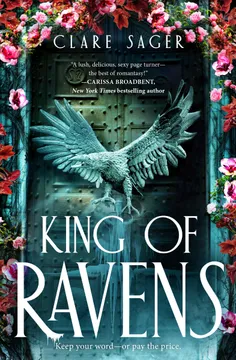


Plot Summary
Mirror, Notebook, Ashes
As her thirty-third birthday approaches, Rhiannon1 lives with unexplained weakness, painful episodes, and a heart she keeps going with carefully measured belladonna. Her younger brother Lowen3 brings her a beautiful raven-framed mirror, and its fractured surface shows how much illness has changed her.
She imagines it might be magical, perhaps able to offer the medical knowledge she has sought for years. That hope is already fragile: Lowen3 has sacrificed his own independence to help care for her, and Rhiannon1 hides her guilt behind cheerfulness.
Then she discovers the green leather notebook containing her research burning in the fireplace. Her father4 admits destroying it because he believes no cure exists, while her mother5 agrees. Rhiannon1 suppresses her anger to prevent a family quarrel, but her search for answers has been erased.
Rhiannon’s cheer is not simple optimism. It is a form of emotional labor that protects her parents and brother from the fear she already carries, even as it makes her own distress harder to acknowledge. The burned notebook turns that private strategy against her: her family treats hope as a danger to be managed, while she regards inquiry as one of the few ways to remain an agent in her life. The mirror offers a counterimage, but not a cure. Its importance lies in giving Rhiannon a reason to imagine that the world may contain knowledge her household has withheld.
The Iron Wall Opens
After dreaming for years of a dark figure2 she associates with Death,2 Rhiannon1 wakes to find Lowen3 sleepwalking in the garden. He is tearing down the family’s stone wall and pulling at a concealed wire. When his bleeding fingers will not release it, she cuts the wire with her father’s4 hatchet.
Thunder arrives in the wrong order, and a flock of ravens gathers before taking the shape of a fae. Drystan,2 a King of Death,2 demands a bargain made by Rhiannon’s father with The Morrigan.
During a storm at sea, her father4 promised his firstborn daughter1 as Drystan’s2 bride. The family admits it hid the pact and never gave Rhiannon1 a true name, calling her Annon1 instead. When her parents refuse the claim, Drystan2 raises the dead against their home. Rhiannon1 surrenders to protect them.
The boundary that kept Rhiannon safe also kept her uninformed. Her father’s iron wall is both a literal defense and a model of the family’s broader protection: it blocks danger, but it also blocks her from making decisions with full knowledge. The bargain turns the family’s private history into an external law, while the concealed name makes the injury more intimate. Rhiannon’s surrender is not consent to marriage; it is a tactical choice made under threat to her family. That distinction will matter as she tries to recover control over a fate arranged before she could speak.
A Bride in Mordren
Drystan2 carries Rhiannon1 through darkness to Mordren, the frozen Underworld where the sun is black and the dead travel toward another realm. He explains that she is expected to become his queen, though he resents the human bride1 imposed on him.
In his fortress, he gives her rules: names carry power, favors create debts, and weakness invites attack. His sartor, Min,6 bathes and dresses Rhiannon1 before her introduction to court. The fae stare at the sickly human, and Phaedra,9 a beautiful court rival, questions whether she is fit to rule.
Drystan2 publicly presents Rhiannon1 as his future queen and gives her ginger biscuits, sharing one when she offers it. Their brief human warmth does not undo the danger, but it gives Rhiannon1 a first glimpse of the person beneath the king’s2 practiced coldness.
Mordren makes social behavior an instrument of survival. A thank-you can become a debt, a name can wound, and apparent generosity can conceal leverage. Rhiannon’s education therefore begins as a practical defense, not an invitation to assimilate. Her first small connection with Drystan comes through a biscuit, an ordinary pleasure neither status nor power can fully control. The scene complicates the imposed marriage without romanticizing its coercion: Drystan can be momentarily curious and still hold Rhiannon captive. Her task is to recognize both facts at once.
The Hunt Turns Her Back
Believing she can slip out while the fortress sleeps, Rhiannon1 tricks Astrid,7 one of Drystan’s2 red-haired guards, into leaving her post. She reaches the outer gate but runs straight into the Wild Hunt, whose spectral riders seize her and return her to Drystan.2
He shows her the dead roaming beyond the walls and a monstrous, corrupted soul that would have devoured her. Rhiannon1 understands that escape by sheer endurance will not work, but refuses to surrender her wish to go home. She deliberately provokes the court, hoping Drystan2 will release her as an unsuitable bride.
Instead, he offers a conditional bargain: for fourteen days, she must behave as a devoted fiancée and repair the political damage she caused. By day she may try his six-tier labyrinth, the only permanent route back to the surface.
The failed escape changes the problem from whether Rhiannon wants freedom to what freedom will cost. The Wild Hunt proves that the world beyond the fortress is not an open road, while Drystan’s bargain converts his power into a structured, if punishing, chance. Rhiannon accepts because a limited opportunity is better than indefinite captivity. Her attempt to manipulate court opinion also exposes a gap in her understanding: in Mordren, public disrespect can destabilize a ruler and endanger everyone under his protection. Her learning now has immediate consequences.
Min Behind the Glass
In the labyrinth, Rhiannon1 meets the Collector,10 a many-voiced fae creature formed from souls who have lost their way. Its danger eases when she treats it as a person and speaks politely. Later, a trial offers a key that can open a shortcut to the final gate, but only if Rhiannon1 abandons Min,6 whom a predatory creature has trapped in a cage.
Rhiannon1 refuses the shortcut and uses the key to free her. The Collector10 guides her toward the next tier, while Min6 returns to the fortress. Drystan2 is surprised that Rhiannon1 chose another life over her own escape and removes glass splinters from her hand. The decision costs Rhiannon1 time, but it earns her Min’s6 trust and begins a friendship that will alter the meaning of her journey.
The trial presents self-preservation as the labyrinth’s expected logic. Rhiannon’s refusal does not arise from abstract heroism; she sees Min as a person whose life matters more than a faster route to her own safety. Her choice reveals a moral reflex that the court reads as weakness and she experiences as ordinary care. The Collector’s response reinforces the same principle: recognition changes how a frightening being behaves. Rhiannon does not conquer Mordren by becoming less compassionate. She survives by learning when compassion can create alliances, and when its cost must be accepted.
Ink Learns to Move
Kishel,8 a patient seer, teaches Rhiannon1 to look for fate in water, ink, stars, and moving creatures, but her first attempts reveal nothing. A vision eventually shows a chestnut horse throwing its rider and the rider dying. Rhiannon1 recognizes the danger and runs to the stables, where Astrid7 is about to ride that horse.
Astrid7 heeds the warning, and the patrol returns safely with skullflowers Drystan2 had sent the guards to collect for Rhiannon.1 The lessons also give Rhiannon1 a clearer view of Mordren’s politics: the Withan advises Drystan,2 Phaedra9 tests his authority, and the missing Effan,12 his half-brother,12 could become a rival. Rhiannon1 begins to see that her mistakes at court ripple beyond personal embarrassment.
Rhiannon’s first useful vision matters because it links attention to responsibility. She cannot yet summon knowledge at will, but she notices the warning and acts before certainty is comfortable. That instinct resembles her herbal research: observe, compare, intervene cautiously, and accept that an imperfect method may still save someone. At court, the same attentiveness helps her perceive power beneath polite speech. Fatework is not merely a supernatural talent; it is a demand to read consequences beyond the immediate scene. Her emerging role as future consort makes private perception politically consequential.
The King Learns Care
Rhiannon’s1 first snowball fight, with Drystan,2 Min,6 and Astrid,7 lets the king2 laugh openly and gives her a rare night of unguarded pleasure. The exertion catches up with her in the labyrinth, where she collapses.
Drystan2 carries her to his rooms, learns that she is ill, and discovers that her red tablets contain substances he cannot identify. He arranges for the Apothic to replace them with harmless tablets, then gives Rhiannon1 time to recover rather than sending her back into the maze. She resents losing days but gradually regains strength.
The change also makes her body less frail, though neither she nor Drystan2 yet understands why. Her dependence on medication is no longer a secret between them, and his concern begins to complicate her certainty that he feels nothing.
Care enters the relationship through a conflict over time and bodily limits. Rhiannon sees rest as a threat to her chance of escape, while Drystan sees continued exertion as a threat to her life. His intervention helps her, but it also reveals how easily a powerful protector can treat another person’s body as his responsibility to manage. The novel does not make tenderness erase that imbalance. Instead, Rhiannon’s need to survive and Drystan’s need to control outcomes begin to collide, setting up a later question that affection alone cannot answer: who gets to decide what happens to her?
Moonfire Wakes the Garden
During Moonburn, Drystan2 takes Rhiannon1 beneath the rare celestial display and admits that The Morrigan’s13 interference cost him a former lover and the child they expected. His guardedness gains a history, though it does not excuse the danger he has imposed on Rhiannon.1
The two share their first night together, and flowers grow across his bed as Rhiannon’s dormant magic awakens. A dark floral mark appears on her back, and she begins to affect plants throughout the fortress. Their intimacy deepens even as Drystan2 remains capable of manipulation.
When Threnn,11 his captain, corners Rhiannon1 on a tower and threatens to kill her, Drystan2 intervenes, tears out Threnn’s11 throat, and raises his body to present the severed tongue. Astrid7 takes command of the guard, while Rhiannon1 sees the full violence behind Drystan’s2 protection.
The moonlit intimacy offers Rhiannon a new experience of being desired rather than treated as fragile, while the magic that blooms around her makes that change materially visible. Yet desire and safety remain entangled with violence. Drystan’s past grief helps explain why he fears attachment, but his answer to danger is still annihilation. The tower scene makes his love, if that is what it is, difficult to separate from possession and power. Rhiannon’s task is not to deny the attraction or excuse the brutality. It is to keep her own judgment alive inside both.
The Collector Is Lost
Rhiannon’s1 new sight into fate reveals Lowen3 at home, exhausted and studying forbidden rituals in an effort to reach her. She pushes deeper into the labyrinth, afraid he will follow her into danger.
The Collector10 joins her beyond its familiar tier, sharing fragments of its former life and learning from Rhiannon1 what the sea looks like. As a spreading corruption overtakes the maze, the Devourer pursues them. Rhiannon1 uses blood to scry the right door, but the Collector10 stays behind the closing bars to hold the creature off.
It dies after thanking her for treating its many voices as people. Rhiannon1 reaches the next level alone, carrying grief for the friend who made the labyrinth less lonely. Drystan2 cannot arrange a message to Lowen3 until the moon permits travel.
The Collector’s companionship gives Rhiannon a relationship outside the court’s hierarchy, built through curiosity and reciprocal recognition. Its death turns the labyrinth’s physical danger into moral loss: the very quality that helped Rhiannon connect with it cannot save it from the Devourer. Lowen’s vision sharpens the guilt she has carried for years, but the Collector’s final gratitude offers a different measure of what her care has accomplished. She cannot keep everyone alive. She can still change what another being remembers about its own worth.
Jasmine Breaks Despair
Rhiannon1 reaches the Gauntlet of Despair, where the maze amplifies her fears until she believes no one has ever escaped and that she is too weak to be the first. Min’s6 farewell and Drystan’s2 assurance that he will not let her die alone return to her as memories she can hold.
The jasmine flower Min6 tucked behind her ear roots in the soil, and Rhiannon’s magic sends vines through the stone arches until she reaches the final gate. There she faces three possible paths: home, a life as Drystan’s2 queen, or death.
Asked which desire burns brightest, she claims she wants to remain in the Underworld, knowing that the claim is no longer wholly false. The guardian opens the path to the surface. Rhiannon1 chooses to go, driven by the need to reach Lowen3 before he risks himself.
Despair works by making exhaustion sound like evidence. It turns Rhiannon’s real limitations into a verdict that she has no future, then offers surrender as the only rational response. The flower interrupts that logic not with a sudden cure but with an image of patient, incremental growth. Her magic succeeds through connection with living things, not force. At the gate, her answer is emotionally complicated: she has begun to want the life she leaves behind, yet love for Lowen still demands action. Choosing the surface is not a denial of attachment to Drystan. It is a decision made before that attachment can become her only compass.
Home Holds the Poison
Rhiannon1 reaches the family cottage and embraces Lowen,3 telling him he does not owe her his life. Before she can reunite with her parents, Drystan2 confronts them about her medicine. Annem5 and Pa4 confess that they learned Rhiannon1 had magic as a teenager and secretly added iron and aconite to her tablets to suppress it, fearing The Morrigan13 would find her.
The treatment caused the sickness that kept Rhiannon1 housebound. Drystan2 returns her to the Underworld, where he admits he had already replaced the tablets without asking her.
Rhiannon1 condemns him for deciding what happened to her body, even though his substitute medicine was harmless. Later, a medical text confirms that the poison damaged her heart permanently. Her search for a cure ends not in recovery, but in understanding what was done to her.
The revelation reverses Rhiannon’s understanding of both illness and care. Her parents’ protection produced the very confinement they claimed to prevent, and the medicine she trusted was an instrument of control. Drystan repeats a smaller version of that pattern when he changes her pills without consent. The difference in outcome does not erase the violation. Rhiannon’s insistence on bodily autonomy marks a crucial development: she can accept help without surrendering the right to choose. The permanent heart damage also refuses an easy fantasy of healing. Knowledge offers clarity and responsibility, not a guarantee that harm can be undone.
A Queen Returns by Choice
After withdrawing to grieve, Rhiannon1 learns that Drystan2 has kept her condition private, sent food, and asked Min6 and Astrid7 to stay near without demanding details. He acknowledges that he should have told her what he discovered and apologizes, though Rhiannon1 makes clear that he must not make decisions about her body again.
The friends she has made remain with her as she considers a future beyond her parents’ cottage. She has already won the right to leave, but no longer wants to return to the people who poisoned her, and her damaged heart means she must reckon with limited time.
Rhiannon1 chooses Drystan2 and agrees to marry him on the condition that he never conceal such a truth from her again. Her decision is real, but so is the wound between them.
Rhiannon’s choice is neither a simple reconciliation nor a retreat into dependence. She weighs the evidence of Drystan’s care against his failures, names the condition required for trust, and accepts that an apology cannot restore what was broken. Her decision to stay follows the discovery that her old home is no longer a safe refuge, but the Underworld has become more than a substitute shelter: Min, Astrid, Kishel, and Drystan form a community she has helped shape. The unresolved damage matters. Marriage begins here as a negotiated possibility, not proof that the relationship is healed.
The Seal Is Missing
At the wedding ceremony, the Consort’s Seal is missing, leaving Rhiannon’s1 future authority symbolically incomplete. Phaedra9 invokes the Right of Challenge, requiring Rhiannon1 to use Fatework to find it.
Rhiannon1 peers into the glasshouse pond, where flowers rise and a vision guides the court to the abandoned cottage where she and Drystan2 once confronted her parents. Inside, they find Effan,12 Drystan’s missing half-brother,12 dead in a cupboard. The dead man points at Drystan,2 then gives him a gold coin before collapsing.
The coin leaves the king2 shaken, but he refuses to explain its meaning. Phaedra9 argues that Rhiannon1 has not found the Seal; Kishel8 persuades the Withan that Effan’s12 body is the first clue. The court accepts the challenge as passed, and the wedding resumes.
The challenge tests whether Rhiannon’s emerging power can serve the kingdom, but its result is not a neat display of mastery. Her vision leads to a body and a political mystery rather than the missing object itself. Kishel’s argument allows the court to treat an incomplete discovery as meaningful evidence, while Phaedra insists on a stricter reading that would exclude Rhiannon from power. The gold coin introduces a private grief inside a public dispute. The scene makes Rhiannon’s queenship depend not only on magic, but on interpretation, advocacy, and the willingness of others to recognize what a clue can mean.
The Wedding Ends Midfall
With the challenge accepted, Rhiannon1 and Drystan2 complete the wedding rites, binding themselves with ash and blood before the court. His five brothers15 arrive during the celebration, testing Drystan’s2 authority and treating Rhiannon1 as a political curiosity. Their visit leaves him distant.
Rhiannon1 later realizes she loves him and goes to find him, expecting the tenderness they have built to be mutual. Instead, in front of his brothers,15 Drystan2 claims he deliberately treated her kindly so she would fall in love with him and stop trying to escape.
Rhiannon1 is devastated, unable to tell whether his confession is the truth or another cruel deception. As she turns away, Drystan2 suddenly clutches his chest, drops his cup, and collapses. The book ends before anyone explains his condition or reveals what his confession means.
The final reversal attacks the trust Rhiannon has only recently chosen to risk. Drystan’s claim recasts every act of tenderness as strategy, though his collapse arrives before she or the reader can test that account against his behavior. The timing makes emotional interpretation inseparable from physical danger: Rhiannon is left with a shattered confession and a fallen husband at once. The ending does not resolve whether his declaration is calculated truth, self-protective cruelty, or something more complicated. It leaves the central romance suspended at the point where affection must confront power, manipulation, and the cost of believing.
Analysis
King of Ravens turns a familiar bargain-and-bride premise into a sustained argument about who has the right to define care. Rhiannon’s1 family confines her in the name of protection; Drystan2 controls her choices in the name of duty and safety; even his well-intentioned substitution of her medicine repeats the violation of deciding what her body needs without asking. The novel distinguishes affection from ethical action. Love may explain why characters protect, conceal, or intervene, but it does not make those choices harmless.
Rhiannon’s1 strength is not a miraculous escape from bodily limits. She remains vulnerable, needs rest, and faces permanent heart damage. Her agency appears instead in how she observes, learns, names harm, and chooses whom to help. The labyrinth rewards attention and connection as much as force: politeness quiets the Collector,10 compassion frees Min,6 and a jasmine sprout gives Rhiannon1 a way to answer despair. Her magic grows through relation to the living world, making the garden a counterforce to Mordren’s frozen structures without reducing survival to a simple triumph of nature over death.
The romance is compelling and dangerous for the same reason. Drystan’s2 tenderness gives Rhiannon1 an experience of being seen and desired, while his status lets him manipulate the conditions under which she can refuse or leave. Her eventual choice to marry him matters because she states a boundary, but the book does not pretend that choosing him repairs trust automatically. The final revelation that he engineered her love destabilizes the decision just as he collapses, leaving both his motives and his survival unresolved. The ending insists that intimacy is not secured by passion or sacrifice alone. It depends on truthful disclosure, consent, and the difficult work of making power answerable to the person it claims to protect.
Review Summary
Reviews for King of Ravens are mixed, averaging 3.92/5. Many readers praise the refreshing 33-year-old FMC, meaningful chronic illness representation, and the slow-burn Hades x Persephone-inspired romance. The ghost cat, labyrinth trials, and found family elements were fan favorites. Critics found the plot slow and predictable, with underdeveloped characters and lacking tension. The ending proved divisive—many found it diabolically shocking and compelling, while others felt it was underwhelming. Overall, fans of forced marriage, morally grey MMCs, and cozy underworld romantasy will likely enjoy it.
Characters
Rhiannon
The hopeful humanRhiannon is a fisherman’s daughter who has spent much of her life managing unexplained weakness and learning about medicine on her own. She keeps careful notes, experiments cautiously with herbs, and studies anatomy because no local healer has been able to explain her condition. Her warmth is genuine, but so is her habit of hiding pain to spare the people she loves. She is observant, practical, and naturally curious, with a strong impulse to care for others even when her own needs go unmet. Her journey tests the difference between accepting help and surrendering agency. What drives her is not only the wish to survive, but the desire to make choices about the life she has.
Drystan
The raven kingDrystan rules Mordren as one of the Kings of Death, a fae sovereign whose authority depends on both supernatural power and the careful management of a dangerous court. He is controlled, proud, and accustomed to treating rules as instruments of order. His wit often conceals impatience, while his rare moments of warmth expose a person less certain than his royal manner suggests. He values loyalty and security, but his instinct to control threats can override another person’s freedom. Rhiannon1 unsettles him because she questions his authority, notices details he would rather conceal, and responds to the dead with compassion. His struggle is between the safety he can enforce and the intimacy he cannot command.
Lowen
Rhiannon’s devoted brotherLowen is Rhiannon’s1 younger brother, an artist who brings her books and sketches and helps make her isolated life feel wider. His affection is expressed through practical attention: he remembers what she misses, finds objects that might delight her, and supports her curiosity. Rhiannon1 worries that he has limited his own future to care for her, a fear that shapes her guilt and her determination to return. Lowen is sensitive and loyal, but not merely a caretaker; he has his own hopes and private choices. Their bond is one of the few relationships in which Rhiannon1 feels both protected and understood.
Pa
The fisherman fatherPa is Rhiannon’s1 fisherman father, a hardworking man whose life by the sea has taught him to fear what cannot be controlled. He loves his family and believes protection is a duty, especially when danger threatens his daughter1. His quiet manner can harden when he thinks a decision is necessary. He represents the costs of fear when a parent mistakes secrecy for safety, while his bond with Rhiannon1 remains rooted in years of shared work, care, and family life.
Annem
Rhiannon’s watchful motherAnnem is Rhiannon’s1 mother, a loving, attentive presence who worries over her daughter’s1 health and tends to the household. Her protectiveness is intimate and constant, shaped by fear of losing the child she has watched struggle for years. She often expresses care through practical acts rather than direct discussion of painful truths. Rhiannon1 loves her, even as the closeness of their home can feel confining. Annem’s relationship with her daughter1 reflects the difficulty of distinguishing nurture from control when fear governs a family.
Min
The royal sartorMin is Drystan’s2 royal sartor, responsible for clothing, grooming, and the visual language of court. Her skill gives her influence, but her scar leaves her socially vulnerable in a culture that prizes apparent perfection. She is perceptive about etiquette and offers Rhiannon1 practical guidance for surviving the unseelie court. Beneath her professional competence is a deep longing to be valued beyond her work and appearance. Rhiannon’s1 kindness gives their connection room to grow, while Min’s own choices reveal that loyalty and friendship carry real risks in Mordren.
Astrid
The redcap guardAstrid is a redcap warrior in Drystan’s2 elite guard, distinguished by blood-red hair and a missing forearm. She is disciplined, physically formidable, and direct, yet she has an easy humor that makes her less intimidating than her reputation suggests. Her loyalty to the king2 does not erase her independent judgment. She becomes one of the few people Rhiannon1 can approach without feeling handled or pitied. Astrid’s growing closeness with Min6 also reveals a gentler side beneath her warrior’s readiness.
Kishel
The patient seerKishel teaches Rhiannon1 Fatework, the craft of reading possible futures and helping a kingdom find a better course. He is patient where Drystan2 is impatient, encouraging experimentation rather than treating failure as proof of incapacity. His humor softens his authority, though his eyes suggest he sees more than he chooses to reveal. He becomes an important advocate for Rhiannon1 when court procedure threatens to exclude her. Kishel’s teaching frames foresight not as certainty, but as disciplined attention to signs and consequences.
Phaedra
The courtly rivalPhaedra is a beautiful, influential fae who understands courtly status and expects the role of queen to belong to someone of her own kind. She is sharp, ambitious, and skilled at turning etiquette into a weapon. Rhiannon’s1 arrival threatens the order Phaedra understands, and she tests the human’s fitness through pointed remarks and political challenges. Her cruelty is not random; she reads power carefully and knows how to make others feel watched. Phaedra’s presence forces Rhiannon1 to learn that surviving court requires more than good intentions.
The Collector
The many-voiced guideThe Collector is a strange, many-voiced being who inhabits the labyrinth and carries traces of several lives within one body. At first its size and layered voices make it frightening, but it responds to courtesy and to being treated as a person rather than a monster. It is curious about the world beyond the maze and especially drawn to Rhiannon’s1 descriptions of the sea. The Collector’s longing and fear are recognizable to Rhiannon1, whose own life has been narrowed by illness and isolation. Their companionship gives both of them a reason to face dangers they would otherwise avoid.
Threnn
The stern captainThrenn leads Drystan’s2 redcap guard and embodies its martial discipline. He is imposing, blunt, and intensely loyal to the king2, but his idea of loyalty is shaped by rigid beliefs about strength and fitness to rule. He watches the court as a soldier watches a border, alert to any perceived threat to Mordren’s stability. His severity makes him both an asset and a source of tension when Rhiannon1 enters a world that measures worth by power.
Effan
The missing royal bakerEffan is Drystan’s2 half-brother, a member of the old royal line who works in the fortress kitchens as a baker. His position gives him a place in court without making him seem fully committed to its demands. He is restless and known for taking liberties with his responsibilities, which causes others to underestimate how much his place in the succession matters. His connection to Drystan2 adds a private family dimension to the kingdom’s political tensions.
The Morrigan
The fate-bound goddessThe Morrigan is the goddess of fate, war, and death, feared by humans and revered by the fae. She acts through bargains whose consequences may arrive long after the original crisis has passed. Her authority reaches into family choices and the succession of the Underworld’s kings, even when she is not physically present. The distance between her divine power and ordinary human life gives her bargains a chilling quality: those who call on her may survive the immediate danger while binding others to a future they never chose.
Bran
The pale ravenBran is the pale raven among Drystan’s2 three familiar birds. Unlike the black ravens, her feathers carry a violet sheen, and she watches Rhiannon1 with unusual curiosity. Bran’s presence offers small moments of companionship in the fortress, where nearly every other creature belongs to the king’s2 court or guard.
Drystan’s brothers
The rival death-kingsDrystan’s five brothers rule neighboring Underworld kingdoms and arrive as a powerful family bloc. They are polished, teasing, and politically alert, using humor to probe Drystan’s2 authority and the value Rhiannon1 might bring as his consort. Their relationships with him are shaped by rivalry rather than easy affection. Their visit makes clear that a marriage in Mordren is not only personal: it can change the balance of power among the kings.
Plot Devices
The Morrigan’s bargain
A promise inherited at birthDuring a storm at sea, Rhiannon’s father4 bargains with The Morrigan13 to survive, promising his firstborn daughter1 to her son. The agreement binds Drystan2 to claim Rhiannon1 as his bride, despite neither of them choosing the arrangement. Her parents hide the bargain and withhold a true name in an attempt to keep the fae from finding her. The bargain drives the story’s forced marriage, but it also raises the central question of whether a fate imposed by others can become a choice made freely.
The mirror and iron ward
A breach in the boundaryThe raven-framed mirror Lowen3 finds on the beach is a magical link that lets Drystan2 influence events beyond the iron-protected cottage. He uses it to prompt Lowen3 to dismantle part of the wall, though Lowen3 does not understand the source of the impulse. When Rhiannon1 cuts the iron wire to free her sleepwalking brother, the ward fails and Drystan2 can enter the garden. The mirror first offers Rhiannon1 hope of hidden knowledge, then becomes the route through which the secret bargain reaches her home.
Drystan’s labyrinth
A costly road homeThe six-tier labyrinth is the only permanent route from Mordren back to the surface. Rhiannon1 must find each way forward and survive trials that test her judgment, relationships, and resolve. Some obstacles can be met through observation or courtesy; others threaten to kill or transform those who fail. Drystan’s2 fourteen-day bargain gives her access to the maze, but its dangers make escape a question of endurance and choice rather than simply finding an exit. The final gate asks her to identify the desire that matters most.
Fatework and living growth
Signs become choicesFatework allows a consort to read possible futures and influence the kingdom’s direction. Kishel8 teaches Rhiannon1 to interpret water, ink, and other signs, but her visions arrive unevenly. As her dormant magic emerges, plants respond to her emotions and intentions, turning her affinity for gardening into a force that can alter the Underworld. Fatework is not simple prophecy: Rhiannon1 must decide what a sign means, who it affects, and whether she will act before certainty arrives.
The red tablets
Medicine conceals its sourceRhiannon1 believes her daily tablets are medicine for an unnamed illness. In truth, her parents have been giving her iron and aconite to suppress her magic and prevent The Morrigan13 from tracing her. The substances poison her body, causing disabling symptoms and permanent damage to her heart. Drystan2 later replaces the tablets without her consent, believing he is protecting her. The device joins the novel’s magical and familial conflicts to the question of bodily autonomy: treatment can be framed as care while concealing both its purpose and its harm.
About the Author
Other books by Clare Sager



Download PDF
Download EPUB
.epub digital book format is ideal for reading ebooks on phones, tablets, and e-readers.








