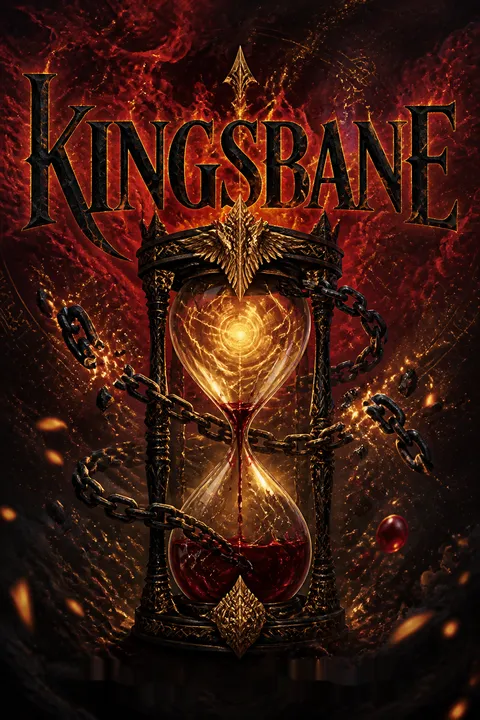


Plot Summary
Prologue
Simon wakes on a frozen plateau with no magic and no child in his arms. He remembers Queen Rielle giving birth, her father dying, and the infant princess entrusted to him as Corien attacked.
Simon’s first attempt to carry the baby through time failed; only a singed scrap of her blanket remains. Unable to call the threads again, he nearly gives himself to the cold until a fur-clad stranger finds him. The stranger calls herself the Prophet and asks for his help.
The opening makes rescue inseparable from failure. Simon has accomplished the impossible by carrying a child out of a collapsing moment, yet he wakes without either the child or the power that made the rescue possible. His despair is not abstract: it has a physical remnant, the burned blanket, and a physical cost, his inability to summon magic. The Prophet’s arrival interrupts his wish to die by giving him a task, but the scene leaves the task’s meaning uncertain. The novel begins with a rescue whose outcome Simon cannot understand, establishing time itself as an unreliable refuge.
Carduel’s Bloodied Temple
Newly anointed Sun Queen Rielle travels through Celdaria with Prince Audric, her lover, and Ludivine, his cousin and Rielle’s closest friend. In Carduel, the crowd’s celebration turns dangerous when armed men attack during a temple ceremony.
Rielle deflects arrows and orders a captured attacker spared, but the man’s expression changes as Corien, the angel she burned at her trial, speaks through him. The possessed attacker dies moments later. Ludivine forces Rielle and Audric to flee on Rielle’s godsbeast, Atheria.
Rielle resents being controlled and leaving frightened people behind, while Ludivine insists Corien’s return makes distance essential. Audric’s secret letters reveal Borsvall is being battered by unnatural storms, and Rielle chooses to answer its prince’s request for help.
Rielle’s first public crisis exposes the contradiction between her new title and her private instincts. She can protect herself, but choosing mercy requires her to suppress the urge to make fear answer fear. Ludivine’s intervention is protective and coercive at once, an early warning that love can become control when danger is treated as permission. Rielle’s decision to aid Borsvall comes from compassion and pride, but also from her desire to prove she can act independently. Corien’s return complicates all three motives: he is an external threat, yet his attention already has emotional force for Rielle.
Navi’s Sudden Violence
Centuries later, Eliana Ferracora lives in Astavar’s palace with her younger brother Remy, her childhood friend Harkan, and Simon, the scarred soldier who calls her the Sun Queen.
After a nightmare about her mother’s death, Eliana wanders the palace and encounters Navi, the young Astavari princess, attacking her in a delirious frenzy. Eliana’s old wounds once closed without effort, but Navi’s blows leave her bleeding. Simon restrains Navi, and Eliana calms her by recalling a private memory they share.
The incident reveals that Navi has been altered by the Empire’s experiments and may soon lose herself. Eliana rejects the destiny Simon sees in her and resists practicing magic, even as the people around her increasingly treat her as their hoped-for ruler.
Eliana’s loss of invulnerability converts a hidden gift into a bodily crisis. Her identity has been built around competence and control, so an ordinary wound feels like evidence that her entire former self has disappeared. The scene also makes care reciprocal: she saves Navi not through force but through shared memory, while Simon and the palace guards recognize a danger Eliana cannot yet accept. Her refusal of the Sun Queen role is less simple denial than self-protection. If power is inherited from a woman whose choices devastated the world, accepting it means accepting an unwanted family history as well as a political burden.
Borsvall’s Black Wave
At the ruined Borsvall coast, Prince Ilmaire and his twin sister, military commander Ingrid, receive Rielle, Audric, and Ludivine. Ingrid’s soldiers ambush the visitors, blaming Celdaria for her sister Runa’s death and threatening Audric with his own sword.
Before the confrontation can become a battle, the approaching storm reveals itself as a tidal wave racing toward Borsvall’s mountain capital. Rielle initially refuses to save people who tried to kill her beloved, but Audric argues that their lives and a chance at peace matter more than the insult.
Rielle flies out on Atheria and uses the empirium to arrest the wave, then lower it harmlessly into the sea. The city’s people and rulers bow to her, while Rielle savors both their gratitude and the scale of her power.
The rescue marks a genuine achievement but does not settle Rielle’s motives. She acts to prevent mass death, yet also wants Borsvall humbled and made to recognize her. The two impulses coexist rather than cancel each other, which is why the crowd’s adoration feeds a dangerous appetite as well as relief. Audric’s appeal succeeds because it ties power to relationship and obligation, not because Rielle has suddenly become selfless. The episode also changes the political landscape: Ingrid’s attack no longer defines Rielle’s standing, while the spectacle of her power makes her harder for any court to treat as an ordinary visitor.
A Daughter’s Inheritance
Eliana learns from Zahra, a wraith who helps Red Crown, that the angels’ banishment created a bodiless prison called the Deep. The revelation makes human history less innocent than Eliana believed, but it does not soften her refusal to become a weapon.
Then Harkan arrives, injured but alive, and Eliana clings to the friend who once shared her home. That night she tells him what Simon and Zahra claim: she is the daughter of ancient Sun Queen Rielle, and her storm in Astavar was real magic.
She also admits she killed Rozen, the woman who raised her, after the Empire transformed her into a monster. Remy overhears and calls Eliana a monster before fleeing. To prepare for Zahra’s promised antidote mission, Eliana forges palm-bound castings from scrap metal and her inherited necklace.
Eliana’s origin story arrives not as a triumphant revelation but as a threat to the relationships that make her feel human. Harkan tries to find explanations that preserve the person he knows, while Eliana wants him to reject her, because condemnation would match the punishment she already inflicts on herself. Remy’s response makes the secret’s cost immediate and intimate. The castings embody her attempt to impose limits on a power she fears: she deliberately binds it to her hands. Their creation is also an act of authorship, since she converts an inherited object into a tool bearing her own choices.
The Gate Opens Wider
In the Sunderlands, Rielle reaches the immense Gate and sees that its seal is already cracked. Drawn toward it and convinced she can mend the damage, she ignores warnings from Audric, Ludivine, and even Atheria.
Touching the light throws her back, but Rielle returns to the Gate and tries again, making the fractures multiply before a second blast knocks her unconscious. Reports soon arrive of disasters across Avitas, including storms, earthquakes, and deaths.
Obex scholar Jodoc explains that the Gate’s collapse could free the angels and that Rielle’s failed effort accelerated the danger. He proposes that the saints’ seven castings might give her the knowledge needed to repair it. Rielle leaves with a mission, but the Obex refuse to tell her where the relics are hidden.
Rielle’s mistake is not lack of courage but confidence that courage can substitute for knowledge. She treats the Gate as a challenge that will yield to enough force, repeating a familiar pattern in which the magnitude of her ability appears to promise mastery. Instead, power without understanding worsens the crisis. The consequence is ethical as well as magical: her urgency has harmed people far beyond the room where she acted. The castings offer a corrective model, making inherited memory and disciplined practice necessary. Yet the Obex’s refusal means Rielle must earn access while also confronting the distrust her own recklessness has created.
The Blightblade’s Cost
At the Sunderlands shore, an Obex archer shoots Ludivine with a blightblade, a weapon made with blood from a creature of the Deep. The blade extracts Ludivine’s angelic spirit from her borrowed body, leaving her lifeless on the sand.
Rielle shatters the weapon and Ludivine returns, though a painful scar remains. The revelation forces Audric and Ilmaire to confront what Ludivine is. Later, in Borsvall, King Hallvard’s apparent illness gives way to the angel Bazrifel, who has occupied the king’s body for years.
Bazrifel dies after identifying himself as Corien’s officer. Borsvall’s Obex then entrust Rielle with Saint Grimvald’s hammer. The same journey gives the group evidence that angels are already operating across kingdoms, not merely waiting beyond the Gate.
The blightblade turns an abstract dispute about angelic identity into a bodily violation that Rielle and Audric must witness. Ludivine’s body is both her means of living and a reminder that she occupies a life that was not originally hers, making the weapon’s harm morally complicated even as the attack is brutal. Bazrifel’s exposure extends that uncertainty into political institutions: a king’s weakness has concealed an enemy rather than merely a private illness. The hammer’s transfer offers hope, but its timing matters. Rielle receives the relic only after others have seen her protect them, suggesting that trust is earned through actions, not titles.
Fire Beneath the Mountain
Zahra leads Eliana and Harkan through flooded tunnels into the Nest, a criminal market beneath Vintervok, where they search a wraith-run storehouse for antidotes to the Empire’s crawler serum.
Eliana’s newly forged castings remain unreliable, and she enters the mission hungry and exhausted, hoping the strain will make her power answer. They find several kinds of antidote, but the wraith Sarash arrives before they can escape. A copper device traps Zahra, and Sarash fights Eliana and Harkan while speaking through Corien.
Eliana’s castings erupt in uncontrolled fire, destroying much of the underground market as the pair flee with the antidotes and Zahra’s prison. Back at the palace, Simon condemns their recklessness, but the medicine offers Navi a chance to recover.
The Nest forces Eliana to act before she has learned how to distinguish courage from self-harm. Her determination is tied to guilt over Navi’s capture, and she treats hunger and exhaustion as tools because previous breakthroughs came under physical duress. The result is efficacy without mastery: she gets the medicine, but the fire devastates a city and leaves Zahra imprisoned. The market’s uneasy coexistence between human criminals and wraiths contrasts with the orderly violence of empire, though neither arrangement is safe. Eliana’s rescue mission succeeds materially while deepening the costs she must carry.
Marzana’s Borrowed Shield
After returning to Celdaria, Rielle resists Queen Genoveve’s anger over her unsanctioned journey and the damage at the Gate. She and Audric continue the search for the saints’ castings, traveling to Kirvaya while Corien visits Rielle in dreams and feeds her visions of a northern refuge.
In the snowy mountains, he appears and gives her Saint Marzana’s shield, explaining that he took it from the Obex rather than wait for their tests. Rielle is drawn to his promise that she need serve no crown or church, though she returns with the casting rather than openly joining him. Corien’s gift advances her mission, but it also makes her trust in him more personal and harder to separate from her desire for freedom.
Corien’s influence works through recognition rather than simple force. He names a frustration Rielle already feels: her life is organized by institutions that praise her power while directing its use. The shield therefore functions as both practical assistance and emotional leverage. By bypassing the Obex’s tests, Corien frames himself as the one person who does not make Rielle prove her worth. Her acceptance does not yet mean allegiance, but it creates a debt and a secret. The scene exposes how manipulation can exploit a legitimate need, especially when the offered intimacy appears to respect autonomy more than the surrounding world does.
The Sun Queen’s Mercy
Corien’s visions guide Rielle toward Kirvaya’s missing elemental children and the Obex holding Saint Tokazi’s staff. Princess Kamayin reveals that the Obex have taken her friend hostage and forced her to attack Rielle. During a Gate-born storm, Rielle reaches the Holdfast, retrieves the staff, and kills the Obex who stand in her way.
Soon afterward, Corien draws her to Polestal, where he has made villagers burn one another. Rielle tries to restore a badly burned man, but her healing swells his body into a grotesque mass before she can undo the damage. The villagers call her the Blood Queen. Rielle escapes with Audric and her guard, while the young queen Obritsa uses her marque threads to send them away.
The episode brings Rielle’s greatest strength and greatest danger into the same frame. She can overpower armed opponents and retrieve the staff, but the power that makes her effective also exceeds her ethical and technical control. In Polestal she intends to heal, yet the man’s suffering worsens under her hands. Her failure makes the title Blood Queen more than a hostile rumor, because it reflects the fear generated by what people actually witness. Obritsa’s intervention supplies a counterpoint: her quiet thread magic protects others without spectacle, suggesting another model of power grounded in escape and care.
The Brother’s Return
Harkan takes Eliana from besieged Astavar by drugging her, believing he can save her by removing her from the war. On a ship to Meridian, she learns that Patrik is alive and agrees to help Red Crown raid a Fidelia outpost. The raid frees prisoners, but Empire forces and creatures called cruciata attack their camp. Simon arrives with Remy, who is shot in the fighting.
Eliana uses her power to restore her brother’s body, and the effort frees Zahra from the copper blightbox. The same surge awakens Simon’s ability to weave threads through time. Remy forgives Eliana, while she and Simon recognize that their next move may be to return to the past and change the history that produced the Empire.
Eliana’s first successful act of healing is not a clean redemption: it follows a choice made for her by Harkan, a battlefield, and the near-death of Remy. Yet the result changes her relationship to power. Rather than simply destroy, she can restore, and the recognition comes through a bond she feared had been severed. Simon’s recovered threading links personal intimacy to historical consequence: Eliana’s power makes his time travel possible. Harkan’s protective betrayal remains unresolved, showing that love does not erase the harm of taking another person’s choice away, even when the motive is fear of losing them.
One Queen’s Deadly Vision
Back in Celdaria, Rielle tries to heal Ludivine’s growing blightblade scar and succeeds, though Ludivine’s comment that Rielle will deliver her unsettles her. During a visit to Baingarde, Queen Genoveve, overwhelmed by grief and disturbed by Corien’s influence, throws herself from a terrace.
Rielle brings her back to life, but Genoveve wakes in terror and accuses Rielle of endangering everyone. Rielle’s apparent miracle fuels both a resurrectionist movement and protests calling her the Blood Queen.
As the Gate’s disasters continue, she pursues Saint Katell’s casting in Mazabat. She gains Saint Tokazi’s staff after confronting the Obex and uses her power to heal Ludivine, but her growing abilities make even her allies fear what she might do next.
Resurrection appears to fulfill Rielle’s wish to make loss reversible, but the returned life is not a restored relationship. Genoveve survives and remains tormented, so Rielle’s power cannot simply repair grief or consent. Public reaction splits between worship and terror, turning a private act into political spectacle. Rielle reads adoration as confirmation of her role, while Audric and Ludivine see the cost of her increasing isolation from ordinary limits. Healing Ludivine proves that Rielle can direct power with care, but it also intensifies her confidence that no limit should bind her.
The First Meeting Fails
Simon sends Eliana through time to meet Rielle before the ancient war has fully begun. The encounter goes wrong almost immediately: Rielle, already manipulated by Corien and unable to trust what she sees, attacks the stranger who claims to be her daughter.
Eliana tries to explain that the angels’ history and the future Empire must be stopped, but she has limited Old Celdarian and cannot get through Rielle’s fear. Corien enters Eliana’s mind during the fight, exposing her memories and distracting her while Rielle’s magic injures her.
Eliana escapes through Simon’s unstable thread before Rielle can catch her. Back in her own time, Eliana is badly wounded. Rielle dismisses the meeting as a deception, though the encounter leaves a persistent doubt.
The failed meeting demonstrates how truth can become unusable when delivered without trust, shared language, or preparation. Eliana arrives with a correct warning but appears to Rielle as a supernatural intrusion at a moment when Corien has already destabilized her judgment. Their resemblance intensifies the danger rather than creating recognition. Corien’s access to Eliana’s thoughts also collapses the presumed boundary between past and present, making the mission vulnerable before it can begin. The failure is not only tactical: each woman leaves with a more painful version of the other, and the future’s chance of repair narrows.
A Wedding Under Siege
Rielle marries Audric despite the protests and unease surrounding her power, believing the union can reassure Celdaria that the crown stands with its Sun Queen. At the wedding celebrations, Corien takes control of Ludivine and uses her to reveal Rielle’s hidden role in the deaths of their fathers.
The guests see Rielle’s power kill King Bastien, Lord Dervin, and her father during the fire trial, while Audric learns that she and Ludivine concealed the truth. He confronts Rielle, who insists she acted in panic while trying to stop Corien, but cannot deny the deaths or the lies. Audric’s trust collapses. Rielle leaves him and the city, finding Corien in the mountains as Merovec’s forces seize Baingarde.
The wedding tries to convert private devotion into public legitimacy, but Corien turns the ceremony into a courtroom. The revelation is devastating because it contains truth arranged to erase context: Rielle did kill the men, but the vision strips away her fear, Corien’s role, and the reasons she hid what happened. Audric’s injury is therefore not simply jealousy or political doubt; it is the discovery that intimacy has been used to protect him from knowledge. Rielle’s flight follows a terrible emotional logic. When the person whose belief sustains her withdraws it, Corien’s acceptance becomes the only refuge she can still perceive.
Audric Loses His City
While Rielle leaves with Corien, Audric learns that Merovec has prepared a takeover with northern bannermen and supporters inside the city guard. The Archon is detained, the council is brought under supervision, and the capital becomes unsafe for the remaining loyalists. Audric’s first impulse is to pursue Rielle, but Ludivine shows him how completely Corien has isolated her and warns that a direct pursuit would get him killed.
Audric sends Miren to gather intelligence inside the city, then escapes through the mountain tunnels with Ludivine, Sloane, and the Sun Guard. Atheria carries them away from Baingarde toward Mazabat, leaving Audric without his city, his wife, or any certainty that he can reach either again.
Audric’s political defeat arrives at the precise moment his private life disintegrates. His choice to flee rather than pursue Rielle is an act of restraint, not indifference: he recognizes that grief cannot substitute for a viable rescue plan. Ludivine’s warning forces him to shift from husband to king, preserving a remnant of the government and placing agents inside the occupied city. The escape also reverses the novel’s earlier image of Audric as Rielle’s steady anchor. He is now displaced and dependent on allies, carrying responsibility without the authority of his capital.
The Jubilee Turns Bloody
In Festival, Eliana and the Red Crown team attend Admiral Ravikant’s Jubilee disguised among the masked revelers, waiting for a ship to carry them away. The admiral chooses Eliana as a dance partner and probes her under the name Scarlett. When explosions announce the Empire’s arrival, Eliana and Simon run toward the docks, where Remy and their allies should be waiting.
Eliana uses her power to clear a path through the panicked crowd, but Jessamyn, now an imperial operative, attacks her. During the confusion, Simon speaks to the angels in their own language and directs their fire onto Red Crown’s people. Eliana sees friends fall, including Patrik, and is beaten, bound, and taken aboard the admiral’s ship with Remy.
The Jubilee’s masks make treachery theatrically appropriate: everyone hides a face, but Eliana believes she knows which people are on her side. Simon’s betrayal destroys that assumption at the moment her power is most visible and her friends most exposed. Eliana’s choice to illuminate the beach is courageous, yet it also makes her a beacon for both allies and enemies. The scene entwines spectacle with military violence, transforming a public celebration into a hunting ground. Jessamyn’s appearance adds another rupture, showing how thoroughly the altered future has changed relationships Eliana thought she understood.
Harkan Sees the Betrayal
From the cliffs above Festival’s beach, Harkan keeps his Red Crown team fighting to delay the imperial advance. The soldiers eventually overwhelm them, and Harkan is stabbed while trying to protect his companions. As Zahra helps him recover the last moments, he sees the Dovitiam burning and the imperial ship leaving with Eliana aboard.
He also understands that Simon was not leading Eliana to safety: Simon had been directing the angels as they killed the rebels at the pier. Harkan remembers the friends he lost and the life he shared with Eliana, then dies with Zahra and Patrik beside him. Zahra promises to keep fighting for Eliana, carrying Harkan’s love with her.
Harkan’s final realization gives the betrayal its full human cost. He does not die with a strategic overview but with the knowledge that the person he loved has been delivered to the enemy by someone she trusted. His memories of ordinary childhood rituals and first love resist the Empire’s habit of reducing people to combatants. Zahra’s presence makes his death witnessed rather than solitary, yet her promise cannot undo the loss. The scene leaves love as a form of testimony: what Harkan felt remains true even when he cannot protect Eliana or explain the betrayal to her.
Two Queens, One Captive
Rielle reaches Corien in the mountains, where Queen Obritsa and her fallen guard are also present. Convinced that Audric and Celdaria have rejected her, Rielle accepts Corien’s comfort and leaves her former life behind. On the imperial ship, Eliana wakes bound and finds Simon in an Emperor’s uniform, holding Remy at knifepoint.
Admiral Ravikant removes his mask to reveal Ioseph Ferracora, Eliana’s father, now an angel. Eliana has lost her castings and cannot protect Remy. Ioseph orders her imprisoned and threatens to torture her brother if she resists. Simon says nothing as guards take Eliana below deck. The novel ends with Rielle aligned with Corien and Eliana captive, both separated from the people who might have kept them grounded.
The ending makes the title’s two queens less a prophecy fulfilled than a crisis of interpretation. Rielle chooses the person who appears to accept her, while Eliana confronts the most intimate possible form of betrayal: her father’s face and Simon’s allegiance joined to the Empire. Both women are isolated through relationships that once promised belonging. The parallel does not make their situations equivalent: Rielle moves voluntarily, though under manipulation and grief, while Eliana is physically captive. The unresolved ending asks whether identity can survive inherited power and corrupted kinship without pretending that love alone can repair either.
Analysis
Kingsbane makes inheritance feel less like a crown passed down than a force arriving before a person has consented to it. Eliana and Rielle are linked by blood and power, but their parallel stories resist a simple opposition between a good queen and a bad one. Eliana fears becoming her mother and slowly discovers that the same magic can restore what violence has damaged. Rielle wants freedom from institutions that claim her, yet Corien’s offer of freedom is itself a form of capture. Their choices become most dangerous when others interpret love as permission to decide for them: Harkan drugs Eliana to protect her, Ludivine controls minds to shield Rielle, and Corien turns intimacy into leverage.
The novel’s historical conflict sharpens that problem. The saints’ victory was built on a lie about the Deep, so the human story of righteous survival cannot remain morally clean. The angels’ suffering explains Corien’s grievance without excusing his conquest. The Gate, like the characters’ bodies, bears the consequences of violence disguised as order. Repair demands memory and restraint, not simply greater force, yet both queens are pushed toward spectacular demonstrations of power because frightened societies prefer symbols to complicated people.
The ending refuses the comfort of a completed rescue. Rielle is drawn toward the one person who accepts her while turning away from Audric, and Eliana is delivered to an enemy by the man she loves. In both timelines, manipulation succeeds by fastening itself to a real emotional need. The tragedy is not that love is false, but that love can coexist with betrayal, fear, and coercion. The book leaves its queens at the point where inherited roles threaten to replace selfhood, asking whether they can still choose who they become when nearly everyone around them has already chosen for them.
Review Summary
Kingsbane received mostly positive reviews, with readers praising the complex plot, world-building, and character development. Many found the sequel even more engaging than the first book, with unexpected twists and intense emotions. Readers appreciated the exploration of power, sexuality, and morality. However, some criticized the pacing and found certain characters frustrating. The cliffhanger ending left many readers eager for the final installment. Overall, fans were captivated by the intricate story and Legrand's writing, despite some controversial elements and the book's mature content.
People Also Read







Characters
Eliana Ferracora
Reluctant Sun QueenEliana is a fiercely capable young fighter raised in occupied Ventera, where survival has taught her to rely on speed, suspicion, and her own blades. She loves her younger brother Remy and values the chosen family formed with Harkan and other rebels, but she resists the inherited identity Simon and Zahra place upon her. Her central psychological conflict is between self-definition and responsibility: she fears her power because it links her to a past she did not choose, yet she repeatedly acts when someone she loves is threatened. Her sharp humor and appetite for defiance protect a more vulnerable fear of becoming monstrous. Across the story, she begins to see that her power can both destroy and heal.
Rielle Dardenne
The blazing Sun QueenRielle is a young Celdarian noblewoman chosen as Sun Queen after surviving elemental trials. Audacious, sensual, and impatient with ceremony, she loves Audric and Ludivine while chafing against a life in which church, crown, and public opinion claim her power as their own. Her capacity for awe and tenderness exists beside a capacity for anger that can become lethal. Rielle’s greatest vulnerability is not ignorance of her strength, but the belief that strength should free her from ordinary limits and consequences. She wants to serve her people and to possess her own life, and she has not yet found a way to reconcile those desires.
Simon
The scarred time-threaderSimon is a battle-hardened soldier from Rielle’s era, displaced into Eliana’s future and devoted to protecting the Sun Queen he once carried as a baby. His scars mark both physical violence and a life shaped by the Prophet’s severe training. He is disciplined, strategic, and often controlling, especially when he believes Eliana’s survival is at stake. Beneath the Wolf’s cold manner is a man whose sense of purpose has been organized around finding and guarding her. His connection to Eliana is complicated by their growing intimacy and by the burden of knowing more about her destiny than she wants to hear.
Audric Courverie
The steady crown princeAudric is Rielle’s beloved and the heir to Celdaria’s throne. Thoughtful, diplomatic, and deeply attached to the people around him, he offers a steadiness that Rielle both needs and sometimes resents. He believes leadership means building alliances and accepting obligations, even when personal desire points elsewhere. His relationship with Rielle is loving but not uncomplicated: he wants to trust her power without treating her as a tool or a danger. Audric’s characteristic patience can become painful hesitation when politics and intimacy collide, yet he continues trying to hold together both the crown and the people he loves.
Ludivine
The angel in a friend’s bodyLudivine appears to be Audric’s cousin and Rielle’s intimate childhood friend, but she is an angel inhabiting the body of the human girl who died young. She protects Rielle through mind-speech, political counsel, and formidable mental power. Her care is genuine, yet she can overstep, believing that preventing danger justifies taking control. Her existence is shaped by exile, bodily estrangement, and a longing to belong despite knowing she is not human. Ludivine’s tenderness toward Rielle and Audric is real, but so is her history of concealment, which leaves trust between them fragile.
Corien
The exiled angel emperorCorien is an angel who escaped the Deep and now leads an expanding imperial power. He is brilliant, charismatic, and skilled at finding the private wound beneath a person’s public resistance. He believes his people were grievously wronged and frames conquest as restoration, but his pursuit of vengeance makes him willing to manipulate minds and sacrifice lives. His attachment to Rielle is intense and difficult to separate from his hunger for her power. Corien can offer the recognition Rielle longs for, yet his affection arrives entangled with pressure, secrecy, and an agenda that threatens everyone around her.
Harkan
Eliana’s childhood anchorHarkan is Eliana’s oldest friend and a capable Red Crown fighter whose loyalty began in childhood. He shares with her a history of private jokes, coded signals, and affection that has never entirely disappeared, even as Eliana’s feelings change. His instinct is to protect the people he loves, but fear can lead him to make choices for them rather than trust them to choose. Harkan is practical and brave, though he often measures his own worth against Eliana’s growing power and importance. His bond with Remy is protective and familial, and his bond with Eliana carries both tenderness and grief.
Remy Ferracora
The story-loving brotherRemy is Eliana’s younger brother, a boy devoted to the saints, old stories, and the hidden history of magic. He is curious and observant, with a gift for languages and an appetite for asking questions adults would rather avoid. His faith in Eliana is deep, but learning that she killed Rozen, the mother who raised them, shakes the foundation of their relationship. Remy’s interest in stories is not escapism alone: it gives him a way to make history legible and to imagine a future beyond the Empire. His closeness with Eliana is one of her strongest sources of love and guilt.
Zahra
The watchful wraithZahra is an angelic wraith who refuses to inhabit a human body and serves as a guide to Eliana. She carries the history of the angels’ exile and helps Eliana understand both the Deep and her power. Zahra is principled, perceptive, and compassionate, but her limited strength and guarded knowledge leave her unable to protect Eliana from every danger. She values human life despite the betrayal her people suffered, and her loyalty is rooted in a belief that the current cycle of violence must be stopped.
Navi
Astavar’s brave young princessNavi is the youngest daughter of Astavar’s ruling family and a close friend to Eliana. Captured and altered by Empire experimentation, she faces the loss of her own mind and body. Her courage is practical rather than showy: she insists on standing with her people even when still recovering, and she refuses to let Eliana reduce her worth to the world’s larger needs. Navi’s faith in Eliana gives the reluctant queen a glimpse of how hope can be sustained by personal loyalty.
Patrik
Red Crown’s hard realistPatrik is a Red Crown operative and a skilled organizer who distrusts Eliana because of choices made during an earlier rebellion. His bluntness is sharpened by loss, particularly his separation from Hob, but he remains willing to revise his judgment when events demand it. Patrik measures people by what they do under pressure, not by prophecies or titles. He is an effective fighter and planner, and his wary respect for Eliana grows from seeing both her courage and the consequences of her power.
Jessamyn
The sharp-edged fighterJessamyn is a young, formidable fighter whose instincts are quick and whose humor can be as cutting as her knives. She has survived a brutal world by refusing to romanticize danger or sacrifice. Her practical skepticism challenges the group’s belief that Eliana’s destiny will save them. Jessamyn also sees the loneliness behind Eliana’s fear and offers companionship without demanding that Eliana become a symbol. Her independence is hard-won, and she is wary of anyone asking her to surrender it for a cause.
Tal Belounnon
Rielle’s patient teacherTal is a Grand Magister who helped raise and educate Rielle after her mother’s death. He believes in the value of study, prayer, and discipline, though he knows Rielle’s power may exceed the structures he trusts. His affection for her is deep and complicated, and his concern sometimes turns into overprotection. Tal serves as a bridge between Rielle’s childhood and her public role, offering a human measure of care that neither worships her nor ignores the danger she can pose.
Queen Genoveve
A grieving royal motherGenoveve is Audric’s mother and queen of Celdaria, a politically skilled ruler whose composure is strained by the deaths of her husband and the upheaval surrounding Rielle. Her resentment toward Rielle is tied to grief, family alliances, and fear for the crown’s future. She is not simply an obstacle: her reactions reveal how private loss can shape public judgment, especially when a ruler is expected to remain composed while mourning.
Merovec Sauvillier
The northern power brokerMerovec is Ludivine’s brother and a popular military leader from House Sauvillier. He is politically astute, proud of his family, and wary of Audric and Rielle’s relationship after the broken betrothal rearranges old alliances. His charm makes his hostility more dangerous, because it allows him to present personal resentment as sober political concern. Merovec understands the value of public perception and uses that understanding to build influence in a country already divided by fear.
Ilmaire Lysleva
Borsvall’s scholar princeIlmaire is Borsvall’s thoughtful crown prince and Ingrid’s twin. He values diplomacy and learning, and he wants his country to cooperate with Celdaria despite generations of hostility. His gentleness is often mistaken for weakness, particularly by people who believe authority must be enforced through fear. Ilmaire’s curiosity about the Gate and the ancient world makes him an important ally to Audric, but his position forces him to balance idealism with the demands of rule.
Ingrid Lysleva
Borsvall’s fierce commanderIngrid is Ilmaire’s twin sister and a gifted military commander. Her anger over her sister’s death and her suspicion of Celdaria make her quick to choose force, especially when she believes her country is vulnerable. Beneath the aggression is fierce protectiveness toward Borsvall and its people. Ingrid challenges the diplomatic optimism of Audric and Ilmaire, giving the political conflict a human face rather than reducing it to a simple rivalry between nations.
Obritsa Nevemskaya
Kirvaya’s young marque queenObritsa is a young queen of Kirvaya whose bright, eager manner conceals a sharp political mind and a connection to the human revolution. Her upbringing has taught her to perform whatever role keeps her alive, while her hidden marque ability gives her a means of moving through space by threads. She is courageous but not fearless, and she is forced to navigate the competing agendas of her court, the revolution, and the powers gathering around Rielle.
Atheria
Rielle’s winged companionAtheria is Rielle’s massive godsbeast, a winged, horse-like creature whose loyalty is expressed through presence rather than speech. She carries Rielle through battles and across countries, but she is not a mere mount: she resists when Rielle acts recklessly and withdraws when trust has been damaged. Her bond with Rielle offers a relationship built on mutual recognition rather than political duty.
Danizet Keshavarzian
Red Crown’s welcoming hostDani is a Red Crown ally who hides her family’s resistance work behind a convincing appearance of loyalty to the Empire. Warm, brisk, and unafraid of blunt speech, she offers Eliana and the refugees shelter when they arrive exhausted at her estate. Dani’s practical hospitality matters because it gives Eliana a place to rest without demanding immediate heroism, while her organizing skills help support the larger resistance.
Gerren
The young sharpshooterGerren is a boy traveling with refugees and Red Crown fighters, small enough to be underestimated and skilled enough with a rifle to change a battle. He is quick, bold, and eager to prove himself useful. His presence exposes the cost of a war that turns children into combatants, while his loyalty to Eliana and the others gives him a place within the group.
Hob Cavaserra
The storyteller rebelHob is a Red Crown fighter and a collector of stories about the saints and the Old World. His knowledge gives the rebellion a living connection to histories that the Empire has tried to erase. He is devoted to Patrik, and his gentleness with Remy reflects his belief that stories can preserve a person’s humanity amid war. Hob combines practical courage with an imagination that refuses to let the past become mere propaganda.
Sloane
The shadow-casting magisterSloane is Tal’s sister and a Grand Magister whose shadow magic and political judgment make her a capable ally in Celdaria’s upheavals. She is less sentimental than Tal and quicker to recognize when a crisis requires decisive action. Her loyalty is tempered by clear-eyed caution, and she is willing to risk herself when the kingdom’s future is at stake.
Jodoc
The Gate’s guarded scholarJodoc is a senior member of the Obex, the order charged with guarding the Gate and the saints’ castings. He distrusts Rielle after her reckless attempt to repair the Gate, but he understands the danger better than most and offers a theory that may help her. His secrecy reflects the Obex’s conviction that knowledge can be as dangerous as power.
Admiral Ravikant
The Empire’s grand celebrantRavikant is an angelic admiral who treats conquest as a source of personal glory and surrounds his public celebrations with carefully managed power. His refinement and theatrical manner conceal a brutal command of imperial forces. He values ceremony because it makes domination look inevitable and attractive to those forced to live under it.
Plot Devices
The Empirium
Magic beneath the visible worldThe empirium is the connective power underlying matter, bodies, places, and moments. Elementals use it to command fire, water, wind, earth, metal, and other forces, while Rielle and Eliana can perceive deeper structures within it. The same source of power enables rescue, healing, destruction, and the opening of paths through time. Its responsiveness is not the same as moral permission: a character may make the empirium obey and still cause catastrophic harm. It externalizes the novel’s central struggle over whether power is mastered through force, knowledge, or relationship.
The Gate
A failing prison between worldsThe Gate was created by the saints to banish the angels into the Deep, a realm between worlds. Its weakening allows angels and strange creatures to reach Avitas, while natural disasters spread across the continents. Repairing it requires more than raw elemental strength, because the saints’ castings preserve knowledge of how the structure was made. The Gate turns ancient political decisions into immediate physical danger: the worlds’ current crisis grows from a peace settlement built on deception, and every failed attempt to mend it worsens the threat.
The Seven Castings
Memory made into magical toolsEach saint’s casting is a powerful artifact with residual magic and a memory of the empirium. Rielle must find the seven castings to gain the structure and knowledge needed to attempt a true repair of the Gate. Some are guarded by the Obex, while others become entangled with political conflict and Corien’s influence. Their significance is not merely their strength: they connect Rielle’s present power to the choices and techniques of those who created the Gate.
Time Threads
A path between momentsMarques can perceive threads connecting people, places, and moments, then travel along them. Simon’s ability has been dormant, and Eliana’s power helps him recover it. The resulting passage gives them a chance to intervene in the ancient past, but any change can rewrite the lives of everyone in the present. The travelers alone may recognize what has changed. Time travel therefore offers a possible end to the Empire while making the cost of success unknowable.
Blightblades and Blightboxes
Angel containment through cruciata bloodWeapons forged with the blood of cruciata can extract an angel from a human body and trap the spirit inside the blade. Similar blightmetal can be formed into a box that contains a wraith. These devices make angels vulnerable, but they also expose the violence of treating a person’s body as disposable. The blightblade scar cannot be healed by ordinary means, while Eliana’s power eventually breaks Zahra’s prison. Their use gives the human resistance a defense against angels, though its rare material and painful effects limit its reach.
Empirium Series

About the Author
Other books by Claire Legrand

Download PDF
Download EPUB
.epub digital book format is ideal for reading ebooks on phones, tablets, and e-readers.








