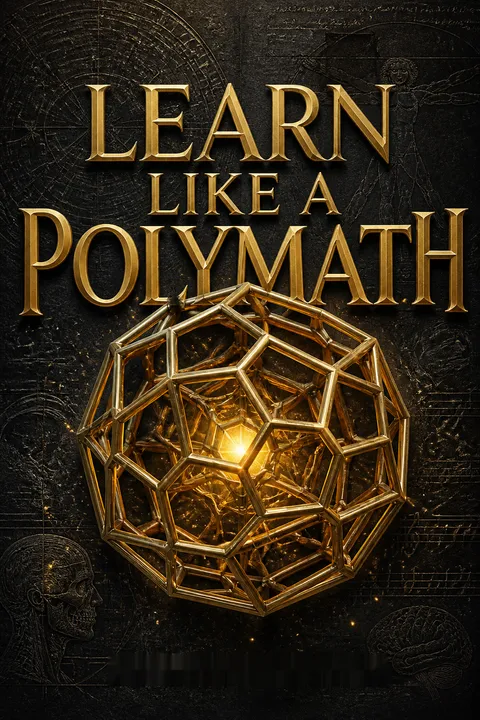


Key Takeaways
Build polymathy by integrating three fields, not merely collecting credentials.
A useful definition. The book rejects the idea that a polymath is simply a person who knows a little about everything. Drawing on Michael Araki’s model, it defines polymathy through breadth, depth, and integration: knowledge across distinct subjects, meaningful expertise in some of them, and the ability to combine them. Leonardo da Vinci exemplifies the last element because he applied mathematical ideas to art and invention, rather than keeping each talent in a separate box.
Combination creates value. Research discussed in the book points in two directions: innovators with varied backgrounds may produce fewer commercially successful ideas, yet their occasional breakthroughs can be unusually valuable. Studies of research papers and scientists also associate disciplinary diversity and artistic interests with influential work. The practical test is not how many subjects appear on a résumé, but whether one field changes how another is understood or used.
The definition shifts polymathy from a status label to a working practice: integration is observable in what someone makes, explains, or solves. That is a stronger standard than counting hobbies, and it helps distinguish productive range from scattered curiosity. The research examples also imply a useful risk profile: unusual combinations may have lower average returns but greater upside. Still, integration is not automatically an advantage. It depends on whether the fields illuminate the same problem, and whether the learner has enough depth to avoid superficial analogies.
Choose skills where curiosity, future usefulness, and existing strengths overlap.
Start with a destination. The book’s learning plan begins by naming what you want to be able to do, then comparing that future capability with your current skills. Darlene, a web developer, already knows HTML and CSS but relies on others for some website functions. That gap points her toward learning Java, which she can use immediately at work. Her example shows how a broad ambition becomes a concrete learning target.
Build a workable route. Identify the missing knowledge, choose resources that suit your schedule and support needs, study people who have reached a similar goal, and set measurable milestones. Reserve time for practice and reflection, then revise the plan if a course or method is not helping. The book also advises weighing personal interest and strengths, not just fashionable skills or career prospects. A plan is useful when it can survive contact with daily life.
This approach resembles backward design: define the performance wanted, identify the gap, then select instruction and practice that close it. Darlene’s example makes the method unusually tangible because the new skill has an immediate job-related use. That feedback can sustain effort and expose misunderstandings quickly. The caution is that strengths should guide choices without becoming a cage. A learner may need to enter a weak area when the goal demands it, while resisting the opposite mistake of chasing a trend with no genuine purpose.
Move from familiar applications toward deliberate, carefully tested far transfer.
Learning must travel. Transfer of learning occurs when knowledge or a skill acquired in one setting is used in another. The book draws on the identical components theory: transfer is easier when the original and new situations share something, and unreliable when a learner assumes a connection that is not there. Applying percentages to a restaurant bill is a close, practical transfer; carrying a strategy from mathematics into investment decisions is more distant and requires judgment.
Increase the distance gradually. Robert Haskell’s six-stage taxonomy moves from learning based on prior knowledge, through application and related contexts, toward near transfer, far transfer, and creative transfer. The book’s example of Einstein links the sensation of upward acceleration in an elevator with gravity, treating the connection as a creative leap. Such leaps are rare, so practice reliable applications first, then test more surprising connections rather than trusting them automatically.
The gradual progression is valuable because people often confuse resemblance with equivalence. A method that succeeds in one setting may fail in another because incentives, constraints, or causal mechanisms differ. Treating transfer as a hypothesis to test makes cross-disciplinary thinking more disciplined: identify the shared structure, then look for the parts that do not match. The model’s stages are best understood as a teaching scaffold, not a guaranteed sequence. Real expertise can involve moving back and forth between routine application and ambitious synthesis.
Study actively by questioning, applying, and checking what you actually understand.
Think about your thinking. Metacognition means monitoring and regulating one’s own thought processes. Instead of passively receiving information, ask where an idea connects to prior knowledge, what remains confusing, and how it could be explained simply. If a concept is difficult to explain, that is a signal to return to it, not proof of inability. The book also encourages linking study to lived experience, such as using sports statistics to make mathematical ideas relevant.
Make application immediate. Practice skills while learning them, look for early chances to use new knowledge, and revisit it in varied situations. The book recommends varying learning media and using less predictable practice schedules after initial instruction. Confidence and enthusiasm can help learners attempt applications, but overconfidence can mislead. Its advice is cautious optimism: believe application is possible, then let practice and feedback show what is working.
The useful distinction here is between exposure and usable knowledge. Reading can supply information, but questions, retrieval, and application reveal whether the learner can reconstruct an idea without leaning on the page. Metacognitive questions also turn confusion into diagnostic information. A practical qualification: changing media is not inherently better if it merely adds novelty, and enthusiasm cannot replace accurate feedback. The most effective routine is one in which each study method serves a purpose, such as explaining, recalling, practicing, or correcting.
Let a real problem pull knowledge out of books and into action.
Learn by solving. Problem-based learning, or PBL, begins with a challenge that requires new knowledge, rather than presenting information first and inventing an application afterward. The author recalls wanting to impress a classmate in Spanish; the goal pushed him to study vocabulary and phrases intensely, and he earned a top grade even though the hoped-for romance went nowhere. The joke makes the mechanism memorable: a meaningful problem can focus effort better than an abstract instruction to learn.
Give the problem structure. First define the challenge and what is already known. Then identify what must be learned, where to find it, and what actions could solve the problem. Meal planning can teach cooking while reducing dinner-time confusion; repairing a broken toaster can prompt practical learning about electronics. The problem should be safe and manageable, with appropriate help when the task carries real risks.
PBL aligns motivation with knowledge acquisition: the learner has a reason to seek information, evaluate it, and use it. That can make study more coherent than collecting facts without a purpose. The Spanish story also shows that learning may succeed even when the original goal does not, a useful separation between process and outcome. However, unguided problem-solving can overwhelm novices or cement errors. The method works best when the challenge is well-scoped and reliable resources or knowledgeable feedback are available.
Use analogies to expose what you understand, then test where they break.
Compare, then explain. An analogy relates two things through a shared relationship. Academic analogies make that relationship explicit: laws are to a constitution as code is to a digital application, because each supplies essential rules or structure. Building the comparison requires the learner to identify what the concepts do, not just memorize their names. The book describes several relationship types, including part and whole, cause and effect, and problem and solution.
Keep the limits visible. Analogies can make difficult ideas accessible, but a memorable comparison can also conceal differences. The familiar description of mitochondria as a cell’s energy source, for example, can mislead if it suggests the organelle merely stores energy. The book recommends using multiple comparisons for difficult concepts, adding concrete examples, and explaining why each analogy fits. Personal examples, such as the high cost of a hotel during peak demand, can also make abstract principles easier to grasp.
Analogy is both a teaching tool and a test of conceptual structure. A good comparison lets a learner transfer a relationship while preserving awareness that the two subjects are not identical. Naming the limits matters because people often remember the vivid image and forget its qualifications. Multiple analogies can help reveal which features are essential and which are incidental. The technique should remain selective, though: elaborate comparisons for simple material can create extra mental work rather than clarity.
Map relationships visually before a growing subject becomes an information swamp.
Make the structure visible. Mind mapping organizes a topic around a central idea, with branches for major areas and smaller branches for details. A map of philosophy, for instance, might branch into ethics, metaphysics, and political philosophy, then divide ethics into approaches such as utilitarianism and deontology. This arrangement can show both what has been studied and where important connections or gaps remain.
Keep the map readable. The book’s method uses a central image or phrase, distinct branches, and brief labels. Colors, symbols, and changes in branch thickness can make categories and hierarchy easier to distinguish. Large fields may need separate maps for subtopics rather than one crowded diagram. A map is not a substitute for understanding: it is a compact aid for seeing relationships, organizing study, and deciding what deserves further investigation.
A visual map externalizes the learner’s mental model, making omissions and unexpected links easier to inspect. It is particularly useful when studying several disciplines because it can show where ideas converge without forcing them into a single narrative. The map’s value depends on its design, however. Overcrowded branches can turn a tool for orientation into a decorative archive. Brief labels and deliberate hierarchy matter more than adding colors or images for their own sake.
Keep identity provisional so unfamiliar fields remain available.
Stay open to revision. The book argues that labels about what kind of person someone is can quietly restrict what they are willing to explore. Declaring a dislike for a musical genre, for example, may prevent someone from discovering an artist they would enjoy. A polymathic outlook treats preferences and assumptions as revisable rather than permanent facts about the self.
Adapt before crisis. The book contrasts a hypothetical clothing professional who clings to familiar business practices with an outsider whose secondhand-clothing interest helps them recognize an emerging opportunity in resale or rental. The point is not that newcomers always outperform experts, but that flexibility makes it easier to notice when old methods no longer fit. Openness also means tolerating uncertainty and questioning conventions without assuming every rule is worthless.
Identity can function as a filter: it helps people make choices, but it can also make contrary evidence feel irrelevant. Keeping self-descriptions flexible supports exploration and makes it easier to update beliefs when circumstances change. The clothing scenario illustrates the possible value of perspective from outside a field, while remaining a hypothetical example rather than proof that inexperience is an advantage. Expertise still matters; the stronger lesson is to pair domain knowledge with willingness to question inherited routines.
Run small experiments before letting perfectionism decide for you.
Turn assumptions into tests. An experimental mindset means trying an idea, observing what happens, and adjusting in light of the result. The experiment need not be a laboratory procedure. Trying a new hobby or habit for a limited period, or testing a different approach to a recurring task, can produce evidence that speculation alone cannot provide. Framing the attempt as a test can lower the pressure to make a perfect, permanent decision.
Make failure informative. The book presents failed attempts as ordinary parts of learning, not verdicts on a person’s ability. A result can clarify what to change, what to investigate, or whether the idea is worth pursuing. Experimentation is easier when the potential cost is limited and the learner feels safe enough to try. Small, reversible trials are especially useful when the alternative is endless planning without feedback.
This approach connects curiosity to action by shrinking the distance between having an idea and gathering evidence. It can also reduce the emotional stakes of uncertainty: a trial is not a final judgment on identity or competence. The crucial design choice is reversibility. A low-cost test can encourage learning, but the same experimental spirit should not excuse careless decisions where other people, safety, or substantial resources are at risk. Good experiments have clear questions and attentive observation.
Re-enter familiar subjects with a beginner’s questions, not an expert’s assumptions.
Practice Shoshin. The book uses the Zen term Shoshin for a beginner’s attitude of openness and curiosity, even when studying a familiar or advanced subject. Beginners ask many questions because they do not yet know which details matter. An experienced driver, for instance, might deliberately notice the feel of the steering wheel or the sound of the air conditioner, sensations usually ignored through habit.
Make room for basic questions. Treating a subject as new can reveal assumptions that experience has hidden. Asking what a term means, why a method works, or what evidence supports a familiar claim helps uncover gaps before they become blind spots. This does not require pretending expertise has no value. It means keeping expertise answerable to observation and making it socially acceptable to ask simple questions.
The beginner stance is a form of attention management: familiarity compresses perception, while deliberate questioning restores detail. It is especially useful when a person carries methods from one domain into another, since confidence can make a mismatch hard to see. Still, novice openness is not sufficient by itself. Questions need to be paired with evaluation, evidence, and accumulated knowledge; otherwise, every claim can appear equally plausible. The productive combination is curiosity without credulity.
Treat limits as hypotheses, and expect mastery to require repeated discomfort.
Belief can change effort. In 1954, Roger Bannister ran a mile in 3:59.4, crossing a barrier many observers had considered unreachable. John Landy followed within months, and other runners crossed the threshold in the next year. Bannister’s achievement helped make the feat imaginable, though belief alone cannot explain athletic performance; training and physical capacity still mattered.
Expect the difficult stretch. The book presents self-discipline as the willingness to continue through confusion, uncertainty, and effort rather than waiting for learning to feel pleasant. It urges learners to practice manageable discomfort before circumstances force it upon them. The point is not to seek needless suffering, but to stop treating every frustrating stage as evidence that the goal is impossible. Persistence gives ambition time to become skill.
Bannister’s record is a vivid case of a psychological ceiling giving way, and the rapid succession of later sub-four-minute miles suggests that perceived possibility can influence collective effort. It does not show that mindset is the only cause: athletic preparation, competition, and individual differences matter. The more defensible lesson is that beliefs affect whether people attempt demanding work, while disciplined practice affects what they can do. Discomfort is informative only when it accompanies a worthwhile, sustainable effort.
Analysis
The book’s central move is to redefine polymathy as integration rather than accumulation. That distinction gives the reader a practical standard: multiple interests become a genuine advantage when knowledge from one area helps interpret or produce something in another. The chapters then supply a learning architecture for that work. A learner selects a goal, develops breadth and depth, practices transfer, breaks difficult ideas down, and adopts habits of curiosity and persistence.
Its strongest contribution is procedural. Transfer, problem-based learning, analogy, and mind mapping each address a different obstacle: applying knowledge elsewhere, sustaining motivation, grasping abstraction, and organizing complexity. Together they encourage learning that is active rather than merely consumptive. The examples, from a student studying Spanish for a personal goal to Bannister’s mile, make the method memorable without suggesting that every learner needs a grand historical achievement.
The argument is less secure when it implies that polymathic success is broadly available through attitude and technique alone. Opportunity, time, money, health, and access to instruction shape who can develop expertise across fields. The book itself recognizes that resources and support matter, but its expansive promise can understate those constraints. Its discussion of far transfer also needs careful handling: distant connections can generate insight, but resemblance is not proof that a principle applies. Learners need domain knowledge and feedback to separate useful synthesis from attractive error.
The most durable reading is therefore neither that everyone can become a Da Vinci nor that specialization is obsolete. It is that people can deliberately widen their competence while protecting depth, and can make that breadth productive by testing connections. In a world of changing work, such intellectual flexibility is valuable, but only when joined to craft, evidence, and a concrete purpose.
Review Summary
Learn Like a Polymath receives mixed reviews, with an average rating of 3.86/5. Readers appreciate its practical learning tips and concise format, finding it helpful for students. Many praise the book's coverage of learning techniques like mind mapping and chunking. However, some criticize its lack of depth and tangential discussions. Critics argue it doesn't offer much new information for experienced learners. Overall, readers find it a decent introduction to learning strategies, though some desire more in-depth coverage of polymath-specific techniques.
People Also Read








Glossary
breadth, depth, and integration
Three parts of polymathyA model for understanding polymathic ability. Breadth is familiarity with multiple subjects, depth is substantial knowledge or skill in selected areas, and integration is the ability to connect and use those areas together. The model distinguishes productive multidisciplinary expertise from simply collecting interests or credentials.
cross-pollination
Combining knowledge across fieldsThe transfer and combination of ideas or skills from distinct areas to produce a new insight, method, or creation. In the book, cross-pollination is central to polymathy: knowledge in separate subjects is not enough unless the learner can connect and apply it across them.
transfer of learning
Applying learning in another contextThe use of knowledge or skills acquired in one situation in a different situation. Transfer can help performance when contexts share relevant features, or hinder it when a learner carries over an unsuitable assumption. The book presents increasingly distant forms of transfer as central to multidisciplinary learning.
identical components theory
Transfer depends on shared elementsA theory associated with Edward Thorndike and Robert Woodworth stating that learning transfers between tasks when the tasks share relevant components. The closer the overlap, the easier transfer is likely to be. The idea cautions against assuming that practicing a broad ability in one field will automatically improve performance in an unrelated field.
Haskell's taxonomy of learning transfers
Six stages of transferRobert Haskell’s sequence for describing learning transfer, moving from prior knowledge and practical application through context transfer and near transfer to far and creative transfer. The book uses the taxonomy to show how learners can progress from using knowledge in familiar situations toward applying it in less obvious, more innovative ways.
metacognition
Monitoring and regulating thoughtThinking about one’s own thinking and using that awareness to guide learning and behavior. In the book, metacognition involves asking questions about connections, difficulty, importance, and gaps in understanding. It helps learners notice when they need to review, break a topic into parts, or find a practical application.
Problem-based learning (PBL)
Learning through solving a problemAn instructional approach that begins with a problem or goal requiring new knowledge. Learners identify what they already know, determine what remains unknown, find useful resources, and develop a solution. The book presents PBL as a way to increase motivation, practical application, and ownership of learning.
Shoshin
A beginner’s open attitudeA Zen Buddhist concept used in the book for approaching a subject with openness, eagerness, and few preconceptions, even at an advanced level. Practicing Shoshin means asking basic questions, attending to details that habit has obscured, and remaining receptive to new evidence.
mind mapping
Visual organization of related ideasA technique for arranging information around a central topic using branches for major themes and sub-branches for details. The book recommends brief labels and visual cues such as colors or symbols. Mind maps help learners see a subject’s structure, track what they have covered, and identify gaps or connections.
FAQ
What's "Learn Like a Polymath" about?
- Overview: "Learn Like a Polymath" by Peter Hollins is a guide on how to teach yourself anything, develop expertise across multiple disciplines, and become irreplaceable in your professional and personal life.
- Polymath Concept: The book explores the concept of polymathy, which involves acquiring knowledge and skills in various fields and integrating them creatively.
- Practical Advice: It provides practical strategies for learning effectively, transferring skills across domains, and thinking like a polymath to achieve success.
Why should I read "Learn Like a Polymath"?
- Skill Diversification: The book emphasizes the importance of diversifying your skill set in today's rapidly changing world, making you more adaptable and valuable.
- Learning Techniques: It offers actionable techniques for self-directed learning and skill acquisition, which can be applied to any field of interest.
- Mindset Development: Reading this book can help you develop a polymathic mindset, characterized by curiosity, adaptability, and a willingness to experiment.
What are the key takeaways of "Learn Like a Polymath"?
- Cross-Pollination: Integrating knowledge from different fields can lead to creative breakthroughs and unique solutions.
- Learning Transfer: Understanding and applying the concept of learning transfer can enhance your ability to use knowledge in new contexts.
- Polymathic Traits: Developing traits such as adaptability, curiosity, and a beginner's mindset is crucial for becoming a polymath.
What is the "cross-pollination" concept in "Learn Like a Polymath"?
- Definition: Cross-pollination involves combining knowledge and skills from different disciplines to create innovative solutions and ideas.
- Importance: It is a key strategy for achieving polymathy, as it allows for the integration of diverse expertise.
- Application: The book provides guidelines on how to identify and connect disparate fields to enhance creativity and problem-solving.
How does "Learn Like a Polymath" define a polymath?
- Multiple Intelligences: A polymath is someone who has developed expertise in at least three different domains, integrating them effectively.
- Breadth, Depth, Integration: The book emphasizes the importance of having a broad knowledge base, deep understanding in specific areas, and the ability to integrate these seamlessly.
- Modern Relevance: In today's world, being a polymath is increasingly valuable as it allows for adaptability and innovation.
What is the "learning transfer" concept in "Learn Like a Polymath"?
- Definition: Learning transfer is the ability to apply knowledge or skills acquired in one context to different, often unrelated, contexts.
- Types of Transfers: The book discusses various types of learning transfers, including positive, negative, simple, complex, specific, and non-specific transfers.
- Enhancing Transfer: Strategies are provided to improve learning transfer, such as being an active learner and using metacognition to regulate your thought process.
What are "academic analogies" in "Learn Like a Polymath"?
- Purpose: Academic analogies are used to simplify complex concepts by comparing them to more familiar ideas, aiding in understanding and retention.
- Types of Analogies: The book outlines different types of analogies, such as synonym, antonym, part/whole, and cause/effect, each serving a unique purpose in learning.
- Application: Using analogies helps in transferring knowledge across disciplines and enhances creative thinking.
How does "Learn Like a Polymath" suggest using mind-mapping?
- Organizational Tool: Mind-mapping is recommended as a technique to organize and visualize information, making it easier to understand and remember.
- Creation Process: The book provides a step-by-step guide on creating mind maps, starting with a central idea and branching out into subtopics.
- Benefits: Mind maps help in seeing the bigger picture, identifying connections between concepts, and retaining information more effectively.
What is the "beginner's mindset" in "Learn Like a Polymath"?
- Definition: The beginner's mindset involves approaching learning with openness, curiosity, and a lack of preconceived notions, similar to how a novice would.
- Benefits: This mindset encourages asking questions, exploring new ideas, and avoiding the complacency that can come with expertise.
- Application: The book suggests adopting this mindset to enhance learning and adaptability, allowing for continuous growth and discovery.
How does "Learn Like a Polymath" address the role of belief in learning?
- Belief in Possibility: The book emphasizes the importance of believing in your ability to learn and achieve goals, as this mindset can significantly impact your success.
- Historical Example: It uses the story of Roger Bannister breaking the four-minute mile as an illustration of how belief can overcome perceived limitations.
- Self-Fulfilling Prophecy: Believing in your potential can lead to actions that make success more likely, reinforcing the importance of a positive mindset.
What does "Learn Like a Polymath" say about being relentless?
- Definition: Being relentless involves perseverance and the willingness to push through discomfort and obstacles to achieve your goals.
- Importance: The book highlights that true polymaths are relentless in their pursuit of knowledge and mastery, often going beyond their comfort zones.
- Self-Discipline: Developing self-discipline is crucial for maintaining focus and motivation, especially when learning new and challenging subjects.
What are the best quotes from "Learn Like a Polymath" and what do they mean?
- "Cross-pollination is the key to innovation." This quote emphasizes the importance of integrating knowledge from different fields to create new ideas and solutions.
- "A polymath is not defined by what they know, but by how they think." It highlights the significance of mindset and approach over mere accumulation of knowledge.
- "Belief is the first step to achievement." This underscores the power of a positive mindset in overcoming challenges and reaching goals.
About the Author
Other books by Peter Hollins






Download PDF
Download EPUB
.epub digital book format is ideal for reading ebooks on phones, tablets, and e-readers.








