

Key Takeaways
Aim for faster comprehension, not a speed record that leaves the meaning behind
Speed has a ceiling. Hollins rejects both extremes: speed reading is not impossible, but claims of absorbing tens of thousands of words per minute are not credible. He puts ordinary adult reading near 300 words per minute and suggests that many readers can move toward 500 to 600 while preserving understanding. The point is not to race through every book. Dense material may require slower reading, while familiar or less demanding nonfiction can often be covered more selectively.
Measure what matters. A quicker pace is useful only if the reader can explain or use what was read. If comprehension falls, slow down, reread, or change tactics. The book's promise is greater efficiency, not a magical shortcut around thought.
The useful distinction is between reading speed and learning throughput. A reader who finishes quickly but cannot recall the argument has improved the wrong metric. Treating speed as adjustable to a text's difficulty is more credible than treating it as a fixed personal score. The numerical ceiling should be read as Hollins's practical estimate, not a guarantee for every reader or genre. A sensible test is whether speed gains survive a short recap, a question, or an attempt to apply the central idea.
Preview first so the book's structure tells you where to spend attention
Build a map before walking. Previewing means examining a book's title, contents, headings, introduction, conclusion, and visuals before reading closely. Hollins offers three approaches. The KBG Method asks readers to clarify prior Knowledge, Biases, and Goals. The 4 Ps Method checks Purpose, Preview, Prior knowledge, and Prediction. The THIEVES Method is a quick scan of Titles, Headings, Introduction, first sentences, Visuals, end questions, and summaries or conclusions.
Choose the right investment. KBG suits a longer book when thorough preparation is worthwhile; the 4 Ps is a lighter option, and THIEVES is designed as a brief survey. Before opening a book on economics, for instance, a reader can note what they already know, what they suspect, and what they hope to learn.
Previewing makes reading goal-directed rather than automatic. It also gives readers a chance to notice when a book does not fit their purpose, which is a legitimate productivity gain: abandoning a poor match can be wiser than finishing it out of obligation. The methods are overlapping checklists, not competing doctrines. Their shared mechanism is to activate prior knowledge and establish expectations. Predictions should remain provisional, however, since a strong preview can also make readers overconfident that they already understand the argument.
Match your reading depth to the job, from survey to synthesis
Reading has levels. Mortimer Adler's Four Levels of Reading distinguish different purposes. Elementary reading is basic decoding, including learning unfamiliar language or technical vocabulary. Inspectional reading surveys a book to grasp its subject and general direction without mastering every detail. Analytical reading is a close, questioning engagement with one work, often involving notes and highlights. Syntopical reading compares several sources to build a broader understanding of a topic.
Go deeper by need. Someone deciding whether a book is relevant can stop at inspectional reading. Someone who must explain its argument needs analytical reading. A reader investigating a field across competing accounts needs syntopical reading. These levels are choices about effort, not a rule that every book deserves the deepest possible treatment.
This framework helps resolve a common false choice: either read every page carefully or skim carelessly. Different tasks justify different depths, and the reader can spend effort where it changes the outcome. The distinction between understanding one book and synthesizing a field is especially valuable because a single author cannot stand in for an entire subject. Still, a survey can create familiarity without mastery. Inspectional reading is best treated as orientation, not as evidence that the book's claims have been tested.
Turn headings into questions, then retrieve answers instead of rereading passively
Make reading a search. The SQ3R Method stands for Survey, Question, Read, Recite, and Review. First, inspect the book's structure. Next, turn chapter titles and headings into questions. Then read to find answers, pausing to restate important points in your own words. Finally, review notes, questions, or flashcards to strengthen recall and connect ideas.
Use the whole cycle. A chapter heading about the origins of a theory can become a question about how that theory developed. That question gives the reader a reason to look for particular evidence. Reciting does not mean copying sentences; it means explaining the idea in one's own language, aloud or in writing. Hollins presents this as a more deliberate process than simply beginning at page one and continuing until attention runs out.
SQ3R's strength is that it alternates input with effortful output. Questions focus attention, while restating an answer exposes gaps that smooth rereading can conceal. The method also gives a useful structure to self-study, where no teacher is present to set objectives or check understanding. Its full version is labor-intensive, so it need not be applied to every casual book. The practical choice is to use the complete cycle for material worth learning and a lighter preview for everything else.
Use a pointer to steady attention, but keep inner speech when meaning needs it
Quiet the inner narrator selectively. Subvocalization is mentally sounding out words while reading. Hollins argues that it can limit pace, and suggests practicing with a finger or pen as a guide, or briefly occupying the inner voice by humming or counting. A pointer can also help reduce eye wandering and keep a reader moving consistently through a line.
Do not ban it everywhere. The book recognizes that inner speech can help with difficult, technical material, and that fast reading is not necessarily desirable when savoring prose. The aim is to reduce unnecessary word-by-word pronunciation when the text is easy enough to understand without it, not to force every reader into silent, maximal-speed reading.
The most defensible version of this advice is flexible control, not eradication. Inner speech can be a useful scaffold when vocabulary, syntax, or argument is demanding; suppressing it indiscriminately may trade understanding for pace. The pointer is a simple attentional aid, but its value should be judged by whether it reduces losing one's place, not by whether it produces a dramatic speed increase. A technique that improves focus for one reader may feel distracting to another.
Read phrase groups and key signals, not every word at equal weight
Shift from words to meaning. Word-chunking means taking in several neighboring words as a group rather than fixing on each word separately. Hollins recommends practicing with small groups and increasing their size only while comprehension holds. Strategic skimming adds another filter: notice nouns, verbs, contrast words, cause-and-effect signals, and examples, while treating some repeated or connecting words as less important.
Check your understanding. The book also proposes beginning and ending a line several words in from its margins, on the premise that peripheral vision can pick up the edges. Such shortcuts are experiments, not universal rules. If a sentence stops making sense, restore the skipped words, slow down, and reread. Poetry, fiction, and intricate arguments may depend on wording that a quick scan would flatten.
This approach treats prose as structured information rather than a row of equally important tokens. It can be efficient when arguments repeat themselves or when a reader already knows the vocabulary. But the supposedly expendable words often carry qualifications, exceptions, or relationships between claims. Skimming is therefore safest when paired with a comprehension check. The goal is not to guess the gist from a handful of nouns; it is to allocate attention according to the text and correct course when meaning becomes uncertain.
Picture what the prose describes to replace sound with usable meaning
Build a mental scene. Hollins calls this dynamic comprehension: forming images from what is being read instead of relying entirely on an inner voice. He recommends practicing with vivid fiction first, then trying the approach with more technical material. A simple exercise is to study a photograph, look away, and reconstruct its details from memory. The point is to make descriptions and relationships easier to imagine, not merely to move one's eyes faster.
Let the material guide the tool. A scene or concrete process may lend itself to imagery; an abstract definition or unfamiliar formula may not. Visualization can complement close reading, notes, and verbal explanation. Hollins also invokes the right brain as a route to image-based reading, but the useful practice does not depend on treating reading as a contest between two brain halves.
Mental imagery is a practical translation strategy: it turns language into a representation that can be inspected and remembered. The book is strongest when it describes the exercise and weaker when it frames the skill through a simple right-brain versus left-brain division. Complex reading draws on interacting abilities, and some readers form vivid images while others do not. Visualization should therefore be one option in a reader's toolkit, not a test of whether someone is reading correctly.
Make memory work after reading: summarize, explain, map, and revisit
Turn pages into recall cues. Hollins recommends notes, short chapter summaries, teaching the material to another person, and mind maps that show how concepts connect. McDowell's Grid records an idea alongside the reader's reaction to it, such as fascination or confusion. A Knowledge Tree links ideas from different texts, helping new information attach to what the reader already knows.
Return to the ideas. Review can include answering questions aloud, revisiting notes, making flashcards, or rewriting a table of contents in one's own words. The goal is not to preserve every sentence. It is to retain a compact structure of the argument and the reader's own connections. A broader reading background also makes unfamiliar terms and ideas easier to place, reducing the need to stop and decode each passage.
These practices convert reading from exposure into reconstruction. Summaries reveal what the reader considers central; teaching tests whether that understanding can survive without the page in view; maps make relationships visible. Recording emotional reactions can also identify which ideas deserve further attention, though interest alone is not proof that a claim is true. The strongest retention system combines personal meaning with checks against the source, so a memorable interpretation does not quietly replace what the author actually argued.
Analysis
The book's most durable contribution is a change in the unit of effort. Efficient reading is not simply faster eye movement. It begins with selecting the right depth, previewing the structure, and deciding what the reader needs to learn. It then alternates between faster passage through familiar or low-value material and slower attention where understanding is at risk. This makes the title's promise of a book a day less important than its practical question: what level of engagement does this book deserve?
The strongest methods are those that create feedback. Turning headings into questions, reciting ideas in one's own words, summarizing chapters, and teaching another person all make misunderstanding easier to detect. They also prevent a familiar trap: mistaking the feeling of recognition during rereading for durable knowledge. The book's advice is most coherent when speed supports these activities rather than displacing them.
Some physiological claims deserve more caution than the book gives them. The proposed ceilings for reading speed are presented without enough context to treat them as universal, and exercises that supposedly expand peripheral vision are not established here as reliable ways to improve comprehension. Likewise, explaining imagery through a right-brain versus left-brain split makes a complex activity sound simpler than it is. These claims are not necessary to preserve the useful core. Readers can test pacing, chunking, and visual aids by measuring recall and understanding, rather than assuming that a faster reading rate proves improvement.
The book also makes a persuasive case for matching method to genre and purpose. A novel read for pleasure, a technical manual, and a book being compared with several others call for different kinds of attention. That distinction protects reading from becoming an empty productivity contest. The best outcome is not the largest number of completed books. It is more informed judgment per hour, with enough retained detail to explain why the ideas matter and where they may fail.
Review Summary
Speed Read Anything receives mostly positive reviews, with an average rating of 4.17/5. Readers appreciate its practical tips, concise presentation, and effectiveness in improving reading speed and comprehension. Many find the techniques useful and easy to implement, praising the book for its no-nonsense approach. Some reviewers note the importance of practice and patience in developing speed reading skills. A few criticisms mention poor e-book formatting and repetitive content. Overall, readers recommend it as a valuable resource for those looking to enhance their reading abilities.
People Also Read








Glossary
KBG Method
Knowledge, biases, goalsA book-previewing method that asks readers to identify what they already know, what assumptions or biases they bring, and what they want to learn. Hollins pairs those questions with a scan of a book's title, headings, introduction, conclusion, and other structural clues so readers can direct attention toward their learning goals.
4 Ps Method
Purpose, preview, knowledge, predictionA preparation method organized around four steps: clarify the purpose for reading, preview the text, assess prior knowledge, and predict what the author may discuss. It helps readers approach a text with goals and expectations. Hollins presents it as a quicker alternative to the more detailed KBG Method, especially for shorter works.
THIEVES Method
A rapid text previewA brief previewing framework whose letters refer to Titles, Headings, Introduction, Every first sentence, Visuals, end-of-chapter questions, and Summary or conclusion. Readers scan these features to get a general sense of a text before reading closely. Hollins describes it as a roughly five-minute survey.
SQ3R Method
Survey, question, read, recite, reviewA structured study method. Readers first survey a text's organization, turn headings into questions, read to find answers, recite key ideas in their own words, and review through notes, questions, flashcards, or maps. The sequence is designed to make reading active and to support understanding and recall.
Four Levels of Reading
Four depths of readingMortimer Adler's framework distinguishes elementary, inspectional, analytical, and syntopical reading. The levels range from decoding language, through surveying a book and closely analyzing one work, to comparing multiple works on a subject. Each level serves a different purpose and requires a different degree of effort.
Subvocalization
Inner speech while readingThe quiet mental sounding of words as a person reads. Hollins argues that subvocalization can limit reading pace, and describes techniques such as using a pointer or briefly occupying the inner voice to reduce it. He also acknowledges that it can help with difficult material and can contribute to the enjoyment of reading.
Word-chunking
Reading words in groupsA reading practice in which the eyes and mind take in several adjacent words as a unit rather than focusing on each word separately. Hollins recommends beginning with small groups and expanding them only while comprehension remains strong. The aim is to process phrases and ideas more efficiently.
Dynamic comprehension
Meaning through mental imageryHollins's term for forming a sequence of mental images from what a text describes, rather than depending entirely on mentally pronouncing its words. He suggests developing the skill with vivid fiction and simple image-recall exercises before applying it to more abstract or technical material.
McDowell's Grid
Ideas paired with reactionsA two-column note-taking tool. The reader lists ideas or concepts from a text in one column and records a personal reaction in the other, such as interest, boredom, amusement, or confusion. Hollins presents it as both a memory aid and a way to notice topics worth exploring further.
Knowledge Tree
Connections across textsA visual way to connect ideas from different sources. A text's central concepts form a trunk, while related ideas form branches that can link to concepts from other books or materials. Hollins presents these links as a way to place new information alongside existing knowledge and make relationships easier to recall.
FAQ
What's "Speed Read Anything" about?
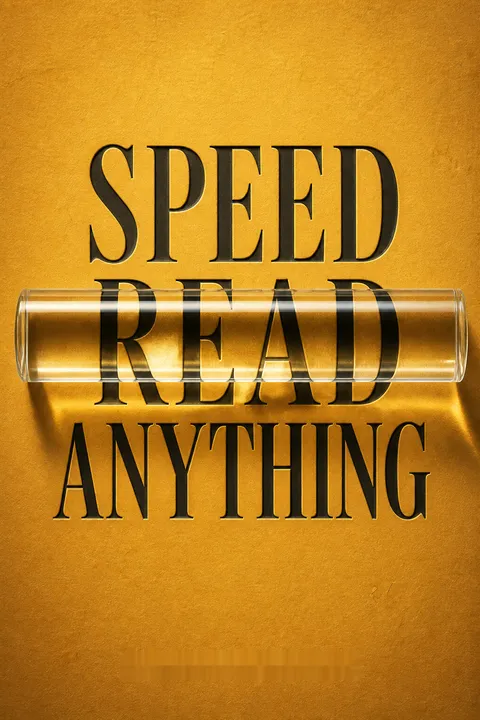
- Overview: "Speed Read Anything" by Peter Hollins is a guide on how to read a book a day with better retention than ever. It focuses on techniques to increase reading speed without sacrificing comprehension.
- Core Concept: The book introduces speed reading as a skill that involves more than just reading quickly; it includes understanding and retaining information efficiently.
- Methods and Techniques: Hollins presents various methods like the KBG Method, the 4 Ps Method, and the THIEVES Framework to help readers prepare and read more effectively.
- Target Audience: It's aimed at anyone looking to improve their reading efficiency, from students to professionals who need to process large amounts of information quickly.
Why should I read "Speed Read Anything"?
- Enhance Reading Skills: The book offers practical techniques to significantly increase your reading speed and comprehension, which can be beneficial in both personal and professional settings.
- Improve Retention: It provides strategies to retain more information, making your reading time more productive and effective.
- Time Management: By learning to read faster, you can save time and allocate it to other important tasks or leisure activities.
- Cognitive Benefits: The book discusses how reading can improve memory, focus, and even empathy, contributing to overall personal development.
What are the key takeaways of "Speed Read Anything"?
- Speed Reading Techniques: The book emphasizes reducing subvocalizations, training your eyes, and strategically skimming to read faster.
- Pre-Reading Strategies: Methods like the KBG Method and the 4 Ps Method help in preparing to read by understanding the text's structure and main ideas beforehand.
- Comprehension and Retention: Visualization and ocular fitness are highlighted as key strategies to improve understanding and memory of the material read.
- Myth Busting: The book dispels common myths about speed reading, such as the idea that it compromises comprehension or that it's impossible to read quickly with understanding.
What are the best quotes from "Speed Read Anything" and what do they mean?
- "Reading is arguably the one activity that can single-handedly make you smarter than you are today." This quote emphasizes the transformative power of reading in enhancing intelligence and knowledge.
- "Speed reading isn’t just about mindlessly reading as fast as you can." It highlights the importance of balancing speed with comprehension and retention.
- "Visualization is such a powerful tool for speed reading because humans are largely visual creatures." This underscores the role of visualization in improving reading comprehension and retention.
- "The average adult can read up to 300 words per minute." This sets a benchmark for readers to understand their current reading speed and the potential for improvement.
What is the KBG Method in "Speed Read Anything"?
- Purpose: The KBG Method is a pre-reading strategy designed to clarify your knowledge, biases, and goals before reading a text.
- Steps Involved: It involves three main steps: understanding the text's theme, familiarizing with its content through headings and introductions, and assessing your prior knowledge, biases, and goals.
- Application: This method helps in maximizing learning by focusing on what you already know, identifying biases, and setting clear learning objectives.
- Outcome: By using the KBG Method, readers can approach texts more strategically, enhancing both speed and comprehension.
How does the 4 Ps Method work in "Speed Read Anything"?
- Four Components: The 4 Ps Method consists of Purpose, Preview, Prior Knowledge, and Predict, each serving a specific role in pre-reading.
- Purpose: Determine why you are reading the text and what you aim to achieve, which influences your reading strategy.
- Preview: Familiarize yourself with the text's structure, including titles, headings, and introductions, to get an overview of the content.
- Prior Knowledge and Predict: Assess what you already know and make predictions about the text's content, which helps in engaging more deeply with the material.
What is the THIEVES Framework in "Speed Read Anything"?
- Acronym Meaning: THIEVES stands for Titles, Headings, Introduction, Every first sentence, Visuals, End of chapter questions, and Summary/conclusion.
- Purpose: It's a quick pre-reading strategy designed to be completed in about five minutes to get a broad understanding of the text.
- Application: By focusing on these elements, readers can quickly grasp the main ideas and structure of a text, aiding in faster and more effective reading.
- Efficiency: This method is particularly useful for those with limited time, providing a rapid way to prepare for reading.
How can I stop subvocalizations according to "Speed Read Anything"?
- Understanding Subvocalizations: Subvocalizations are the habit of saying words in your head as you read, which slows down reading speed.
- Techniques to Reduce: The book suggests using distractions like soft music, visual pacers like a finger, and even chewing gum to minimize subvocalizations.
- Visualization: Instead of subvocalizing, focus on visualizing the meaning of words, which can help in processing information faster.
- Practice: Regular practice and conscious effort are required to break the habit of subvocalization and improve reading speed.
How does "Speed Read Anything" suggest training your eyes for better reading?
- Eye Training Importance: Training your eyes is crucial for reducing unnecessary movements and increasing reading speed.
- Use of Pointers: Using a finger or pen as a pointer can help guide your eyes and maintain focus on the text.
- Peripheral Vision: Strengthening peripheral vision allows you to take in more words at a time, reducing the number of eye fixations needed.
- Exercises: The book recommends specific exercises to improve eye muscle flexibility and widen your vision span.
What is word-chunking in "Speed Read Anything"?
- Definition: Word-chunking is the practice of reading groups of words together instead of one at a time, which increases reading speed.
- Practice: Start by taking in two or three words at a time and gradually increase as you become more comfortable.
- Benefits: This method allows for faster processing of information without losing comprehension, as ideas are often conveyed in phrases rather than individual words.
- Tools: Resources like Ron Cole’s Alchemy Educational Training website can help practice word-chunking with custom PDFs.
How does "Speed Read Anything" address improving comprehension and retention?
- Visualization: The book emphasizes visualization as a key strategy, leveraging the brain's natural preference for visual information to enhance understanding.
- Ocular Fitness: Training your eyes to see more words at once and using exercises to improve peripheral vision are crucial for better retention.
- Reading for Ideas: Focus on understanding the main ideas and concepts rather than getting bogged down by individual words.
- Retention Strategies: Techniques like taking notes, summarizing, and teaching others what you've learned are recommended to improve retention.
What are some miscellaneous strategies to read faster in "Speed Read Anything"?
- Timing Yourself: Set a timer for one minute and see how much you can read, then try to beat that benchmark using speed-reading techniques.
- First and Last Lines: Focus on reading the first and last lines of paragraphs, especially in technical texts, to grasp the main ideas quickly.
- Vocabulary Improvement: Expanding your vocabulary can prevent slowdowns caused by unfamiliar words, thus improving overall reading speed.
- Practice and Patience: Regular practice and patience are essential as you incorporate these strategies into your reading routine.
About the Author
Other books by Peter Hollins




Download PDF
Download EPUB
.epub digital book format is ideal for reading ebooks on phones, tablets, and e-readers.








