

Key Takeaways
Treat learning as trainable skill, not a verdict on talent
Learning changes what is possible. Hollins opens with his own history as an unexceptional student, then tells of John, a new coworker who had overstated his qualifications. John filled his desk with reminders and short instructions, learned the unfamiliar job quickly, and reached his colleague’s level of proficiency within months. His advantage was not prior mastery, but a methodical willingness to learn.
A practical source of leverage. The book’s central claim is that learning is a skill for understanding, remembering, and using new knowledge. It can open doors that credentials or initial ability do not. John’s story makes that claim concrete: being behind at the start need not determine how well someone can perform later.
The opening story usefully shifts attention from looking capable to becoming capable. Its strongest implication is that learning strategies can matter even after someone enters a role without every prerequisite. Still, one fast-learning coworker cannot establish that effort alone overcomes every disadvantage. Access to time, support, and useful materials shapes who can improve. The story works best as an invitation to test one’s learning process, not as proof that barriers disappear when a person tries hard.
Schedule focused study blocks instead of trusting marathon effort
Attention needs boundaries. Hollins argues that concentrated learning is limited, and recommends sessions of roughly 30 to 50 minutes followed by a short break, often five to ten minutes. The precise interval should be adjusted to the learner and task. A 25-minute work period followed by five minutes away from the material is another option, not a universal prescription.
Plan for your own rhythms. Put study blocks on a calendar, choose times when concentration is more available, and protect sleep and meals. Hollins also discusses the body’s roughly 90-minute ultradian cycles as a possible guide to planning. The practical lesson is not to worship a timer, but to notice fatigue and stop treating more hours as automatic proof of more learning.
A scheduled block converts an intention into a manageable unit, while a break creates a natural point to notice whether attention is still productive. The useful test is quality of engagement, not minutes completed. Claims about a single human attention span can be misleading because focus varies with task difficulty, familiarity, and setting. A learner should treat the suggested timings as starting points, then adjust based on whether the work is producing understanding rather than mere time at a desk.
Learn the pattern first, then hang details on it
Facts need a framework. Concept learning means organizing examples around the underlying ideas or relationships that explain them. Instead of memorizing isolated dates and names about a court ruling, a learner might first grasp the larger questions about defendants’ rights and police procedure. Those ideas give individual details somewhere to belong, making them more meaningful and easier to reconstruct.
Understand why steps work. Hollins illustrates this with cooking. A recipe gives instructions for making sauce, but understanding how early cooking builds flavor and simmering brings ingredients together makes the method transferable to other dishes. Memorizing a recipe may help reproduce one meal; grasping the principles makes it easier to adapt, troubleshoot, and learn a new recipe.
A conceptual map makes knowledge more than a collection of stored answers. It gives the learner a way to infer, adapt, and notice relationships when a familiar problem changes shape. Yet not every task hides a useful pattern: arbitrary lists, vocabulary, or exact sequences may still require direct memorization. The strongest approach is therefore not to reject facts, but to ask which facts can be explained by a structure and which must simply be practiced until retrievable.
Let difficult attempts teach you before supplying the answer
Failure can reveal structure. Productive failure is an approach in which learners first try a challenging problem without being shown the solution, then explain their reasoning and compare possible approaches. In a study described by Hollins, one group received instructional support and solved the assigned problems. Another group worked together without that help and did not solve them, yet performed better on a later test of the material.
Keep struggle calibrated. The point is not to leave people stranded. Choose problems that challenge without overwhelming, ask learners to make their thinking visible, and compare successful and unsuccessful solutions. Keeping a record of what went wrong can turn an unsuccessful attempt into information for the next one. Frustration is useful only when it leads to reflection or a changed strategy.
An unsuccessful first attempt can expose assumptions that a polished demonstration leaves hidden. The learner must decide what the problem requires, where the uncertainty lies, and which ideas might apply. That effort can deepen understanding, but struggle is not automatically educational. Without a later explanation, feedback, or a chance to revise, repeated failure may only entrench confusion. The valuable sequence is attempt, diagnosis, correction, and another attempt, not difficulty for its own sake.
Retrieve information repeatedly, with gaps that let forgetting begin
Memory is built in stages. Hollins describes encoding information, storing it, and retrieving it. Forgetting is normal: the forgetting curve, associated with Hermann Ebbinghaus, represents how recall declines when material is not revisited. Retrieval practice means actively bringing information to mind instead of merely rereading it. Trying to answer a question before checking the notes asks more of memory than recognizing a familiar answer on a page.
Return at intervals. Spaced repetition distributes reviews over time. Hollins gives a Spanish history example: after an initial lesson, a learner briefly tests recall and reviews notes across several days. The schedule adds about 75 minutes of work across the week but revisits the material six times. The key is frequent, effortful recall, followed by checking what was missed.
Retrieval changes studying from exposure to a test of what can actually be produced. That distinction matters because familiarity while looking at notes can be mistaken for independent knowledge. Spacing also makes review diagnostic: each return reveals what has endured and what needs attention. The book’s schedule is an illustration, not a magic timetable. Review intervals should respond to the material and the learner’s results, and a short review that never checks accuracy can preserve errors as easily as correct knowledge.
Make study active: explain, test, and mix related practice
Do more than mark the page. A review of study methods discussed by Hollins distinguishes useful active techniques, such as practice testing and distributed practice, from familiar methods that may help less on their own, including highlighting and rereading. Elaborative interrogation asks why a claim is true. Self-explanation asks the learner to describe how an idea or solution works.
Expose gaps in plain language. The Feynman technique applies self-explanation: choose an idea, explain it simply, find where the explanation breaks down, and use an analogy to test understanding. Interleaved practice alternates among related skills rather than completing one large block of each. Hollins reports a 43 percent improvement in learning and retention in comparisons cited by the book, while noting that interleaving is not indiscriminate multitasking.
These techniques make the learner generate, connect, and distinguish ideas, rather than simply encounter them again. That is a more demanding way to study, and the extra effort makes misunderstandings harder to hide. The reported advantage for interleaving should not be treated as a guarantee for every subject or person. The useful distinction is between deliberate alternation among related problems, which forces choices, and scattered attention across unrelated activities, which can derail the work.
Give new skills a real-world job beyond learning itself
Let a goal pull learning along. Hollins calls this making learning secondary: knowledge grows as a byproduct of pursuing something that matters. He describes studying Spanish to impress a classmate and his brother learning to type faster in order to chat online. In both cases, the immediate goal supplied repeated practice without making practice itself the main attraction.
Start with a problem. Problem-based learning begins with a real task, then identifies what is already known, what remains unknown, and how to get the missing information. A learner who wants calmer dinners might plan meals and use the process to improve cooking. Games, progress trackers, or a brief ten-minute start can also help sustain effort, but the book cautions that rewards cannot replace a worthwhile purpose.
A practical goal gives study a reason to continue when the material is dry. It also creates a feedback loop: knowledge is tested against a task, not just recalled in isolation. The larger aim matters, though. A game can make progress visible, but points can also become a distraction if they reward activity rather than competence. The strongest design keeps the external goal meaningful and uses practice, milestones, and feedback to move toward it.
Teach someone else to discover what your own understanding misses
Teaching forces precision. The protégé effect describes how preparing to teach can make learners work harder to understand, organize, recall, and apply material. Hollins describes Stanford students who taught virtual agents by building concept maps for them. Those students engaged more with the material than peers who made maps only to display their own understanding.
Make explanation accountable. Teaching requires more than claiming familiarity. A learner must explain steps, relationships, and answers to questions. Giving feedback sharpens the task: useful feedback is specific, timely, connected to a goal, respectful, and paired with a next step. Hollins also discusses the Learning Pyramid’s estimates of retention across activities, but warns that its numbers are not established as exact measures. Its broad point is that active participation matters.
Teaching creates an audience, even if the audience is a virtual student or an imagined beginner. That perspective pushes the learner to organize knowledge for someone who cannot fill in the missing steps. It can also reveal how much explanation depends on jargon. The role does not require formal expertise or a classroom: answering a real question or demonstrating a process can serve as a test. Accuracy still matters, so teaching should include checking explanations against reliable material.
Monitor your thinking, then steer it with better questions
Notice the learning process. Metacognition is awareness of how one is thinking, paired with the ability to regulate that thinking. A learner might notice that diagrams hold attention better than dense paragraphs, try making a diagram, then check whether comprehension improves. The cycle is observation, adjustment, and assessment, not a fixed judgment about one’s ability.
Give reading a route. PQ4R is a structured approach that asks readers to preview material, form questions, read, reflect on meaning, recite key ideas from memory, and review. Before, during, and after study, useful questions include what is unclear, how an idea connects to what is already known, and what can be done with it. The method turns reading into purposeful inquiry rather than eye movement alone.
Self-monitoring allows the learner to change tactics before an unproductive session becomes a habit. Its power lies in making a vague problem specific: not understanding may mean unfamiliar vocabulary, a missing prerequisite, or fading attention, and each calls for a different response. The risk is over-monitoring, where reflection consumes the time meant for practice. A few purposeful questions at natural stopping points can guide action without turning every study session into an audit.
Turn reading and notes into a conversation with the material
Read at the depth the task deserves. Hollins presents Mortimer Adler’s four reading levels, from basic decoding through survey reading, close analysis, and comparison across multiple works. A quick survey can establish what a book covers; close reading is more appropriate when the goal is to explain its argument; comparing several sources helps map a whole subject.
Make notes do work. The Cornell method divides a page into a main-notes area, a cue column, and a summary space. After recording material, the learner distills it into prompts and a concise account. Hollins also describes editing, analyzing, and reflecting on notes. Copying another person’s outline may save effort, but phrasing and organizing ideas oneself forces a more active encounter.
Different purposes warrant different depths of reading. Treating every text as a cover-to-cover assignment wastes time, while skimming alone cannot support expertise. The staged approach lets readers decide what deserves close attention. Notes are most useful when they become a retrieval tool, not a transcript or decorative archive. A brief summary and a question that can be answered from memory make a page more useful than a large volume of copied text.
Praise the learning process, not a supposedly fixed talent
Treat ability as developable. Carol Dweck’s fixed and growth mindsets describe contrasting beliefs about whether capability can change. In the book’s account, children with a fixed mindset tended to choose easier puzzles that confirmed current ability, while growth-minded children chose harder ones as a chance to learn. The distinction changes how setbacks are interpreted: a wrong answer can be evidence of incapacity or information for improvement.
Reinforce useful action. Hollins recommends praising effort and strategy rather than labeling someone naturally clever. Praise can point to persistence, a thoughtful revision, or the way a learner worked through a problem. This encourages attention to controllable actions. It does not mean effort is always enough; a learner may also need better instruction, resources, or a different strategy.
Process-focused praise directs attention toward choices a learner can repeat or revise. It also makes feedback less like a verdict on identity. The distinction should not be flattened into the idea that effort alone guarantees success: persistent use of an ineffective method can waste time, and circumstances differ. More useful encouragement recognizes effort alongside strategy, help-seeking, and adjustment. A growth-oriented stance keeps failure informative without pretending that every obstacle is under individual control.
Use varied formats instead of treating preferences as brain limits
Preference is not destiny. Hollins challenges the claim that each person has a fixed learning style, such as visual, auditory, or kinesthetic, that must be matched to instruction for learning to occur. People may enjoy or prefer certain formats, but the book argues that preference alone is not evidence that other formats cannot work. Relying on one label can unnecessarily narrow what a learner tries.
Adjust the process, not your identity. The book contrasts learning styles with Gregorc’s mind styles, organized around concrete versus abstract perception and sequential versus random ordering. These describe preferences for how information is encountered, rather than a single medium required for learning. A learner can use text, diagrams, demonstrations, and practice, then choose what best serves the task instead of treating a category as a limit.
The distinction between liking a format and learning only through it is important. Preferences can guide engagement, but they need not dictate the whole curriculum. Trying multiple modes can also reveal which one helps with a particular task, rather than turning a past preference into a permanent identity. The mind-style categories may be useful as prompts for reflection, but they should not become another rigid label. Their practical value depends on whether they help someone adapt the learning environment.
Analysis
The book’s most useful through-line is that learning improves when a person stops treating it as information intake and starts treating it as an activity. Attention creates the conditions, conceptual structure gives facts context, retrieval strengthens access, and explanation or practice tests whether understanding can travel beyond the page. The personal anecdotes make that sequence human: the coworker who learned a job through reminders, the student studying Spanish for a social goal, and the novice who learns by solving an actual problem all illustrate learning as behavior in context.
The most actionable recommendations are also the ones with the clearest feedback loop: attempt recall, check the result, identify a gap, and return to it later. This is more reliable than judging progress by hours spent or pages highlighted. The book’s repeated preference for active learning is persuasive, but activity alone is not a sufficient measure. A learner can be busy explaining a misconception or repeatedly practicing an unhelpful approach. Correction and a meaningful standard of accuracy are essential parts of practice.
The book sometimes presents estimates and broad claims with more certainty than they warrant. Its attention-span figures and Learning Pyramid retention percentages should not be mistaken for universal laws, and a suggested study interval is not a biological prescription. Its own better advice is to monitor performance and adjust. Likewise, a growth mindset can make challenge more approachable, but it cannot substitute for teaching, time, or access to resources.
Taken as a toolkit rather than a rigid system, the book offers a coherent cycle: orient yourself, engage with a task, retrieve and explain what you know, notice what remains unclear, and choose the next attempt. That cycle is useful because it joins memory, motivation, and self-correction without requiring one perfect method for every subject.
Review Summary
Super Learning receives mostly positive reviews, with readers praising its concise, practical approach to effective learning strategies. Many appreciate the scientific basis and real-world applications. Readers find value in techniques like spaced repetition, active learning, and teaching to learn. Some criticize the book for being basic or lacking originality. Overall, reviewers recommend it as a helpful guide for students and lifelong learners, though some suggest it's better suited for those new to learning methodologies.
People Also Read





Glossary
Concept learning
Learning by underlying patternsA way of learning that organizes examples around the important features and relationships they share. Instead of storing facts as isolated items, the learner builds an understanding of the broader idea that explains them. That structure can make details easier to remember, apply, and adapt to new situations.
Productive failure
Learning through initial struggleAn instructional approach in which learners first attempt challenging problems before receiving full guidance. The attempt may not produce a correct answer, but learners generate ideas, examine the problem, and compare possible solutions. The struggle is intended to support deeper understanding when it is followed by explanation and reflection, not left unresolved.
Forgetting curve
Memory loss over timeA description of how recall tends to decline over time when information is not reviewed. Hollins attributes the concept to Hermann Ebbinghaus and emphasizes that rehearsal can strengthen later recall and slow the decline. The curve is a model of forgetting, not a precise timetable for every learner or subject.
Retrieval practice
Actively recalling learned materialA learning technique that requires bringing previously studied information to mind, rather than simply rereading it. A learner might answer a question from memory, explain a concept aloud, or use a flashcard and state the answer before checking. The effort of recall helps reveal what is accessible and what still needs work.
Spaced repetition
Reviewing across timeA practice of returning to material at intervals instead of concentrating all study into one session. Hollins presents it as a way to counter forgetting and strengthen recall through repeated exposure over time. Reviews are most useful when they involve active recall and checking, rather than passive rereading alone.
Interleaved practice
Alternating related practice topicsA practice schedule that alternates among related skills or topics instead of completing one uninterrupted block of each. Because the learner repeatedly has to identify which approach fits a problem, interleaving can strengthen discrimination among concepts. Hollins distinguishes this deliberate alternation from multitasking across unrelated activities.
Feynman Technique
Testing understanding through explanationA self-explanation method named for physicist Richard Feynman. The learner selects a concept, explains it in plain language, locates gaps in the explanation, and uses an analogy to test whether the idea is understood. The method treats difficulty explaining a concept as a signal to revisit the underlying material.
Problem-based learning
Learning by solving a problemAn approach that begins with a practical problem rather than a prepared sequence of facts. Learners identify what they know, what they need to learn, where to find the missing information, and how to use it to develop a solution. The problem gives learning a purpose and creates opportunities to apply knowledge.
Protégé effect
Learning more by teachingThe improvement in a learner’s effort and understanding that can occur when preparing to teach another person or a teachable agent. Teaching requires information to be organized, recalled, and explained accurately. The responsibility to help someone else learn can prompt more careful engagement than studying only for oneself.
Metacognition
Monitoring and regulating thoughtAwareness of one’s own thinking and the ability to adjust it toward a goal. In learning, metacognition includes noticing what is confusing or engaging, judging whether a study strategy is working, and changing the approach when needed. It combines observation of thought with deliberate regulation of the learning process.
PQ4R Method
A structured reading routineA reading and study method whose name refers to preview, question, read, reflect, recite, and review. The reader first surveys the material and forms questions, then reads actively, connects ideas to existing knowledge, recalls key information, and checks understanding. It is designed to make reading more purposeful and memorable.
Cornell method
Notes organized for reviewA note-taking format that divides a page into an area for main notes, a narrower cue column, and a summary section. After recording information, the learner identifies key prompts and condenses the central ideas. This creates material that can be reviewed and used for recall, rather than merely stored as a transcript.
Mind styles
Preferences for processing informationAnthony Gregorc’s model describes preferences across two dimensions: concrete or abstract perception, and sequential or random ordering. Their combinations form four broad patterns for approaching information. Hollins presents these as possible preferences for organizing learning, not as fixed channels that determine whether a person can learn.
Learning Pyramid
A model of learning activityA model that ranks learning activities from more passive forms, such as lectures and reading, to more active forms, such as practice and teaching. Hollins uses it to illustrate the general claim that active participation supports learning, while cautioning that its specific retention percentages are not exact or firmly established.
FAQ
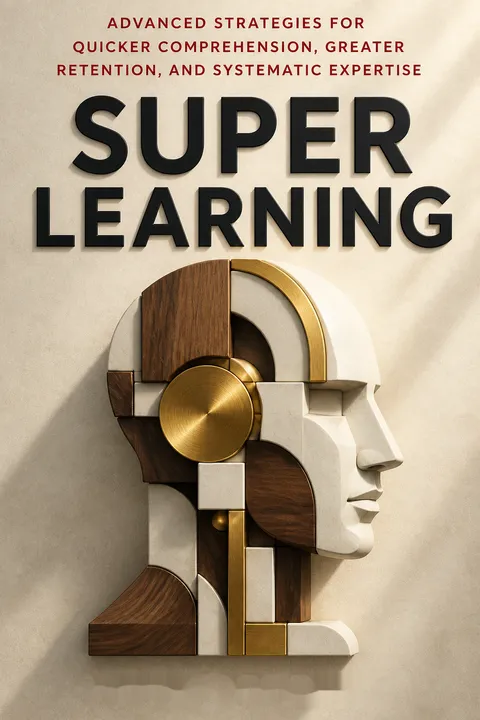
What's "Super Learning: Advanced Strategies for Quicker Comprehension, Greater Retention, and Systematic Expertise" about?
- Focus on Learning Efficiency: The book by Peter Hollins provides strategies to enhance learning speed, retention, and expertise systematically.
- Scientific Principles: It uses scientific principles to help readers understand how to learn effectively, focusing on attention span, memory retention, and active learning techniques.
- Practical Techniques: The book offers practical techniques like retrieval practice, spaced repetition, and the Feynman Technique to improve learning outcomes.
- Mindset and Motivation: It also emphasizes the importance of mindset, motivation, and making learning secondary to a larger goal.
Why should I read "Super Learning" by Peter Hollins?
- Improve Learning Skills: The book is ideal for anyone looking to improve their learning skills, whether for academic, professional, or personal development.
- Scientific Backing: It provides scientifically-backed methods to enhance memory retention and comprehension.
- Practical Application: The strategies are practical and can be applied to various learning contexts, making them versatile.
- Mindset Shift: It encourages a shift in mindset towards a growth-oriented approach, which can be beneficial beyond just learning.
What are the key takeaways of "Super Learning"?
- Attention Span Management: Understanding and working within the limits of your attention span can enhance learning efficiency.
- Memory Techniques: Techniques like retrieval practice and spaced repetition are crucial for long-term memory retention.
- Active Learning: Engaging actively with material through methods like the Feynman Technique leads to deeper understanding.
- Growth Mindset: Adopting a growth mindset can transform how you approach challenges and learning opportunities.
How does Peter Hollins define "Super Learning"?
- Accelerated Learning: Super Learning is about learning how to learn efficiently, focusing on quick comprehension and retention.
- Systematic Expertise: It involves developing systematic expertise by using structured methods and techniques.
- Beyond Memorization: The concept emphasizes understanding and applying knowledge rather than just memorizing facts.
- Life Application: Super Learning is seen as a way to create a better version of oneself and steer life in desired directions.
What is the Forgetting Curve and how does it relate to "Super Learning"?
- Memory Decay: The Forgetting Curve illustrates how memory retention decreases over time without reinforcement.
- Rehearsal Importance: Regular rehearsal and review can flatten the curve, leading to better long-term retention.
- Spaced Repetition: The book emphasizes spaced repetition as a method to combat the Forgetting Curve effectively.
- Memory Techniques: Understanding the Forgetting Curve helps in applying memory techniques more strategically.
What is the Feynman Technique mentioned in "Super Learning"?
- Simplified Explanation: The Feynman Technique involves explaining a concept in simple terms to identify gaps in understanding.
- Four Steps: It includes choosing a concept, explaining it plainly, identifying blind spots, and using analogies.
- Deep Understanding: This technique helps in achieving a deeper understanding by forcing you to simplify and clarify your thoughts.
- Practical Application: It's a practical tool for both learning new material and teaching others.
How does "Super Learning" address the concept of a growth mindset?
- Mindset Impact: The book highlights how a growth mindset can positively impact learning and personal development.
- Embrace Challenges: It encourages embracing challenges and viewing failures as opportunities for growth.
- Effort and Improvement: A growth mindset focuses on effort and improvement rather than innate talent.
- Mindset Shift: The book provides strategies to shift from a fixed to a growth mindset, enhancing learning potential.
What is the role of "productive failure" in "Super Learning"?
- Learning from Mistakes: Productive failure involves learning from mistakes and using them as stepping stones to success.
- Deeper Understanding: It encourages a deeper understanding of problems by allowing learners to explore solutions independently.
- Growth Opportunity: The book suggests that failure can be a valuable source of information if approached correctly.
- Mindset Adjustment: Embracing failure requires a mindset adjustment, focusing on long-term learning rather than immediate success.
How does "Super Learning" suggest using retrieval practice?
- Active Recall: Retrieval practice involves actively recalling information to strengthen memory retention.
- Flashcards and Quizzes: Techniques like flashcards and regular quizzes are recommended to implement retrieval practice.
- Memory Reinforcement: This method reinforces memory by repeatedly accessing stored information.
- Learning Enhancement: It shifts learning from passive absorption to active engagement, improving retention and understanding.
What is the PQ4R Method in "Super Learning"?
- Structured Reading: PQ4R stands for Preview, Question, Read, Reflect, Recite, and Review, a method to enhance reading comprehension.
- Active Engagement: It encourages active engagement with the material, leading to better understanding and retention.
- Step-by-Step Process: The method provides a step-by-step process to approach reading systematically.
- Comprehension Improvement: By following these steps, readers can improve their comprehension and memory of the material.
How does "Super Learning" address the myth of learning styles?
- Scientific Evidence: The book challenges the idea that tailoring learning to specific styles is scientifically supported.
- Flexible Learning: It advocates for a flexible approach, using multiple methods and senses to enhance learning.
- Mind Styles: Instead of learning styles, the book discusses mind styles, focusing on how individuals process information.
- Comprehensive Approach: A comprehensive approach to learning, using various techniques, is recommended for better outcomes.
What are the best quotes from "Super Learning" and what do they mean?
- "Learning is how you create the life you want." This quote emphasizes the transformative power of learning in shaping one's life.
- "Expect frustration, but don’t succumb to it." It highlights the importance of resilience and perseverance in the learning process.
- "Learning is the only way to create a better version of yourself." This underscores the role of continuous learning in personal development.
- "Failure is a part of learning, so embrace it when it happens." It encourages viewing failure as a natural and valuable part of the learning journey.
About the Author
Other books by Peter Hollins



Download PDF
Download EPUB
.epub digital book format is ideal for reading ebooks on phones, tablets, and e-readers.








