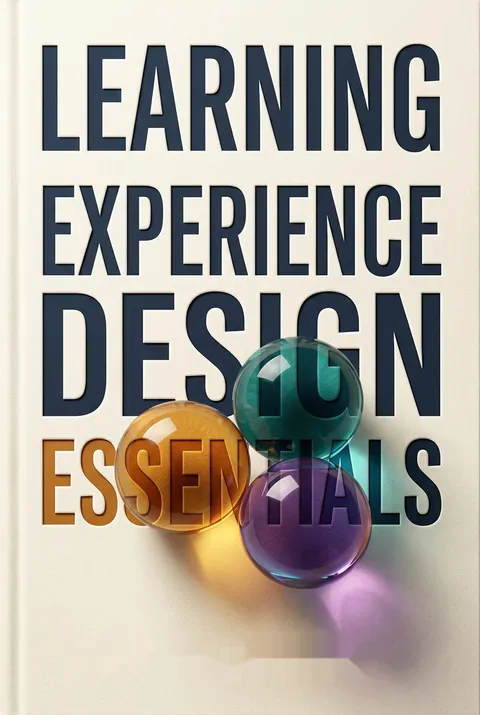


Key Takeaways
Design for the job people face, not the course you can build
Start with the whole experience. Cara North defines learning experience design, or LXD, as combining content with context to help people perform. Content is the information and practice needed for a task. Context includes the workplace, tools, constraints, and situations in which people must apply it. A course can explain how to prevent a manufacturing defect, for example, but still fail if poor lighting makes the defect hard to see.
Engagement has three parts. Learners need to do something, think through a meaningful challenge, and feel that the experience matters. A polished digital module is only a delivery vehicle. North adapts a metaphor from learning scholar M. David Merrill: the technology is the truck, but usable learning is the cargo. A sleek truck cannot rescue the wrong or damaged cargo.
What's valuable here is the shift from judging a learning product by what it contains to asking whether it fits the conditions of use. That resembles human-factors engineering, which treats performance as an interaction between people, tools, and environments rather than a test of memory alone. The emotional dimension matters too: relevance can invite attention, while a punitive or detached course can signal that workers are being blamed. Still, engagement should not become a proxy for effectiveness. Enjoyment, activity, and learning are related, but they are not interchangeable; evidence of job performance remains essential.
Treat every training request as a hypothesis, not a prescription
Find the cause first. Stakeholders may request training after a mistake, but mistakes can arise from unclear procedures, insufficient tools, fatigue, poor communication, or gaps in skill. The five whys is a root-cause technique: ask why a problem occurred, then keep asking why until the underlying conditions become clearer. It is not a magic formula, but it can expose assumptions hidden inside a request.
Look beyond the person who requested help. In one example, a care worker gave a resident food that conflicted with the resident's dietary restriction. The requester wanted a training course, but lacked information about why the mistake happened. Was it a knowledge gap, an unavailable suitable snack, or an exhausted worker filling in? Each cause calls for a different response. Training cannot repair broken systems or substitute for a necessary conversation.
This is a useful application of systems thinking: an error is a starting signal for investigation, not proof that an individual failed to learn. In safety-critical work, focusing only on the last person in a chain can conceal design flaws that make mistakes predictable. The five whys helps slow that reflex, although repeated questioning can oversimplify complex causes or steer discussion toward a convenient answer. Interviews with workers, observation, and operational data help test the emerging explanation. The learning designer's influence also has limits: identifying a staffing or accountability problem does not grant authority to fix it.
Tie the project to a measurable business outcome before building
Make the request concrete. North recommends gathering information before agreeing to develop a course. Ask what problem is occurring, what evidence shows it exists, who performs the task, what has already been tried, and how success would be recognized. A kickoff meeting should bring relevant people together to test the problem and identify a useful measure, such as product yield or delivery performance.
Put the partnership in writing. A scope agreement records the work, responsibilities, deliverables, communication plan, and timing. It may include a memorandum of understanding that clarifies what the designer and subject matter experts each owe the project. The cost of time makes alignment practical, not bureaucratic: one hour of mandatory training for 1,000 employees earning an average of $25 per hour represents at least $25,000 in employee time, before development or technology costs.
The strongest move is translating a vague request into a shared definition of success before resources are committed. This is closely related to program evaluation: measures are most useful when chosen before an intervention, not after someone needs to prove it worked. But a metric is a compass, not the territory. A performance measure can be influenced by equipment, staffing, policy, and market conditions, so the team should record those conditions and avoid attributing every change to training. A clear scope also distributes responsibility, preventing a designer from being held accountable for work that depends on unresponsive partners.
Watch people work before trusting the expert's version of work
Map the real task. A task analysis documents how people perform work, what tools and knowledge they need, what decisions they make, how they know a step is correct, and where errors occur. Designers can observe workers, interview several people who do the job, and compare what they see with current procedures. This matters because experts may describe an ideal process while overlooking the shortcuts, constraints, and local language of everyday work.
Use the evidence to edit. North recalls creating a mandatory course about an online wish-list product after relying on a senior stakeholder's content. She did not investigate customer-service agents' existing knowledge or the frequency of related calls. The course consumed time during the busiest period and addressed the wrong need. A task analysis helps identify what belongs in practice and what can remain a reference resource.
Task analysis turns tacit expertise into something that can be checked, taught, and supported. It also gives the designer a principled reason to exclude information: content earns a place when it supports a real task or decision. This is powerful because expert knowledge is often compressed; experienced workers may skip steps mentally that novices still need to see. Observation has limits, however. A few workers may not represent every shift, location, or exception. Comparing multiple accounts and validating findings with a broader group reduces the risk of designing for one person's habits.
Choose the simplest usable format, not the shiniest technology
Let the task choose the medium. A communication, job aid, discussion, simulation, or course may each be appropriate in different circumstances. North has designed everything from brief workplace notices to instructor-led sessions. Choosing an authoring tool first can turn every problem into the same kind of product, even when a quick performance-support resource would be more useful.
Test the experience, not just the content. User experience concerns how the whole product works; user interface concerns its presentation and controls. North describes a course that learners called broken because they did not realize they needed to scroll to continue. A five whys analysis of a delayed hospital software launch also showed that missing departments in early planning, not poor time management, caused the delay. Both examples argue for asking why a product or process fails before adding more instruction.
This distinction protects learning design from a familiar technology trap: choosing a tool because it is available, then shaping the problem around its features. Usability principles such as clear status, consistent controls, and ways to recover from mistakes reduce needless cognitive effort. Testing with actual users is more reliable than assuming a navigation choice is obvious. The same discipline applies to aesthetics: attractive design can build trust, but it cannot compensate for irrelevant content. Conversely, a simple format can be highly effective if people can find it when the task arises.
Make access part of the design, not a retrofit
Build for varied conditions. North uses POUR, an accessibility framework whose four qualities are perceivable, operable, understandable, and robust. In practice, that means providing captions and transcripts, writing useful descriptions for meaningful images, making controls keyboard-accessible, using clear language and headings, and testing materials across technologies. The author began using live captions for presentations after noticing her own hearing difficulty; captions helped her follow her words and made the talk easier for others to access.
Plan for more than permanent disabilities. A temporary injury, a noisy workplace, limited internet, or the need to pause while caring for a child can also make a standard experience difficult to use. Testing offline, allowing learners to pause, and offering more than one way to access information can help a broader audience. Accessibility added at the start is usually easier to plan than retrofitting a finished product.
Accessibility is strongest when it is treated as a design condition rather than a special request that learners must disclose. The curb-cut effect captures the broader value: features built for people with disabilities can also help people navigating temporary or situational barriers. POUR gives teams a practical checklist, but a checklist cannot tell designers how a real person experiences a product. Testing with people who use assistive technologies is therefore more than quality control; it corrects the blind spots of teams designing from their own assumptions.
Assess decisions in realistic practice, not quiz-taking tricks
Make assessment resemble the work. Multiple-choice questions can test knowledge, but clues in the wording or an obviously longer correct answer may let learners guess. A work-based scenario gives people a safe chance to make decisions before the job carries consequences. The learner should know whose role they are taking, face a realistic choice, and receive feedback explaining why an answer works or fails.
Practice should match the risk. The 3C model for scenarios organizes an activity around a challenge, choices, and consequences. North's manufacturing team built a 40-hour machinist program with at least 20 hours of hands-on practice, including simulations of machine tasks. Learners were expected to make mistakes in a safe setting, then use coaching to correct them. Formative assessments check understanding during learning; summative assessments judge whether learners can apply it.
The emphasis on realistic practice reflects a basic principle of transfer: people need opportunities to retrieve and use knowledge in conditions resembling the decisions they face. Scenarios can expose misunderstandings that a recall quiz hides, while informative feedback turns an error into useful evidence. Yet realism should not mean piling on names, backstory, and irrelevant complexity. Those demands can measure reading stamina instead of job skill. Nor should every activity simulate high stakes. Practice needs to be challenging enough to reveal gaps, but safe enough that learners can examine and correct them.
Launch with a reason, then track whether work actually changes
Explain the purpose and logistics. A launch message should say what is happening, why it matters, who is expected to participate, how much time it requires, and what happens next. Tell leaders as well as learners, and plan for the work time people will lose while training. After launch, observe a live session, visit the work area, or gather a user group. North shares a colleague's story of finding an employee asleep in front of a newly launched course, a blunt reminder that delivery is not proof of attention.
Evaluate beyond satisfaction. The Kirkpatrick model distinguishes reaction, learning, behavior on the job, and organizational results. A confidence question can reveal who needs support; managers can report whether new behaviors appear at work; business measures can show whether broader results changed. Those results may have causes beyond training, so evaluation must consider workplace conditions too.
This approach treats launch as the beginning of observation rather than the finish line. The four evaluation levels help separate a pleasant experience from acquired skill, applied behavior, and organizational impact, distinctions often blurred by a single satisfaction score. Follow-up can also uncover needs that a course cannot meet, such as coaching or clearer management expectations. Attribution remains difficult: a business metric may improve or decline for reasons unrelated to learning. Strong evaluation therefore combines learner reports, observation, and operational evidence instead of treating one number as a verdict.
Grow beyond course production without losing the user's point of view
Expand the craft deliberately. North's research coded 100 job postings against three capability areas. It found 346 mentions of professional-development capabilities, 193 of personal capabilities, and 94 of organizational-impact capabilities. The imbalance suggests that job descriptions often emphasize producing learning materials more than influencing business performance. North groups LXD skills into foundational work, such as research, needs assessment, learning science, and relationships; applied work, such as accessibility, measurement, and technology; and strategic work, such as agility and resource management.
The setting changes the work. Higher education brings accreditation and faculty partnerships; corporate roles often face urgency, business metrics, and access to workers; consultants may have influence but limited organizational context. Across these settings, the champion's job is to keep learning grounded in actual work while continuing to develop the skills needed to serve it.
The job-posting analysis gives the book's professional argument an empirical anchor: the field is expected to span more than course production, yet organizational-impact skills appear less often in postings. Broader capability can help designers earn influence, but it also creates a risk of role overload. A designer cannot be the needs analyst, developer, project manager, accessibility specialist, and evaluator on every project. Organizations need to resource that breadth, while practitioners make deliberate choices about which capabilities to deepen and where partnerships can fill gaps.
Analysis
The book's central contribution is a practical reframing of learning design as a performance service rather than a content-delivery function. Its strongest move is causal: before building a solution, investigate the task, its setting, and the conditions that shape performance. That principle connects needs assessment, task analysis, user experience, accessibility, assessment, communication, and evaluation into one coherent practice. The sequence is not merely a production workflow. It is a safeguard against mistaking a requested deliverable for the actual problem.
North makes the argument credible through candid failures and workplace examples. The wish-list course demonstrates how a designer can satisfy a powerful stakeholder while failing the people who do the work. The manufacturing examples show the opposite: authentic practice, user input, and operational partnership can produce learning that resembles performance rather than a test of recall. Accessibility is also treated as a design obligation, not a charitable extra, and the book's attention to situational barriers widens the idea of who a learner is.
The framework's main tension is that designers are asked to become broader strategists while many organizations still define them as rapid content producers. Intake forms, scoped responsibilities, and outcome measures can help establish professional boundaries, but they cannot create organizational authority on their own. The book is appropriately clear that training cannot repair poor management, missing equipment, or a hostile environment. Its performance focus also needs a humanistic counterweight: measurable productivity is important, but learning can serve development, confidence, and inclusion even when immediate business returns are difficult to quantify.
The most useful reading is therefore not as a rigid ten-step recipe, but as a set of questions that keep the learner, the task, and the workplace visible. The repeated call to observe, test, listen, and revise makes LXD less like decorating information and more like responsible systems design.
Review Summary
Learning Experience Design Essentials receives mostly positive reviews, with an average rating of 4.06 out of 5. Readers praise the author's experience and clear roadmap for learner experience design, highlighting chapters on assessment and analysis as particularly strong. The book is recommended for learning and development professionals, offering helpful tips and best practices. Some appreciate the author's openness about successes and failures, likening it to mentorship sessions. However, one critical review suggests the book may be tedious for some readers.
People Also Read









Glossary
Learning experience design (LXD)
Content shaped for performanceNorth's approach to designing learning by joining useful content with the context in which people must apply it. It considers the work, the learner, the environment, and the supports needed after a formal learning event. Its aim is not simply to deliver information, but to help people perform tasks successfully.
Task analysis
Map how work is doneA structured examination of a job or task that records its steps, performance criteria, tools, required knowledge, decisions, safety concerns, and common errors. It can draw on observation, interviews, and existing procedures. In LXD, it helps designers verify expert claims, understand real working conditions, and create relevant practice and support.
Action mapping
Design from business performanceA performance-centered design process associated with Cathy Moore. It begins with a measurable business goal, identifies the actions people need to take, investigates barriers to those actions, and selects solutions accordingly. Training is included when people need knowledge or practice, rather than assumed to be the answer to every performance problem.
POUR
Four accessibility qualitiesAn accessibility framework describing content as perceivable, operable, understandable, and robust. Perceivable content can be sensed through alternatives such as captions or image descriptions. Operable content works through different controls, including a keyboard. Understandable content uses clear language and consistent structure. Robust content works across technologies and assistive tools.
Five whys
Trace a problem's causesA root-cause questioning technique in which a team asks why a problem occurred, then asks why again about each answer. The repeated questions can reveal system conditions beneath an apparent individual error. It is a prompt for investigation, not proof that every complex problem has one simple cause.
3C
Structure a learning scenarioA scenario-design model organized around a challenge, the choices available to the learner, and the consequences of those choices. It helps make practice active and decision-focused. Feedback should explain the reasoning behind outcomes, particularly when an incorrect choice signals a skill or knowledge gap.
Kirkpatrick New World Evaluation Model
Evaluate four outcome levelsAn evaluation framework that considers four levels: participant reaction, learning, behavior on the job, and organizational results. The levels move from immediate response to broader impact. The framework helps distinguish satisfaction from learning and application, while organizational results still require caution because many factors besides training influence performance.
Scope agreement
Clarify project responsibilitiesA project document that aligns the learning designer and stakeholders on tasks, deliverables, responsibilities, timing, communication, and measures of success. It makes collaboration explicit and helps manage delays or changing expectations. It can include a memorandum of understanding that specifies each partner's contributions.
Panicgogy
Emergency teaching under pressureNorth's informal term for teaching created in a state of urgency, with more emphasis on responding to a crisis than on carefully designed online learning. She uses it to distinguish hurried emergency remote teaching from a deliberately planned online course that accounts for learning, students, and instructional design.
Download PDF
Download EPUB
.epub digital book format is ideal for reading ebooks on phones, tablets, and e-readers.








