

Key Takeaways
Let efficiency return your attention instead of packing every minute
The goal is room. Ari Meisel’s Less Doing approach is about reclaiming time and mental space for what matters, not finding ever more work to fill the day. Its practical sequence is to remove unnecessary steps, use technology for predictable actions, and delegate the work that remains.
Stress supplied the motive. After a severe Crohn’s disease diagnosis, Meisel changed his health habits and eventually completed an Ironman. He also came to see stress as a significant part of his struggle. His response was to redesign daily life, not just work harder at managing it. The promise is modest but meaningful: fewer routine demands can leave more attention for health, relationships, and chosen work.
The book’s strongest premise is that productivity is a means, not a moral score. That distinction pushes against a culture that treats every recovered minute as an opportunity to produce more. Meisel’s illness story gives the argument human stakes: reducing friction can support well-being as well as output. Still, a personal health journey cannot establish a general treatment for Crohn’s or other illness. The most transferable lesson is about managing avoidable demands, while medical decisions belong with qualified clinicians.
Measure effort before deciding what deserves your best hours
Find the uneven returns. The 80/20 Rule, also called the Pareto Principle, describes how a minority of inputs can account for a majority of results. It is a pattern to investigate, not a promise that every life divides neatly into those proportions. Meisel recommends tracking time, activities, or health measures to see where effort actually goes.
Use evidence to choose. A computer activity tracker can reveal hours lost to websites or apps; an end-of-day log can make completed work visible. The point is to identify high-return work and distinguish it from merely busy work. Meisel extends the principle beyond time, arguing that people should devote much more energy to rest and self-improvement than to work. That is a provocative target, not a universal formula.
Tracking turns vague impressions into questions that can be tested: which client work produces value, or which interruptions consume the day? This resembles feedback loops in engineering, where a system cannot be tuned without observing its output. But measurement can distort behavior when a proxy becomes the goal. Logged hours are not the same as useful work, and a productivity app cannot tell whether an activity matters to the person doing it. The best metric is one that informs a decision, then gets out of the way.
Turn recurring work into instructions before it becomes someone else's task
Make the invisible explicit. Meisel calls a written, step-by-step description of personal work the “Manual of You.” It captures how a recurring task is actually completed, including details that its owner may overlook because they feel obvious. Clear instructions make work easier to repeat, improve, automate, or hand off.
Let a newcomer find the gaps. Meisel describes a routine task for issuing a class discount code. His first instructions had sixteen steps. Questions and suggestions from virtual assistants exposed missing context and unnecessary actions; revision reduced the process to nine steps. The useful test is whether someone unfamiliar with the task can complete it without repeated clarification. Include likely exceptions, such as what to do when more than one class date is available.
Writing a procedure is a form of process discovery. It exposes tacit knowledge, the unspoken know-how people rely on but rarely articulate. That is useful even when nobody else takes over the task, because the writer can see duplicated effort and fragile assumptions. The counterpoint is that documentation also has a maintenance cost: interfaces change, edge cases multiply, and overexplaining can make simple work cumbersome. A procedure earns its keep when repetition, risk, or handoff makes the clarity valuable.
Store commitments outside your head, then retrieve them at the right moment
Use memory for thinking. Meisel’s “External Brain” is a searchable place to capture ideas, reference material, and reminders so they do not have to be held in working memory. He recommends recording ideas as they arise, even if many prove irrelevant. An old note can become useful when a new project gives it context.
Capture, then cue. A digital notebook can hold text, scanned pages, images, and saved web material. Follow-up reminders can bring an unanswered message back at a chosen time. Meisel also recommends replacing an open-ended task list with a small, current queue: do the task, defer it until a useful time, delegate it, or save it as reference material. He invokes the Zeigarnik effect, the tendency for unfinished tasks to remain mentally salient, to explain why an unprocessed list can feel burdensome.
External memory is more than a filing convenience. Cognitive offloading, the practice of putting information into the environment rather than keeping it in mind, can reduce the mental effort needed to remember intentions. A reminder is most useful when it arrives at a moment when action is possible, which is why timing matters as much as storage. Yet an inbox is not automatically a better task system: it can become another cluttered queue. The tool succeeds only when capture is paired with regular decisions about what to do.
Make software handle predictable actions before paying people to do them
Remove work in order. Meisel’s sequence is to simplify a task first, automate the predictable parts second, and outsource what remains. Delegating an inefficient process merely moves the waste to another person. Once a task is clear and repeatable, software can often run it without further attention.
Connect actions to triggers. Meisel uses IFTTT, a service for linking online events, to turn a new blog post into an email request for an assistant to submit or share it. That replaces a manual reminder and a separate assignment. He also distinguishes assistants who handle individual requests from dedicated assistants who learn a client’s routines. On-demand help can scale across many small tasks, but written instructions are still essential when the person completing a request may change.
This sequence resembles automation in manufacturing: first stabilize the process, then mechanize the stable parts. It prevents the common mistake of building software around a workflow that nobody has examined. Trigger-based systems also make intentions concrete, much like implementation intentions, which connect a specific cue with a planned response. The risk is brittleness. If an online service changes or a trigger misfires, work may silently stop. High-consequence tasks need monitoring, a clear failure path, and an easy way for a human to intervene.
Customize repeated friction instead of waiting for a perfect off-the-shelf fix
Fit the solution to use. Meisel treats customization as a practical way to save time, money, or effort when standard products do not fit. Options range from ordering a tailored product to commissioning a design through an online marketplace. The guiding question is whether a small design change could remove a recurring annoyance.
A rough sketch can travel. Meisel describes wanting a wall mount for a small computer. He paid a designer through Fiverr to turn a rough drawing into a 3D model, then ordered a printed prototype for $43. Including the design, the first version cost about $48, and he later sold six mounts for $65 each. The broader point is not that every custom idea becomes a business. It is that design and manufacturing services can make a one-off solution more accessible than it once was.
Customization is compelling when a person encounters the same mismatch repeatedly: a poor fit imposes a small tax every day. In design, this is the difference between making people adapt to a product and adapting a product to its users. The example also shows how digital marketplaces separate skills: one person sketches an idea, another models it, and a service manufactures it. The caution is that a bespoke fix can create new costs, maintenance, and dependence. Customization works best when the recurring friction is real and the solution stays simpler than the problem.
Set availability boundaries and batch work to protect long stretches of focus
Define when work can reach you. Meisel defines a workweek not simply as the hours spent working, but as the time when clients and colleagues can expect a response. He describes making Tuesday and Wednesday his main days for meetings and work involving others, while still doing some work outside that window. A scheduling page showed others only the times he chose to offer.
Group similar demands. Batching means collecting similar tasks and handling them together, reducing the mental cost of switching. Meisel gives examples such as preparing several meals at once, processing paperwork on a set day, and checking email at intervals rather than whenever it arrives. He estimates batching can save five to ten hours weekly, while warning that waiting too long can turn a manageable batch into an overwhelming backlog.
Boundaries shape other people’s expectations, not just an individual’s calendar. A limited scheduling window can reduce negotiation and make focused time more predictable. Batching fits research on task switching: changing attention has a cost, especially when a person must reload context after an interruption. But the ideal cadence varies. Customer support, caregiving, or urgent operations may require faster responses than a narrow work window allows. The useful principle is selective availability, paired with explicit coverage for tasks that truly cannot wait.
Eliminate routine errands with recurring delivery and occasional help
Stop repeating predictable trips. Meisel argues that errands consume time through travel, waiting, and the risk of forgetting something. For household basics, he recommends scheduled deliveries that can be adjusted or canceled. The practical advantage is not merely delivery to the door; it is removing the repeated decision to notice, shop for, and carry home the same necessities.
Delegate what remains. For errands that cannot be automated, services such as TaskRabbit connect people with local help. Meisel recounts arranging for a worker in California to buy and assemble a birthday gift for his nephew, at a total cost of $47. The example illustrates specialization: someone already near the store can complete a job that would otherwise require coordination from across the country. The point is to reserve personal effort for tasks that genuinely need the person’s own attention.
The argument identifies a hidden cost of errands: each trip bundles several small frictions, from planning and transit to follow-up. Scheduled delivery can reduce that burden, while local task platforms turn distance into a solvable coordination problem. Still, outsourcing is not cost-free. Fees, packaging, delivery emissions, labor conditions, and the value of an outing all matter. The best candidates are repeat purchases or low-skill tasks that reliably drain time, not every activity that could be performed by someone else.
Track transactions before trimming costs or changing accounts
Make spending visible. Meisel recommends bringing bank accounts, cards, loans, and investments into one dashboard so spending patterns are easier to inspect. Receipt tools can explain what sits behind a transaction, while alerts can flag unusual charges. The aim is a clearer picture, not simply another app to check.
Look for meaningful savings. After reviewing spending, comparison services can identify cheaper options for recurring bills. Meisel says one service suggested he could save about $14,000 over two years by changing providers. That is his estimate, not a guaranteed result for every user. His broader process is to inspect the data, find an expense worth changing, and compare the actual cost and terms before switching. He also suggests electronic statements to cut paper and simplify record keeping.
Financial visibility is a form of feedback: recurring costs often become psychologically invisible because each charge is small or automatic. Aggregating transactions can make patterns legible enough to change. Yet dashboards depend on accurate categories and trustworthy access to sensitive information. A large projected saving is only useful if it includes switching fees, service quality, and the likelihood that the advertised rate persists. The strongest habit here is periodic review, with privacy and data security treated as part of the system rather than an afterthought.
Cap storage and inboxes so excess triggers redesign
Make capacity finite. Meisel uses upper and lower limits to keep systems manageable. His electronics once occupied a closet; after sorting and clearing them, he imposed a single small box as the maximum storage space. When something new arrives, something else must leave. This first-in, first-out logic makes accumulation visible instead of allowing it to disappear into unused space.
Treat overflow as feedback. Meisel applies limits to email, software, and work time. He describes keeping his inbox below ten messages and restricting the programs installed on his computer. If a limit is repeatedly exceeded, the answer is not simply to tolerate a larger pile; the process may need better filters, delegation, or removal of unnecessary items. A limit is useful when it prompts a deliberate choice rather than creating another arbitrary rule to feel guilty about.
Finite capacity forces trade-offs that unlimited digital storage hides. This resembles a kanban system, where work in progress is capped so bottlenecks become visible instead of being buried under new commitments. The idea is powerful because it turns clutter into information: overflow signals that intake or workflow needs attention. But rigid limits can be counterproductive when they ignore real obligations. A useful cap should be adjustable, tied to a meaningful constraint, and designed to expose system strain without punishing people for circumstances beyond their control.
Treat sleep, nutrition, and training as a negotiated wellness budget
Recovery supports capacity. Meisel presents sleep, nutrition, and fitness as connected parts of wellness, with sleep especially important to available energy. His own Ironman training took more than twenty hours a week for a year, but he argues that most people do not need such a demanding plan. He proposes balancing strength or skill work, brief high-intensity exercise, and mobility, with roughly thirty minutes for each component.
Experiment before prescribing. Meisel recommends tracking food and mood, favoring less processed meals, and adjusting routines to individual responses. He describes changing exercise when a poor night’s sleep leaves him depleted. That is a useful reminder that training, eating, and rest compete for limited time and energy. His specific dietary and supplement preferences are personal recommendations, not universal medical guidance; individual needs and health conditions can differ substantially.
The section’s most durable insight is the systems view: exercise, food, and sleep influence one another, so optimizing one while neglecting the others can backfire. That aligns with modern health science’s emphasis on interacting behaviors rather than isolated hacks. The book is strongest when it encourages observation and personal adjustment, and less persuasive when it presents a favored diet or supplement as broadly applicable. Self-tracking can reveal patterns, but symptoms, lab results, and treatment choices should be interpreted with qualified medical support.
Analysis
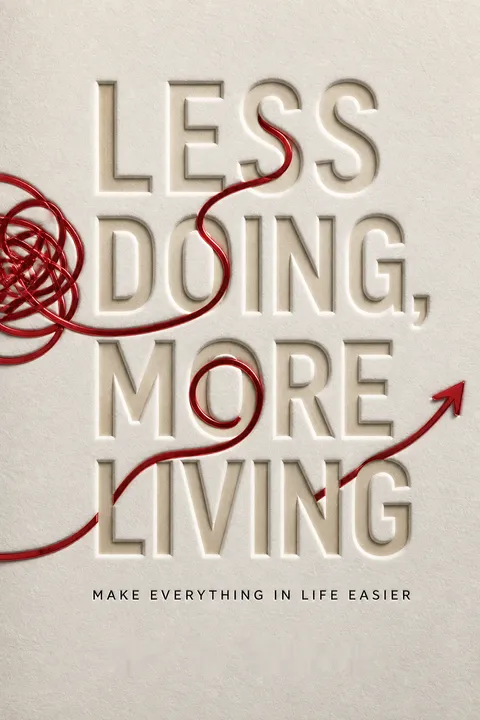
Less Doing, More Living is best understood as a design manual for reducing avoidable friction, not a promise that software can eliminate the demands of being alive. Its central contribution is procedural: observe where effort goes, simplify repeated work, automate stable actions, and delegate only what remains. That sequence is more thoughtful than the familiar instruction to outsource everything, because it asks whether a task needs to exist in its current form before assigning it to another person.
The book’s strongest examples reveal a consistent method. A written process exposes hidden assumptions. A reminder tied to a date or trigger replaces anxious rehearsal. A fixed storage limit turns clutter into a choice. These are small interventions, but they move control from intention to environment. That shift has affinities with cognitive science and organizational design: people perform more reliably when the system carries part of the memory and coordination burden.
The framework also has limits. Technology changes, services fail, and automated systems can obscure responsibility. Outsourcing may save one person time while transferring cost or inconvenience to another. Measurement can overvalue what is easy to count, and the wellness section sometimes moves from personal experience to broad claims without enough qualification. Readers should treat tools and health advice as dated or individual where appropriate, and protect privacy when connecting accounts or sharing credentials.
The book is most useful when approached as a set of experiments rather than a universal operating system. Choose one recurring irritation, record how it happens, remove needless steps, and test a simpler design. Keep the parts that create genuine time or calm. The point is not to automate life until it feels frictionless. It is to spend less attention on routine administration and more on the work and relationships that deserve it.
Review Summary
Less Doing, More Living receives mixed reviews, with an average rating of 3.37/5. Some readers find the book's focus on outsourcing and automation helpful for productivity, while others criticize it as unrealistic for average people. The book is praised for its practical suggestions and tools, but criticized for being outdated and resembling an advertisement for various websites and apps. Readers appreciate the emphasis on streamlining tasks and reclaiming time, but question the practicality of some recommendations. The book's short length and quick-read format are generally viewed positively.
People Also Read









Glossary
Less Doing
Reduce routine effortMeisel’s approach to reclaiming time and mental space by examining everyday tasks, removing unnecessary steps, using technology for predictable actions, and delegating the remaining work where appropriate. The aim is not simply to increase output, but to make room for priorities, relationships, and personal well-being.
External Brain
Searchable memory outside yourselfA system for capturing and retrieving ideas, information, and reminders outside a person’s own memory. In the book, it includes searchable notes, saved material, and timed follow-ups. The system is intended to reduce the effort of remembering and make stored information available when it becomes relevant.
Manual of You
Instructions for recurring workA written description of how a person completes a task, detailed enough for someone unfamiliar with the process to follow it. Creating the manual helps reveal missing steps, unnecessary actions, and exceptions. It can make work easier to repeat, automate, or delegate without relying on one person’s unspoken knowledge.
Achievement Architecture
Structured goal problem-solvingMeisel’s coaching approach to reaching goals through analysis, experimentation, tracking, and selecting suitable tools or methods. The book describes it as a way to build the conditions and processes needed for a desired result, including in productivity, business operations, fitness, or chronic illness management.
Zeigarnik effect
Unfinished tasks stay salientA psychological effect named in the book to describe how incomplete tasks can remain mentally active. Meisel uses it to explain why an unprocessed task list may create a persistent sense of pressure. His practical response is to decide when each task can be handled, rather than repeatedly reviewing a list of unresolved items.
Essential vs. Optional
Separate necessary from electiveA simple sorting distinction for information and activities. Essential items require attention or action; optional items may be interesting or enjoyable but are not obligatory. Meisel uses the distinction to prevent nonessential material, such as much of an email or news feed, from competing with important work.
Download PDF
Download EPUB
.epub digital book format is ideal for reading ebooks on phones, tablets, and e-readers.








