

Key Takeaways
Preserve liberty by limiting government to powers citizens actually delegated
The book’s dividing line. Levin’s central contrast is between liberty and tyranny. He calls a society ordered around individual rights, family, faith, private property, custom, and voluntary cooperation a civil society. A Statist, in his vocabulary, treats the state as the chief authority for solving social problems and directing people’s lives. The danger he calls soft tyranny is not a sudden dictatorship, but a gradual growth of state control presented as benevolent reform.
Power needs guardrails. The Constitution, in this account, gave the federal government enough authority to act while dividing and limiting that authority. Levin treats the New Deal as a decisive expansion of federal power through agencies, taxes, and entitlements. That history is a central conservative interpretation, not a politically neutral account.
The argument’s durable insight is institutional: good intentions do not remove the need to constrain power. Political science describes this as a problem of commitment. Officials may promise restraint today, but institutions must still limit what they can do tomorrow. The book is persuasive when it asks who decides, under what authority, and with what checks. Its weakness is the sharp division between liberty-minded citizens and Statists, which can make ordinary disagreements about public goods look like a contest between freedom and domination. The more useful test is whether a policy has clear limits, accountability, and a credible way to correct failure.
Ground human rights in principles no government can grant or revoke
Rights precede the state. Levin argues that the Founders understood basic rights as natural and God-given, rather than permissions issued by government. Natural Law is the moral order he believes people can discover through reason, human experience, and faith. The Declaration’s claim that people possess rights before government exists supports his conclusion that rulers may protect those rights, but cannot legitimately create or cancel them.
Faith and freedom coexist. Levin presents the Founders as religiously diverse but united in appealing to a Creator. He also argues that the First Amendment was meant to prevent a national church while protecting religious liberty. In this account, faith helps sustain the moral duties that make freedom workable, without requiring citizens to share one denomination.
The section joins a theological claim to a constitutional one: rights are more secure when they are treated as prior to political convenience. That idea has a strong secular counterpart in human-rights theories that locate dignity in personhood rather than citizenship. The harder question is how a pluralistic society identifies shared moral limits when citizens disagree about their divine source. Levin’s distinction between religious influence and theocracy helps, but the argument is strongest when it defends freedom of conscience for believers and nonbelievers alike. A durable rights framework needs reasons that can be debated across faith traditions, not only reasons persuasive within one.
Choose evidence-shaped reform over political promises of perfect equality
Repair before replacement. Drawing on Edmund Burke, Levin distinguishes reform from wholesale change. Reform targets a specific defect while preserving useful institutions; radical redesign risks discarding what works along with what does not. Prudence, in his usage, means judgment informed by history, experience, and likely consequences, not reflexive defense of the status quo.
Equality has competing meanings. Levin endorses equal rights under law, but rejects government efforts to force equal wealth or social outcomes. He argues that such projects require increasing state power because people differ in ability, choices, and circumstances. He sees utopian promises as especially dangerous when every failure is blamed on insufficient authority. The practical lesson is to ask whether a proposed remedy addresses a defined harm or claims the power to perfect society.
This is a useful antidote to policy designs that promise clean outcomes in messy societies. Burkean gradualism resembles modern risk management: make a bounded intervention, observe what happens, and preserve the ability to reverse course. But caution can also protect unjust arrangements when those who benefit from the status quo define every correction as reckless. The crucial distinction is not simply reform versus change. It is whether a policy can be tested, evaluated against explicit goals, and adjusted without concentrating unchecked power. Prudence should discipline both ambitious reformers and defenders of inherited institutions.
Read the Constitution as a binding charter, not a blank policy canvas
Meaning constrains power. Levin’s originalism is an approach to constitutional interpretation that looks to the text’s public meaning when adopted, informed by its historical context. He argues that treating the Constitution as a document whose meaning shifts with current preferences lets judges substitute their policy judgments for the law. The amendment process, rather than judicial improvisation, is the legitimate path for changing constitutional rules.
Rights can expand in name. Levin criticizes Franklin Roosevelt’s proposed Second Bill of Rights, which included claims to jobs, housing, and medical care. He calls these positive rights: entitlements that require government to provide goods or services, unlike protections against government interference. The dispute matters because creating such guarantees can enlarge public authority and the demands placed on taxpayers.
Originalism makes constitutional interpretation answerable to something beyond a judge’s personal sense of justice, which is a real constraint on arbitrary rule. Yet historical meaning is not always singular or easy to recover; constitutional language can be broad, and the founding generation itself disagreed. Originalism therefore cannot eliminate judgment. It can, however, require interpreters to show their evidence and explain why a reading fits the text and history better than its rivals. The same discipline should apply to claims that a constitutional right is merely invented. A careful debate separates interpretive method from disagreement about the policy result.
Move decisions closer to citizens when national uniformity is unnecessary
Federalism disperses authority. Federalism is the division of governing power between national and state governments. Levin argues that states and localities can respond more closely to residents and serve as testing grounds for policies. He cites Oregon welfare reforms and Milwaukee school vouchers as experiments that influenced other jurisdictions, while Maryland’s computer-services tax illustrates how a policy can be reversed when businesses and residents respond by leaving.
The center can overreach. Levin points to the 1942 Wickard v. Filburn ruling, which allowed federal regulation of wheat a farmer grew for his own use, as an example of national power reaching local economic activity. He also recognizes that state governments have committed grave abuses, including slavery and racial oppression, and accepts a federal role in enforcing civil rights when states refuse to protect citizens.
Decentralization can improve public learning: different jurisdictions can try distinct approaches, and residents can compare results. It also makes government more accessible to citizens who want to challenge a decision. But moving power downward does not guarantee justice or competence. Local majorities can exclude minorities, and people often lack the resources to relocate when policy harms them. The book’s acknowledgment of federal civil-rights enforcement is therefore important. Federalism works best as a balance of scales, with local discretion where possible and national rights protections where necessary, rather than as a presumption that one level of government is always more trustworthy.
Let voluntary exchange create wealth, but refuse corporate favoritism and permanent rescue
Property connects effort to choice. Levin treats private property as the material result of a person’s labor and as a condition of independence. A free market, in his account, coordinates many voluntary decisions without requiring a central authority to know what each person needs. He also accepts that markets change through creative destruction, the process in which new products and businesses displace older ones.
Intervention can compound mistakes. To explain the 2008 financial crisis, Levin traces government housing goals, risky mortgage lending, mortgage-backed financial products, and Federal Reserve interest-rate policy. He argues that interventions distorted market signals, then criticizes bailouts for shielding institutions from the consequences. He makes a similar case against subsidized ethanol and auto-industry rescues, which he says reward political allies and postpone necessary restructuring.
The strongest insight is about dispersed knowledge: no agency can easily gather the changing information contained in millions of choices. Markets can transmit some of that information through prices, investment, and failure. But the book’s account of the housing crisis assigns responsibility heavily to government policy, while the crisis also involved private lenders, investors, and failures of oversight. That makes the episode a warning against monocausal explanations. Rejecting favoritism does not settle whether emergency action is justified when financial collapse threatens people beyond the firms that made poor decisions. The hard question is how to contain systemic harm without turning rescue into a standing guarantee.
Count entitlement promises as debts owed by people not yet born
Promises have future costs. Levin argues that Social Security, Medicare, and Medicaid create obligations that current taxes do not fully fund. He cites a 2008 estimate by comptroller general David Walker that the present value of federal liabilities and commitments was about $53 trillion. That historical estimate included more than these three programs, but Levin emphasizes their role in long-term fiscal pressure.
Insurance language can obscure financing. Social Security is not an individual account holding each worker’s payroll contributions. As Levin explains it, current taxes largely fund current benefits, while trust-fund bonds represent obligations within the government. He argues that the insurance framing can make the system feel fully funded and earned, even as future taxpayers inherit its shortfalls. His broader concern is that expanding public benefits can create dependency and constrain future choices.
The intergenerational lens adds a moral dimension to budget arithmetic: a benefit enjoyed now may require taxes, borrowing, or reduced services later. Public finance also distinguishes a government’s accounting commitments from the resources needed to honor them, a distinction that makes long-term projections valuable but uncertain. The book is right to treat demographic and health-cost trends as constraints rather than rhetorical details. Its framing of social insurance as deception, however, can understate the genuine security people value in pooling risks across generations. Reform debates are clearer when they separate the program’s social purpose from the question of how to finance it sustainably.
Demand evidence and count human costs before regulating environmental risks
Good intentions can misfire. Levin calls environmental politics enviro-statism when he believes environmental concerns are used to justify expanding government control. His central illustration is DDT, an insecticide used to control disease-carrying mosquitoes. He argues that restrictions on DDT, influenced by Rachel Carson’s Silent Spring and subsequent political pressure, weakened malaria control and carried grave human costs. He also warns that fuel-efficiency rules can trade lower fuel use for reduced vehicle size and safety.
Assess the evidence, not the slogan. The book challenges the 2009 climate-policy consensus and opposes cap-and-trade, predicting high costs and extensive regulation. These claims reflect the book’s historical moment. Its broader point is that environmental policies should disclose uncertainty, unintended effects, and trade-offs rather than treating regulation as automatically harmless.
The DDT example usefully asks policymakers to compare environmental risks with the risks of withholding a tool that protects human health. Yet the book’s presentation is polemical, and its claims about the consequences of DDT restrictions should not be treated as settled simply because they are vivid. Its rejection of human-caused climate change also does not reflect the current scientific consensus that human activity is warming the climate. The lasting lesson is methodological: assess evidence transparently, account for harms on both sides, and update policy when results differ from predictions. Skepticism is most valuable when it tests claims in every direction.
Make immigration policy serve civic cohesion, not just labor demand
Admission shapes the nation. Levin argues that immigration policy should consider the capacity of newcomers to join a shared civic culture, not only employers’ demand for workers. He criticizes the 1965 Hart-Celler Act for replacing national-origin quotas with preferences for family ties, a shift he says helped produce larger-scale immigration and chain migration, in which relatives gain priority for admission.
Assimilation is the proposed answer. Levin favors enforcing immigration laws, securing borders, teaching English, and encouraging allegiance to American institutions and traditions. He argues that a common language and civic identity help people participate in public life. He also opposes policies that, in his view, weaken those shared bonds. This is among the book’s most contested sections, combining questions about labor, legal status, national identity, and social services.
The book makes a serious civic point: immigration policy affects not only employers and migrants, but also public institutions and the meaning of citizenship. A common language can lower barriers to education, work, and political participation. However, the case often moves from legitimate questions about integration to broad judgments about ethnic groups and cultural difference. Those claims require careful evidence and cannot be inferred from aggregate statistics alone. Assimilation and pluralism are not necessarily opposites; a society can share civic rules while allowing diverse traditions. Strong policy analysis separates legal enforcement, labor-market effects, and integration outcomes instead of treating them as one problem.
Use military strength and alliances to defend national interests, not export utopia
Security requires judgment. Levin reads George Washington’s foreign policy as neither isolationist nor interventionist. Washington sought neutrality when taking sides risked national division, but supported a strong defense and alliances when they served American interests. Levin uses this example to argue that the means should change with circumstances while the goal remains national security.
Idealism needs limits. He opposes attempts to spread democracy everywhere as a standing mission, while accepting actions such as the Marshall Plan when they strengthen security. He also argues that counterterrorism requires intelligence gathering, detention, and interrogation, and criticizes restrictions on those tools. The chapter’s underlying question is how to protect a free society without allowing foreign commitments or emergency powers to exceed their purpose.
The distinction between defending institutions and trying to remake other societies is strategically important. Nation-building can consume resources and political attention without producing stable partners, while alliances can deter threats when interests align. But security arguments also need institutional checks: secrecy and urgency can hide mistakes, and emergency powers have a tendency to outlast emergencies. The book stresses the danger of underreacting to threats more than the danger of excessive force. A balanced doctrine must evaluate both costs, preserve lawful oversight, and ask whether a security measure actually reduces risk rather than merely signaling resolve.
Defend a free society through civic work, not election-day slogans
Participation must be continuous. In the manifesto, Levin urges conservatives to become active in public life: seek office, teach, work in media and public institutions, and discuss founding principles with children and neighbors. He recommends learning beyond sources he sees as politically dominant and using clear language to challenge terms that disguise policy trade-offs.
Principles need practical policies. His proposals include reducing taxes and federal spending, limiting administrative agencies, changing entitlement programs, enforcing immigration laws, and keeping foreign policy focused on national security. He argues that political compromise can be useful when it advances core principles, but should not become an end in itself. The closing message is a call for organized, sustained civic engagement rather than passive confidence that liberty will preserve itself.
The strongest part of the program is its recognition that institutions are shaped by people who choose to participate. Civic education, public argument, and sustained involvement can make abstract constitutional principles legible in everyday decisions. The proposals themselves are not all consistent with the book’s stated caution about concentrated power. For example, giving Congress a veto over Supreme Court decisions could strengthen legislative authority while weakening judicial independence. That tension is worth confronting rather than smoothing over. A principled movement needs both energy and self-restraint, especially when its preferred tools could be used by political opponents.
Analysis
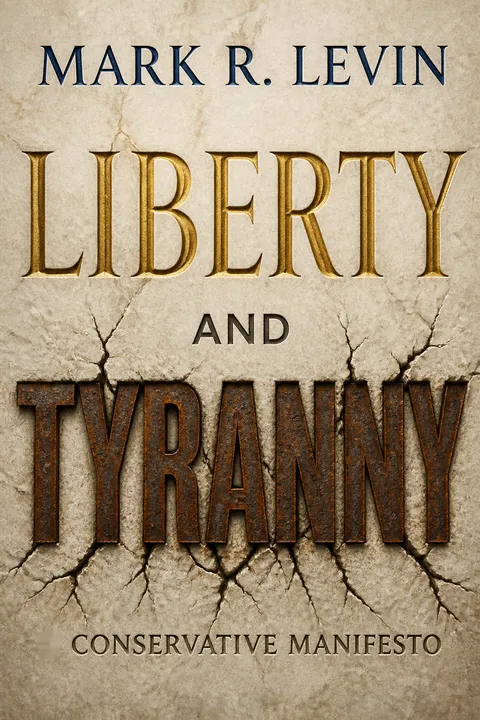
Liberty and Tyranny is a 2009 political polemic organized around a stark opposition: a civil society of self-governing people versus a state that steadily absorbs their choices. Its breadth is both its strength and its difficulty. Levin links constitutional interpretation, faith, markets, welfare, environmental policy, immigration, and national security through one recurring question: who has legitimate authority to decide, and what limits that authority?
The book’s strongest contribution is its insistence that institutional design matters even when public officials claim benevolent motives. Federalism, property rights, constitutional limits, and transparent fiscal accounting are presented not as technical details but as protections against dependency and arbitrary rule. The historical examples give that argument narrative force, particularly the evolution from the Articles of Confederation to the Constitution and the expansion of federal responsibilities during the New Deal.
Its main analytical weakness is the tendency to treat disputed political motives as settled explanations. The label Statist compresses very different positions into one antagonist, while complex events such as the Great Depression, the financial crisis, and environmental regulation receive strongly selective causal accounts. The book is most convincing when it asks readers to scrutinize incentives and unintended consequences. It is less convincing when suspicion of government substitutes for weighing evidence about a specific policy.
A deeper tension runs through the manifesto. Levin advocates limiting public power, yet many of his prescriptions would use federal authority, courts, or political appointments to reshape institutions. That does not invalidate the proposals, but it raises the question the book asks of its opponents: what prevents a power claimed for a good cause from becoming permanent? Its most useful legacy is therefore not a complete policy platform. It is a demanding test for any platform: identify the authority being used, the rights it affects, the evidence behind it, and the mechanisms that can reverse it if it fails.
Review Summary
Liberty and Tyranny receives mostly positive reviews for its clear articulation of conservative principles and critique of statism. Readers appreciate Levin's logical arguments, historical context, and call to action. Critics argue the book relies on straw man arguments and lacks nuance. Some find it an essential primer on conservatism, while others see it as partisan rhetoric. The book's popularity and bestseller status indicate its resonance with conservative readers seeking to understand and defend their ideology in the current political climate.
People Also Read





Glossary
Civil society
Self-governing social orderLevin’s term for a society in which individuals pursue legitimate interests within a moral and legal order. It includes families, communities, religious institutions, private property, voluntary cooperation, and predictable law. The concept contrasts with a society in which the central state directs people’s choices and provides the primary source of social organization.
Statist
State-centered political actorLevin’s label for a person or political movement that favors expanding government authority to manage social and economic life. He uses the term broadly across policies involving regulation, taxation, entitlements, education, and foreign affairs. It is a polemical category in the book, not a neutral political-science classification.
Soft tyranny
Gradual loss of libertyA form of political control that grows incrementally through administrative decisions, regulations, benefits, and promises of public improvement rather than through an overt seizure of power. Levin uses the term to warn that citizens may accept constraints on independence when those constraints are presented as compassionate or necessary.
Natural Law
Moral order beyond governmentA universal moral order that Levin describes as grounded in divine creation and discoverable through reason and human experience. In his argument, it supplies a foundation for rights that precede government. Public authority may recognize and protect those rights, but cannot legitimately create or erase them.
Originalism
Interpretation grounded in original meaningA method of constitutional interpretation that seeks to understand the text according to its public meaning when adopted, using historical context and evidence. Levin presents originalism as a restraint on judges who might otherwise reshape constitutional rules to fit current preferences. Interpretations can still differ over historical evidence and meaning.
Federalism
Shared national and state authorityThe constitutional division of governing power between the federal government and the states. Levin argues that this arrangement limits central authority, keeps some decisions close to affected citizens, and allows jurisdictions to test different policies. He also recognizes that federal authority may be needed to protect rights when states violate them.
Creative destruction
Innovation displaces older systemsAn economic process in which new products, technologies, firms, or ways of organizing work replace older ones. Levin uses the concept, associated with economist Joseph Schumpeter, to explain why market economies are dynamic and why efforts to preserve every existing business or industry can obstruct adaptation.
Positive rights
Claims to government-provided goodsRights framed as entitlements to services or material conditions, such as housing, medical care, or employment. Levin contrasts them with protections against government interference, which he treats as negative rights. He argues that positive rights require public authority to tax, regulate, or allocate resources, thereby expanding government obligations and power.

Download PDF
Download EPUB
.epub digital book format is ideal for reading ebooks on phones, tablets, and e-readers.








